
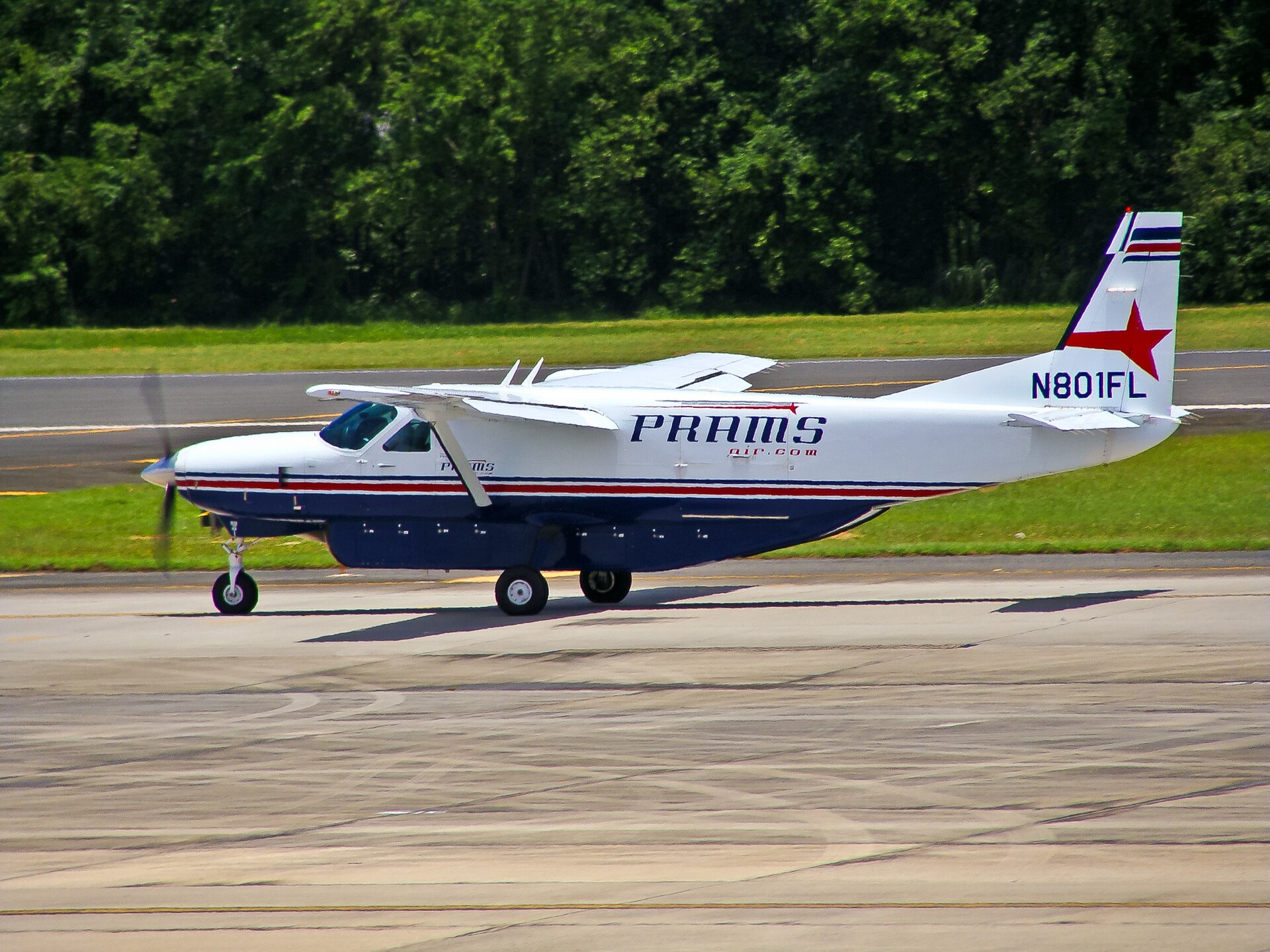
Grand Caravan 208B N801FL, photographed in 2009. · Photo: Tomás Del Coro via Wikimedia Commons, CC BY-SA 2.0
Cessna · Turboprop
Grand Caravan 208B
The stretched Caravan, built with a 675-shp engine until the Grand Caravan EX took over in 2013.
The 675-shp Grand Caravan is the roomiest, best-supported single-engine utility turboprop on the used market and the cheapest way into a 208B. It is slow, unpressurized and short on power when hot or high, and many examples have worked hard.
Buy it if
You need to move eight to eleven people or bulky cargo on trips under about 600 nm, want one pilot and one proven engine, and value easy parts and service almost anywhere in the world.
Skip it if
Your trips regularly run past 800 nm, cross high mountains, or start from hot, high or very short strips, or your passengers expect a pressurized cabin, a toilet and jet-like speed.
Biggest compromise
Its 675-shp engine moves a lot of airplane. At full weight it needs about 2,420 ft to clear a 50-ft obstacle and climbs under 1,000 ft a minute, so hot days, high airports and short strips cut what it can carry.
The numbers that matter
Purchase price
$1.99M
typical asking · $1.3M–$2.33M
What it costs per year
$442K
at 300 hrs · one professional pilot
How far it flies
1,163 nm
400–850 nm with passengers
How fast
184 kt
high-speed cruise
Seats
9
9 typical, 8 to 11 by interior
Pilots needed
1
Certified for one pilot; the right cockpit seat can carry a co-pilot or a passenger.
Price
What one costs to buy
Typical asking price
$1,987,500
Where asking prices sit
Low
$1.3M
Typical
$1.99M
High
$2.33M
Most asking prices fall inside this band.
Other sites
Priced vs call
with a price / call for price
Eight of 15 listings show prices: about $1.3–1.85 million for 1989–2004 aircraft and $2.1–2.3 million for 2008–2012 glass-cockpit examples.
Price vs its family and alternatives
Scroll to explore · select a jet for details
Grand Caravan 208B · This aircraft
$1.99M
The least expensive here; next up is the Caravan (208).
For sale now
None listed right now
Cost to own
What it costs per year to run
300hours / year
Per year
Per flight hour
Estimate — your operator will quote actual numbers.
Fuel, airframe and propeller maintenance, engine program or overhaul reserve and landing fees, cleaning and miscellaneous rise as you fly more. One professional pilot, recurrent training, hangar, insurance and subscriptions and databases stay the same however much you fly.
Where the money goes
- One professional pilot$120,00027%
- Recurrent training$9,0002%
- Hangar$29,5007%
- Insurance$24,0005%
- Subscriptions and databases$4,5001%
- Fuel$133,65030%
- Airframe and propeller maintenance$63,00014%
- Engine program or overhaul reserve$48,00011%
- Landing fees, cleaning and miscellaneous$10,0002%
Fuel is the biggest single cost at 30% of the total.
The JetGrade
76 out of 100 — Clearly above its class
Peer group: Cessna Caravan 208, Cessna Grand Caravan EX, Daher Kodiak 100 Series I, Texas Turbines DHC-3 Turbo Otter, Pacific Aerospace P-750 XSTOL
Seven categories at a glance
- - - 70 = typical— This aircraft
Strongest on reliability & support, weakest on airport access.
Grades are editorial opinions about the model, not any specific aircraft. Sponsors and affiliates have no input. Reviewed 2026-10-02.
Where it flies
Sample trips and reach
Typical trips on a map
Nonstop
Depends on weight or weather
Fuel stop likely
1 of 6 sample trips are comfortable nonstops.
Sample flight times
- 1.6 hr
Carlsbad → Las Vegas
205 nm · Easy nonstop with fuel to spare
- 4.0 hr
Carlsbad → Aspen
625 nm · Nonstop, but oxygen needed over the Rockies
- 4.8 hr
Santa Ana → San José del Cabo
765 nm · Nonstop in light winds; headwinds may force a stop
- 5.7 hr
Teterboro → West Palm Beach
900 nm · One fuel stop, usually in the Carolinas
- 7.4 hr
Dallas → Teterboro
1,190 nm · One fuel stop, typically near the midpoint
- 12.8 hr
Carlsbad → Teterboro
2,100 nm · Two fuel stops; a full day of flying
Lineage
What came before and after


1986–2012
Grand Caravan 208B
Four-foot stretch for up to 11 passengers or more cargo.

What changed from the Caravan 208
- Fuselage stretched 4 ft, adding about a third more cabin volume.
- Maximum takeoff weight raised to 8,750 lb.
- Earliest aircraft used a 600-shp PT6A-114; a 675-shp PT6A-114A became standard in 1990.
- Room for up to 11 passenger seats, plus a bigger cargo hold.
- Garmin G1000 glass cockpit standard on aircraft built from 2008.
Size and cabin
How big it is, inside and out
Outside
Silhouette · scaled to length
Length
Wingspan
Height
Inside the cabin
Cabin length
Width
Height
Compare
How it stacks up
This aircraft
Grand Caravan 208B
- JetGrade
- 76
- Price
- $1.99M
- Cost per year
- $442K
- Range
- 1,163 nm
- Speed
- 184 kt
- Seats
- 9
- Cabin length
- 16′ 9″
- Pilots
- 1
- Years built
- 1986–2012
← Before
- JetGrade
- 75
- Price
- $2.25M
- Cost per year
- $448K
- Range
- 1,070 nm
- Speed
- 186 kt
- Seats
- 8
- Cabin length
- 12′ 9″
- Pilots
- 1
- Years built
- 1985–now
After →
- JetGrade
- 77
- Price
- $2.65M
- Cost per year
- $467K
- Range
- 912 nm
- Speed
- 185 kt
- Seats
- 8
- Cabin length
- 16′ 9″
- Pilots
- 1
- Years built
- 2013–now
Alternative
- JetGrade
- 73
- Cost per year
- $427K
- Range
- 1,132 nm
- Speed
- 174 kt
- Seats
- 8
- Cabin length
- 15′ 10″
- Pilots
- 1
- Years built
- 2007–2018
Alternative
- JetGrade
- 77
- Price
- $2.9M
- Cost per year
- $515K
- Range
- 1,500 nm
- Speed
- 265 kt
- Seats
- 6
- Cabin length
- 16′ 11″
- Pilots
- 1
- Years built
- 1996–2005
- Cessna Grand Caravan EX instead: Same cabin with an 867-shp engine for better climb and hot-day takeoffs; Aircraft Bluebook values start near $1.8 million for a 2014 example.
- Daher Kodiak 100 Series I instead: Smaller cabin, but clears a 50-ft obstacle in about 1,500 ft and asks around $1.6 million for high-time examples.
- Pilatus PC-12/45 instead: Pressurized, faster and longer-legged, with far more passenger comfort; costs more to buy and maintain.
Gold marks the best figure in each row.
Owning one
What to know before you buy
Engines & inspections
1 × Pratt & Whitney Canada PT6A-114A · 675 shp each
No APUEngine hours until overhaul
- Turbine blade directive · 500 hr
- Engine hot section inspection · 1,800 hr
- Engine overhaul · 3,600 hr
Overhaul every 3,600 hours; busy operators flying over 300 hours a year can extend this with engine trend monitoring.
Known issues
Engine turbine directives
Turbine blade and vane directives can cost $60,000 to $117,000 if a past owner has not completed them.
Icing limitations
Since 2007, a 120-knot minimum, a low-airspeed alert and no continued flight in moderate or worse ice.
Hard-working commercial histories
Many have flown freight or commuter routes; listed examples show 13,000 to 21,900 hours and up to 33,000 landings.
Pre-buy checklist
0 of 10 checked
Textron Aviation still builds the Caravan family, with more than 3,000 delivered, and supports it worldwide. The PT6A-114A powers over 2,000 aircraft, so engine shops and parts are easy to find.
Review
The full review
Strengths
- A 16 ft 9 in cabin with 340 cu ft of space, four doors and up to 11 passenger seats.
- About 3,800 lb of useful load in an equipped example, leaving roughly 1,550 lb with full tanks.
- Over 3,000 Caravans delivered and more than 2,000 PT6A-114A engines in service keep parts and mechanics easy to find.
Limitations
- Cruises at 175 to 184 knots, so an 850 nm trip with four passengers takes close to five hours.
- Unpressurized, so high cruising altitudes need oxygen and mountain routes are slower and less comfortable.
- Strict icing rules since 2007, including a 120-knot minimum and no continued flight in moderate or worse ice.
The Cessna 208B Grand Caravan is the stretched version of Cessna's single-engine utility turboprop. Cessna lengthened the original Caravan by four feet, first for FedEx as a freighter in 1986 and then as a passenger aircraft certified in 1989. This page covers the Grand Caravans built with the 675-shp Pratt & Whitney Canada PT6A-114A engine, about 1990 to 2012, plus the early aircraft built with a 600-shp engine. The Grand Caravan EX, with an 867-shp engine, replaced it from 2013.
Pilot's take
The Grand Caravan flies like a big, honest Cessna: stable, predictable and easy to land. The trade-off is that 675 shp is working hard at full weight, so climb is leisurely and hot afternoons demand careful takeoff planning. Expect about 175 knots with the cargo pod and a busy cockpit in winter, because the icing rules leave little room for improvisation. We would favor a well-documented G1000 example with known-icing equipment, and treat engine turbine directive status and landing counts as the first questions on any airframe.
Who this is for
Operators and owners who value payload and cabin space over speed: tour, skydiving, cargo and island operators, ranches and remote lodges, and companies or families moving six to ten people and gear on 200 to 600 nm trips.

Ask about this aircraft
Answers come only from our research file on the Grand Caravan 208B.
Your earlier questionsOwners
Private to verified ownersOwn a Cessna Grand Caravan 208B? Verify with its FAA registration to join the owners' thread and the real-cost poll.