
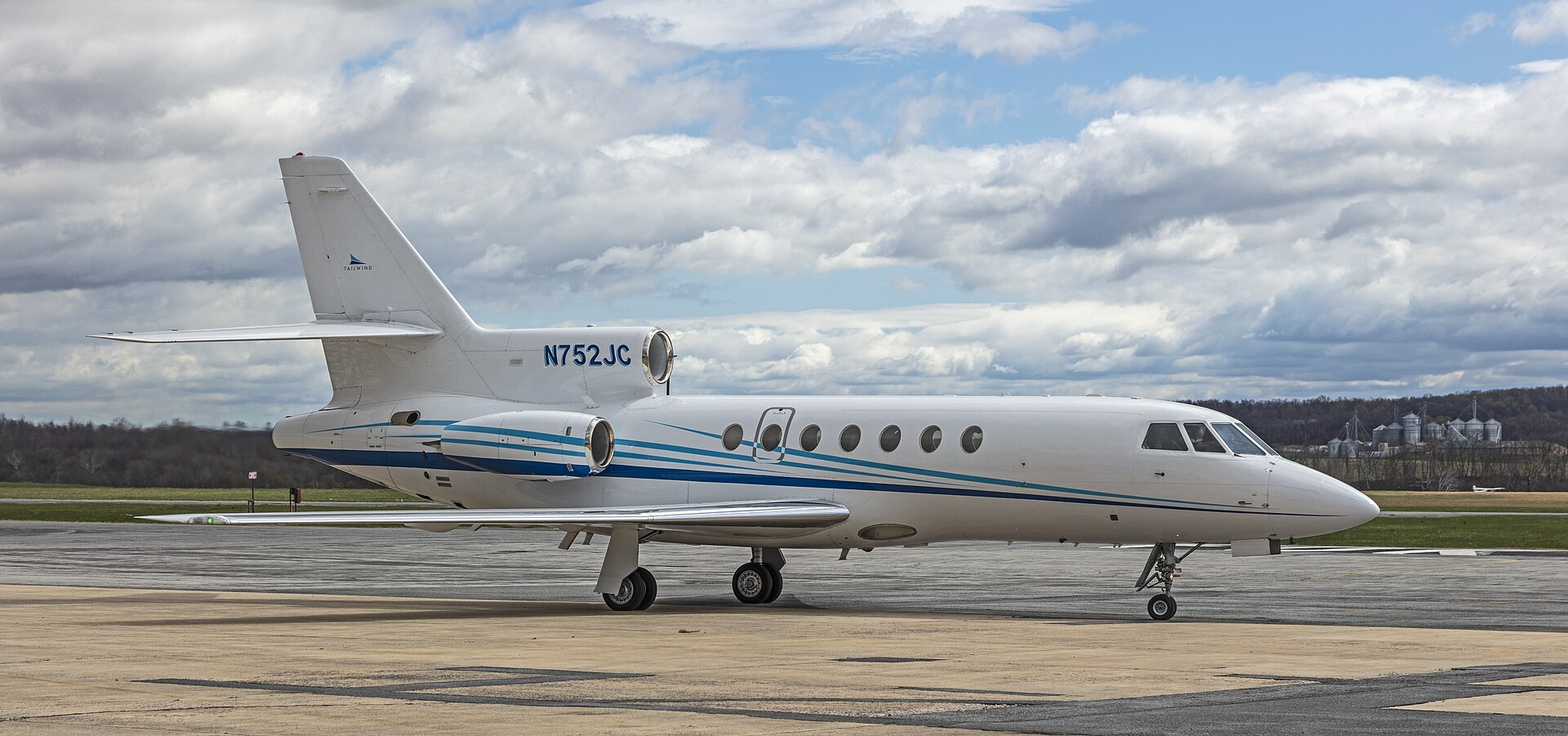
A Falcon 50 at Frederick Municipal Airport, Maryland, in April 2022. · Photo: Acroterion / Wikimedia Commons, CC BY-SA 4.0
Dassault · Super-Midsize Jet
Falcon 50
Dassault's first three-engine jet and first nonstop transatlantic Falcon, replaced by the Falcon 50EX in 1997 and the basis for the Falcon 900.
A proven trijet that buys real coast-to-coast and Atlantic range plus short-runway ability for midsize-jet money. The catch is age: three older engines, big calendar inspections and dated cockpits make the right example worth far more than the cheapest one.
Buy it if
You want nonstop coast-to-coast or occasional Atlantic range for under about $3.2 million, use shorter runways, and can find an aircraft with engines on a maintenance plan and an upgraded cockpit.
Skip it if
You need a wide stand-up cabin, want few maintenance surprises, or plan to fly only a few hours a year, when fixed costs above $500,000 dominate.
Biggest compromise
Age-related ownership costs. Three TFE731-3 engines each need hot-section and core inspections, the airframe has major checks at 6, 12 and 24 years including a gear overhaul, and many cockpits still use 1980s displays.
The numbers that matter
Purchase price
$2.59M
typical asking · $1.57M–$3.19M
What it costs per year
$1.83M
at 300 hrs · two professional pilots
How far it flies
3,148 nm
3,057–3,200 nm with passengers
How fast
470 kt
high-speed cruise
Seats
9
9 typical; up to 12 in denser layouts
Pilots needed
2
Two pilots are required on every flight.
Price
What one costs to buy
Typical asking price
$2,590,000
Where asking prices sit
Low
$1.57M
Typical
$2.59M
High
$3.19M
Most asking prices fall inside this band.
Other sites
9.4% of the fleet
6-month move
Priced vs call
with a price / call for price
Five of 14 original-engine listings show prices, from $1.58M to $3.2M. Re-engined examples ask more; one lists at $3.95M.
Price vs its family and alternatives
Scroll to explore · select a jet for details
Falcon 50 · This aircraft
$2.59M
Sits between the Hawker 1000 (BAe 125 Series 1000) and the Falcon 50EX.
For sale now
None listed right now
Cost to own
What it costs per year to run
300hours / year
Per year
Per flight hour
Estimate — your operator will quote actual numbers.
Fuel, airframe maintenance, engine reserve, three engines and landing, handling and trip costs rise as you fly more. Two pilots, recurrent training, hangar, insurance, management and subscriptions and other fixed costs stay the same however much you fly.
Where the money goes
- Two pilots$308,58417%
- Recurrent training$38,0032%
- Hangar$49,6483%
- Insurance$30,3752%
- Management$78,0004%
- Subscriptions and other fixed costs$25,0551%
- Fuel$636,57935%
- Airframe maintenance$257,22914%
- Engine reserve, three engines$284,36116%
- Landing, handling and trip costs$120,0007%
Fuel is the biggest single cost at 35% of the total.
The JetGrade
68 out of 100 — Below its class average
Peer group: Bombardier Challenger 601-3A, BAe Hawker 1000, Gulfstream G200, Cessna Citation X, Dassault Falcon 2000
Seven categories at a glance
- - - 70 = typical— This aircraft
Strongest on airport access, weakest on cabin & passenger comfort.
Grades are editorial opinions about the model, not any specific aircraft. Sponsors and affiliates have no input. Reviewed 2026-10-29.
Where it flies
Sample trips and reach
Typical trips on a map
Nonstop
Depends on weight or weather
7 of 9 sample trips are comfortable nonstops.
Sample flight times
- 0.8 hr
Carlsbad → Las Vegas
205 nm
- 1.8 hr
Carlsbad → Aspen
625 nm · Hot-and-high; summer departures may be weight-limited
- 2.0 hr
Santa Ana → San José del Cabo
765 nm
- 2.5 hr
Teterboro → West Palm Beach
900 nm
- 3.0 hr
Dallas → Teterboro
1,190 nm
- 3.5 hr
Teterboro → San Juan
1,410 nm
- 5.2 hr
Carlsbad → Teterboro
2,100 nm · Nonstop coast to coast with typical loads
- 5.6 hr
Los Angeles → Honolulu
2,215 nm · Over-water leg within four-passenger range
- 7.6 hr
Teterboro → London
2,990 nm · Eastbound with light loads; westbound often stops
Lineage
What came before and after
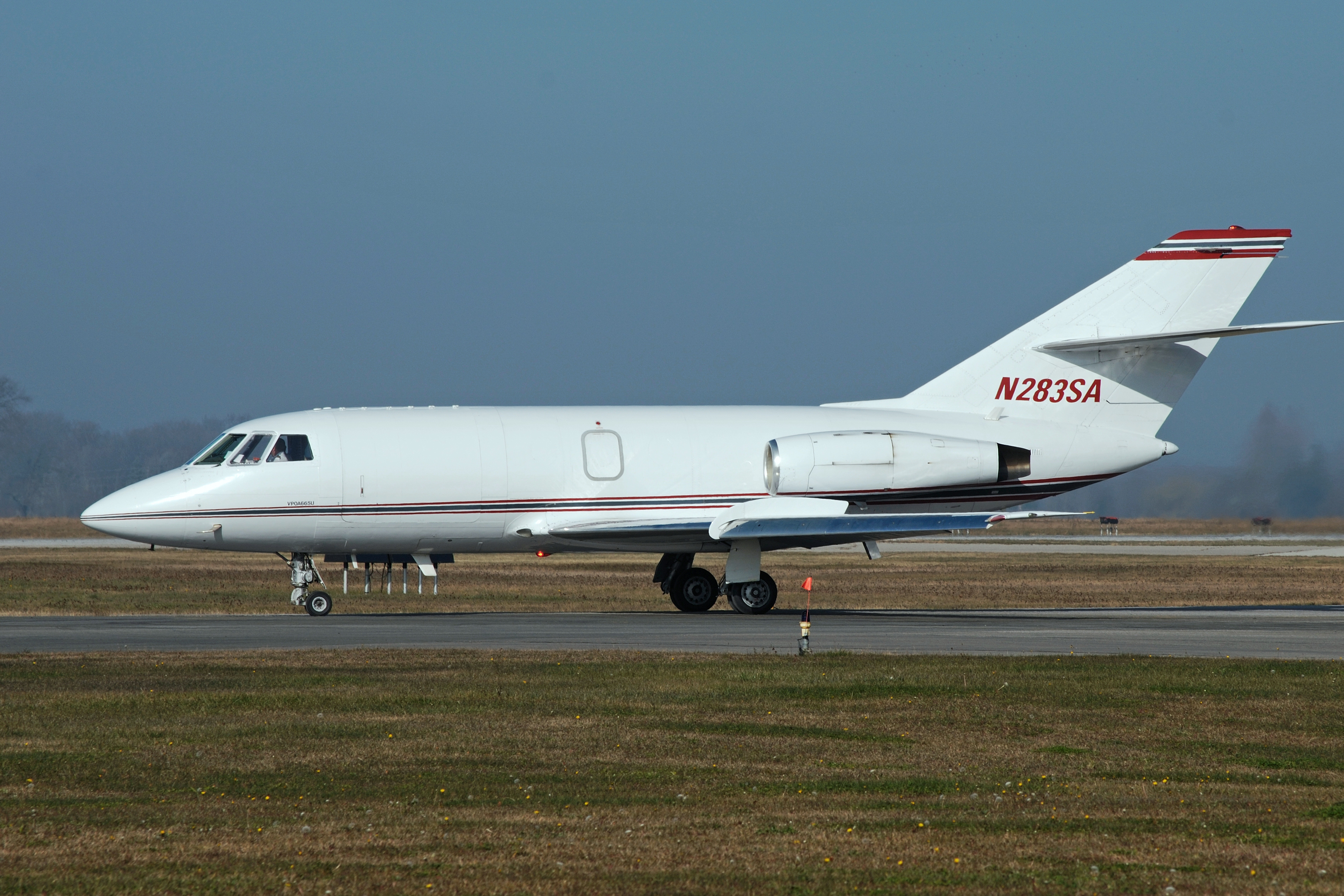

1979–1997
Dassault Falcon 50
First Falcon trijet and first nonstop transatlantic Falcon.

What changed from the Dassault Falcon 20
- Three Garrett TFE731-3 turbofans of 3,700 lb thrust replace two engines; the centre one breathes through an S-duct.
- A new, larger wing with a supercritical profile, leading-edge slats and double-slotted flaps.
- Range grows to about 3,150 nm, making it the first Falcon able to cross the North Atlantic nonstop.
- Keeps the Falcon 20 nose and cabin cross-section but adds length, a larger fin and a new tail.
- Maximum takeoff weight rises to 38,800 lb, or 40,780 lb with a later factory upgrade.
- Dassault's first business jet with a composite flight-control surface, the aileron.
Size and cabin
How big it is, inside and out
Outside
Silhouette · scaled to length
Length
Wingspan
Height
Inside the cabin
Cabin length
Width
Height
Compare
How it stacks up
This aircraft
Falcon 50
- JetGrade
- 68
- Price
- $2.59M
- Cost per year
- $1.83M
- Range
- 3,148 nm
- Speed
- 470 kt
- Seats
- 9
- Cabin length
- 23′ 6″
- Pilots
- 2
- Years built
- 1979–1997
← Before
Falcon 20 (20C / 20D / 20E / 20F)
- JetGrade
- 57
- Price
- $200K–$495K guide
- Cost per year
- $1.64M
- Range
- 1,795 nm
- Speed
- 465 kt
- Seats
- 8
- Cabin length
- 24′ 0″
- Pilots
- 2
- Years built
- 1965–1983
After →
- JetGrade
- 68
- Price
- $5.09M
- Cost per year
- $2.59M
- Range
- 3,388 nm
- Speed
- 480 kt
- Seats
- 9
- Cabin length
- 23′ 6″
- Pilots
- 2
- Years built
- 1997–2007
Alternative
Bombardier (Canadair) Challenger 601-3A
- JetGrade
- Not yet graded
- Range
- 3,500 nm
- Speed
- 460 kt
- Seats
- 9
- Years built
- 1987–1993
Alternative
Hawker 1000 (BAe 125 Series 1000)
- JetGrade
- 67
- Price
- $890K–$1.52M guide
- Cost per year
- $1.59M
- Range
- 3,110 nm
- Speed
- 460 kt
- Seats
- 8
- Cabin length
- 24′ 5″
- Pilots
- 2
- Years built
- 1991–1997
- Dassault Falcon 50EX instead: Same airframe with factory TFE731-40 engines, a Pro Line 4 cockpit, a standard APU and about 7% lower fuel use, at a higher price.
- Bombardier Challenger 601-3A instead: A twin-engine choice with a much wider stand-up cabin, though it needs more runway than the Falcon 50.
- BAe Hawker 1000 instead: A twin-engine jet from the same era with coast-to-coast range and two engines to maintain instead of three.
Gold marks the best figure in each row.
Owning one
What to know before you buy
Engines & inspections
3 × Honeywell TFE731-3-1C · 3,700 lbf each
Engine hours until overhaul
- Winglet aileron strap check · 400 hr
- Engine hot-section inspection · 1,400 hr
- B inspection · 1,500 hr
- Engine core inspection · 4,200 hr
- 1C inspection every 72 months
- 2C inspection every 144 months
- 4C inspection every 288 months
- Landing-gear overhaul every 144 months
Many listed aircraft have engines on Honeywell's MSP hourly plan, which spreads inspection and overhaul costs. Engines not enrolled may face a buy-in charge to join.
Known issues
Major calendar inspections
The 24-year 4C includes gear overhaul, flight-control restoration and interior removal; corrosion findings are common.
Short engine inspection intervals
Original TFE731-3-1C engines need hot-section inspections every 1,400 hours; check plan enrollment and any buy-in.
Ageing cockpit displays
Original 1980s Collins displays face parts obsolescence; full Pro Line 21 upgrades cost about $1 million.
Pre-buy checklist
0 of 10 checked
Dassault still supports the Falcon 50 through about 40 service centers and 15 parts depots worldwide. Honeywell supports the engines, and FlightSafety offers pilot training in Houston and Paris.
Review
The full review
Strengths
- About 3,150 nm of range: New York to Los Angeles nonstop, plus Atlantic crossings with light loads.
- Balanced field length near 4,950 ft at sea level, helped by leading-edge slats and double-slotted flaps.
- Internal baggage hold rated for 2,200 lb, generous for a nine-seat cabin.
Limitations
- Cabin about 6 ft 1 in wide, narrower than a Challenger 601, Gulfstream G200 or Falcon 2000.
- Three original engines need hot-section inspections every 1,400 hours and three overhauls to fund.
- Major inspections at 6, 12 and 24 years; full cockpit upgrades cost up to about $1 million.
The Falcon 50 is the jet that turned Dassault into a long-range business-aircraft maker. It first flew in November 1976, was certified in France and the US in early 1979, and about 250 were built before the improved Falcon 50EX took over in 1997. It kept the Falcon 20's nose and cabin cross-section but added a new wing, a longer fuselage and a third engine, and its layout later grew into the larger Falcon 900. This page covers the original version with Honeywell TFE731-3 engines. Aircraft re-engined later with TFE731-40 or TFE731-4 engines are noted where they differ.
Pilot's take
We see the Falcon 50 as a responsive, well-mannered airplane with an unusual amount of margin built in. Slats and double-slotted flaps keep approach speeds low for a jet with this much range, and a third engine adds options on long over-water legs and at high, hot airports. Climb is leisurely by modern standards, with about 30 minutes to 39,000 ft, and the original engines are thirstier than the later -40s. Older cockpits carry noticeably more workload than modern screens, so an avionics upgrade changes the experience. Two pilots are required, and simulator training is offered in Houston and Paris.
Who this is for
Owners and companies that need genuine long range on a budget, fly a few hundred hours a year with professional crew, and value short-runway access. It suits buyers ready to manage an older jet with a strong maintenance shop.

Ask about this aircraft
Answers come only from our research file on the Dassault Falcon 50.
Your earlier questionsOwners
Private to verified ownersOwn a Dassault Falcon 50? Verify with its FAA registration to join the owners' thread and the real-cost poll.