
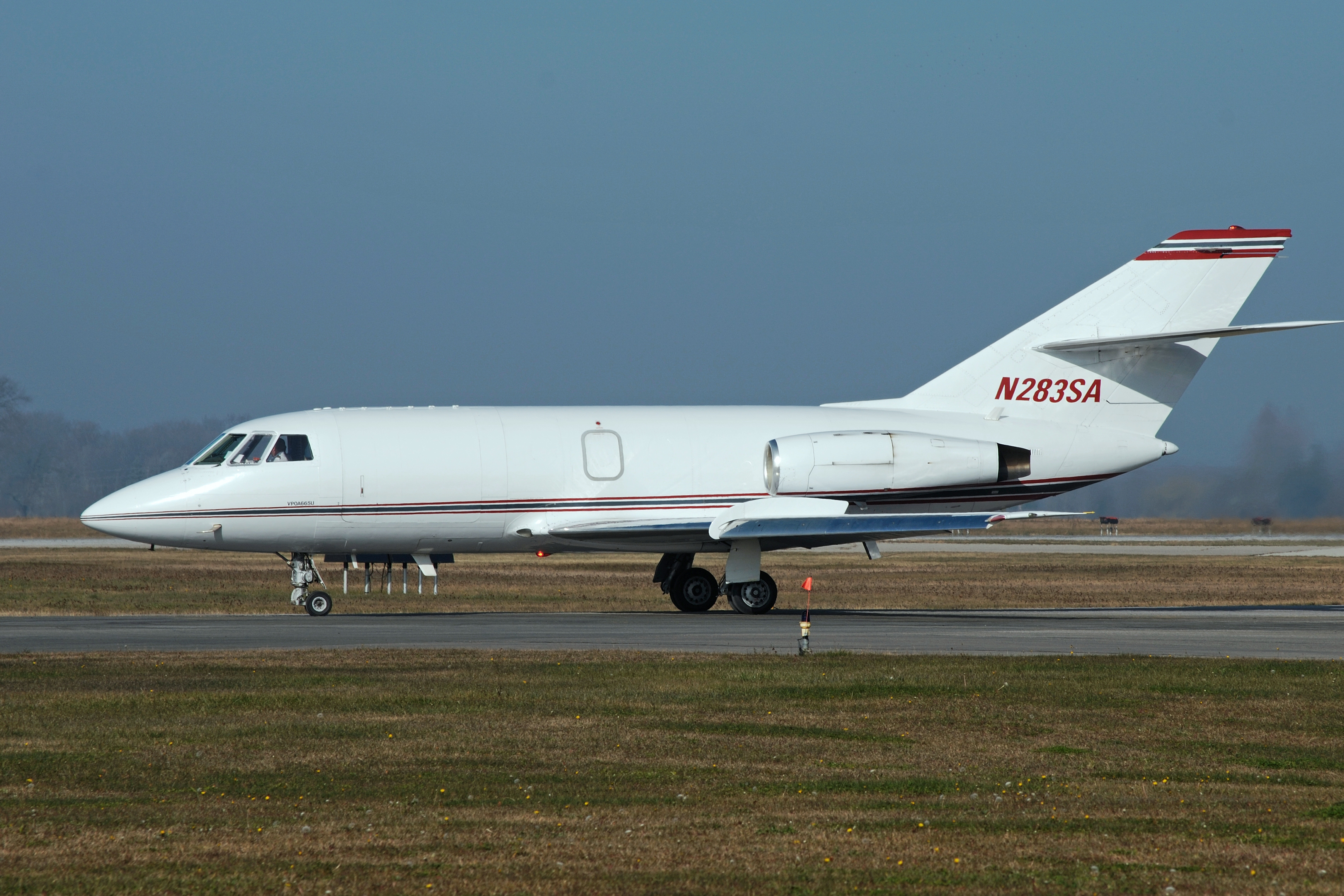
A Falcon 20C converted for freight, at Hamilton, Ontario, in November 2010. · Photo: Reinhard Zinabold / Wikimedia Commons, CC BY 2.0
Dassault · Midsize Jet
Falcon 20 (20C / 20D / 20E / 20F)
The first production version of Dassault's business-jet line, later replaced by the Falcon 200 and widely re-engined as the Falcon 20-5.
A roomy, well-built classic that most US buyers cannot use. Unless the aircraft carries Dassault's Stage 3 noise modification, it may not fly to or from airports in the lower 48 states. For flying, the re-engined Falcon 20-5 is the practical choice.
Buy it if
You will base and fly it outside the contiguous US, or you have found one with proven Stage 3 noise compliance, and you want a wide cabin with an enclosed lavatory for very little purchase money.
Skip it if
You need to use airports in the lower 48 states, want a jet you can resell later, or want engine support and pilot training close to home.
Biggest compromise
Noise. The original GE CF700 engines are FAA Stage 2, so since the end of 2015 these jets may not use airports in the contiguous US except on special ferry permits.
The numbers that matter
Purchase price
$200K–$495K
guide value (Aircraft Cost Calculator and evoJets)
What it costs per year
$1.64M
at 300 hrs · two professional pilots
How far it flies
1,795 nm
About 1,540 nm with four passengers
How fast
465 kt
high-speed cruise
Seats
8
8 typical, 10 certified maximum
Pilots needed
2
Two pilots are required on every flight.
Price
What one costs to buy
Guide value
$200K–$495K
Other sites
Priced vs call
with a price / call for price
No flyable original-engine Falcon 20 is advertised; about 16 are listed only as parts aircraft. Published guide values run $200,000–$495,000.
Price vs its family and alternatives
Scroll to explore · select a jet for details
Falcon 20 (20C / 20D / 20E / 20F) · This aircraft
$200K–$495K guide
Guide value, not a listed asking price.
The least expensive here; next up is the Falcon 20-5 (TFE731 retrofit).
For sale now
None listed right now
Cost to own
What it costs per year to run
300hours / year
Per year
Per flight hour
Estimate — your operator will quote actual numbers.
Fuel, airframe maintenance, engine overhaul reserve and landing, handling and other costs rise as you fly more. Two pilots, recurrent training, hangar, insurance and management stay the same however much you fly.
Where the money goes
- Two pilots$244,30415%
- Recurrent training$29,0372%
- Hangar$34,1822%
- Insurance$8,7831%
- Management$48,0003%
- Fuel$701,72743%
- Airframe maintenance$285,48317%
- Engine overhaul reserve$210,75913%
- Landing, handling and other costs$81,4655%
Fuel is the biggest single cost at 43% of the total.
The JetGrade
57 out of 100 — Well below its class
Peer group: Hawker Siddeley HS-125-400, Hawker Siddeley HS-125-600, Sabreliner 60, Sabreliner 75A / 80, IAI Westwind 1124
Seven categories at a glance
- - - 70 = typical— This aircraft
Strongest on cabin & passenger comfort, weakest on value & resale.
Grades are editorial opinions about the model, not any specific aircraft. Sponsors and affiliates have no input. Reviewed 2026-10-28.
Where it flies
Sample trips and reach
Typical trips on a map
Nonstop
Depends on weight or weather
Fuel stop likely
Out of reach
4 of 8 sample trips are comfortable nonstops.
Sample flight times
- 0.8 hr
Carlsbad → Las Vegas
205 nm · Stage 3 noise compliance needed for US airports
- 1.9 hr
Carlsbad → Aspen
625 nm · Hot-and-high; Stage 3 aircraft only
- 2.2 hr
Santa Ana → San José del Cabo
765 nm · Stage 3 noise compliance needed to depart Santa Ana
- 2.5 hr
Teterboro → West Palm Beach
900 nm · Stage 3 noise compliance needed for US airports
- 3.2 hr
Dallas → Teterboro
1,190 nm · Within four-passenger range; Stage 3 aircraft only
- 3.9 hr
Teterboro → San Juan
1,410 nm · Near range limit over water; Stage 3 aircraft only
- 5.5 hr
Carlsbad → Teterboro
2,100 nm · Needs one stop, typically mid-continent
Los Angeles → Honolulu
2,215 nm · Beyond range; no fuel stop possible over water
Lineage
What came before and after
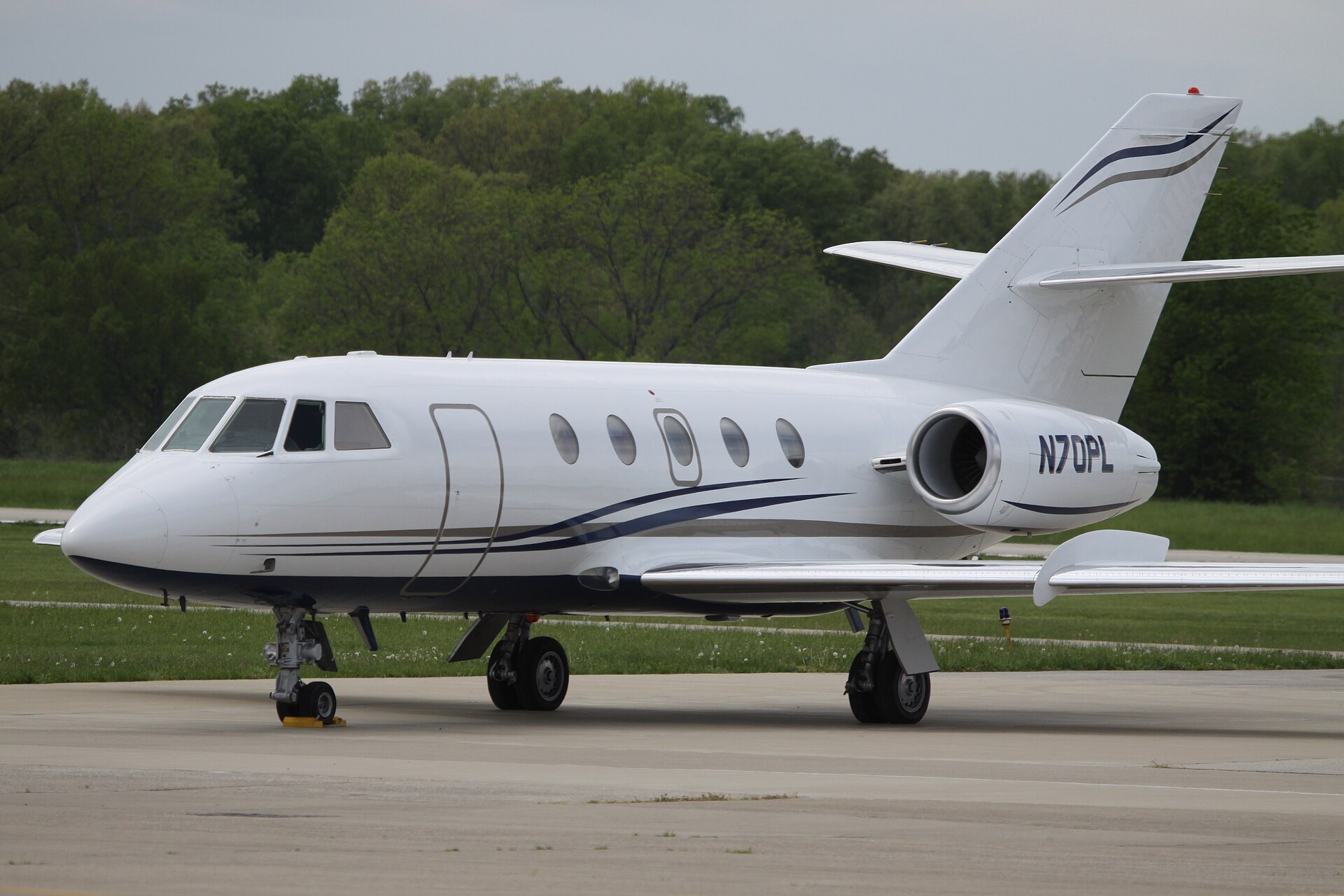
1965–1983
Dassault Falcon 20 (20C / 20D / 20E / 20F)
Original Falcon with GE CF700 engines; 20F added slats and fuel.
Size and cabin
How big it is, inside and out
Outside
Silhouette · scaled to length
Length
Wingspan
Height
Inside the cabin
Cabin length
Width
Height
Compare
How it stacks up
This aircraft
Falcon 20 (20C / 20D / 20E / 20F)
- JetGrade
- 57
- Price
- $200K–$495K guide
- Cost per year
- $1.64M
- Range
- 1,795 nm
- Speed
- 465 kt
- Seats
- 8
- Cabin length
- 24′ 0″
- Pilots
- 2
- Years built
- 1965–1983
After →
- JetGrade
- 56
- Price
- $610K–$2.5M guide
- Cost per year
- $2.64M
- Range
- 2,270 nm
- Speed
- 460 kt
- Seats
- 9
- Cabin length
- 24′ 0″
- Pilots
- 2
- Years built
- 1983–1988
Alternative
- JetGrade
- 68
- Price
- $897K–$1.25M guide
- Cost per year
- $1.58M
- Range
- 2,460 nm
- Speed
- 455 kt
- Seats
- 8
- Cabin length
- 24′ 2″
- Pilots
- 2
- Years built
- 1989–2005
Alternative
- JetGrade
- 68
- Price
- $2.59M
- Cost per year
- $1.83M
- Range
- 3,148 nm
- Speed
- 470 kt
- Seats
- 9
- Cabin length
- 23′ 6″
- Pilots
- 2
- Years built
- 1979–1997
- Dassault Falcon 20-5 instead: Same cabin with Garrett TFE731-5 engines that meet Stage 3, burn less fuel and fly farther; these still trade as flyable aircraft.
- Dassault Falcon 200 instead: The last factory version of the family, with Garrett ATF3 engines that meet Stage 3 and more fuel, though ATF3 support is scarce.
- Dassault Falcon 50 instead: Three TFE731 engines and a cabin derived from the Falcon 20, with enough range for coast-to-coast and transatlantic trips.
Gold marks the best figure in each row.
Owning one
What to know before you buy
Engines & inspections
2 × GE CF700-2D-2 (20E, 20F); CF700-2C or -2D on earlier aircraft · 4,390 lbf each
Engine hours until overhaul
- APU exhaust insulation check · 10 hr
- Engine overhaul · 5,000 hr
- Entry door closing checks every 72 months
No pay-per-hour engine plan was found. Owners reserve by the hour and rely on independent CF700 shops for overhauls and parts.
Known issues
Stage 2 noise ban
Unmodified aircraft may not use airports in the 48 contiguous states since 31 December 2015, except on special ferry permits.
Noise kit no longer made
Dassault's Stage 3 configuration exists on paper, but the FAA reported in 2013 that the kit was out of production.
Landing-gear life records
Gear parts now carry cycle limits; aircraft missing cycle histories may need replacement parts before flying.
Pre-buy checklist
0 of 8 checked
Dassault still issues structural updates for the type, but GE no longer markets the CF700. Engine and parts support comes mainly from independent shops, and FlightSafety's simulator for the type is in Paris.
Review
The full review
Strengths
- Cabin about 6 ft 2 in wide and 24 ft long, roomier across than most business jets of its era.
- Full-fuel payload near 1,880 lb, and about 1,540 nm of range with four passengers.
- Forward galley and enclosed full-width aft lavatory, with room for up to 10 passengers.
Limitations
- Stage 2 engines: barred from contiguous-US airports since 31 December 2015 unless the Stage 3 kit is fitted.
- Thirsty at about 280 to 320 gallons an hour, pushing estimated costs near $5,480 an hour.
- GE no longer markets the CF700; support rests on a few independent shops and parts dealers.
The Falcon 20 is where Dassault's business-jet line began. The prototype flew in May 1963, Pan Am's business-jet division sold the early aircraft to American customers, and the type was certified in the US in 1965. This page covers the versions built with General Electric CF700 engines: the original aircraft usually sold as the 20C, the 20D from 1968, and the 20E and 20F from 1970. The 20F, with wing slats and the most fuel, is the version described here. The Falcon 200 replaced it on the production line in 1983, and many airframes were later re-engined as the Falcon 20-5, which has its own page.
Pilot's take
We see the Falcon 20 as a straightforward two-pilot airplane built for its era. The 20F's leading-edge slats bring its minimum control speeds down to about 100 kt, the lowest of the CF700 versions, and its 42,000 ft ceiling and Mach 0.88 limit were strong numbers in 1970. The CF700's rear-mounted fan is unusual, and at about 300 gallons an hour every trip needs careful fuel planning. The flying qualities are not what limits this jet today. Noise certification, thin engine support and the lack of a US simulator course for pilots are.
Who this is for
Cargo and special-mission operators, owners basing an aircraft outside the lower 48 states, and restoration or parts specialists. It is not a sensible first private jet for a US owner unless Stage 3 compliance is proven in the logbooks.

Ask about this aircraft
Answers come only from our research file on the Dassault Falcon 20 (20C / 20D / 20E / 20F).
Your earlier questionsOwners
Private to verified ownersOwn a Dassault Falcon 20 (20C / 20D / 20E / 20F)? Verify with its FAA registration to join the owners' thread and the real-cost poll.