
Silhouette traced from a photo by flybyeigenheer · CC BY-SA 2.0
Dassault · Midsize Jet
Falcon 200
The final factory version of the Falcon 20 family, built from 1983 to 1988 after the 20F.
The best-performing factory Falcon 20, with Stage 3 engines and about 2,270 nm of range, held back by rare, costly ATF3 engines and a market with almost no buyers or sellers. Only for operators with a firm engine-support plan.
Buy it if
You already operate ATF3 engines or have a shop lined up to support them, want a wide-cabin midsize that crosses the country with one stop, and can find an aircraft with complete engine records.
Skip it if
You want predictable costs, easy recurrent training, a straightforward resale later, or a first jet. A Falcon 20-5 or Hawker 800 offers a similar cabin with far wider support.
Biggest compromise
The engines. The Garrett ATF3 gives the Falcon 200 its range and its quiet Stage 3 rating, but it is a rare three-spool engine whose biggest operator retired it in 2014.
The numbers that matter
Purchase price
$610K–$2.5M
guide value (FlyCraft and JetAV)
What it costs per year
$2.64M
at 300 hrs · two professional pilots
How far it flies
2,270 nm
About 2,050–2,270 nm with four passengers
How fast
460 kt
high-speed cruise
Seats
9
9 typical, 10 certified maximum
Pilots needed
2
Two pilots are required on every flight.
Price
What one costs to buy
Guide value
$610K–$2.5M
Other sites
Priced vs call
with a price / call for price
No Falcon 200 is advertised. Published guide values run about $610,000–$2.5 million, and a 2009 review priced a good 1987 example near $1.6 million.
Price vs its family and alternatives
Scroll to explore · select a jet for details
Falcon 200 · This aircraft
$610K–$2.5M guide
Guide value, not a listed asking price.
Sits between the Hawker 800 (BAe 125-800) and the Falcon 50.
For sale now
None listed right now
Cost to own
What it costs per year to run
300hours / year
Per year
Per flight hour
Estimate — your operator will quote actual numbers.
Fuel, airframe maintenance labor and parts, engine maintenance program and trip costs, technician and office rise as you fly more. Two pilots, recurrent pilot training, hangar and office, hull and liability insurance and maintenance tracking and software stay the same however much you fly.
Where the money goes
- Two pilots$368,34914%
- Recurrent pilot training$58,6172%
- Hangar and office$80,6773%
- Hull and liability insurance$28,2951%
- Maintenance tracking and software$63,7052%
- Fuel$611,91323%
- Airframe maintenance labor and parts$433,20016%
- Engine maintenance program$420,90016%
- Trip costs, technician and office$574,87522%
Fuel is the biggest single cost at 23% of the total.
The JetGrade
56 out of 100 — Well below its class
Peer group: Dassault Falcon 20-5, BAe / HS 125-700 (Hawker 700), Cessna Citation III (650), Learjet 55, IAI Westwind II (1124A)
Seven categories at a glance
- - - 70 = typical— This aircraft
Strongest on range & payload, weakest on reliability & support.
Grades are editorial opinions about the model, not any specific aircraft. Sponsors and affiliates have no input. Reviewed 2026-10-29.
Where it flies
Sample trips and reach
Typical trips on a map
Nonstop
Depends on weight or weather
Fuel stop likely
5 of 8 sample trips are comfortable nonstops.
Sample flight times
- 0.8 hr
Carlsbad → Las Vegas
205 nm · Short hop, well within range
- 1.9 hr
Carlsbad → Aspen
625 nm · Hot-and-high Aspen; depends on weight and weather
- 2.1 hr
Santa Ana → San José del Cabo
765 nm · Comfortably within range
- 2.5 hr
Teterboro → West Palm Beach
900 nm · Comfortably within range
- 3.1 hr
Dallas → Teterboro
1,190 nm · Comfortably within range
- 3.6 hr
Teterboro → San Juan
1,410 nm · Within range with normal reserves
- 5.3 hr
Carlsbad → Teterboro
2,100 nm · Carlsbad's short runway limits fuel; plan one stop
- 5.8 hr
Los Angeles → Honolulu
2,215 nm · At maximum range; light loads and calm winds only
Lineage
What came before and after
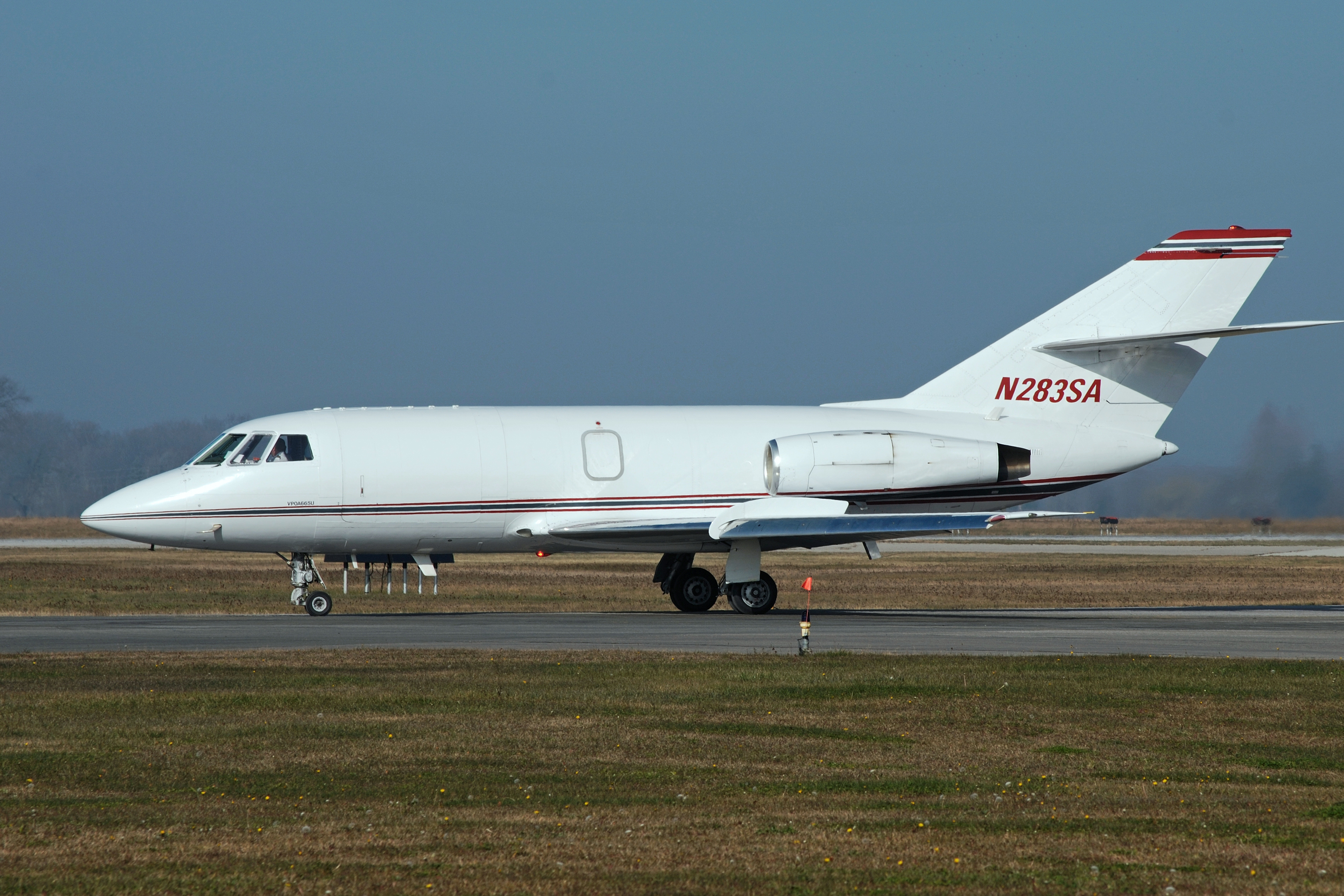
1983–1988
Dassault Falcon 200
Factory Garrett ATF3 engines, fuselage fuel tanks and higher weights.
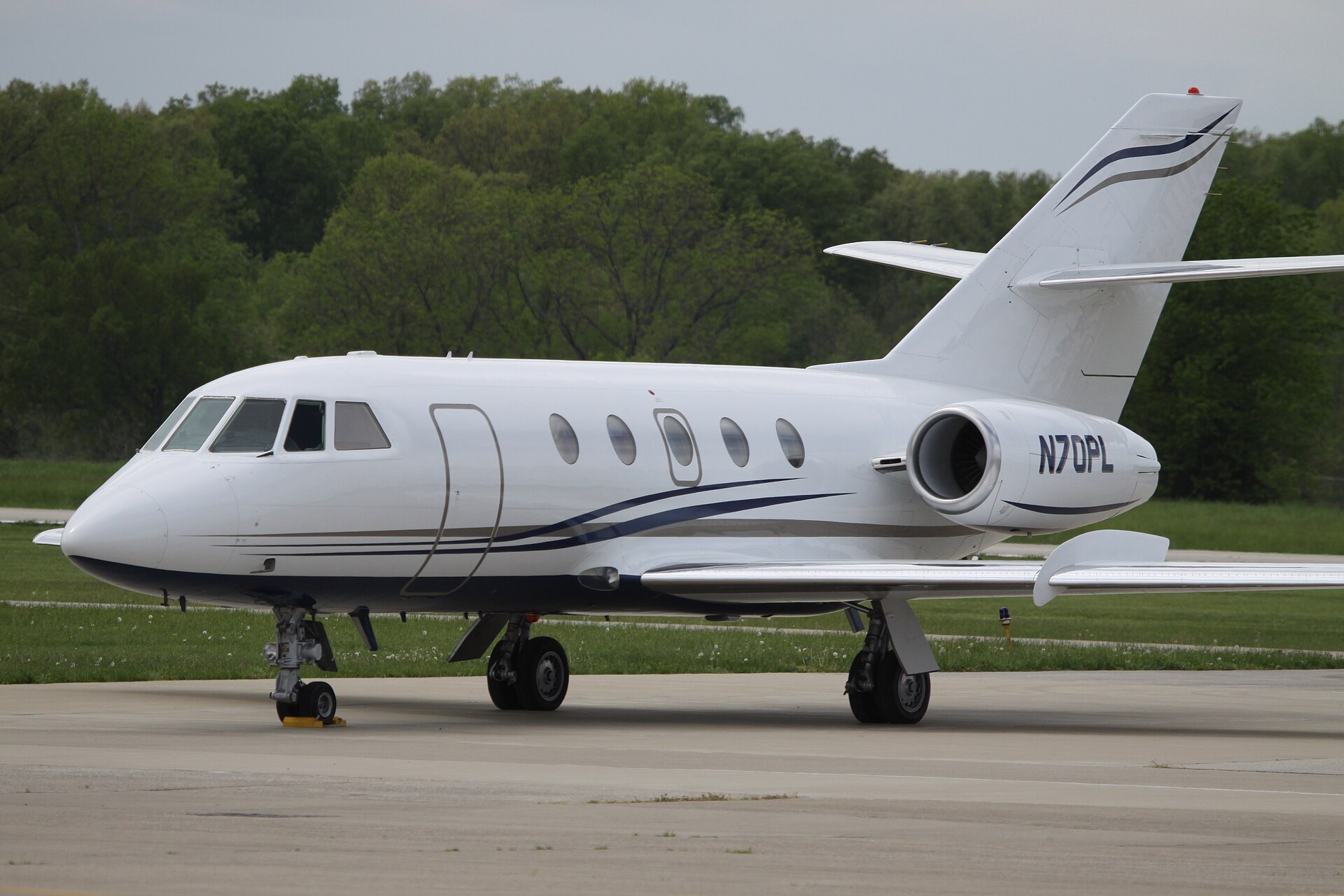
What changed from the Dassault Falcon 20 (20C / 20D / 20E / 20F)
- Garrett ATF3-6A-4C turbofans of 5,200 lb thrust replace GE CF700s of about 4,400 lb.
- Two fuselage tanks raise usable fuel from 1,361 to 1,595 gallons, about 17% more.
- Maximum takeoff weight rises from 28,660 lb to 32,000 lb.
- A redesigned wing-root fairing and shortened wing fence clean up the airflow.
- Bleed air, anti-ice, fuel, hydraulic, electrical and pressurization systems reworked for the new engines.
- Certified to FAA Stage 3 noise rules, unlike the original Stage 2 Falcon 20.
Size and cabin
How big it is, inside and out
Outside
Silhouette · scaled to length
Length
Wingspan
Height
Inside the cabin
Cabin length
Width
Height
Compare
How it stacks up
This aircraft
Falcon 200
- JetGrade
- 56
- Price
- $610K–$2.5M guide
- Cost per year
- $2.64M
- Range
- 2,270 nm
- Speed
- 460 kt
- Seats
- 9
- Cabin length
- 24′ 0″
- Pilots
- 2
- Years built
- 1983–1988
← Before
Falcon 20 (20C / 20D / 20E / 20F)
- JetGrade
- 57
- Price
- $200K–$495K guide
- Cost per year
- $1.64M
- Range
- 1,795 nm
- Speed
- 465 kt
- Seats
- 8
- Cabin length
- 24′ 0″
- Pilots
- 2
- Years built
- 1965–1983
Alternative
- JetGrade
- 68
- Price
- $897K–$1.25M guide
- Cost per year
- $1.58M
- Range
- 2,460 nm
- Speed
- 455 kt
- Seats
- 8
- Cabin length
- 24′ 2″
- Pilots
- 2
- Years built
- 1989–2005
Alternative
- JetGrade
- 74
- Price
- $1.27M
- Cost per year
- $1.65M
- Range
- 2,555 nm
- Speed
- 442 kt
- Seats
- 8
- Cabin length
- 21′ 4″
- Pilots
- 2
- Years built
- 1984–1995
Alternative
- JetGrade
- 68
- Price
- $2.59M
- Cost per year
- $1.83M
- Range
- 3,148 nm
- Speed
- 470 kt
- Seats
- 9
- Cabin length
- 23′ 6″
- Pilots
- 2
- Years built
- 1979–1997
- Dassault Falcon 20-5 instead: The same Falcon 20 cabin with widely supported Garrett TFE731-5 engines; examples were advertised at $1.5–1.9 million in October 2026.
- Hawker 800 instead: A widely supported 1980s midsize jet with TFE731 engines, a much larger fleet and established pilot training.
- Dassault Falcon 50 instead: Three TFE731 engines and transatlantic-class range with a related cabin, for buyers who need more reach.
Gold marks the best figure in each row.
Owning one
What to know before you buy
Engines & inspections
2 × Garrett (now Honeywell) ATF3-6A-4C · 5,200 lbf each
Engine hours until overhaul
- Extinguisher tube inspection · 450 hr
- Entry door closing checks every 72 months
- Fuselage tank foam replacement every 96 months
Most ATF3 engines were on Honeywell's MSP Gold plan in 2009. Confirm current enrollment, coverage and transfer terms for any aircraft.
Known issues
Rare engine, thin support
The ATF3's main user retired it in 2014; in 2020 Honeywell said about a dozen ATF3-6 engines still flew.
High engine costs
Published engine program costs run about $1,400 an hour, among the highest for a midsize jet.
Small, idle US fleet
Nine Falcon 200s are on the US register, and none logged a tracked flight in the past year.
Pre-buy checklist
0 of 9 checked
Honeywell still overhauled ATF3s in Phoenix as of 2016 and certified a 3D-printed engine part in 2020, but the engine's main user retired it in 2014. Dassault still updates the structural limits.
Review
The full review
Strengths
- About 2,270 nm of range with NBAA reserves and 2,050 nm with seats full, long for a 1980s midsize.
- Meets FAA Stage 3 noise rules, so it can use US airports the original Falcon 20 cannot.
- Cabin 6 ft 1 in wide with nine typical seats, a forward refreshment area and a separate lavatory.
Limitations
- Rare ATF3 engines: in 2020 Honeywell said only about a dozen ATF3-6 engines were still flying.
- Estimated $2.6 million a year at 300 hours, roughly $8,800 an hour, driven by engines and maintenance.
- No type simulator, nine US-registered aircraft and no listings, so training, parts and resale are hard.
The Falcon 200 is the last and most capable factory version of Dassault's first business jet. Originally called the Falcon 20H, it first flew with Garrett ATF3 engines in April 1980, was certified in the United States in July 1982 and replaced the Falcon 20F on the production line in 1983. Fewer than 40 were built before production ended in 1988. It shares its type certificate with the Falcon 20 and is a close relative of the US Coast Guard's HU-25 Guardian, which used another version of the same engine.
Pilot's take
We see the Falcon 200 as the Falcon 20 finished properly. Each ATF3 makes 5,200 lb of takeoff thrust, the leading-edge slats keep minimum control speeds near 100 kt, and a Mach 0.865 limit with about 460 kt at 37,000 ft is quick for its era. The extra fuselage fuel turns a regional jet into one that can cross most of the country with a single stop. What a crew has to manage is the engine: a three-spool design with cycle limits on some parts, a small support network and no simulator for training. Planning, more than flying, is the hard part.
Who this is for
Experienced operators and maintenance-savvy owners who already know the ATF3, such as special-mission or overseas operators, and who value range and cabin width over predictable support. Not a sensible first jet.

Ask about this aircraft
Answers come only from our research file on the Dassault Falcon 200.
Your earlier questionsOwners
Private to verified ownersOwn a Dassault Falcon 200? Verify with its FAA registration to join the owners' thread and the real-cost poll.