
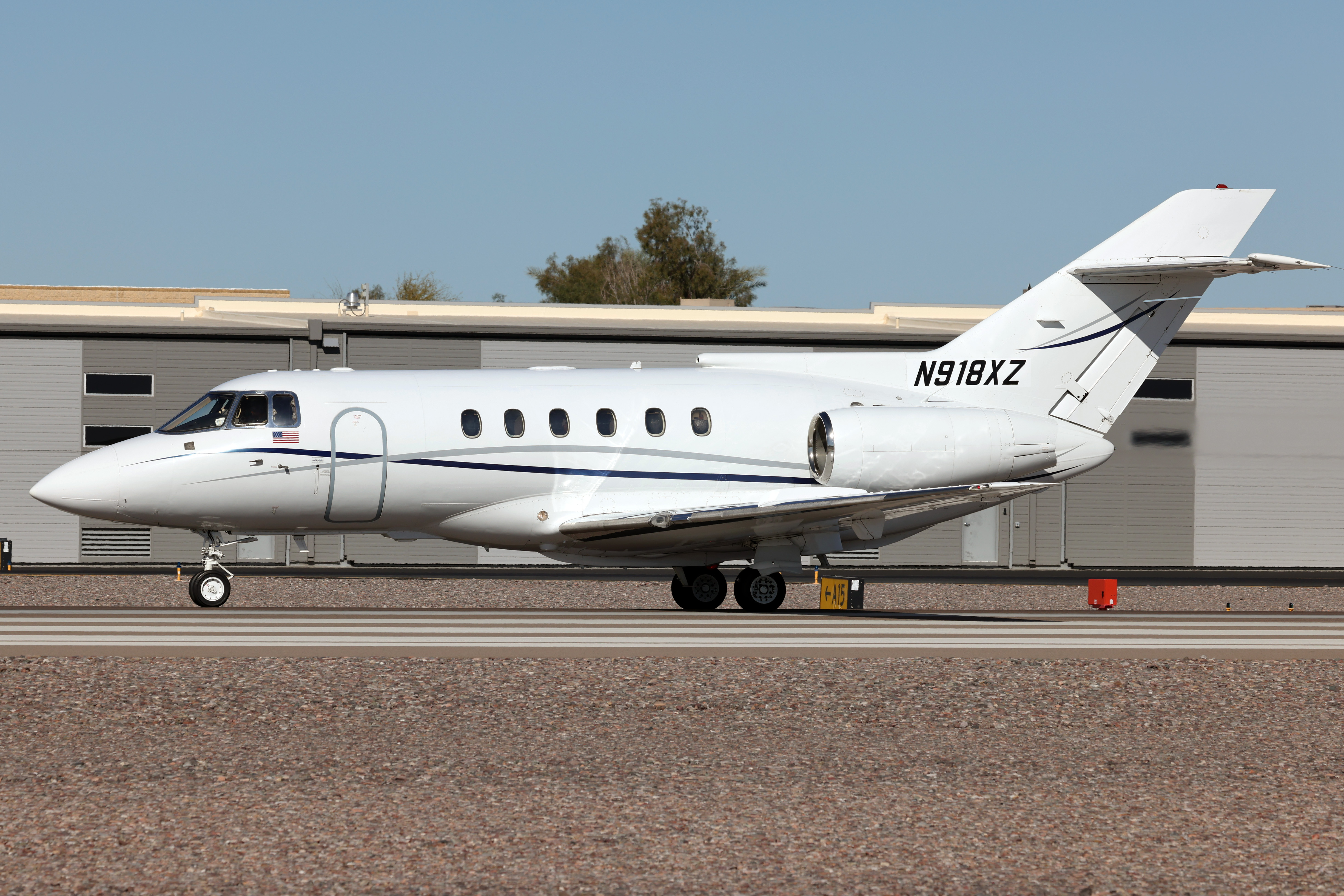
Hawker 800 N918XZ, a 1990 BAe 125-800A, at Scottsdale, Arizona, January 2026. · Photo: Duncan Kirk, CC BY 4.0, via Wikimedia Commons
British Aerospace · Midsize Jet
Hawker 800 (BAe 125-800)
The 125 line's fifth main version: the first with TFE731-5 engines and a glass cockpit, and the basis for the 800XP.
One of the most capable cabins for the money. It seats eight, crosses the US nonstop with light loads and costs about $5,500 an hour to run, but engine status, corrosion and avionics decide whether a given aircraft is a bargain.
Buy it if
You want a true midsize cabin and nonstop range for most US trips on a budget of about $1.3 million, fly from runways of 6,000 ft or more, and can fund two pilots and a Hawker specialist shop.
Skip it if
You often use short or high-elevation runways, want modern avionics without a retrofit, or need predictable maintenance bills; a Hawker 800XP or a newer midsize jet costs more but surprises less.
Biggest compromise
The aging engines and airframe. 3 million airplane.
The numbers that matter
Purchase price
$1.27M
typical asking · $1.1M–$1.5M
What it costs per year
$1.65M
at 300 hrs · two professional pilots
How far it flies
2,555 nm
2,445–2,500 nm with passengers
How fast
442 kt
high-speed cruise
Seats
8
8 typical (8–9 by interior)
Pilots needed
2
Always flown by two pilots; there is no single-pilot option.
Price
What one costs to buy
Typical asking price
$1,270,000
Where asking prices sit
Low
$1.1M
Typical
$1.27M
High
$1.5M
Most asking prices fall inside this band.
Other sites
6-month move
Priced vs call
with a price / call for price
Six of 16 aircraft for sale show a price. Engine program status and avionics upgrades explain most of the spread; published value guides run $820,000 to $1.1 million.
Price vs its family and alternatives
Scroll to explore · select a jet for details
Hawker 800 (BAe 125-800) · This aircraft
$1.27M
Sits between the HS-125-400 and the Hawker 800XP.
For sale now
None listed right now
Cost to own
What it costs per year to run
300hours / year
Per year
Per flight hour
Estimate — your operator will quote actual numbers.
Fuel, airframe maintenance, engine program or reserve and crew travel, landing and handling rise as you fly more. Two pilots, recurrent simulator training, hangar, insurance, management and databases, charts and other fixed stay the same however much you fly.
Where the money goes
- Two pilots$294,78018%
- Recurrent simulator training$48,8303%
- Hangar$28,8852%
- Insurance$35,9192%
- Management$48,0003%
- Databases, charts and other fixed$13,9821%
- Fuel$611,52337%
- Airframe maintenance$287,60117%
- Engine program or reserve$215,46013%
- Crew travel, landing and handling$67,5004%
Fuel is the biggest single cost at 37% of the total.
The JetGrade
74 out of 100 — Slightly above its class
Peer group: Cessna Citation VII, Learjet 60, IAI Astra SP, Cessna Citation III, Learjet 55
Seven categories at a glance
- - - 70 = typical— This aircraft
Strongest on cabin & passenger comfort, weakest on airport access.
Grades are editorial opinions about the model, not any specific aircraft. Sponsors and affiliates have no input. Reviewed 2026-10-28.
Where it flies
Sample trips and reach
Typical trips on a map
Nonstop
Depends on weight or weather
5 of 8 sample trips are comfortable nonstops.
Sample flight times
- 0.9 hr
Carlsbad → Las Vegas
205 nm · Short hop well within range
- 1.8 hr
Carlsbad → Aspen
625 nm · Hot-and-high; depends on weight and weather
- 2.1 hr
Santa Ana → San José del Cabo
765 nm · Comfortable nonstop with four passengers
- 2.4 hr
Teterboro → West Palm Beach
900 nm · Easy nonstop with four passengers
- 3.1 hr
Dallas → Teterboro
1,190 nm · Nonstop with ample reserve
- 3.6 hr
Teterboro → San Juan
1,410 nm · Over-water leg; plan winds and alternates
- 5.2 hr
Carlsbad → Teterboro
2,100 nm · Nonstop in range; Carlsbad runway limits fuel
- 5.9 hr
Los Angeles → Honolulu
2,215 nm · Light load only; winds decide
Lineage
What came before and after


1984–1995
Hawker 800 (BAe 125-800)
Bigger wing, curved windshield, TFE731-5R engines and glass cockpit.


What changed from the BAe / HS 125-700 (Hawker 700)
- Garrett TFE731-5R engines of about 4,300 lb thrust replace the 700's 3,700 lb TFE731-3s.
- Wingspan grows by 4 ft 6 in to about 51 ft 4 in, improving climb and cruise.
- First business jet with an electronic flight instrument system, a five-screen glass cockpit.
- Curved one-piece windshields, a longer fin and a reshaped tail fairing without the ventral fin.
- Maximum takeoff weight rises to 27,400 lb, and the speed limit rises from Mach 0.77 to 0.80.
- A larger belly fuel tank replaces the dorsal tank, and a stick pusher adds stall protection.
Size and cabin
How big it is, inside and out
Outside
Silhouette · scaled to length
Length
Wingspan
Height
Inside the cabin
Cabin length
Width
Height
Compare
How it stacks up
This aircraft
Hawker 800 (BAe 125-800)
- JetGrade
- 74
- Price
- $1.27M
- Cost per year
- $1.65M
- Range
- 2,555 nm
- Speed
- 442 kt
- Seats
- 8
- Cabin length
- 21′ 4″
- Pilots
- 2
- Years built
- 1984–1995
← Before
- JetGrade
- 68
- Price
- $400K–$642K guide
- Cost per year
- $1.82M
- Range
- 2,170 nm
- Speed
- 430 kt
- Seats
- 8
- Cabin length
- 21′ 4″
- Pilots
- 2
- Years built
- 1977–1984
After →
- JetGrade
- 72
- Price
- $2.17M
- Cost per year
- $1.83M
- Range
- 2,540 nm
- Speed
- 448 kt
- Seats
- 8
- Cabin length
- 21′ 4″
- Pilots
- 2
- Years built
- 1995–2005
Alternative
- JetGrade
- 65
- Price
- $2.3M
- Cost per year
- $1.93M
- Range
- 1,825 nm
- Speed
- 452 kt
- Seats
- 8
- Cabin length
- 18′ 5″
- Pilots
- 2
- Years built
- 1992–2000
Alternative
- JetGrade
- 65
- Price
- $2.8M
- Cost per year
- $1.95M
- Range
- 2,390 nm
- Speed
- 465 kt
- Seats
- 7
- Cabin length
- 17′ 8″
- Pilots
- 2
- Years built
- 1993–2007
- Hawker 800XP instead: Same cabin with stronger TFE731-5BR engines that fix hot-and-high climb, thrust reversers standard and higher weights; typically asks considerably more.
- Cessna Citation VII instead: Faster with a shorter takeoff, but about 1,650 nm of seats-full range and a smaller cabin.
- Learjet 60 instead: Quicker climb and a newer design with similar cost per hour, but a narrower cabin and about 2,130 nm of seats-full range.
Gold marks the best figure in each row.
Owning one
What to know before you buy
Engines & inspections
2 × Honeywell (Garrett) TFE731-5R-1H · 4,304 lbf each
Engine hours until overhaul
- Pitot-static drain valve check · 300 hr
- Engine mid-life inspection (MPI) · 2,100 hr
- Engine core inspection (CZI) · 4,200 hr
- E inspection every 12 months
- F inspection every 24 months
- G inspection (48-month) every 48 months
- Landing gear overhaul every 144 months
About half the aircraft listed in October 2026 had engines on an hourly plan such as MSP or JSSI; engines off a plan are a major price item.
Known issues
Engine program status
An engine off a pay-per-hour plan and near its core inspection can cost a large share of a roughly $1 million airplane.
Wing and leading-edge corrosion
Anti-ice fluid and steel wing fasteners cause corrosion; leading-edge overhauls run $12,000 to $55,000 per section.
48-month inspection downtime
The 48-month check starts around $35,000 to $50,000 before repairs and can take six to eight weeks.
Pre-buy checklist
0 of 10 checked
Textron Aviation holds the type certificate, and Hawker specialists such as Duncan, Elliott, West Star and C&L support the airframe. Large Hawker 800XP numbers keep many shared parts available.
Review
The full review
Strengths
- Long range: about 2,445 nm with eight seats full, enough for most US coast-to-coast trips with light loads.
- Big cabin: 21 ft 4 in long and 6 ft wide, with eight seats and a full-width enclosed lavatory.
- Low entry price: six priced listings in October 2026 asked $1.1 million to $1.5 million, median $1.27 million.
Limitations
- Needs about 5,600 ft of runway at full weight, and hot, high airports can push that toward 9,800 ft.
- Running costs near $1.65 million a year at 300 hours, with fuel burn around 245–285 gallons an hour.
- Original 1980s glass cockpits use cathode-ray tube screens; modern retrofits add value but cost extra.
The Hawker 800 is the 1984 evolution of the de Havilland 125, a British business jet line that started in the 1960s. British Aerospace built it as the BAe 125-800, with the 800A for the US market and the 800B for the rest of the world, and it was renamed the Hawker 800 in 1994. Compared with the earlier 125-700 it has a longer wing, curved windshields, Garrett TFE731-5R engines of about 4,300 lb thrust and the first glass cockpit in a business jet. About 260 civil examples were built before the stronger 800XP replaced it in 1995.
Pilot's take
Pilots often describe the Hawker 800 as stable, solid and easy to land, with heavy, cable-driven controls that feel like a bigger airplane. The two-pilot cockpit is busy unless the panel has been upgraded, and the TFE731-5R engines leave little climb margin on hot days, so takeoff and climb planning matter at high airports. Crews also stress discipline with the lift dump: once deployed on landing, the aircraft is committed to stop, which shapes how go-around decisions are made late in the landing roll.
Who this is for
Families and companies stepping up from a light jet who want a roomy cabin for six to eight people and nonstop US range for about $1.3 million, flying 200–400 hours a year with a professional crew and a Hawker specialist shop.

Ask about this aircraft
Answers come only from our research file on the Hawker 800 (800A US / 800B export).
Your earlier questionsOwners
Private to verified ownersOwn a British Aerospace Hawker 800 (BAe 125-800)? Verify with its FAA registration to join the owners' thread and the real-cost poll.