
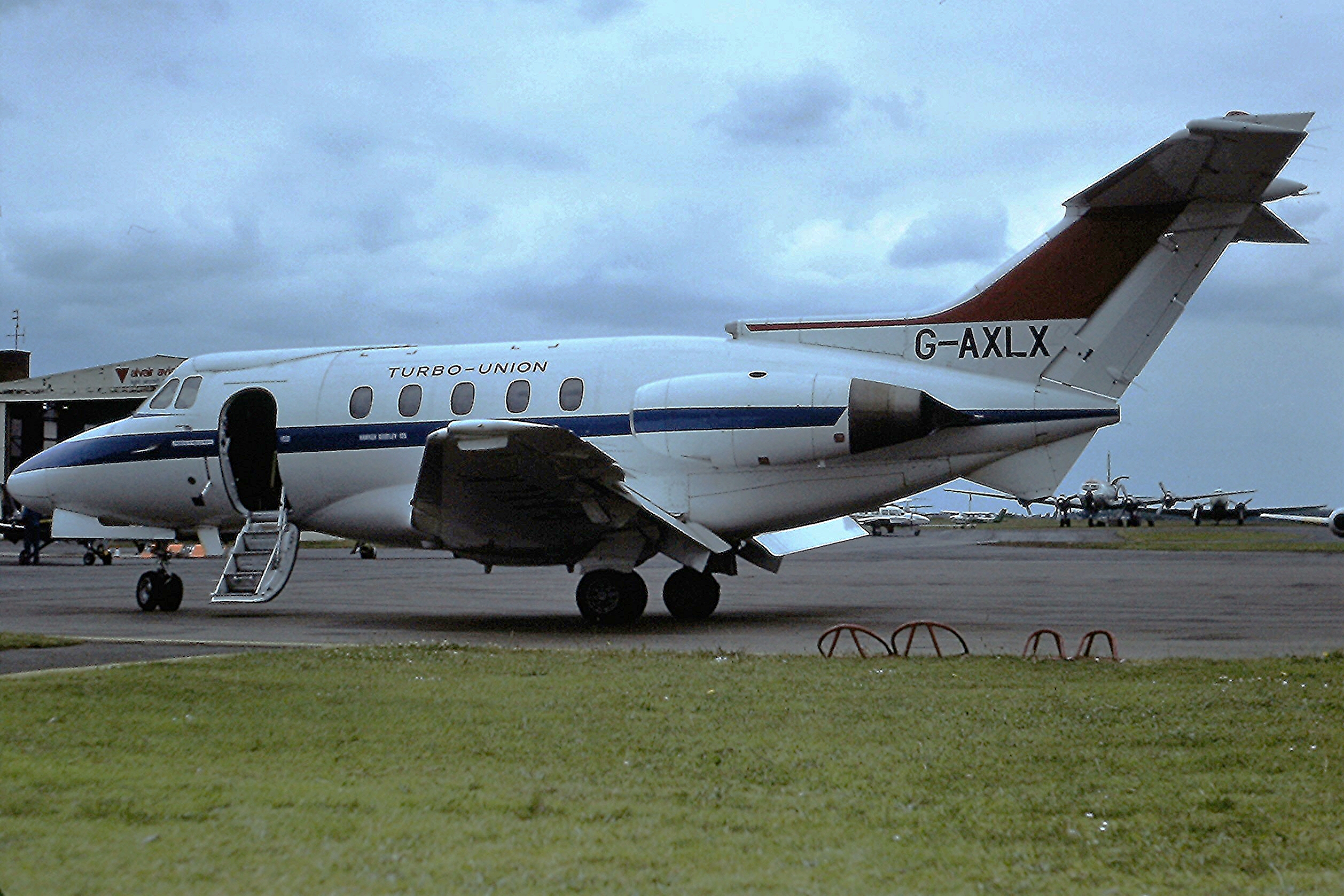
HS-125 Series 400B G-AXLX at Coventry in June 1979, with its original Viper engines. · Photo: Rob Hodgkins (Flickr: cvtperson), CC BY-SA 2.0 (creativecommons.org/licenses/by-sa/2.0)
Hawker Siddeley · Midsize Jet
HS-125-400
Fourth major version of the 125 business jet, between the original 1960s models and the stretched Series 600.
A tough, well-built 1960s design, but the original Viper engines are barred from airports in the lower 48 states. A TFE731-converted example is a usable, inexpensive midsize jet if you can live with scarce parts and a tiny resale market.
Buy it if
You want a real midsize cabin for well under $1M, will only consider a TFE731-converted aircraft with Stage 3 noise paperwork, and have a maintenance shop that knows early 125s.
Skip it if
You need modern avionics already approved for flight above 28,000 ft, a stand-up cabin, nonstop coast-to-coast range, or quick resale. A Viper-powered example cannot be based in the lower 48 states at all.
Biggest compromise
The airframe outlived its engines. Unconverted aircraft fail the US Stage 3 jet-noise standard and can only be ferried out for export, conversion or scrapping.
The numbers that matter
Purchase price
$576K–$576K
guide value (PlanePhD (April 2026 estimate))
What it costs per year
$1.75M
at 300 hrs · two professional pilots
How far it flies
2,150 nm
About 1,800 nm with four passengers
How fast
420 kt
high-speed cruise
Seats
6
6 typical, up to 8 certified
Pilots needed
2
Always certified for two pilots; there is no single-pilot option.
Price
What one costs to buy
Guide value
$576K–$576K
Other sites
Priced vs call
with a price / call for price
No 125-400s were advertised in October 2026. PlanePhD's estimate for a typical example is about $575,500; Viper-engined aircraft sell close to parts value in the US.
Price vs its family and alternatives
Scroll to explore · select a jet for details
HS-125-400 · This aircraft
$576K–$576K guide
Guide value, not a listed asking price.
Sits between the HS 125-700 (Hawker 700) and the Hawker 800 (BAe 125-800).
For sale now
None listed right now
Cost to own
What it costs per year to run
300hours / year
Per year
Per flight hour
Estimate — your operator will quote actual numbers.
Fuel, maintenance and engine reserve and trip fees and other variable rise as you fly more. Two pilots, recurrent training, hangar, insurance, management and databases, charts and other fixed stay the same however much you fly.
Where the money goes
- Two pilots$348,29020%
- Recurrent training$33,0002%
- Hangar$46,6503%
- Insurance$16,7001%
- Management$60,0003%
- Databases, charts and other fixed$50,0003%
- Fuel$609,91835%
- Maintenance and engine reserve$382,05022%
- Trip fees and other variable$202,50012%
Fuel is the biggest single cost at 35% of the total.
The JetGrade
63 out of 100 — Below its class average
Peer group: Dassault Falcon 20 (20C / 20D / 20E / 20F), Sabreliner 60, HS-125-600, BAe / HS 125-700 (Hawker 700)
Seven categories at a glance
- - - 70 = typical— This aircraft
Strongest on range & payload, weakest on value & resale.
Grades are editorial opinions about the model, not any specific aircraft. Sponsors and affiliates have no input. Reviewed 2026-10-28.
Where it flies
Sample trips and reach
Typical trips on a map
Nonstop
Depends on weight or weather
Fuel stop likely
Out of reach
5 of 8 sample trips are comfortable nonstops.
Sample flight times
- 0.9 hr
Carlsbad → Las Vegas
205 nm · Short Carlsbad runway limits takeoff weight
- 2.0 hr
Carlsbad → Aspen
625 nm · Hot-and-high Aspen; depends on weight and weather
- 2.3 hr
Santa Ana → San José del Cabo
765 nm
- 2.6 hr
Teterboro → West Palm Beach
900 nm
- 3.4 hr
Dallas → Teterboro
1,190 nm
- 3.9 hr
Teterboro → San Juan
1,410 nm · Within range; plan alternates over water
- 6.0 hr
Carlsbad → Teterboro
2,100 nm · Needs one stop, typically mid-continent
Los Angeles → Honolulu
2,215 nm · Beyond range with no stop over water
Lineage
What came before and after

1968–1973
HS-125-400
Airstair door and higher weights; 116 built, many later re-engined.


What changed from the HS-125-1A / -1B / -3
- Outward-opening main door with built-in steps replaced the inward-opening 'up and over' door.
- Maximum takeoff weight rose to 23,300 lb from 22,700 lb on the late Series 3.
- Reworked cockpit layout; cabin kept 5 ft 9 in headroom and five windows per side.
- Later TFE731 conversions raised thrust to 3,700 lb per engine and met US noise rules.
- Converted aircraft reach about 1,800 nm with four passengers versus about 1,530 nm originally.
Size and cabin
How big it is, inside and out
Outside
Length
Wingspan
Inside the cabin
Cabin length
Width
Height
Compare
How it stacks up
This aircraft
HS-125-400
- JetGrade
- 63
- Price
- $576K–$576K guide
- Cost per year
- $1.75M
- Range
- 2,150 nm
- Speed
- 420 kt
- Seats
- 6
- Cabin length
- 19′ 4″
- Pilots
- 2
- Years built
- 1968–1973
← Before
- JetGrade
- 36
- Cost per year
- $1.57M
- Range
- 1,185 nm
- Speed
- 430 kt
- Seats
- 7
- Cabin length
- 19′ 4″
- Pilots
- 2
- Years built
- 1964–1968
After →
- JetGrade
- 43
- Cost per year
- $1.34M
- Range
- 1,650 nm
- Speed
- 454 kt
- Seats
- 8
- Cabin length
- 21′ 4″
- Pilots
- 2
- Years built
- 1971–1977
Alternative
- JetGrade
- 68
- Price
- $400K–$642K guide
- Cost per year
- $1.82M
- Range
- 2,170 nm
- Speed
- 430 kt
- Seats
- 8
- Cabin length
- 21′ 4″
- Pilots
- 2
- Years built
- 1977–1984
Alternative
Falcon 20 (20C / 20D / 20E / 20F)
- JetGrade
- 57
- Price
- $200K–$495K guide
- Cost per year
- $1.64M
- Range
- 1,795 nm
- Speed
- 465 kt
- Seats
- 8
- Cabin length
- 24′ 0″
- Pilots
- 2
- Years built
- 1965–1983
Alternative
- JetGrade
- Not yet graded
- Range
- 1,900 nm
- Speed
- 450 kt
- Seats
- 8
- Years built
- 1983–1992
- BAe / HS 125-700 (Hawker 700) instead: Factory-fitted TFE731 engines, a longer cabin and a much larger fleet, which makes parts, shops and resale easier.
- Dassault Falcon 20 instead: A contemporary midsize jet that, unlike the Viper-powered 125, gained a certified hushkit, so more examples stayed legal to fly in the US.
- Cessna Citation III (650) instead: A 1980s midsize jet with TFE731 engines from new, an active resale market and asking prices around $1.15M in October 2026.
Gold marks the best figure in each row.
Owning one
What to know before you buy
Engines & inspections
2 × Honeywell TFE731-3 (converted; originally Rolls-Royce Viper 522) · 3,700 lbf each
Engine hours until overhaul
- Engine MPI · 1,400 hr
- Engine CZI · 4,200 hr
- 12-month inspection every 12 months
- 24-month inspection every 24 months
- 48-month inspection every 48 months
- 96-month inspection every 96 months
- Landing gear overhaul every 72 months
Converted engines can be enrolled in Honeywell's pay-per-hour maintenance plan; several aircraft offered for sale were enrolled.
Known issues
Viper engines fail noise rules
Unconverted aircraft may not use airports in the lower 48 states; only TFE731-converted aircraft fly normally.
Scarce structural parts
Out-of-production airframe parts can be hard to find and can hold up a major inspection.
Altitude and ADS-B approvals
Flight above 28,000 ft and modern ADS-B position reporting depend on each aircraft's individual upgrades.
Pre-buy checklist
0 of 9 checked
Textron Aviation holds the type certificate, but factory focus moved to later Hawkers. Converted engines are well supported through Honeywell; airframe parts come from specialist shops and salvage.
Review
The full review
Strengths
- Converted aircraft carry about 1,870 lb with full tanks, so four passengers and bags rarely force a fuel trade-off.
- The cabin is 6 ft wide with 5 ft 9 in of headroom, roomier than most light jets at a similar price.
- TFE731 turbofans give 3,700 lb of thrust each and are supported widely, including Honeywell's pay-per-hour maintenance plan.
Limitations
- The original Viper engines fail US noise rules; since 2015 unconverted aircraft cannot use airports in the lower 48 states.
- Only 116 were built and four remain on the US register, so parts and experienced shops are hard to find.
- About 1,800 nm of range with four passengers means coast-to-coast trips need a fuel stop.
The Hawker Siddeley HS-125-400 is the fourth major version of the British 125, the business jet line that later became the Hawker 800 and 900XP. Built at Broughton, near Chester, from 1968 to 1973, the Series 400 introduced an outward-opening main door with built-in steps and raised maximum takeoff weight to 23,300 lb. Hawker Siddeley built 116: 400A models for North America, sold through Beechcraft dealers from 1970, and 400B models for everyone else. It sits between the original 1960s versions and the stretched Series 600.
Pilot's take
From the flight deck, the 125-400 is a conventional, honest airplane: a slightly swept wing derived from the Comet, big slotted flaps and airbrakes, and a cockpit layout that was a clear step up from earlier 125s. The TFE731 conversion transforms it, adding thrust and cutting fuel burn, and converted aircraft cruise around 420 kt. What demands attention is everything around the flying: confirm the noise paperwork, the altitude approvals and each avionics installation before the first trip, and budget time for parts. Training happens in a later-series Hawker simulator plus differences training, so plan for that as well.
Who this is for
A budget-minded owner who wants a classic midsize jet for regional trips of 500 to 1,500 nm, has access to experienced Hawker technicians, and accepts a low-cost aircraft that may be hard to resell.

Ask about this aircraft
Answers come only from our research file on the HS-125-400.
Your earlier questionsOwners
Private to verified ownersOwn a Hawker Siddeley HS-125-400? Verify with its FAA registration to join the owners' thread and the real-cost poll.