
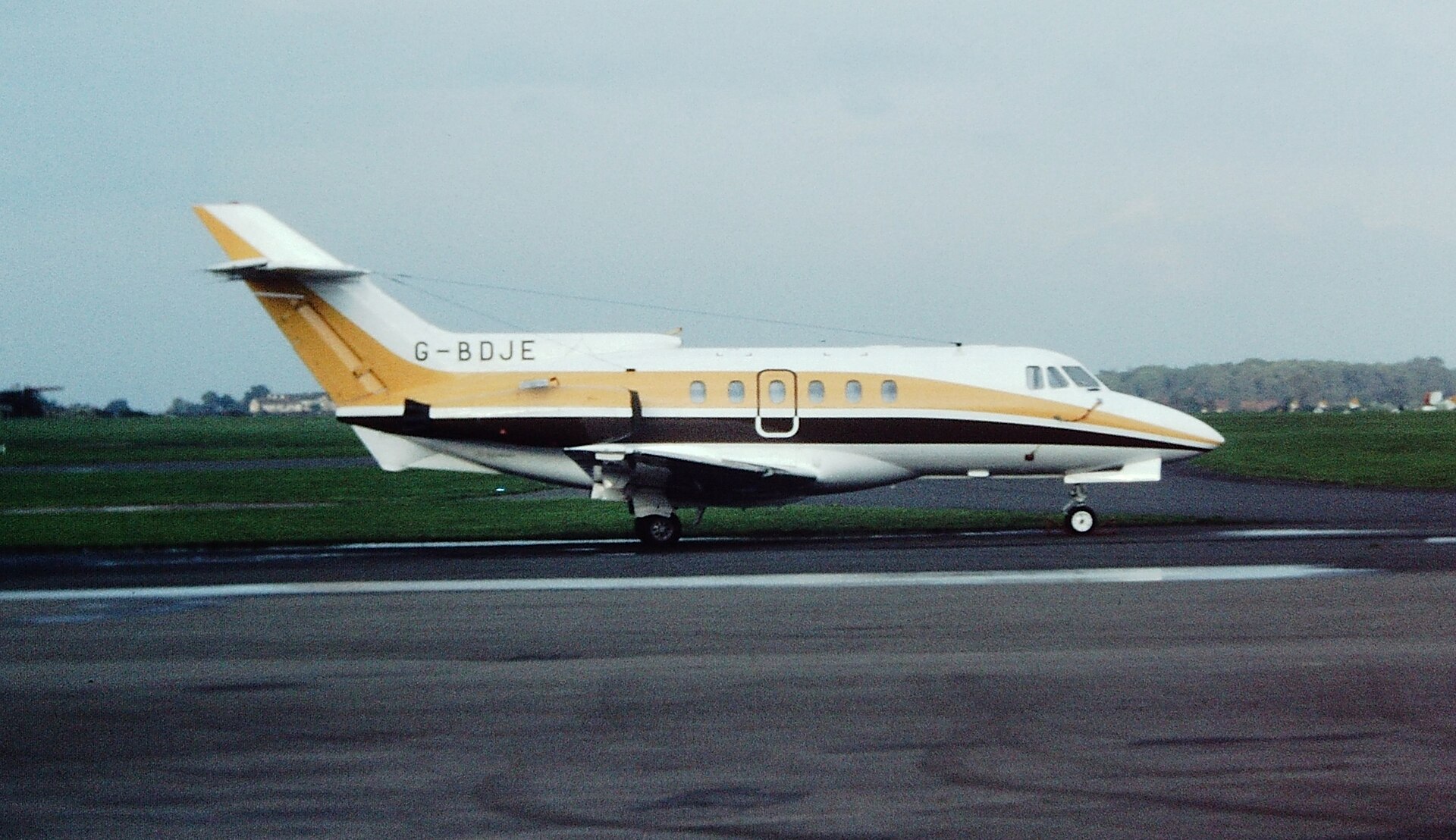
Series 600B G-BDJE taxiing at Coventry Airport, England, in 1976. · Rob Hodgkins (Flickr 'cvtperson') / Wikimedia Commons, CC BY-SA 2.0
Hawker Siddeley · Midsize Jet
HS-125-600 (600A / 600B)
The last turbojet-powered version of the original 125, between the Series 400 and the turbofan Hawker 700.
A comfortable cabin for its age on a jet most buyers cannot use. Its Viper turbojets fail US Stage 3 noise rules with no kit available, so it is barred from lower-48 airports, and engine support is thin. Only turbofan-converted examples remain practical.
Buy it if
You will base and fly it outside the 48 contiguous US states, such as in Mexico or South America, have Viper-experienced mechanics and an engine shop lined up, and value a 6 ft wide cabin over running costs.
Skip it if
You plan to fly from US airports, want predictable engine costs, or need more than about 1,150 nm with passengers. A Hawker 700 has the same cabin with fuel-saving turbofans and is not covered by the US ban.
Biggest compromise
Noise rules. The Viper turbojets do not meet Stage 3 standards and no noise kit was ever approved, so since 2016 an unconverted 600 may not use airports in the 48 contiguous states except on special one-off FAA permits such as ferry flights.
The numbers that matter
What it costs per year
$1.34M
at 300 hrs · two professional pilots
How far it flies
1,650 nm
About 1,090–1,190 nm (estimate) with passengers
How fast
454 kt
high-speed cruise
Seats
8
8 typical (up to 14 high-density)
Pilots needed
2
Two pilots are required on every flight; there is no single-pilot version.
Price
What one costs to buy
Typical asking price
$0
Other sites
Priced vs call
with a price / call for price
No airworthy Series 600 showed an asking price in October 2026. Before the 2016 US noise ban, a 2011 price guide put typical values near $400,000.
Price vs its family and alternatives
Scroll to explore · select a jet for details
HS 125-700 (Hawker 700)
$400K–$642K guide
Guide value, not a listed asking price.
See the HS 125-700 (Hawker 700)For sale now
None listed right now
Cost to own
What it costs per year to run
300hours / year
Per year
Per flight hour
Estimate — your operator will quote actual numbers.
Fuel rises as you fly more. Two professional pilots, recurrent pilot training, hangar and office, insurance and management company stay the same however much you fly.
Where the money goes
Partial estimate- Two professional pilots$280,52521%
- Recurrent pilot training$53,8574%
- Hangar and office$57,8224%
- Insurance$35,9193%
- Management company$48,0004%
- Fuel$866,91065%
Fuel is the biggest single cost at 65% of the total.
The JetGrade
43 out of 100 — Well below its class
Peer group: HS-125-400, BAe / HS 125-700 (Hawker 700), Falcon 20 (20C / 20D / 20E / 20F), Sabreliner 60, 1123 Westwind, Learjet 25 / 25B / 25C / 25D
Seven categories at a glance
- - - 70 = typical— This aircraft
Strongest on cabin & passenger comfort, weakest on airport access.
Grades are editorial opinions about the model, not any specific aircraft. Sponsors and affiliates have no input. Reviewed 2026-10-28.
Where it flies
Sample trips and reach
Typical trips on a map
Nonstop
Depends on weight or weather
Fuel stop likely
Out of reach
3 of 8 sample trips are comfortable nonstops.
Sample flight times
- 0.9 hr
Carlsbad → Las Vegas
205 nm · Easy range; noise rules bar lower-48 airports
- 1.9 hr
Carlsbad → Aspen
625 nm · Hot-and-high; noise rules also bar lower-48 airports
- 2.2 hr
Santa Ana → San José del Cabo
765 nm · In range; noise rules bar the US departure
- 2.6 hr
Teterboro → West Palm Beach
900 nm · In range; noise rules bar lower-48 airports
- 3.5 hr
Dallas → Teterboro
1,190 nm · Likely one stop; noise rules bar lower-48 airports
- 4.0 hr
Teterboro → San Juan
1,410 nm · One stop, typically Florida; noise rules bar Teterboro
- 5.6 hr
Carlsbad → Teterboro
2,100 nm · One stop mid-continent; noise rules bar lower-48 airports
Los Angeles → Honolulu
2,215 nm · Beyond range over open ocean
Lineage
What came before and after


1971–1977
HS-125-600
Stretched 3 ft 1 in with uprated Viper 601 engines; 72 built.


What changed from the HS-125-400
- Uprated Viper 601-22 turbojets of about 3,675–3,750 lb thrust replaced the Series 400's Viper 522.
- Fuselage stretched 3 ft 1 in, adding a sixth window per side and two more seats.
- A new 61-gallon tank in the dorsal fin raised usable fuel to 1,419 US gallons.
- Maximum takeoff weight rose from 23,300 lb to 25,000 lb, and landing weight to 22,000 lb.
- Longer nose, steeper windshield, taller fin and a larger ventral fin.
- Improved brakes and anti-skid, revised aileron gearing and a redesigned cockpit.
Size and cabin
How big it is, inside and out
Outside
Silhouette · scaled to length
Length
Wingspan
Height
Inside the cabin
Cabin length
Width
Height
Compare
How it stacks up
This aircraft
HS-125-600 (600A / 600B)
- JetGrade
- 43
- Cost per year
- $1.34M
- Range
- 1,650 nm
- Speed
- 454 kt
- Seats
- 8
- Cabin length
- 21′ 4″
- Pilots
- 2
- Years built
- 1971–1977
← Before
- JetGrade
- 63
- Price
- $576K–$576K guide
- Cost per year
- $1.75M
- Range
- 2,150 nm
- Speed
- 420 kt
- Seats
- 6
- Cabin length
- 19′ 4″
- Pilots
- 2
- Years built
- 1968–1973
After →
- JetGrade
- 68
- Price
- $400K–$642K guide
- Cost per year
- $1.82M
- Range
- 2,170 nm
- Speed
- 430 kt
- Seats
- 8
- Cabin length
- 21′ 4″
- Pilots
- 2
- Years built
- 1977–1984
Alternative
- JetGrade
- 74
- Price
- $1.27M
- Cost per year
- $1.65M
- Range
- 2,555 nm
- Speed
- 442 kt
- Seats
- 8
- Cabin length
- 21′ 4″
- Pilots
- 2
- Years built
- 1984–1995
- BAe / HS 125-700 (Hawker 700) instead: The same fuselage and cabin with TFE731 turbofans: far lower fuel burn per mile, longer range, engine maintenance plans and no US noise ban.
- Hawker 800 (800A / 800B) instead: A later development of the same family with a longer-span wing, curved windshield, glass cockpit displays and TFE731-5 turbofans.
Gold marks the best figure in each row.
Owning one
What to know before you buy
Engines & inspections
2 × Rolls-Royce Viper 601-22 turbojet · 3,675 lbf each
Engine hours until overhaul
- 150-hour inspection · 150 hr
- Pitot-static drain valve test · 300 hr
- Engine overhaul · 4,000 hr
- Engine turbine blade replacement · 4,600 hr
- 12-month inspection every 12 months
- Landing gear overhaul every 144 months
No current pay-per-hour engine plan was found, so owners fund overhauls and replacement engine parts themselves.
Known issues
US noise ban, no kit
Viper-powered 600s may not use airports in the 48 contiguous states since 2016; no Stage 3 noise kit was ever approved.
Engine parts and support
FAA directives cut turbine blade life to 4,600 hours and shortened other critical parts; replacement parts run tens of thousands per engine.
High fuel burn
Turbojets burn an estimated 340–400 US gallons an hour, far more than the turbofan Hawker 700 on the same trip.
Pre-buy checklist
0 of 10 checked
Rolls-Royce still issues service information for the Viper 601 through its defense business in Bristol, but no independent civil overhaul shop was found. Airframe support comes from Textron Aviation, which holds the type certificate.
Review
The full review
Strengths
- A 21 ft 4 in cabin, about 6 ft wide and 5 ft 9 in tall, seats eight in the standard layout.
- A high-speed cruise of about 454 knots at 28,000 ft and a sea-level climb near 4,900 feet per minute.
- Large tanks holding 1,419 US gallons give a published range of about 1,650 nm with a light load.
Limitations
- Barred from airports in the 48 contiguous US states since 2016; no Stage 3 noise kit exists for its engines.
- The turbojets burn an estimated 340–400 US gallons an hour, putting fuel alone near $2,900 an hour.
- Only 72 were built, FAA directives keep shortening engine part lives, and no pay-per-hour engine plan was found.
The HS-125 Series 600 is the stretched, final turbojet version of the original de Havilland and Hawker Siddeley 125. It first flew in January 1971 and was approved in Britain and the US in August 1972. Hawker Siddeley sold it as the 600A in the Americas, marketed through Beechcraft as the BH.125-600A, and as the 600B elsewhere. Seventy-two were built before the turbofan Hawker 700 replaced it in 1977, and the line continued through the Hawker 800 and 900XP.
Pilot's take
The Series 600 was reported at its 1972 debut as a marked improvement on the 400 in handling and performance, with better brakes and anti-skid, revised aileron gearing and a redesigned cockpit. It climbs briskly, near 4,900 feet per minute at sea level, and cruises around 454 knots at 28,000 ft. The trade-offs are a turbojet's: fuel burn rises steeply down low, a 280-knot speed limit applies while fuel remains in the dorsal or ventral tanks, and engine noise is high. Two pilots are always required, and simulator training specific to the Viper models may be hard to find, so crews with earlier 125 experience are worth seeking out.
Who this is for
An operator based outside the 48 contiguous US states, a museum or collector, or a buyer of one of the turbofan-converted examples, who wants a roomy 1970s Hawker cabin and has engine expertise lined up. Most US buyers should look at a Hawker 700.

Ask about this aircraft
Answers come only from our research file on the HS-125-600.
Your earlier questionsOwners
Private to verified ownersOwn a Hawker Siddeley HS-125-600 (600A / 600B)? Verify with its FAA registration to join the owners' thread and the real-cost poll.