
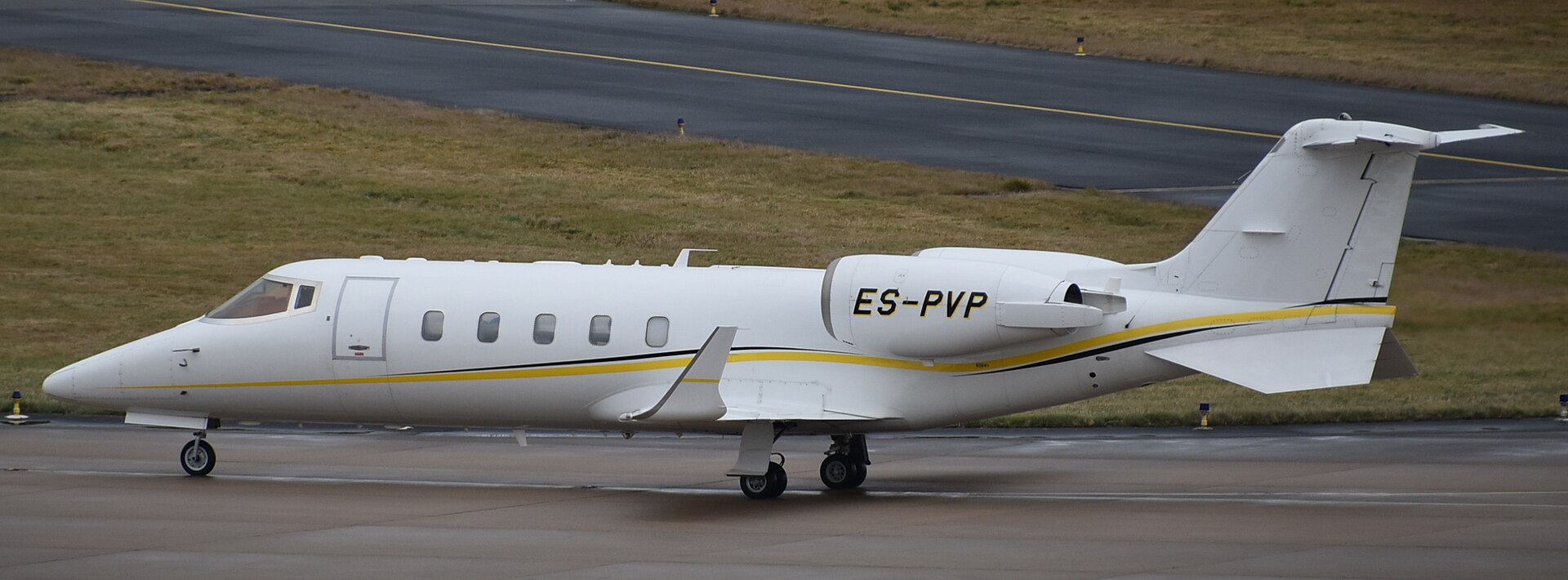
Learjet 60 ES-PVP at Birmingham Airport, UK, in January 2017. · Photo: Alec Wilson, Wikimedia Commons (via Flickr), CC BY-SA 2.0
Learjet · Midsize Jet
Learjet 60
The middle generation of Learjet's 55/60 family: a stretched, re-engined Learjet 55C, later updated as the 60XR.
The sports car of older midsize jets: about 2,190 nm with four passengers and 41,000 ft in 18 minutes. You pay for it with a short cabin, 48 cu ft of baggage and runways of 5,000 ft or more.
Buy it if
You usually fly two to four people on long trips, want coast-to-coast range and speed for around $2–3M, and your home airport has at least 5,000 ft of dry runway.
Skip it if
You often fill every seat with luggage, fly from runways under 5,000 ft, or want a modern cockpit and a roomier cabin without paying for upgrades.
Biggest compromise
Runways and cabin space. At maximum weight it needs about 5,450 ft to take off at sea level, roughly 1,900 ft more than a Citation Excel, and about 8,520 ft at a hot 5,000 ft airport.
The numbers that matter
Purchase price
$2.8M
typical asking · $1.46M–$3M
What it costs per year
$1.95M
at 300 hrs · two professional pilots
How far it flies
2,390 nm
How fast
465 kt
high-speed cruise
Seats
7
7 typical, 8 certified
Pilots needed
2
Certified for two pilots on every flight.
Price
What one costs to buy
Typical asking price
$2,800,000
Where asking prices sit
Low
$1.46M
Typical
$2.8M
High
$3M
Most asking prices fall inside this band.
Other sites
11.5% of the fleet
Priced vs call
with a price / call for price
Only 5 of 27 listed aircraft show prices, mostly 2006 models; the $1.46M ask may be outdated. 2024 guide values ran about $1.15–2.7M.
Price vs its family and alternatives
Scroll to explore · select a jet for details
Learjet 60 · This aircraft
$2.8M
Sits between the Hawker 800XP and the Learjet 60XR.
For sale now
None listed right now
Cost to own
What it costs per year to run
300hours / year
Per year
Per flight hour
Estimate — your operator will quote actual numbers.
Jet fuel, airframe maintenance, scheduled and unscheduled, engine pay-per-hour program, both engines and landing fees, handling, crew travel, catering rise as you fly more. Two professional pilots, annual recurrent simulator training, home-base hangar, hull and liability insurance, professional management and charts, databases, weather and tracking stay the same however much you fly.
Where the money goes
- Two professional pilots$325,64017%
- Annual recurrent simulator training$33,0002%
- Home-base hangar$46,6502%
- Hull and liability insurance$29,4722%
- Professional management$60,0003%
- Charts, databases, weather and tracking$50,0003%
- Jet fuel$576,84030%
- Airframe maintenance, scheduled and unscheduled$345,00018%
- Engine pay-per-hour program, both engines$280,50014%
- Landing fees, handling, crew travel, catering$202,50010%
Jet fuel is the biggest single cost at 30% of the total.
The JetGrade
65 out of 100 — Below its class average
Peer group: Hawker 800XP, Cessna Citation Excel, Cessna Citation VII, Gulfstream G100
Seven categories at a glance
- - - 70 = typical— This aircraft
Strongest on speed & trip time, weakest on airport access.
Grades are editorial opinions about the model, not any specific aircraft. Sponsors and affiliates have no input. Reviewed 2026-10-28.
Where it flies
Sample trips and reach
Typical trips on a map
Nonstop
Depends on weight or weather
Fuel stop likely
Out of reach
4 of 8 sample trips are comfortable nonstops.
Sample flight times
- 0.9 hr
Carlsbad → Las Vegas
205 nm · Short Carlsbad runway; fine at light weights
- 1.9 hr
Carlsbad → Aspen
625 nm · Short Carlsbad runway and Aspen terrain limit weight
- 2.2 hr
Santa Ana → San José del Cabo
765 nm · Comfortable nonstop with four passengers
- 2.5 hr
Teterboro → West Palm Beach
900 nm · Easy nonstop; a common Learjet mission
- 3.2 hr
Dallas → Teterboro
1,190 nm · Comfortable nonstop with room to spare
- 3.7 hr
Teterboro → San Juan
1,410 nm · Over water but well within range
- 5.8 hr
Carlsbad → Teterboro
2,100 nm · Carlsbad's runway limits fuel; one stop typical
Los Angeles → Honolulu
2,215 nm · Beyond safe range with passengers; no stop possible
Lineage
What came before and after

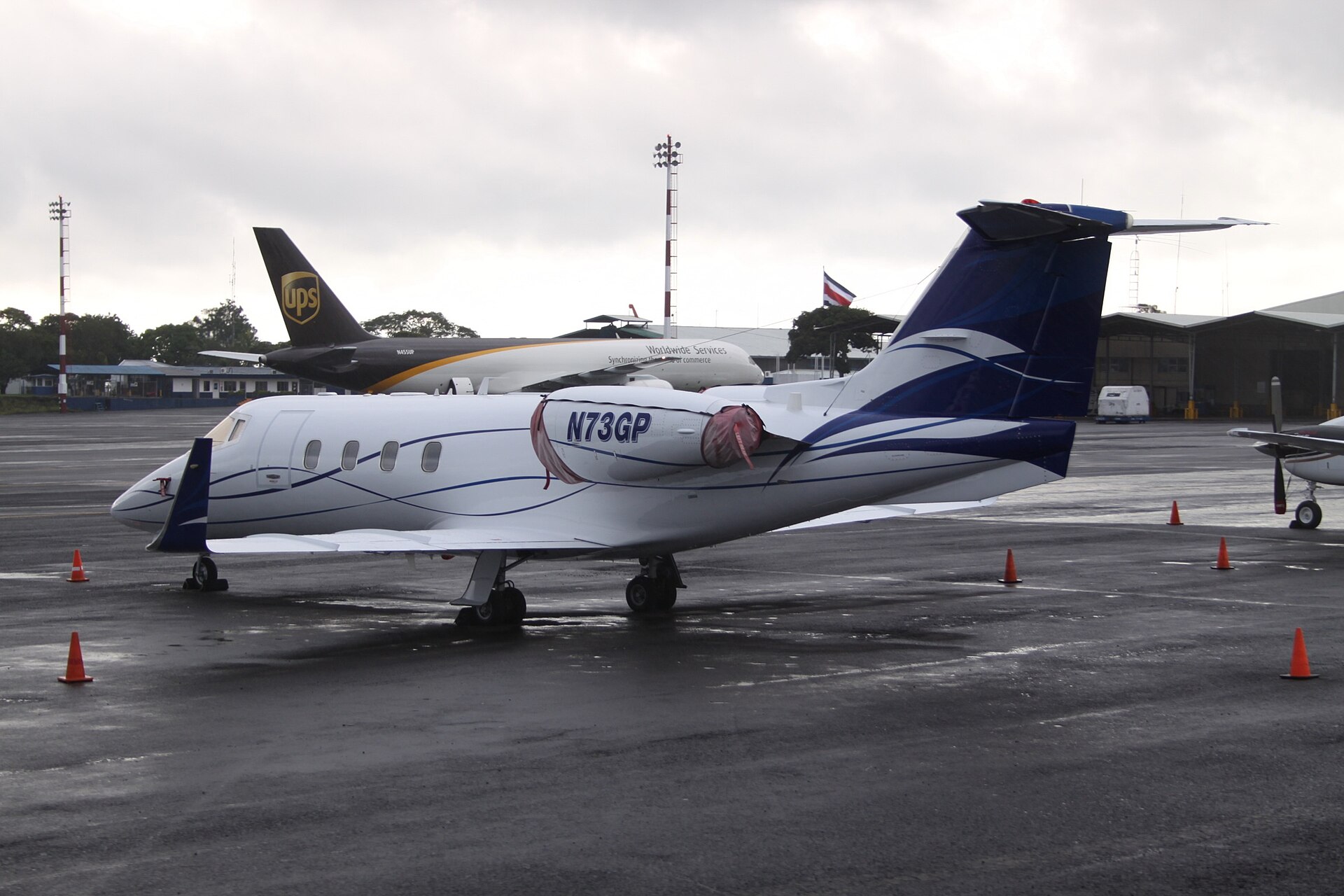


1993–2007
Learjet 60
Stretched cabin, Pratt & Whitney engines, reworked wing; 60SE from 2004.

What changed from the Learjet 55C
- Pratt & Whitney Canada PW305A engines of 4,600 lb thrust replace 3,700 lb Garrett TFE731s.
- Fuselage stretched 43 inches for a longer cabin and a larger fuselage fuel tank.
- New inboard wing cuff, wing-to-body fairing and reshaped winglets cut drag about 4%.
- Maximum range grows by about 350 nm to nearly 2,400 nm.
- Maximum takeoff weight rises to 23,500 lb with an option, from 21,500 lb.
- A four-screen Collins Pro Line 4 cockpit becomes standard.
Size and cabin
How big it is, inside and out
Outside
Silhouette · scaled to length
Length
Wingspan
Height
Inside the cabin
Cabin length
Width
Height
Compare
How it stacks up
This aircraft
Learjet 60
- JetGrade
- 65
- Price
- $2.8M
- Cost per year
- $1.95M
- Range
- 2,390 nm
- Speed
- 465 kt
- Seats
- 7
- Cabin length
- 17′ 8″
- Pilots
- 2
- Years built
- 1993–2007
← Before
- JetGrade
- 63
- Price
- $855K–$950K guide
- Cost per year
- $1.6M
- Range
- 2,040 nm
- Speed
- 447 kt
- Seats
- 7
- Cabin length
- 16′ 8″
- Pilots
- 2
- Years built
- 1988–1990
After →
- JetGrade
- 65
- Price
- $4M
- Cost per year
- $1.68M
- Range
- 2,405 nm
- Speed
- 466 kt
- Seats
- 7
- Cabin length
- 17′ 8″
- Pilots
- 2
- Years built
- 2007–2013
Alternative
- JetGrade
- Not yet graded
- Range
- 1,800 nm
- Speed
- 430 kt
- Seats
- 7
- Years built
- 1998–2004
Alternative
- JetGrade
- 72
- Price
- $2.17M
- Cost per year
- $1.83M
- Range
- 2,540 nm
- Speed
- 448 kt
- Seats
- 8
- Cabin length
- 21′ 4″
- Pilots
- 2
- Years built
- 1995–2005
- Learjet 60XR instead: Same airframe and engines with a Pro Line 21 cockpit and refreshed cabin; 2024 guide values ran about $3.4–5M.
- Cessna Citation Excel instead: Takes off in about 3,590 ft and carries 90 cu ft of bags, but flies about 530 nm less with four passengers.
- Hawker 800XP instead: A roomier cabin of about 600 cu ft against 447 cu ft, for buyers who put cabin space first.
Gold marks the best figure in each row.
Owning one
What to know before you buy
Engines & inspections
2 × Pratt & Whitney Canada PW305A · 4,600 lbf each
Engine hours until overhaul
- Phase A inspection · 300 hr
- Phase B inspection · 600 hr
- Engine overhaul · 5,000 hr
- Phase C inspection every 48 months
- 96-month inspection every 96 months
- 12-year inspection every 144 months
Many listed aircraft have engines on Pratt & Whitney Canada's ESP plan or JSSI, about $425–510 per engine hour. Overhaul intervals are often extended to 7,200–7,700 hours.
Known issues
Costly 12-year inspection
The basic 12-year check runs about $250,000 and six weeks or more; corrosion can force a wing removal and far higher bills.
Tire pressure is safety-critical
Tires must be checked within 96 hours before flight; badly underinflated tires caused a fatal 2008 takeoff accident.
Fast-wearing tires and brakes
Main tires last 150–200 landings at about $12,000 a change; brake overhauls cost about $66,500.
Pre-buy checklist
0 of 10 checked
Bombardier ended Learjet production in 2022 but still supports the fleet through its service centers, and Pratt & Whitney Canada supports the engines worldwide. Some airframe parts can take time to source during major inspections.
Review
The full review
Strengths
- Climbs to 41,000 ft in about 18 minutes and cruises near 436 kt, quicker than a Citation Excel.
- About 2,190 nm with four passengers and standard fuel reserves can cross the US nonstop in still air.
- 2024 guide values of about $1.15–2.7M buy coast-to-coast range and a 465 kt top speed.
Limitations
- Needs about 5,450 ft of runway at maximum weight, and about 8,520 ft at a hot 5,000 ft airport.
- Its 17 ft 8 in cabin and 48 cu ft of bags trail the Excel's 18 ft 6 in, 90 cu ft.
- A basic 12-year inspection costs about $250,000, and corrosion found there can add a wing removal.
The Learjet 60 is the stretched, re-engined successor to the Learjet 55, built in Wichita, Kansas, from 1993 to 2007. Learjet added 43 inches to the fuselage, fitted Pratt & Whitney Canada PW305A engines of 4,600 lb thrust each, and reshaped the wing roots and winglets. About 318 were built, including the 60SE of 2004 to 2007, which made the auxiliary power unit (a small onboard engine for ground power and air conditioning), collision-avoidance and terrain-warning systems standard. The 60XR that followed in 2007 kept the airframe and added a newer Collins Pro Line 21 cockpit.
Pilot's take
From the cockpit the Learjet 60 feels like a sports car: strong acceleration, a steep climb and crisp handling, with gentle stall behavior thanks to its large fins under the tail. The price of that performance is attention to detail. Takeoff and landing speeds are high, the brakes and tires are small, and runway planning matters on every departure. Crews also watch the balance, because the nose gets heavier as the aft tank burns off. Flown by a well-trained, current crew from adequate runways, it rewards owners with quick trips and fuel burn that drops to about 1,200 lb an hour on long legs.
Who this is for
Owners and charter operators who value speed and climb over cabin size: typically two to four passengers on 1,000–2,000 nm trips from longer runways, with about $2M a year to run it with two pilots.

Ask about this aircraft
Answers come only from our research file on the Learjet 60.
Your earlier questionsOwners
Private to verified ownersOwn a Learjet Learjet 60? Verify with its FAA registration to join the owners' thread and the real-cost poll.