
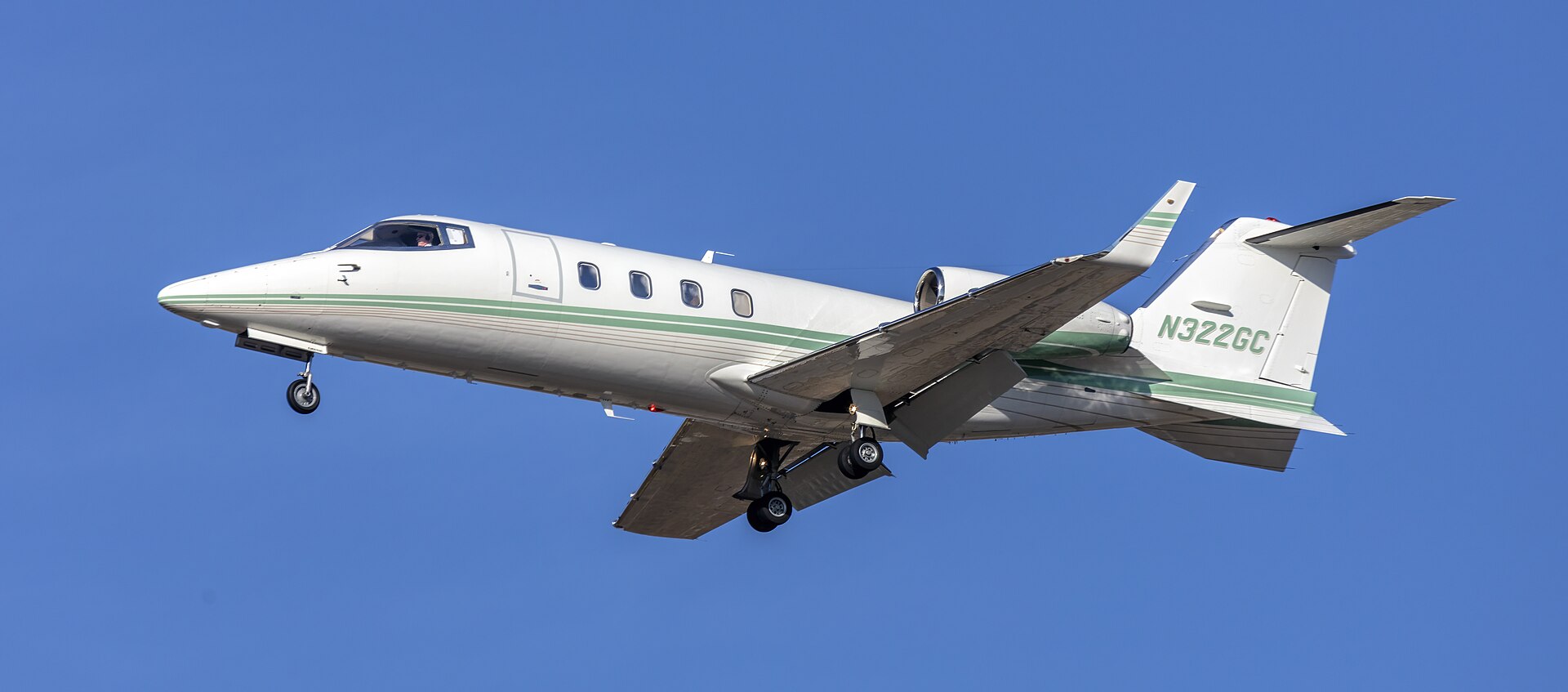
Learjet 55C N322GC on approach to Baltimore-Washington International, November 2021. · Photo: Acroterion, CC BY-SA 4.0 (creativecommons.org/licenses/by-sa/4.0), via Wikimedia Commons
Learjet · Midsize Jet
Learjet 55C
The third and final version of the Learjet 55, after the original 55 and the 55B.
The 55C is the most refined Learjet 55: delta fins tame the stall and trim field speeds, and the cabin is quiet. It still needs long runways and costs about $1.6M a year at 300 hours.
Buy it if
You want a stand-up cabin, Learjet climb and cruise above 45,000 ft for up to seven passengers at a sub-$1M purchase price, fly from long runways, and will keep both engines on an hourly program.
Skip it if
You need short or hot-and-high runways, want seats-full coast-to-coast range, expect a large parts and service network, or need an easy resale market with more than a handful of buyers.
Biggest compromise
The purchase price is small but the airplane is not. 6M a year at 300 hours, almost twice the airplane's value, and with only about a dozen 55Cs in the US, buyers and specialist shops are few.
The numbers that matter
Purchase price
$855K–$950K
guide value (PlanePhD (April 2026) and Aircraft Cost Calculator)
What it costs per year
$1.6M
at 300 hrs · two professional pilots
How far it flies
2,040 nm
1,845–1,900 nm with passengers
How fast
447 kt
high-speed cruise
Seats
7
7 typical (7–8 by interior)
Pilots needed
2
Certified for two pilots only; there is no single-pilot option.
Price
What one costs to buy
Guide value
$855K–$950K
Other sites
Priced vs call
with a price / call for price
Neither advertised 55C shows a price. Published guides value a typical 55C at about $855,000 to $950,000; older base Learjet 55s ask $195,000 to $875,000.
Price vs its family and alternatives
Scroll to explore · select a jet for details
Learjet 55C · This aircraft
$855K–$950K guide
Guide value, not a listed asking price.
Sits between the Learjet 55B and the Hawker 800XP.
For sale now
None listed right now
Cost to own
What it costs per year to run
300hours / year
Per year
Per flight hour
Estimate — your operator will quote actual numbers.
Fuel, airframe maintenance, engine program and crew travel, catering and fees rise as you fly more. Two pilots (salaries and benefits), recurrent simulator training, hangar, insurance and databases, charts and other fixed stay the same however much you fly.
Where the money goes
- Two pilots (salaries and benefits)$370,19823%
- Recurrent simulator training$23,8151%
- Hangar$28,0822%
- Insurance$29,0002%
- Databases, charts and other fixed$14,0001%
- Fuel$530,33733%
- Airframe maintenance$345,60022%
- Engine program$186,00012%
- Crew travel, catering and fees$69,6004%
Fuel is the biggest single cost at 33% of the total.
The JetGrade
63 out of 100 — Below its class average
Peer group: Cessna Citation III, Cessna Citation VI, Hawker 800, BAe 125-700 (Hawker 700), Learjet 60
Seven categories at a glance
- - - 70 = typical— This aircraft
Strongest on speed & trip time, weakest on reliability & support.
Grades are editorial opinions about the model, not any specific aircraft. Sponsors and affiliates have no input. Reviewed 2026-10-28.
Where it flies
Sample trips and reach
Typical trips on a map
Nonstop
Depends on weight or weather
Fuel stop likely
Out of reach
5 of 8 sample trips are comfortable nonstops.
Sample flight times
- 0.9 hr
Carlsbad → Las Vegas
205 nm · Short hop well within range
- 1.9 hr
Carlsbad → Aspen
625 nm · Hot-and-high Aspen departures limit weight
- 2.2 hr
Santa Ana → San José del Cabo
765 nm · Plan weight for John Wayne's short runway
- 2.5 hr
Teterboro → West Palm Beach
900 nm · Comfortable nonstop
- 3.2 hr
Dallas → Teterboro
1,190 nm · Comfortable nonstop
- 3.7 hr
Teterboro → San Juan
1,410 nm · Nonstop in normal winds
- 5.7 hr
Carlsbad → Teterboro
2,100 nm · Usually one stop, typically mid-continent
Los Angeles → Honolulu
2,215 nm · Beyond range; no en-route fuel stop
Lineage
What came before and after
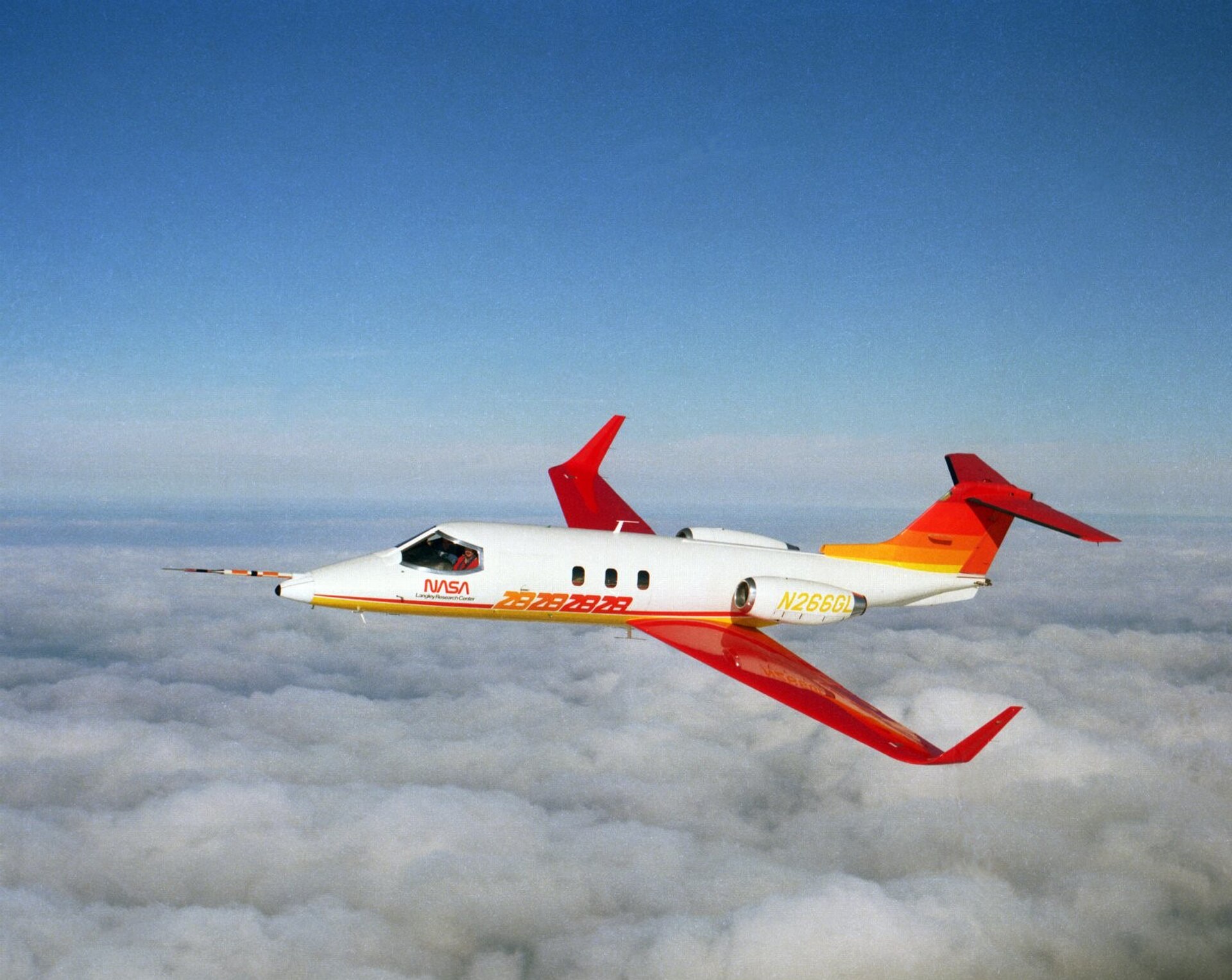

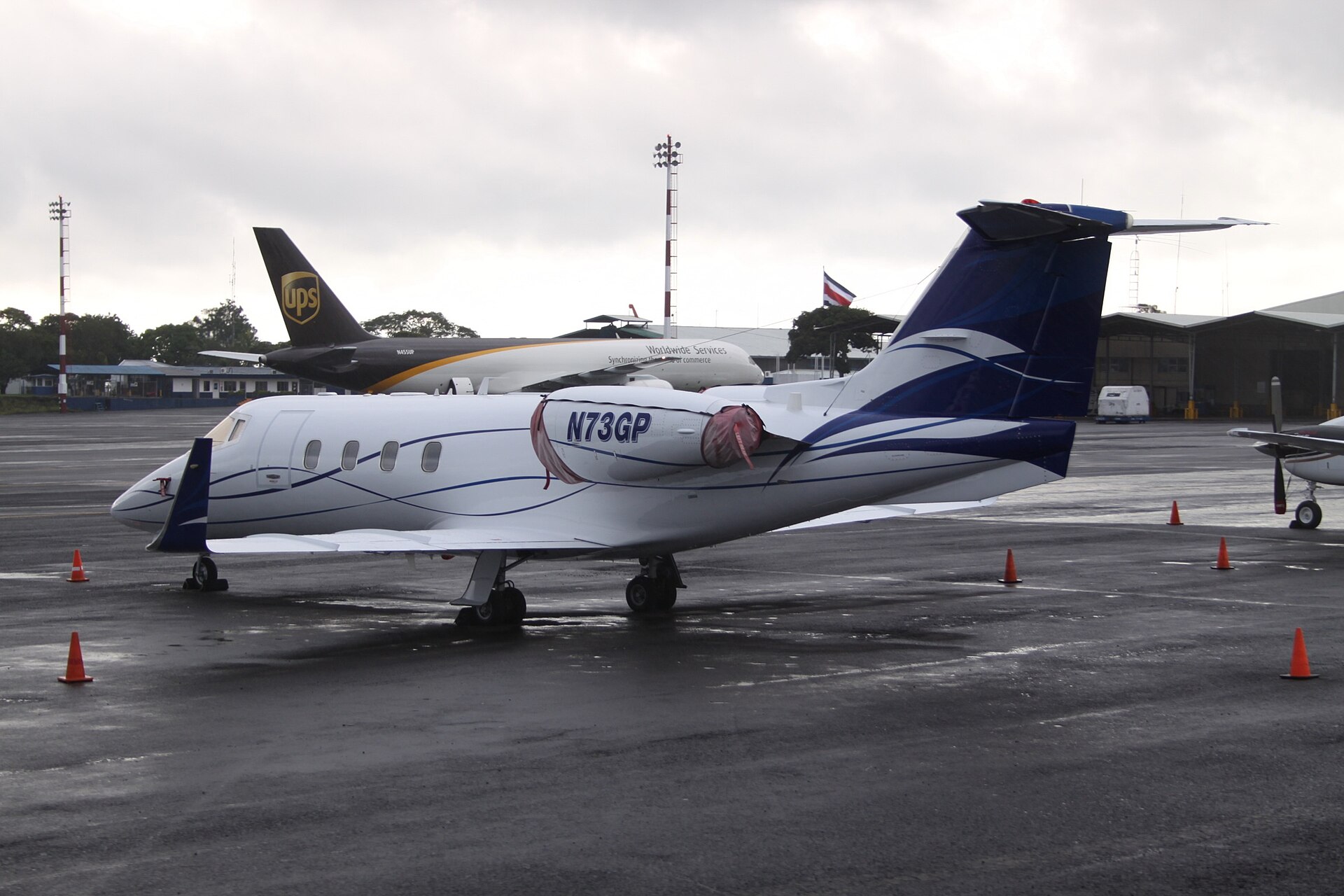

1988–1990
Learjet 55C
Delta fins under the tail, no stick pusher, optional extra fuel.


What changed from the Learjet 55B
- Two delta fins added under the rear fuselage for better stability at low speed.
- Softer stall let Learjet delete the stick pusher, a device that pushes the nose down.
- Lower takeoff and landing speeds than earlier Learjet 55s.
- Optional ER and LR fuel; the LR tail-cone tank adds 259 lb of fuel.
- Keeps the Collins five-screen electronic flight instruments introduced on the 55B.
Size and cabin
How big it is, inside and out
Outside
Silhouette · scaled to length
Length
Wingspan
Height
Inside the cabin
Cabin length
Width
Height
Compare
How it stacks up
This aircraft
Learjet 55C
- JetGrade
- 63
- Price
- $855K–$950K guide
- Cost per year
- $1.6M
- Range
- 2,040 nm
- Speed
- 447 kt
- Seats
- 7
- Cabin length
- 16′ 8″
- Pilots
- 2
- Years built
- 1988–1990
← Before
- JetGrade
- 62
- Price
- $567K–$930K guide
- Cost per year
- $1.66M
- Range
- 2,040 nm
- Speed
- 458 kt
- Seats
- 7
- Cabin length
- 13′ 9″
- Pilots
- 2
- Years built
- 1986–1987
After →
- JetGrade
- 65
- Price
- $2.8M
- Cost per year
- $1.95M
- Range
- 2,390 nm
- Speed
- 465 kt
- Seats
- 7
- Cabin length
- 17′ 8″
- Pilots
- 2
- Years built
- 1993–2007
Alternative
- JetGrade
- Not yet graded
- Range
- 1,900 nm
- Speed
- 450 kt
- Seats
- 8
- Years built
- 1983–1992
Alternative
- JetGrade
- 72
- Price
- $2.17M
- Cost per year
- $1.83M
- Range
- 2,540 nm
- Speed
- 448 kt
- Seats
- 8
- Cabin length
- 21′ 4″
- Pilots
- 2
- Years built
- 1995–2005
- Learjet 60 instead: The same family a decade later: about 6 ft of cabin height, Pratt & Whitney engines and roughly 2,200 nm of range, at a higher purchase price.
- Cessna Citation III instead: Similar purchase price and annual budget, slightly shorter runway needs and a fleet of about 200, so parts, shops and buyers are easier to find.
- Hawker 800XP instead: A six-foot cabin and about 2,500 nm of range, so it handles the seats-full coast-to-coast trips the 55C cannot.
Gold marks the best figure in each row.
Owning one
What to know before you buy
Engines & inspections
2 × Honeywell (Garrett) TFE731-3A / -3AR series · 3,700 lbf each
Engine hours until overhaul
- Phase A inspection · 300 hr
- Phase B inspection · 600 hr
- Phase C inspection · 1,200 hr
- Engine hot-section inspection (MPI) · 2,100 hr
- Phase D inspection · 2,400 hr
- Engine core-zone inspection (CZI) · 4,200 hr
- 12-year airframe inspection every 144 months
Nearly every recent 55C listing shows both engines on Honeywell's MSP Gold hourly program; engines off program carry the full inspection bill.
Known issues
Engine events off program
A core-zone inspection on an engine without an hourly program can cost a large share of the airplane's value.
12-year inspection timing
The 12-year airframe inspection is a major event; an aircraft near it is worth noticeably less.
Long runway needs
About 5,700 ft of runway at maximum weight and high approach speeds leave little margin on wet or short runways.
Pre-buy checklist
0 of 10 checked
Bombardier still holds the type certificate, but classic-Learjet expertise sits with specialist shops such as West Star and Duncan Aviation, and SIMCOM runs Learjet 55 pilot training.
Review
The full review
Strengths
- Stand-up center aisle in a 16 ft 8 in cabin, with an enclosed aft lavatory and baggage reachable in flight.
- Climbs at more than 4,000 ft per minute and cruises near 447 kt up to 51,000 ft, above most weather.
- Delta fins soften the stall and remove the stick pusher, giving the best low-speed manners of any Learjet 55.
Limitations
- Needs about 5,700 ft of runway at maximum weight; hot, high or short fields are the wrong job.
- Seats-full range of about 1,850 nm means a fuel stop on most coast-to-coast trips.
- Only about a dozen are US-registered, so listings are rare, prices are private and resale is slow.
The Learjet 55C is the last and most refined version of the Learjet 55, the first Learjet with a cabin you can stand up in. Gates Learjet delivered the original 55 from 1981 and added a digital cockpit with the 55B in 1986, and the renamed Learjet Corporation built the 55C from 1988 until the line closed in 1990, after 147 Learjet 55s of all versions. Only a small share were 55Cs, and about a dozen remain on the US registry. The stretched, re-engined Learjet 60 replaced it.
Pilot's take
The 55C flies like a Learjet with better manners. The delta fins make it steadier at low speed and remove the stick pusher, so stalls and approaches are less demanding than in earlier 55s. It still wants speed on final and plenty of concrete, so wet or short runways need careful planning. Once airborne it climbs quickly into the mid-40s, where it is efficient and above most traffic. Expect a two-pilot cockpit with 1980s Collins systems, often updated with a modern FMS, and budget for a type rating and annual simulator training.
Who this is for
Charter, freight and air-ambulance operators, and owners who want a fast stand-up cabin for mostly 500- to 1,500-nm trips from long runways, supported by a shop that already knows classic Learjets.

Ask about this aircraft
Answers come only from our research file on the Learjet 55C.
Your earlier questionsOwners
Private to verified ownersOwn a Learjet Learjet 55C? Verify with its FAA registration to join the owners' thread and the real-cost poll.