
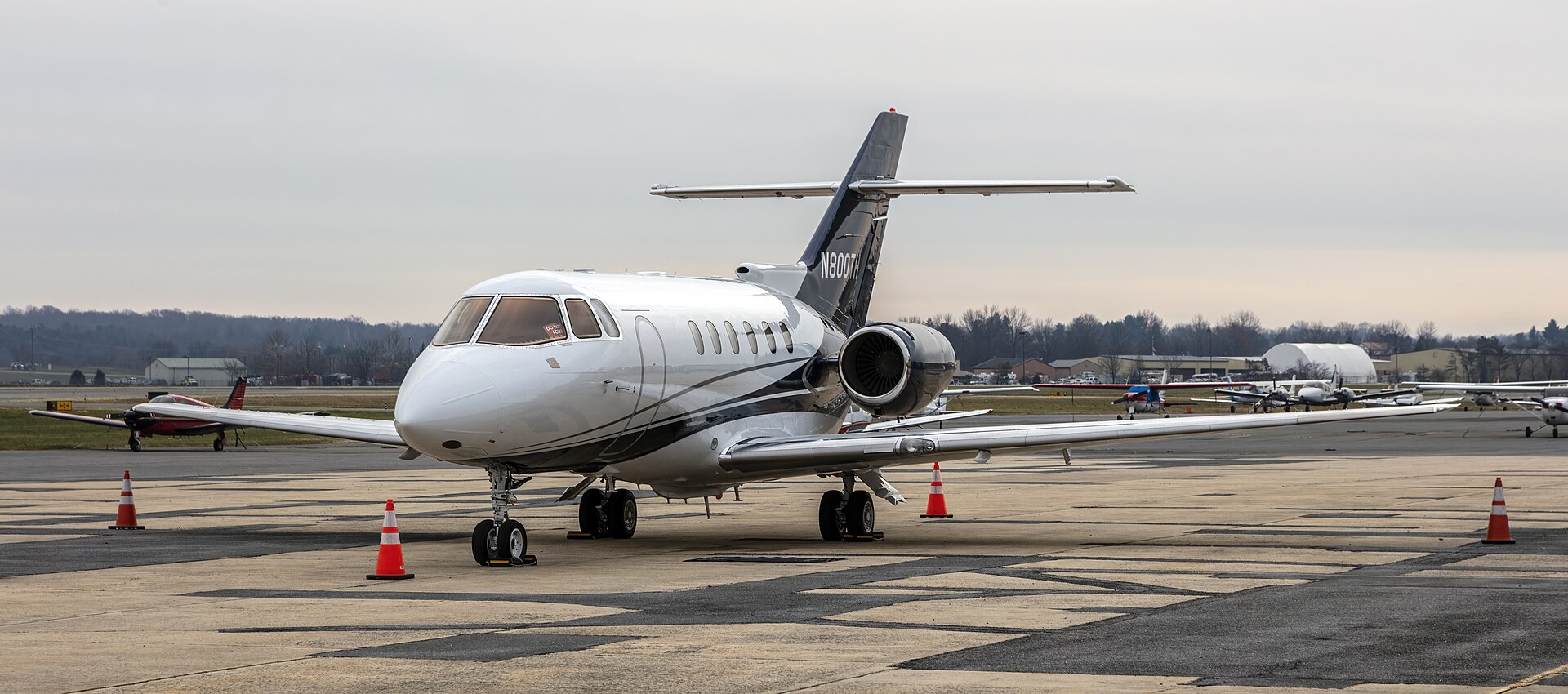
A 2004 Hawker 800XP with Pro Line 21 avionics at Frederick, Maryland, in December 2021. · Photo: Acroterion, Wikimedia Commons, CC BY-SA 4.0
Raytheon · Midsize Jet
Hawker 800XP
The third fan-engined Hawker 125 and the best-selling version, between the Hawker 800 and the 800XPi.
The 800XP gives you one of the roomiest cabins and longest ranges available for about $2 million, backed by a huge support network. It is thirsty and slow to climb, and engine program status and corrosion history decide whether an example is a bargain.
Buy it if
You want a true eight-seat cabin with a private washroom, regularly fly 1,000–2,000 nm trips with four to six people, and value a deep market with plenty of shops that know the airplane.
Skip it if
You often use short or high-altitude runways, want a quick climb above weather, need luggage room for eight, or cannot absorb a six-figure surprise from engines, corrosion or the 48-month inspection.
Biggest compromise
You trade efficiency for space. The 800XP burns about 290 gallons an hour and needs roughly 5,000 ft of runway at sea level, far more on hot days at altitude.
The numbers that matter
Purchase price
$2.17M
typical asking · $1.75M–$3M
What it costs per year
$1.83M
at 300 hrs · two professional pilots
How far it flies
2,540 nm
2,428–2,505 nm with passengers
How fast
448 kt
high-speed cruise
Seats
8
8 typical (8–9 by interior)
Pilots needed
2
Always flown by two pilots; the type certificate requires two on every flight.
Price
What one costs to buy
Typical asking price
$2,172,500
Where asking prices sit
Low
$1.75M
Typical
$2.17M
High
$3M
Most asking prices fall inside this band.
Other sites
Priced vs call
with a price / call for price
12 of 36 listed aircraft show prices, from $1.75M to $3.0M. Later Pro Line 21 aircraft ask more; a broker guide puts typical values near $1.8–2.2M.
Price vs its family and alternatives
Scroll to explore · select a jet for details
Hawker 800XP · This aircraft
$2.17M
Sits between the Citation XLS and the Learjet 60.
For sale now
None listed right now
Cost to own
What it costs per year to run
300hours / year
Per year
Per flight hour
Estimate — your operator will quote actual numbers.
Fuel, airframe maintenance, scheduled and unscheduled, engine program (honeywell msp or similar) and apu program rise as you fly more. Two professional pilots, recurrent simulator training, hangar, insurance and subscriptions and databases stay the same however much you fly.
Where the money goes
- Two professional pilots$327,69618%
- Recurrent simulator training$38,4872%
- Hangar$37,8102%
- Insurance$27,8942%
- Subscriptions and databases$32,0212%
- Fuel$727,32040%
- Airframe maintenance, scheduled and unscheduled$315,00017%
- Engine program (Honeywell MSP or similar)$294,00016%
- APU program$26,5921%
Fuel is the biggest single cost at 40% of the total.
The JetGrade
72 out of 100 — Slightly above its class
Peer group: Cessna Citation Excel (560XL), Cessna Citation VII (650), Learjet 60, IAI Astra SPX
Seven categories at a glance
- - - 70 = typical— This aircraft
Strongest on range & payload, weakest on airport access.
Grades are editorial opinions about the model, not any specific aircraft. Sponsors and affiliates have no input. Reviewed 2026-10-28.
Where it flies
Sample trips and reach
Typical trips on a map
Nonstop
Depends on weight or weather
5 of 8 sample trips are comfortable nonstops.
Sample flight times
- 0.9 hr
Carlsbad → Las Vegas
205 nm · Short hop; Carlsbad's short runway limits takeoff weight
- 1.8 hr
Carlsbad → Aspen
625 nm · Mountain airport; weather, weight and season apply
- 2.2 hr
Santa Ana → San José del Cabo
765 nm · Easy nonstop with four passengers
- 2.5 hr
Teterboro → West Palm Beach
900 nm · Easy nonstop with four passengers
- 3.1 hr
Dallas → Teterboro
1,190 nm · Comfortable nonstop with four passengers
- 3.8 hr
Teterboro → San Juan
1,410 nm · Comfortable nonstop with four passengers
- 5.4 hr
Carlsbad → Teterboro
2,100 nm · Nonstop eastbound; Carlsbad's runway and headwinds can force a stop
- 5.9 hr
Los Angeles → Honolulu
2,215 nm · Possible with light loads; headwinds often force reduced passengers
Lineage
What came before and after


1995–2005
Hawker 800XP
Stronger engines, standard thrust reversers, higher weights


What changed from the Hawker 800 (BAe 125-800)
- TFE731-5BR engines add about 360 lb of thrust per side over the Hawker 800.
- Maximum takeoff weight rose from 27,400 to 28,000 lb; zero-fuel weight to 18,450 lb.
- Thrust reversers became standard, shortening landings and saving brakes.
- Vortilons replaced wing fences and aileron gearing came from the Hawker 1000.
- Mach trim, upgraded air conditioning and a larger anti-ice fluid tank became standard.
- From 2002 the Collins Pro Line 21 cockpit replaced the Honeywell SPZ-8000.
Size and cabin
How big it is, inside and out
Outside
Silhouette · scaled to length
Length
Wingspan
Height
Inside the cabin
Cabin length
Width
Height
Compare
How it stacks up
This aircraft
Hawker 800XP
- JetGrade
- 72
- Price
- $2.17M
- Cost per year
- $1.83M
- Range
- 2,540 nm
- Speed
- 448 kt
- Seats
- 8
- Cabin length
- 21′ 4″
- Pilots
- 2
- Years built
- 1995–2005
← Before
- JetGrade
- 74
- Price
- $1.27M
- Cost per year
- $1.65M
- Range
- 2,555 nm
- Speed
- 442 kt
- Seats
- 8
- Cabin length
- 21′ 4″
- Pilots
- 2
- Years built
- 1984–1995
After →
- JetGrade
- 71
- Price
- $3M–$3M guide
- Cost per year
- $2.15M
- Range
- 2,555 nm
- Speed
- 447 kt
- Seats
- 8
- Cabin length
- 21′ 4″
- Pilots
- 2
- Years built
- 2005–2007
Alternative
- JetGrade
- 72
- Price
- $4.63M
- Cost per year
- $1.78M
- Range
- 2,856 nm
- Speed
- 446 kt
- Seats
- 8
- Cabin length
- 21′ 4″
- Pilots
- 2
- Years built
- 2008–2012
Alternative
- JetGrade
- Not yet graded
- Price
- $1.7M
- Range
- 1,850 nm
- Speed
- 430 kt
- Seats
- 7
- Years built
- 2004–2008
Alternative
- JetGrade
- 65
- Price
- $2.8M
- Cost per year
- $1.95M
- Range
- 2,390 nm
- Speed
- 465 kt
- Seats
- 7
- Cabin length
- 17′ 8″
- Pilots
- 2
- Years built
- 1993–2007
- Hawker 900XP instead: Same cabin with stronger engines, winglets and Pro Line 21, giving better hot-day performance and more range for a higher price.
- Cessna Citation XLS instead: Smaller cabin and shorter range, but it uses much shorter runways and costs less per hour to run.
- Learjet 60 instead: Faster and quicker to climb, but a shorter cabin and a smaller washroom.
Gold marks the best figure in each row.
Owning one
What to know before you buy
Engines & inspections
2 × Honeywell TFE731-5BR · 4,750 lbf each
Engine hours until overhaul
- A inspection · 400 hr
- Engine mid-life inspection · 2,100 hr
- D inspection · 3,200 hr
- Engine core zone inspection · 4,200 hr
- E annual inspection every 12 months
- 48-month G inspection every 48 months
- 96-month X-ray structural inspection every 96 months
- Landing gear overhaul every 144 months
Most buyers want both engines on an hourly program; an off-program engine near its core inspection can cost $550,000–800,000 to overhaul.
Known issues
Engine program status
Each engine's core zone inspection costs $550,000–800,000 without a program; two can rival the value of the aircraft.
Wing leading-edge corrosion
Corrosion under the anti-ice panels is the classic 48-month finding; each leading-edge section overhaul costs $12,000–55,000.
Stall test after wing work
Leading-edge work requires a stall test flight; U.S. investigators issued urgent recommendations in January 2026 after fatal test flights.
Pre-buy checklist
0 of 10 checked
Textron Aviation holds the type certificate and supports the Hawker with parts and service centers, and many independent shops know the type well. Honeywell's TFE731 engines are supported worldwide.
Review
The full review
Strengths
- Roomy cabin, 21 ft 4 in long and 6 ft wide, with a forward galley and a full-width private washroom.
- About 2,500 nm with four passengers, enough for most eastbound coast-to-coast trips without a fuel stop.
- A fleet of about 363 aircraft and 51 sales in 2025 make it easy to buy, sell and service.
Limitations
- Thirsty: about 290 gallons an hour, so fuel alone costs roughly $727,000 a year at 300 hours.
- Needs about 5,000 ft of runway at sea level and much more at hot, high airports like Aspen.
- Only 48 cu ft of baggage space, all inside the cabin, which is tight for eight people.
The Hawker 800XP is the 1995–2005 version of the long-running Hawker 125 family, the British-designed business jet that Raytheon took over in 1993. It kept the Hawker 800's airframe but added stronger Honeywell TFE731-5BR engines, made thrust reversers standard and raised the maximum takeoff weight to 28,000 lb. It became the best-selling Hawker, with about 426 delivered before the 800XPi and the winglet-equipped 850XP replaced it. Most aircraft built before 2002 have a Honeywell SPZ-8000 cockpit; later ones have Collins Pro Line 21 displays.
Pilot's take
The 800XP is a stable, honest airplane with moderate control forces and good harmony, and its rudder bias system makes engine-out handling easy for a jet this size. What it lacks is sparkle: climbs to the high 30s take about 20 minutes, and on a hot day at a mountain airport the takeoff numbers grow quickly. Standard thrust reversers help on wet runways. We would plan on long runways, respect the weight-and-altitude charts, and choose the cockpit generation carefully, because a Pro Line 21 aircraft is much easier to keep current.
Who this is for
Owners and charter operators who want a genuine eight-seat cabin with a private washroom for about $2 million, fly mostly from longer runways, and will pay for engine programs and careful maintenance rather than chase the lowest price.

Ask about this aircraft
Answers come only from our research file on the Hawker 800XP.
Your earlier questionsOwners
Private to verified ownersOwn a Raytheon Hawker 800XP? Verify with its FAA registration to join the owners' thread and the real-cost poll.