
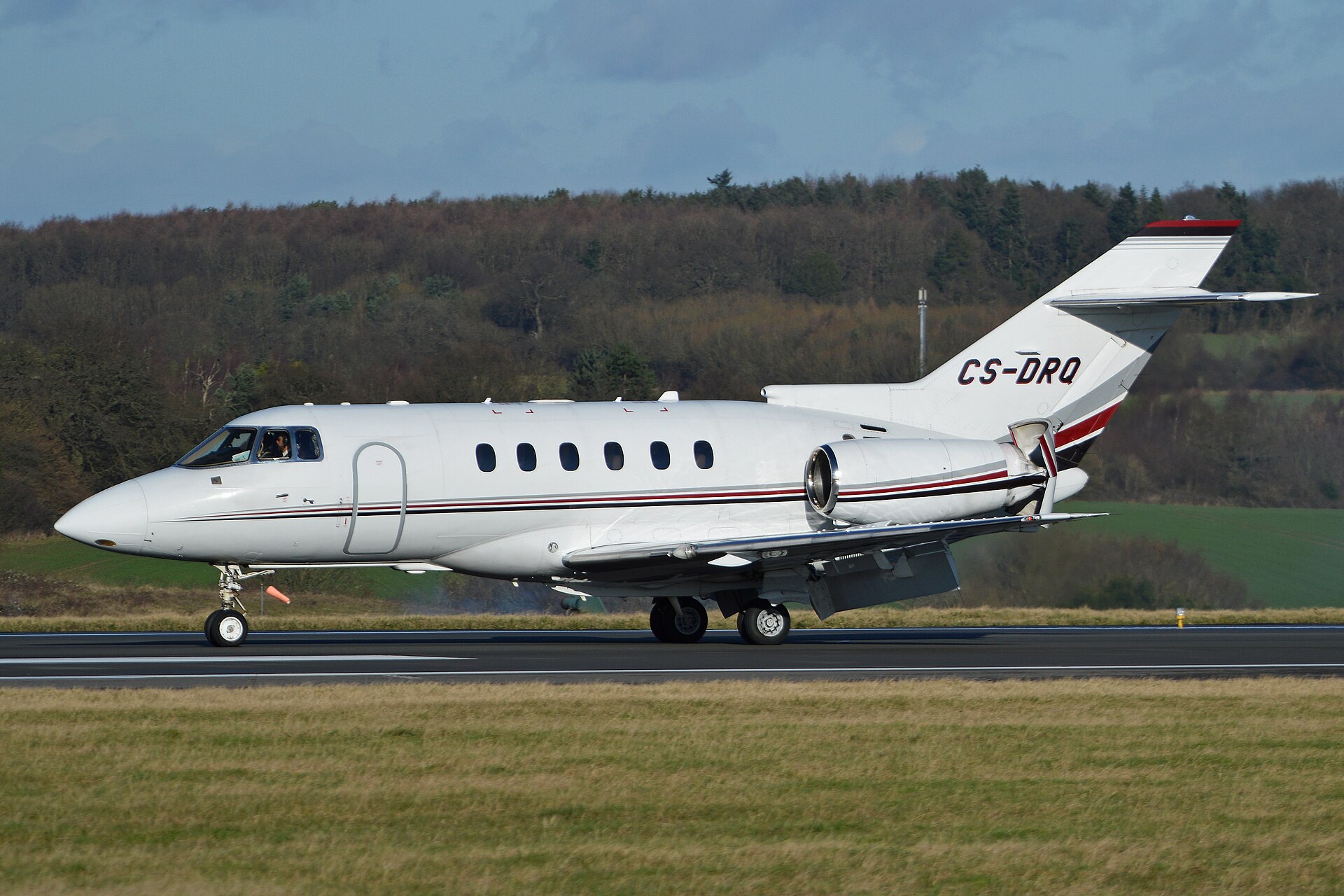
Hawker 800XPi CS-DRQ, a 2006 NetJets Europe aircraft, at London Luton in January 2014. · Photo: Alan Wilson, CC BY-SA 2.0, via Wikimedia Commons
Hawker · Midsize Jet
Hawker 800XPi
The final non-winglet version of the Hawker 800XP, built between the 800XP and the winglet-equipped 850XP.
The 800XPi is the last and best-equipped Hawker 800XP without winglets: a six-foot-wide cabin, coast-to-coast range and asking prices around $2.5 million. You pay for it in fuel, runway length and a demanding maintenance calendar.
Buy it if
You want the widest cabin you can buy for around $3 million or less, carry four to eight people up to about 2,000 nm, and have two professional pilots and an engine program lined up.
Skip it if
You fly from short or hot, high runways, carry lots of luggage, need a stand-up cabin, or want the lowest fuel bill in the class. A Citation XLS or Learjet 60XR may suit better.
Biggest compromise
Runway and fuel. At maximum weight it needs about 5,030 ft of runway at sea level and roughly 8,800 ft from a hot 5,000-ft airport, and it averages about 291 gallons an hour, nearly 30% more than a Citation Excel.
The numbers that matter
Purchase price
$3M–$3M
guide value (Aircraft Bluebook)
What it costs per year
$2.15M
at 300 hrs · two professional pilots
How far it flies
2,555 nm
2,440–2,540 nm with passengers
How fast
447 kt
high-speed cruise
Seats
8
8 typical (up to 9 by interior)
Pilots needed
2
Two pilots are required on every flight.
Price
What one costs to buy
Guide value
$3M–$3M
Other sites
11.8% of the fleet
Priced vs call
with a price / call for price
Only two of six listed 800XPis show a price ($2.45M and $2.6M); Aircraft Bluebook values a 2005 example at about $3.0M. Most sellers ask for offers.
Price vs its family and alternatives
Scroll to explore · select a jet for details
Hawker 800XPi · This aircraft
$3M–$3M guide
Guide value, not a listed asking price.
Sits between the Hawker 800XP and the Hawker 850XP.
For sale now
None listed right now
Cost to own
What it costs per year to run
300hours / year
Per year
Per flight hour
Estimate — your operator will quote actual numbers.
Fuel, airframe maintenance, engine program and crew travel, landing and handling rise as you fly more. Two pilots, recurrent training, hangar, insurance, management and databases, charts and other fixed stay the same however much you fly.
Where the money goes
- Two pilots$411,88119%
- Recurrent training$33,0002%
- Hangar$44,9752%
- Insurance$27,7251%
- Management$60,0003%
- Databases, charts and other fixed$50,0002%
- Fuel$681,81332%
- Airframe maintenance$411,00019%
- Engine program$270,30013%
- Crew travel, landing and handling$157,5007%
Fuel is the biggest single cost at 32% of the total.
The JetGrade
71 out of 100 — Slightly above its class
Peer group: Hawker 800XP, Cessna Citation XLS, Learjet 60XR, Gulfstream G150
Seven categories at a glance
- - - 70 = typical— This aircraft
Strongest on range & payload, weakest on running costs.
Grades are editorial opinions about the model, not any specific aircraft. Sponsors and affiliates have no input. Reviewed 2026-10-28.
Where it flies
Sample trips and reach
Typical trips on a map
Nonstop
Depends on weight or weather
5 of 8 sample trips are comfortable nonstops.
Sample flight times
- 0.9 hr
Carlsbad → Las Vegas
205 nm
- 1.9 hr
Carlsbad → Aspen
625 nm · Hot-and-high Aspen; depends on weight and weather
- 2.3 hr
Santa Ana → San José del Cabo
765 nm
- 2.6 hr
Teterboro → West Palm Beach
900 nm
- 3.4 hr
Dallas → Teterboro
1,190 nm
- 3.9 hr
Teterboro → San Juan
1,410 nm
- 5.8 hr
Carlsbad → Teterboro
2,100 nm · Carlsbad's 4,897-ft runway can limit fuel on hot days
- 6.0 hr
Los Angeles → Honolulu
2,215 nm · Four passengers only; strong headwinds can force a stop
Lineage
What came before and after


2005–2007
Hawker 800XPi
Electronic charts, new interior and larger aft baggage.

What changed from the Hawker 800XP
- Collins IFIS electronic charts and airport maps became standard on the Pro Line 21 cockpit.
- Upgraded Pro Line 21 radios, ready for future digital air traffic communications.
- Redesigned interior with Collins Airshow 21 and touch screens at every seat.
- Larger, easier-to-use aft baggage compartment.
- Options for graphical cockpit weather, a paperless cockpit and 3-D map displays.
- Same engines, wing, weights and range as the 800XP it replaced.
Size and cabin
How big it is, inside and out
Outside
Silhouette · scaled to length
Length
Wingspan
Height
Inside the cabin
Cabin length
Width
Height
Compare
How it stacks up
This aircraft
Hawker 800XPi
- JetGrade
- 71
- Price
- $3M–$3M guide
- Cost per year
- $2.15M
- Range
- 2,555 nm
- Speed
- 447 kt
- Seats
- 8
- Cabin length
- 21′ 4″
- Pilots
- 2
- Years built
- 2005–2007
← Before
- JetGrade
- 72
- Price
- $2.17M
- Cost per year
- $1.83M
- Range
- 2,540 nm
- Speed
- 448 kt
- Seats
- 8
- Cabin length
- 21′ 4″
- Pilots
- 2
- Years built
- 1995–2005
After →
- JetGrade
- 71
- Price
- $3.3M–$4.1M guide
- Cost per year
- $2.21M
- Range
- 2,675 nm
- Speed
- 450 kt
- Seats
- 8
- Cabin length
- 21′ 4″
- Pilots
- 2
- Years built
- 2006–2009
Alternative
- JetGrade
- Not yet graded
- Price
- $1.7M
- Range
- 1,850 nm
- Speed
- 430 kt
- Seats
- 7
- Years built
- 2004–2008
- Hawker 850XP instead: Same cabin and engines with factory winglets for roughly 100 nm more range and better climb; usually priced a step higher.
- Cessna Citation XLS instead: Needs about 3,560 ft of runway and burns about 225 gallons an hour, but the cabin is narrower and range closer to 1,760 nm.
- Hawker 800XP instead: The same airplane without the factory chart system and newer interior; a later Pro Line 21 800XP can save money.
Gold marks the best figure in each row.
Owning one
What to know before you buy
Engines & inspections
2 × Honeywell TFE731-5BR · 4,750 lbf each
Engine hours until overhaul
- Hourly A–D phase inspections · 400 hr
- Engine MPI (hot section) · 2,100 hr
- Engine CZI (overhaul) · 4,200 hr
- E inspection every 12 months
- F inspection every 24 months
- G inspection (48-month) every 48 months
- 96-month structural X-ray inspection every 96 months
- Landing gear overhaul every 144 months
Most buyers want both engines on an hourly program; an off-program engine nearing its 4,200-hour overhaul inspection is a major price deduction.
Known issues
Engine program status
Engines off an hourly program and nearing their overhaul inspection can cost a large share of the airplane's value.
Post-maintenance stall check flights
After leading-edge or de-ice panel work a stall test flight is required; two fatal crashes followed. Use experienced test pilots.
Leading-edge and TKS corrosion
The fluid de-ice panels and leading edges corrode if sealant fails; repairs can need engineering approval and long downtime.
Pre-buy checklist
0 of 10 checked
Textron Aviation backs the Hawker line with a dedicated parts program and service centers, and independent shops such as Duncan, West Star and Elliott compete for heavy inspections.
Review
The full review
Strengths
- Six-foot-wide, 21 ft 4 in cabin with a full forward galley and a large enclosed aft lavatory.
- About 2,540 nm with four passengers and NBAA IFR reserves, enough for Carlsbad to Teterboro nonstop in still air.
- Listed at $2.45–2.6 million, well under half the asking price of a similar-age Citation XLS.
Limitations
- Needs about 5,030 ft of runway at maximum weight; hot, high airports such as Aspen bring heavy weight penalties.
- Averages about 291 gallons an hour, roughly $2,270 an hour in fuel at $7.81 a gallon.
- Cabin height of 5 ft 9 in means most adults stoop, and internal baggage space is only 49.5 cubic feet.
The Hawker 800XPi is the last version of the Hawker 800XP built without winglets. Raytheon launched it at the EBACE show in May 2005 and built about 51 between 2005 and 2007 before the winglet-equipped 850XP took over. Under the skin it is an 800XP: the same TFE731-5BR engines, the same wing and the same 28,000-lb maximum takeoff weight. What the "i" added was Collins' IFIS electronic chart system as standard, upgraded Pro Line 21 radios, a redesigned interior with the Airshow 21 cabin system and a larger aft baggage compartment. New, it listed at about $13.45 million.
Pilot's take
The Hawker flies like a heavier airplane than it is: stable, well harmonized and easy to handle with an engine out thanks to its rudder bias system. The Pro Line 21 cockpit with electronic charts makes it a comfortable two-pilot IFR platform. The trade-off is takeoff performance. Plan hot, high or short-runway departures carefully, and treat leading-edge maintenance with respect, because this wing is sensitive to small defects and light ice that can bring on a stall before the stall warning.
Who this is for
Owners who move four to eight people on 1,000–2,500 nm trips, value cabin width over speed, operate from runways of 5,000 ft or longer, and already have a professional crew and a Hawker-savvy shop.

Ask about this aircraft
Answers come only from our research file on the Raytheon Hawker 800XPi.
Your earlier questionsOwners
Private to verified ownersOwn a Hawker Hawker 800XPi? Verify with its FAA registration to join the owners' thread and the real-cost poll.