
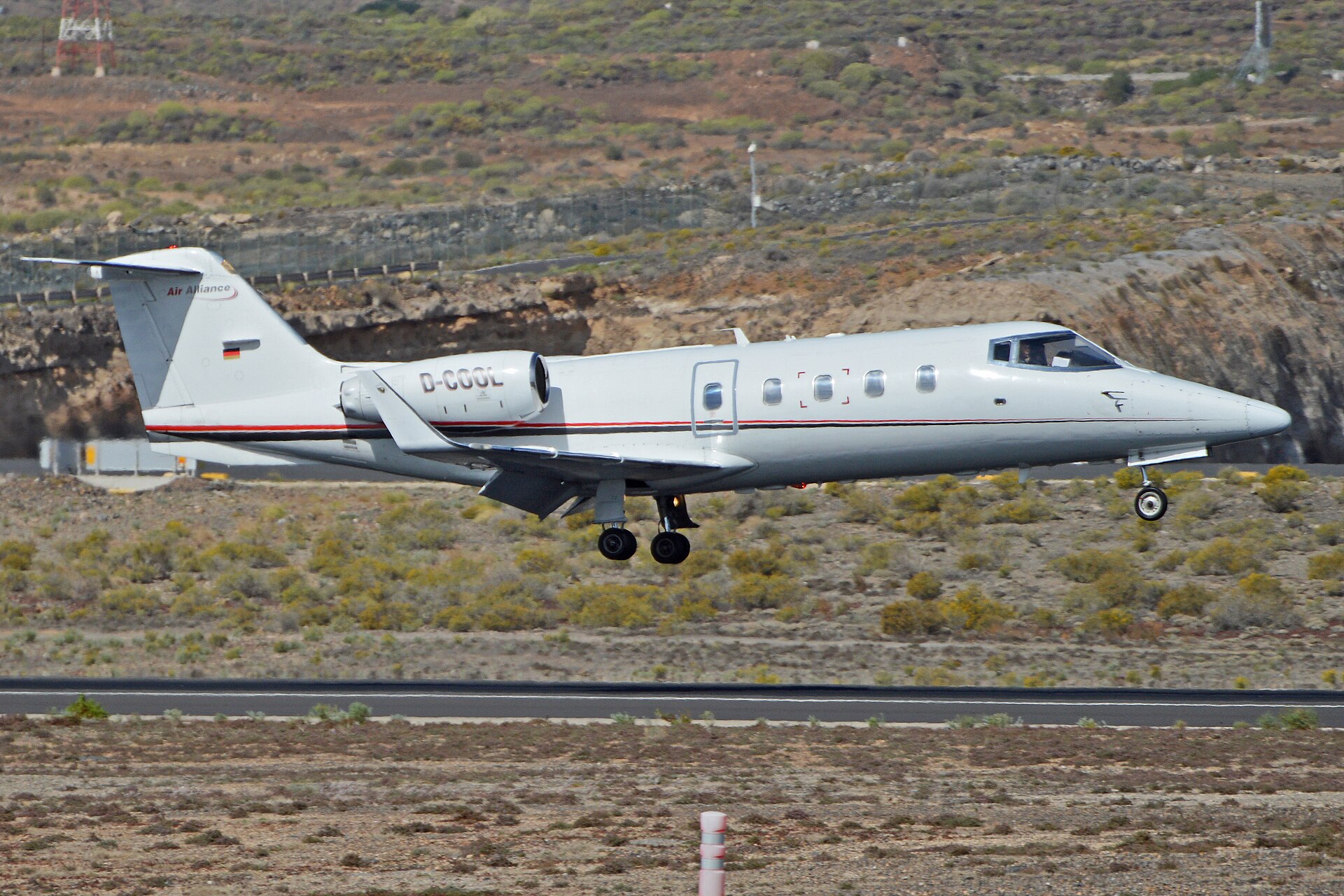
A 1982 Learjet 55 arriving at Tenerife South, Canary Islands, in January 2016. · Alan Wilson, CC BY-SA 2.0, via Wikimedia Commons
Learjet · Midsize Jet
Learjet 55
The original version of Learjet's first midsize jet, later refined as the 55B and 55C, then replaced by the Learjet 60.
The Learjet 55 delivers genuine midsize speed and New York-to-Florida range for the price of a used light jet. The catch is age: thirsty engines, long takeoff runs and big inspections that can rival what the airplane costs.
Buy it if
You want 450-knot trips of up to about 1,900 nm with four to six passengers, fly from runways of 5,600 ft or more, and have a maintenance budget that can absorb surprises.
Skip it if
You need short-runway access, a cabin tall passengers can stand in, modern avionics out of the box, or predictable yearly costs. A Learjet 60 or Hawker 800 fits better.
Biggest compromise
Running costs no longer match the purchase price. 9 million, about three times what most of these jets are listed for, and a single engine core inspection or 12-year inspection can consume a large share of the airplane's value.
The numbers that matter
Purchase price
$649K
typical asking · $595K–$875K
What it costs per year
$1.93M
at 300 hrs · two professional pilots
How far it flies
2,244 nm
1,870–1,995 nm with passengers
How fast
458 kt
high-speed cruise
Seats
7
7 typical (up to 8 by interior)
Pilots needed
2
Two pilots are required; the Learjet 55 was never certified for single-pilot operation.
Price
What one costs to buy
Typical asking price
$649,000
Where asking prices sit
Low
$595K
Typical
$649K
High
$875K
Most asking prices fall inside this band.
Other sites
Priced vs call
with a price / call for price
Four of nine listed Learjet 55s showed whole-aircraft prices; two others were a partial ownership share and an airframe without engines.
Price vs its family and alternatives
Scroll to explore · select a jet for details
Learjet 55 · This aircraft
$649K
The least expensive here; next up is the Learjet 55B.
For sale now
None listed right now
Cost to own
What it costs per year to run
300hours / year
Per year
Per flight hour
Estimate — your operator will quote actual numbers.
Fuel, airframe maintenance, engine program or reserve and landing, handling and trip costs rise as you fly more. Two professional pilots, recurrent training, hangar, insurance, management and databases, weather, tracking and office stay the same however much you fly.
Where the money goes
- Two professional pilots$356,00018%
- Recurrent training$33,0002%
- Hangar$46,6502%
- Insurance$30,0002%
- Management$60,0003%
- Databases, weather, tracking and office$50,0003%
- Fuel$624,45632%
- Airframe maintenance$315,00016%
- Engine program or reserve$210,00011%
- Landing, handling and trip costs$202,50011%
Fuel is the biggest single cost at 32% of the total.
The JetGrade
65 out of 100 — Below its class average
Peer group: Cessna Citation III, Hawker 800, IAI Westwind II, Falcon 20-5, Sabreliner 65
Seven categories at a glance
- - - 70 = typical— This aircraft
Strongest on speed & trip time, weakest on airport access.
Grades are editorial opinions about the model, not any specific aircraft. Sponsors and affiliates have no input. Reviewed 2026-10-28.
Where it flies
Sample trips and reach
Typical trips on a map
Nonstop
Depends on weight or weather
Fuel stop likely
Out of reach
5 of 8 sample trips are comfortable nonstops.
Sample flight times
- 0.9 hr
Carlsbad → Las Vegas
205 nm · Short hop, well within range
- 1.9 hr
Carlsbad → Aspen
625 nm · Hot-and-high; depends on weight and weather
- 2.2 hr
Santa Ana → San José del Cabo
765 nm
- 2.5 hr
Teterboro → West Palm Beach
900 nm
- 3.3 hr
Dallas → Teterboro
1,190 nm
- 3.8 hr
Teterboro → San Juan
1,410 nm · Over-water leg; plan reserves carefully
- 5.7 hr
Carlsbad → Teterboro
2,100 nm · Needs one stop, typically mid-continent
Los Angeles → Honolulu
2,215 nm · Beyond range with passengers; no stop available
Lineage
What came before and after
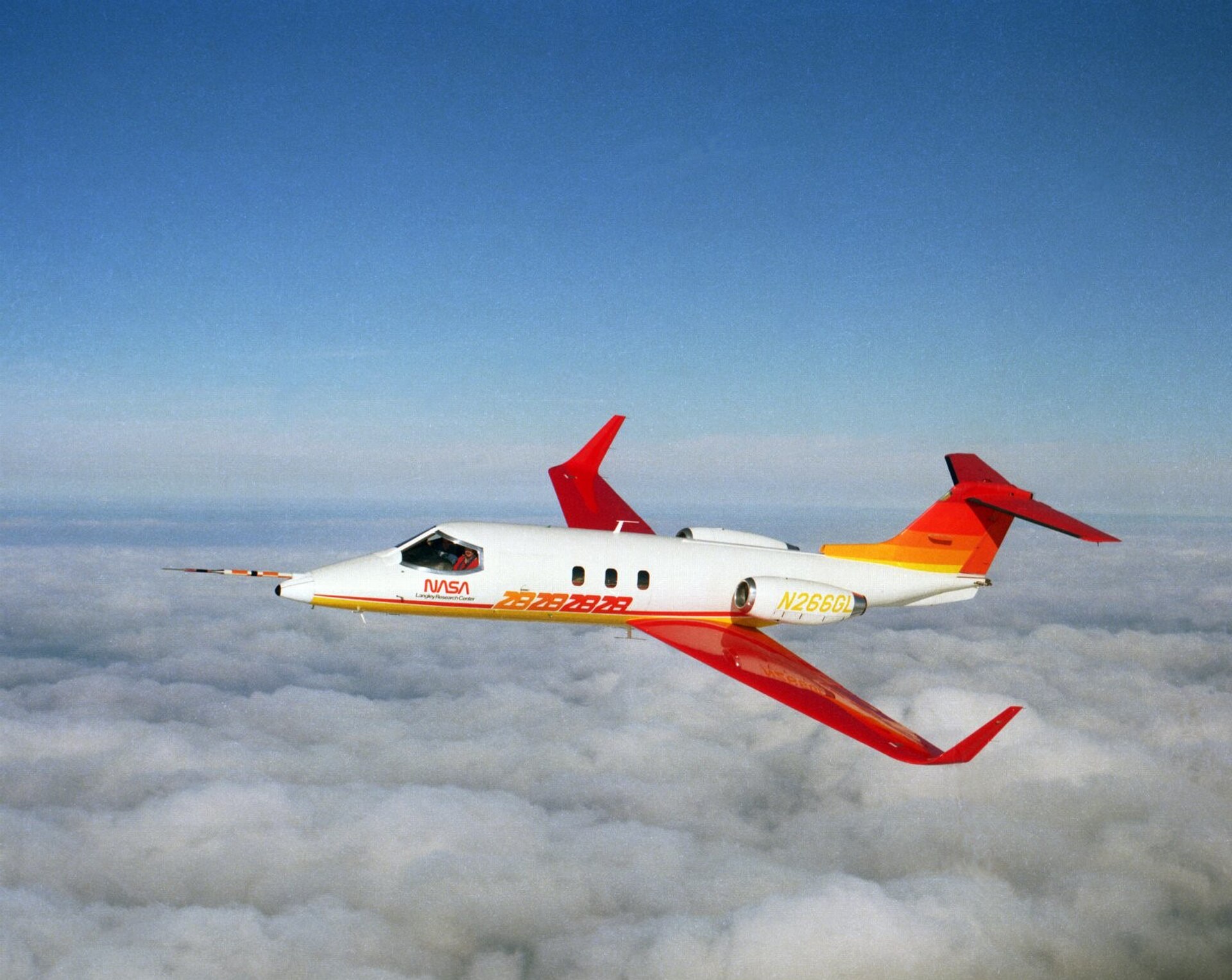

1981–1986
Learjet 55
Bigger midsize cabin and turbofan engines on the winglet wing.
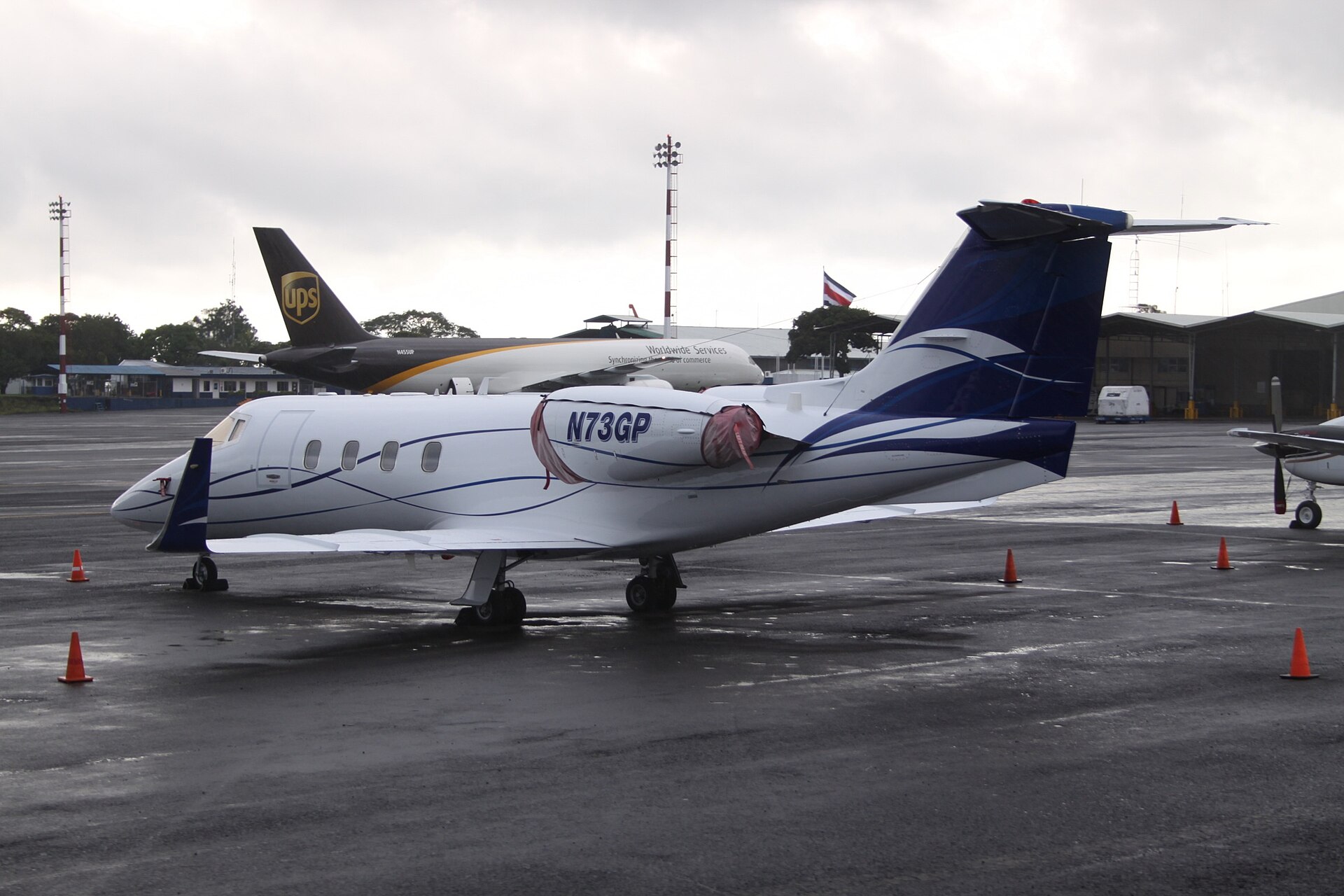


What changed from the Learjet 28 / 29 Longhorn
- New wider, taller fuselage with about 5 ft 8 in of headroom, a big step up.
- Garrett TFE731 turbofans replaced the 28/29's General Electric CJ610 turbojets.
- Range grew to about 2,000 nm with four passengers, well beyond the 28/29.
- Maximum takeoff weight rose to 21,500 lb for the larger airframe.
Size and cabin
How big it is, inside and out
Outside
Silhouette · scaled to length
Length
Wingspan
Height
Inside the cabin
Cabin length
Width
Height
Compare
How it stacks up
This aircraft
Learjet 55
- JetGrade
- 65
- Price
- $649K
- Cost per year
- $1.93M
- Range
- 2,244 nm
- Speed
- 458 kt
- Seats
- 7
- Cabin length
- 13′ 7″
- Pilots
- 2
- Years built
- 1981–1986
← Before
- JetGrade
- 46
- Cost per year
- $1.21M
- Range
- 1,300 nm
- Speed
- 458 kt
- Seats
- 6
- Cabin length
- 12′ 1″
- Pilots
- 2
- Years built
- 1979–1982
After →
- JetGrade
- 62
- Price
- $567K–$930K guide
- Cost per year
- $1.66M
- Range
- 2,040 nm
- Speed
- 458 kt
- Seats
- 7
- Cabin length
- 13′ 9″
- Pilots
- 2
- Years built
- 1986–1987
Alternative
- JetGrade
- 65
- Price
- $2.8M
- Cost per year
- $1.95M
- Range
- 2,390 nm
- Speed
- 465 kt
- Seats
- 7
- Cabin length
- 17′ 8″
- Pilots
- 2
- Years built
- 1993–2007
Alternative
- JetGrade
- Not yet graded
- Range
- 1,900 nm
- Speed
- 450 kt
- Seats
- 8
- Years built
- 1983–1992
Alternative
- JetGrade
- 74
- Price
- $1.27M
- Cost per year
- $1.65M
- Range
- 2,555 nm
- Speed
- 442 kt
- Seats
- 8
- Cabin length
- 21′ 4″
- Pilots
- 2
- Years built
- 1984–1995
- Learjet 60 instead: The 55's successor: a stretched cabin, newer Pratt & Whitney engines and more range, at a higher purchase price.
- Cessna Citation III instead: A same-era midsize jet from Cessna with similar cabin size and range at a comparable price.
- Hawker 800 instead: A wider cabin and roughly 400 nm more range, at a higher yearly operating cost.
Gold marks the best figure in each row.
Owning one
What to know before you buy
Engines & inspections
2 × Honeywell (Garrett) TFE731-3A-2B (many converted to -3AR or -3CR) · 3,700 lbf each
Engine hours until overhaul
- Phase A inspection · 300 hr
- Phase B inspection · 600 hr
- Phase C inspection · 1,200 hr
- Engine mid-life inspection · 2,100 hr
- Engine core inspection · 4,200 hr
- 12,000-hour inspection · 12,000 hr
- 12-year inspection every 144 months
Honeywell's pay-per-hour plan covers these engines, but few listed aircraft are enrolled; unenrolled engines leave inspection bills to the owner.
Known issues
Engine program status
Only one of nine listed aircraft showed engines on Honeywell's plan; others leave mid-life and core inspections to the owner.
Major calendar inspections
The 12-year and 12,000-hour inspections are large, weeks-long events; check when and where each was last done.
Long takeoff runs
About 5,600 ft at maximum weight limits loads from short runways and from hot or high airports.
Pre-buy checklist
0 of 9 checked
Bombardier still holds the Learjet type certificate and supports the fleet, and Honeywell and independent shops still maintain TFE731 engines. Some 1980s airframe parts can take time to source.
Review
The full review
Strengths
- Fast: about 458 knots in high-speed cruise, with a 51,000-ft ceiling above most weather and traffic.
- Roomier than earlier Learjets: about 5 ft 8 in tall, seven seats and a private aft lavatory.
- Cheap to buy: priced listings in October 2026 ran from $595,000 to $875,000.
Limitations
- Needs about 5,600 ft of runway to take off at maximum weight, long for a midsize jet.
- Burns about 252 gallons an hour, pushing a 300-hour year to roughly $1.9 million.
- Built 1981–1986; most need engine, avionics and 12-year inspection homework before purchase.
The Learjet 55 was Learjet's first attempt at a true midsize cabin. Announced at the 1977 Paris Air Show and first flown in 1979, it paired the winglet-equipped Longhorn wing with a new, wider and taller fuselage and Garrett TFE731 turbofans. Learjet delivered the first production aircraft in 1981 and built 126 of this original version before the improved 55B arrived in 1986, followed by the 55C and, in 1993, the Learjet 60.
Pilot's take
The Learjet 55 flies like a Learjet: quick, responsive and happiest at altitude. It climbs hard, settles into the mid-40s and above, and covers ground faster than most jets of its generation. The trade-offs show up on the ground. Takeoff runs are long at heavy weights, so runway length, temperature and elevation shape every heavy departure. It is a two-pilot airplane with older systems that reward a crew who knows the type well. Plan fuel conservatively; it burns more than newer midsize jets.
Who this is for
Charter and air-ambulance operators, experienced owners and buyers who value speed over cabin space, already have type-rated crews and a trusted Learjet shop, and want midsize range for a low entry price.

Ask about this aircraft
Answers come only from our research file on the Learjet 55.
Your earlier questionsOwners
Private to verified ownersOwn a Learjet Learjet 55? Verify with its FAA registration to join the owners' thread and the real-cost poll.