
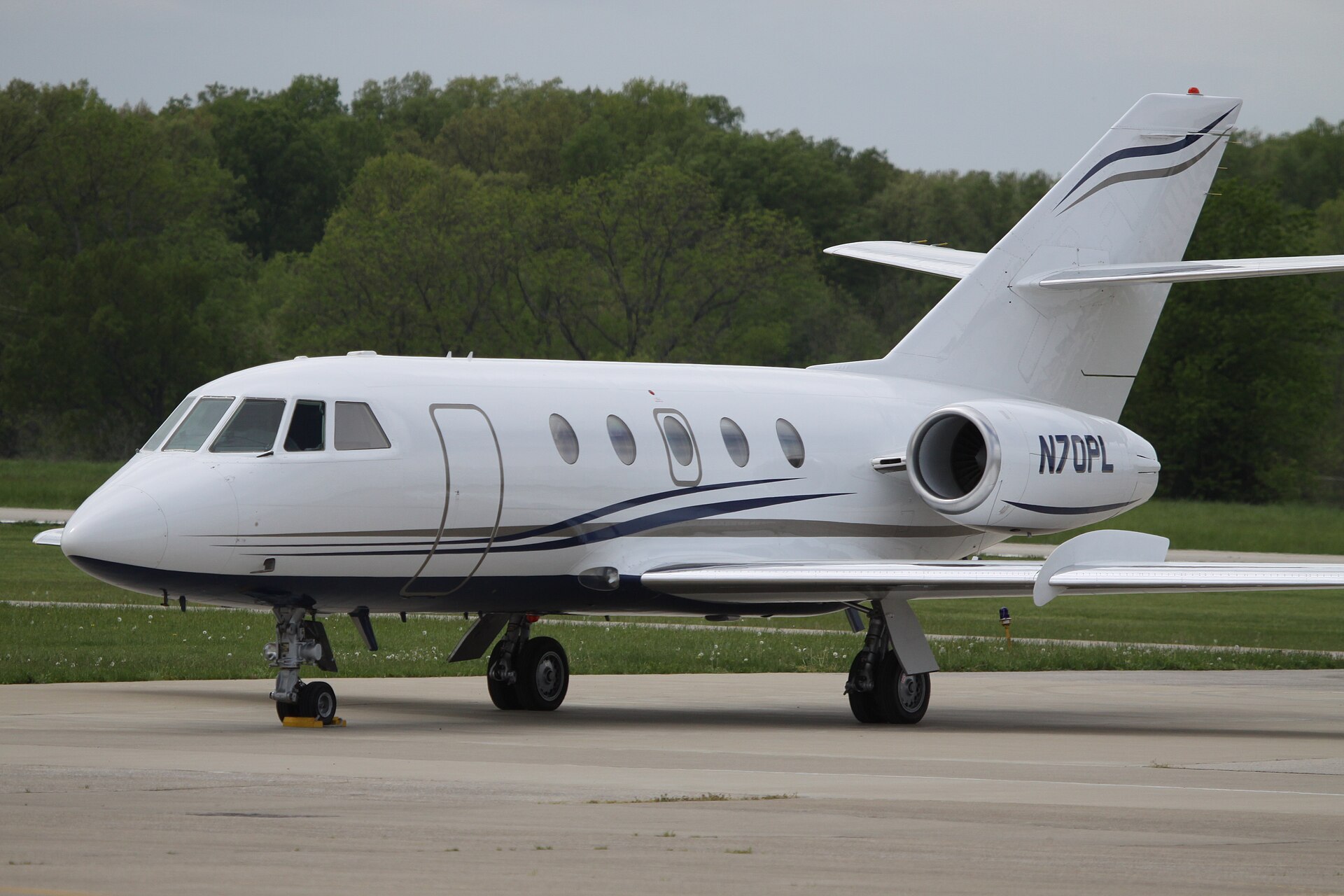
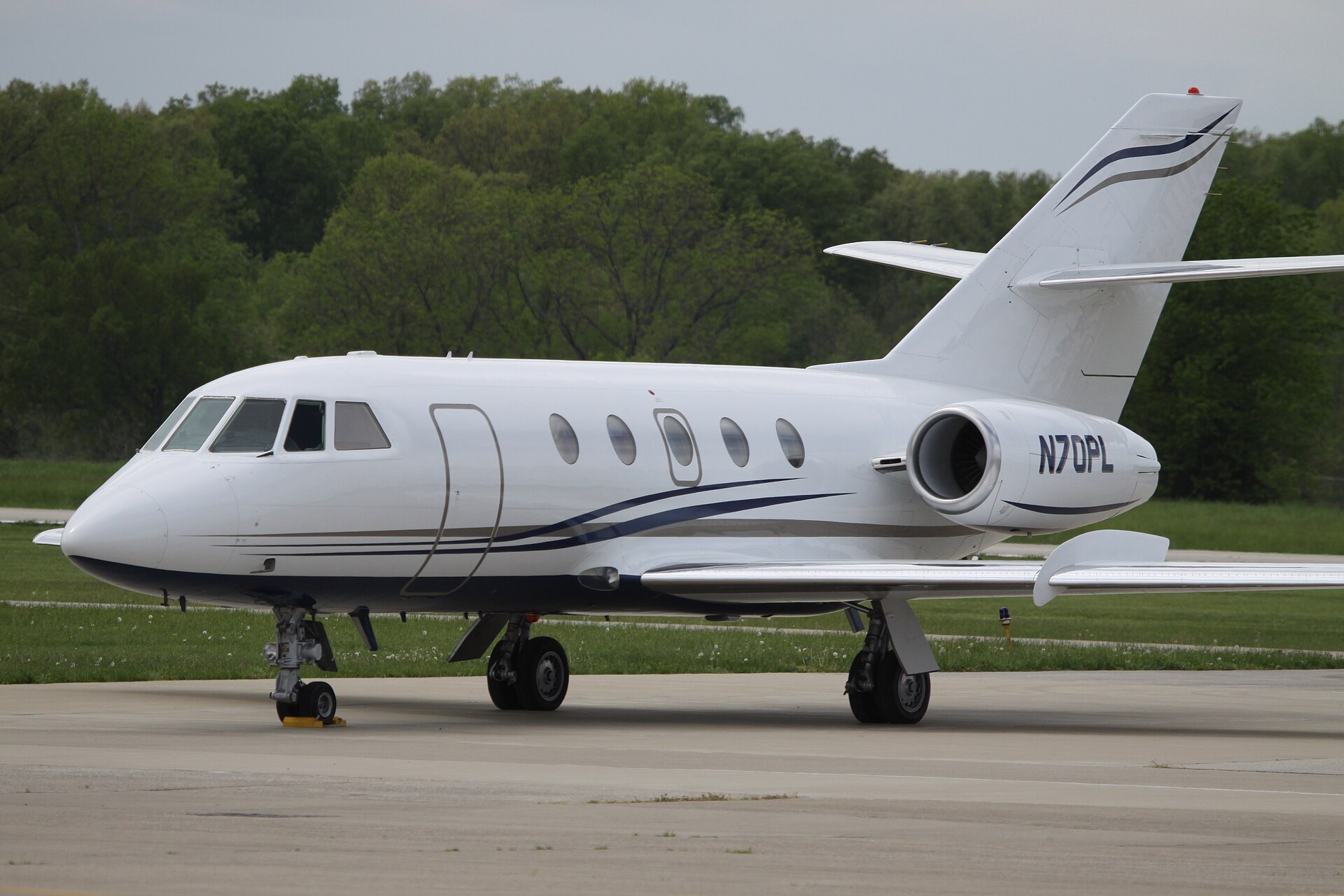
A Falcon 20F-5 at Frankfort, Kentucky, in May 2013, showing its larger TFE731 engine nacelles. · Photo: Aeroprints.com / Wikimedia Commons, CC BY-SA 3.0
Dassault · Midsize Jet
Falcon 20-5 (TFE731 retrofit)
A re-engined Falcon 20: Dassault's original business jet fitted with Honeywell TFE731 turbofans from 1989.
The only Falcon 20 that makes sense for most US buyers today. The newer engines add roughly 900 nm of range and meet Stage 3 noise rules, but the airframes are 40 to 60 years old and few change hands.
Buy it if
You want a wide-cabin midsize jet with about 2,200 nm of range for under $2 million, plan to keep it for years, and have a maintenance shop that knows the Falcon 20.
Skip it if
You need easy resale, a stand-up cabin, plenty of baggage space, or a modern cockpit without spending more on upgrades, or you want pilot training close to home.
Biggest compromise
Age. Every Falcon 20-5 is a converted airframe built between 1965 and 1983, so structural inspections keep tightening and cockpit equipment varies widely from one aircraft to the next.
The numbers that matter
Purchase price
$897K–$1.25M
guide value (PlanePhD model estimates)
What it costs per year
$1.58M
at 300 hrs · two professional pilots
How far it flies
2,460 nm
2,194–2,200 nm with passengers
How fast
455 kt
high-speed cruise
Seats
8
8 typical, 10 maximum
Pilots needed
2
Two pilots are required on every flight.
Price
What one costs to buy
Guide value
$897K–$1.25M
Other sites
Priced vs call
with a price / call for price
Only one current listing shows a price: a 1986 20F-5 asking $1.9 million. Published model estimates put typical values at about $0.9–1.25 million.
Price vs its family and alternatives
Scroll to explore · select a jet for details
Falcon 20-5 (TFE731 retrofit) · This aircraft
$897K–$1.25M guide
Guide value, not a listed asking price.
Sits between the Falcon 20 (20C / 20D / 20E / 20F) and the Hawker 800 (BAe 125-800).
For sale now
None listed right now
Cost to own
What it costs per year to run
300hours / year
Per year
Per flight hour
Estimate — your operator will quote actual numbers.
Fuel, airframe maintenance, engine reserve or hourly program and landing, handling and other costs rise as you fly more. Two pilots, recurrent training, hangar, insurance and management stay the same however much you fly.
Where the money goes
- Two pilots$244,30415%
- Recurrent training$29,0372%
- Hangar$34,1822%
- Insurance$8,7831%
- Management$48,0003%
- Fuel$626,75440%
- Airframe maintenance$403,74325%
- Engine reserve or hourly program$107,1007%
- Landing, handling and other costs$81,4655%
Fuel is the biggest single cost at 40% of the total.
The JetGrade
68 out of 100 — Below its class average
Peer group: Hawker 700, Hawker 800, Learjet 55, Sabreliner 65, IAI Westwind II
Seven categories at a glance
- - - 70 = typical— This aircraft
Strongest on range & payload, weakest on running costs.
Grades are editorial opinions about the model, not any specific aircraft. Sponsors and affiliates have no input. Reviewed 2026-10-29.
Where it flies
Sample trips and reach
Typical trips on a map
Nonstop
Depends on weight or weather
Out of reach
5 of 8 sample trips are comfortable nonstops.
Sample flight times
- 0.9 hr
Carlsbad → Las Vegas
205 nm · Short hop; well within range
- 1.8 hr
Carlsbad → Aspen
625 nm · Hot-and-high; depends on weight and weather
- 2.1 hr
Santa Ana → San José del Cabo
765 nm · Comfortable nonstop with four passengers
- 2.5 hr
Teterboro → West Palm Beach
900 nm · Comfortable nonstop with four passengers
- 3.1 hr
Dallas → Teterboro
1,190 nm · Nonstop with fuel to spare
- 3.6 hr
Teterboro → San Juan
1,410 nm · Nonstop over water within range
- 5.5 hr
Carlsbad → Teterboro
2,100 nm · Nonstop in calm winds; westbound usually stops
Los Angeles → Honolulu
2,215 nm · Too close to maximum range for this ocean crossing
Lineage
What came before and after
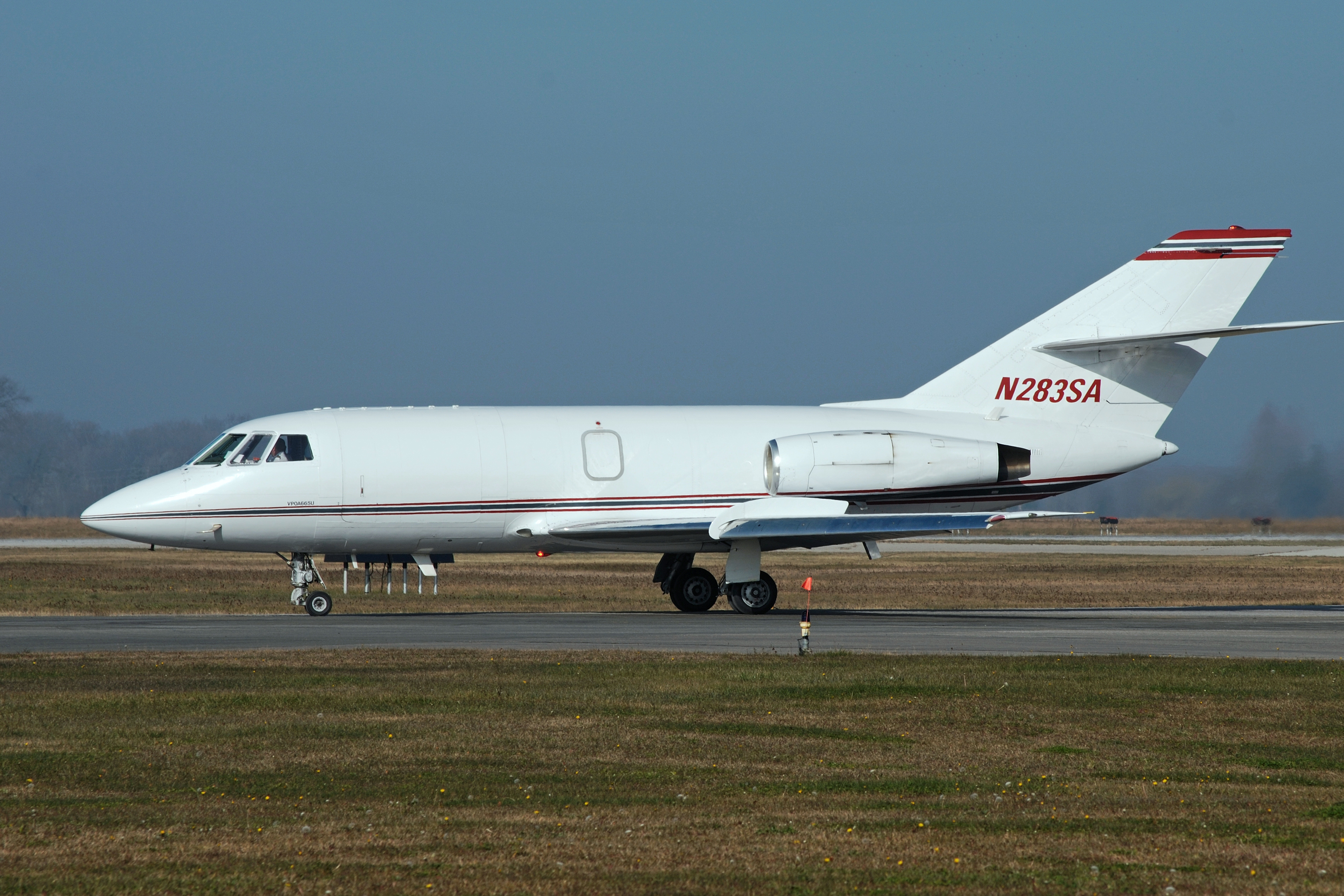
Converted 1989–2005
Dassault Falcon 20-5 (TFE731 retrofit)
Existing Falcon 20s re-engined with Garrett TFE731-5 turbofans.
What changed from the Dassault Falcon 20 (20C / 20D / 20E / 20F)
- CF700s replaced by Garrett TFE731-5AR or -5BR turbofans of 4,500 to 4,750 lb thrust.
- Best range rose from about 1,500 nm to about 2,450 nm on the 20F.
- Maximum payload roughly doubled; takeoff weight rose to 29,100 lb.
- Digital engine control added; meets Stage 3 noise rules, so US airports stay open.
- Most conversions also received new avionics and a refreshed cabin.
Size and cabin
How big it is, inside and out
Outside
Silhouette · scaled to length
Length
Wingspan
Height
Inside the cabin
Cabin length
Width
Height
Compare
How it stacks up
This aircraft
Falcon 20-5 (TFE731 retrofit)
- JetGrade
- 68
- Price
- $897K–$1.25M guide
- Cost per year
- $1.58M
- Range
- 2,460 nm
- Speed
- 455 kt
- Seats
- 8
- Cabin length
- 24′ 2″
- Pilots
- 2
- Years built
- 1989–2005
← Before
Falcon 20 (20C / 20D / 20E / 20F)
- JetGrade
- 57
- Price
- $200K–$495K guide
- Cost per year
- $1.64M
- Range
- 1,795 nm
- Speed
- 465 kt
- Seats
- 8
- Cabin length
- 24′ 0″
- Pilots
- 2
- Years built
- 1965–1983
Alternative
- JetGrade
- 74
- Price
- $1.27M
- Cost per year
- $1.65M
- Range
- 2,555 nm
- Speed
- 442 kt
- Seats
- 8
- Cabin length
- 21′ 4″
- Pilots
- 2
- Years built
- 1984–1995
Alternative
- JetGrade
- 68
- Price
- $2.59M
- Cost per year
- $1.83M
- Range
- 3,148 nm
- Speed
- 470 kt
- Seats
- 9
- Cabin length
- 23′ 6″
- Pilots
- 2
- Years built
- 1979–1997
Alternative
- JetGrade
- 56
- Price
- $610K–$2.5M guide
- Cost per year
- $2.64M
- Range
- 2,270 nm
- Speed
- 460 kt
- Seats
- 9
- Cabin length
- 24′ 0″
- Pilots
- 2
- Years built
- 1983–1988
- Hawker 800 instead: Newer airframes from the late 1980s with the same engine family, a stand-up cabin and a larger, more liquid resale market.
- Dassault Falcon 50 instead: Three TFE731 engines, a cabin derived from the Falcon 20 and enough range for transatlantic trips, at a higher price.
- Dassault Falcon 200 instead: The factory-built final version of the family with more fuel, though its Garrett ATF3 engines are harder to support.
Gold marks the best figure in each row.
Owning one
What to know before you buy
Engines & inspections
2 × Honeywell (Garrett) TFE731-5AR-2C or TFE731-5BR-2C · 4,750 lbf each
Engine hours until overhaul
- Engine mid-life inspection · 2,100 hr
- Engine core inspection · 4,200 hr
Many engines are enrolled on Honeywell's hourly program or JSSI. Check enrolment, any buy-in owed and hours to the next inspection before agreeing a price.
Known issues
Ageing airframes
Every 20-5 is a converted airframe from 1965 to 1983; FAA structural limits were tightened again in 2026.
Engine inspection timing
Hours left to the mid-life and core inspections, and program status, drive a large share of value.
Turbine part directive
An FAA directive requires replacing older first-stage low-pressure turbine assemblies on the -5BR engine.
Pre-buy checklist
0 of 8 checked
Honeywell's TFE731 is widely supported, with hourly programs and shops worldwide. Airframe support depends on Dassault and specialist Falcon shops, and US pilot training for the type is limited.
Review
The full review
Strengths
- About 2,450 nm best range and roughly 2,200 nm with four passengers, versus about 1,500 nm before re-engining.
- Honeywell TFE731 engines of 4,500 to 4,750 lb thrust each, with hourly programs and worldwide shop support.
- Cabin about 6 ft 1 in wide with a forward galley and an enclosed lavatory, roomier than most peers.
Limitations
- Airframes are 40 to 60 years old, and FAA structural limits were tightened again in 2026.
- Running costs near $5,280 an hour at 300 hours a year, with fuel around 255–280 gallons an hour.
- Only about 61 remain on the US register, and just one was advertised with a price in October 2026.
The Falcon 20-5 is not a new airplane. It is a Dassault Falcon 20, built between 1965 and 1983, whose original General Electric CF700 engines were replaced with Garrett TFE731-5 turbofans, the engine family Honeywell still supports today. The program was offered from 1987, certified in France in 1989 and run by Garrett, later AlliedSignal, with Dassault as design authority. Early conversions used the 4,500 lb TFE731-5AR; from 1991 the 4,750 lb -5BR was offered, and most aircraft listed today have it. Depending on the donor airframe they are called the 20C-5, 20D-5, 20E-5 or 20F-5. More than 100 aircraft were converted before the last kits were sold around 2005, and the FAA counted 61 on the US register in 2026.
Pilot's take
We see the Falcon 20-5 as a Falcon 20 that finally has the engines its wing deserved. The TFE731s bring digital engine control, a climb to the low 40s in under half an hour and a cruise around Mach 0.78 to 0.80 up high. The airplane keeps the type's honest handling: a clear buffet before the stall, no stick shaker or pusher, and directional stability good enough that a failed yaw damper does not ground it. It is still a two-pilot design from the 1960s underneath, so cockpit upgrades and recurrent training deserve as much attention as the engines.
Who this is for
Cargo and special-mission operators, and private owners who want a wide midsize cabin and coast-to-coast range on a budget, have access to experienced Falcon maintenance, and plan to keep the aircraft rather than trade it.

Ask about this aircraft
Answers come only from our research file on the Dassault Falcon 20-5 (TFE731 retrofit).
Your earlier questionsOwners
Private to verified ownersOwn a Dassault Falcon 20-5 (TFE731 retrofit)? Verify with its FAA registration to join the owners' thread and the real-cost poll.