
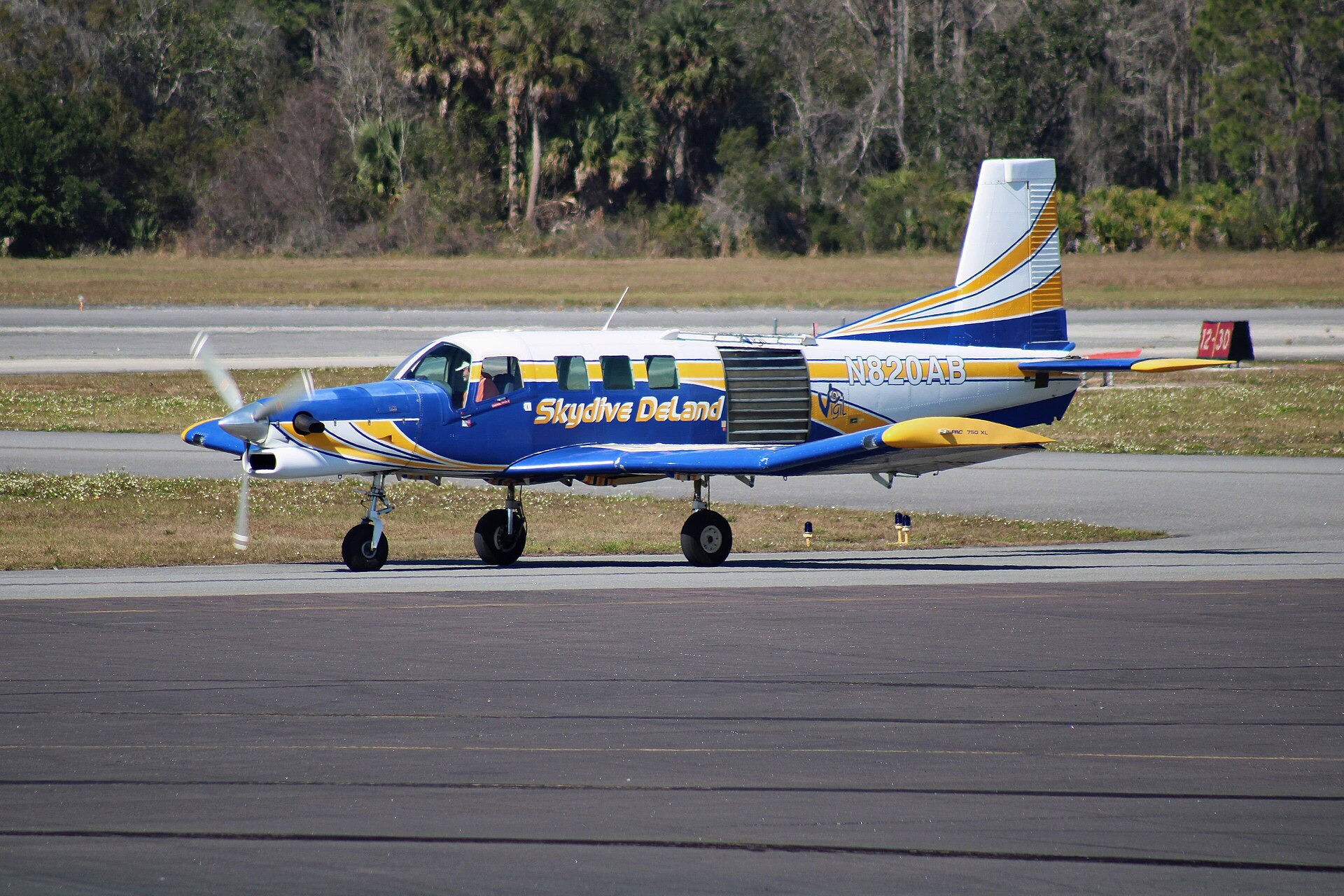
PAC P-750 XSTOL N820AB, photographed in 2024. · Photo: ZLEA via Wikimedia Commons, CC BY-SA 4.0
Pacific Aerospace · Turboprop
P-750 XSTOL
The original New Zealand-built P-750, flying since 2001 and now joined by the more powerful SuperPac 750XL-II.
The P-750 lifts more and stops shorter than most single-engine utility turboprops, and it climbs to jump altitude fast. It is slower than a Kodiak or Caravan, with a small fleet and thin support outside New Zealand.
Buy it if
You run skydiving, survey or remote-strip operations and need a 4,200 lb useful load, takeoffs over a 50 ft obstacle in about 1,200 ft, and a tough cabin you can load with anything.
Skip it if
You want a comfortable aircraft for family or business trips, a large service network close to home, or quick resale. A Cessna Caravan or Kodiak 100 is faster, more common and easier to sell.
Biggest compromise
Support and resale. Little more than 120 had been built by 2019, the original maker entered administration in 2021 before NZAero took over, and airframe parts and engineering help come from Hamilton, New Zealand.
The numbers that matter
Purchase price
$1.44M–$1.44M
guide value (PlanePhD)
What it costs per year
$434K
at 300 hrs · one professional pilot
How far it flies
1,179 nm
About 750–870 nm with four passengers and long-range tanks
How fast
166 kt
high-speed cruise
Seats
8
8 seats typical, up to 9 passengers
Pilots needed
1
Certified for one pilot; skydive and utility operators normally fly it with a single commercial pilot.
Price
What one costs to buy
Guide value
$1.44M–$1.44M
Other sites
Priced vs call
with a price / call for price
No current P-750 listing shows a price. PlanePhD estimates a 2004–2005 example at about $1.44M; an older Australian ad asked $950,000.
Price vs its family and alternatives
Scroll to explore · select a jet for details
P-750 XSTOL · This aircraft
$1.44M–$1.44M guide
Guide value, not a listed asking price.
Sits between the PC-6 Porter and the Caravan (208).
For sale now
None listed right now
Cost to own
What it costs per year to run
300hours / year
Per year
Per flight hour
Estimate — your operator will quote actual numbers.
Fuel, airframe and propeller maintenance, engine program or overhaul reserve and landing fees, cleaning and miscellaneous rise as you fly more. One professional pilot, recurrent training, hangar, insurance and subscriptions and databases stay the same however much you fly.
Where the money goes
- One professional pilot$120,00028%
- Recurrent training$7,0002%
- Hangar$22,5005%
- Insurance$25,0006%
- Subscriptions and databases$4,5001%
- Fuel$124,50029%
- Airframe and propeller maintenance$75,00017%
- Engine program or overhaul reserve$47,25011%
- Landing fees, cleaning and miscellaneous$8,0002%
Fuel is the biggest single cost at 29% of the total.
The JetGrade
69 out of 100 — Below its class average
Peer group: Cessna Caravan 208, Cessna Grand Caravan 208B, Daher Kodiak 100 Series I, Pilatus PC-6 Porter
Seven categories at a glance
- - - 70 = typical— This aircraft
Strongest on airport access, weakest on reliability & support.
Grades are editorial opinions about the model, not any specific aircraft. Sponsors and affiliates have no input. Reviewed 2026-10-04.
Where it flies
Sample trips and reach
Typical trips on a map
Nonstop
Depends on weight or weather
Fuel stop likely
1 of 6 sample trips are comfortable nonstops.
Sample flight times
- 1.7 hr
Carlsbad → Las Vegas
205 nm · Easy nonstop with fuel to spare
- 4.3 hr
Carlsbad → Aspen
625 nm · Nonstop, but oxygen needed over the Rockies
- 5.5 hr
Santa Ana → San José del Cabo
765 nm · Nonstop only with long-range tanks and economy cruise
- 6.2 hr
Teterboro → West Palm Beach
900 nm · One fuel stop, typically in the Carolinas
- 8.1 hr
Dallas → Teterboro
1,190 nm · One fuel stop, typically near the midpoint
- 14.0 hr
Carlsbad → Teterboro
2,100 nm · Two fuel stops; a long day of flying
Lineage
What came before and after
From 1979
PAC Cresco
Turboprop crop-duster whose wings and engine the P-750 inherited.
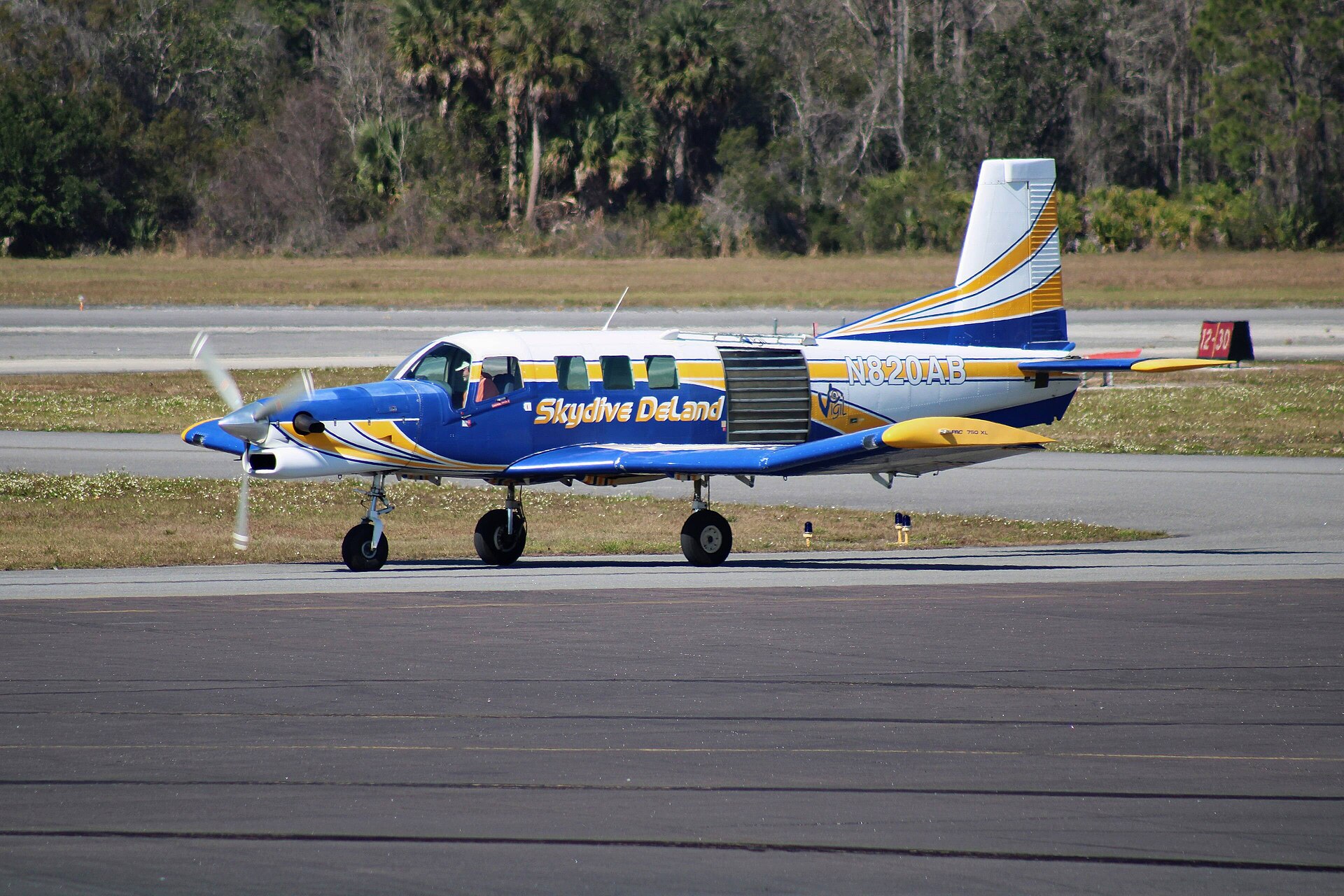
2003–present
P-750 XSTOL
Large utility cabin on Cresco wings, 750 shp PT6A-34, 17 skydivers.
2024–present
SuperPac 750XL-II
900 shp PT6A-140A and four-blade propeller for faster climbs.
What changed from the PAC Cresco
- New, much larger fuselage seats up to nine passengers or 17 skydivers instead of a chemical hopper.
- Keeps the Cresco wing but adds a reworked tail for the longer fuselage.
- Same Pratt & Whitney Canada PT6A family, rated 750 shp for takeoff.
Size and cabin
How big it is, inside and out
Outside
Silhouette · scaled to length
Length
Wingspan
Height
Inside the cabin
Cabin length
Width
Compare
How it stacks up
This aircraft
P-750 XSTOL
- JetGrade
- 69
- Price
- $1.44M–$1.44M guide
- Cost per year
- $434K
- Range
- 1,179 nm
- Speed
- 166 kt
- Seats
- 8
- Cabin length
- 13′ 1″
- Pilots
- 1
- Years built
- 2003–now
← Before
PAC Cresco
Not yet graded
After →
SuperPac 750XL-II
Not yet graded
Alternative
- JetGrade
- 75
- Price
- $2.25M
- Cost per year
- $448K
- Range
- 1,070 nm
- Speed
- 186 kt
- Seats
- 8
- Cabin length
- 12′ 9″
- Pilots
- 1
- Years built
- 1985–now
Alternative
- JetGrade
- 73
- Cost per year
- $427K
- Range
- 1,132 nm
- Speed
- 174 kt
- Seats
- 8
- Cabin length
- 15′ 10″
- Pilots
- 1
- Years built
- 2007–2018
Alternative
- JetGrade
- 63
- Price
- $1.15M
- Cost per year
- $398K
- Range
- 500 nm
- Speed
- 125 kt
- Seats
- 6
- Cabin length
- 7′ 6″
- Pilots
- 1
- Years built
- 1959–2022
- Cessna Caravan 208 instead: Faster and far more common, with service nearly everywhere and easier resale, but it needs about 2,050 ft to clear a 50 ft obstacle.
- Daher Kodiak 100 Series I instead: Similar rough-strip ability with a more passenger-friendly cabin, about 174 kt cruise and an active factory in Idaho.
- Pilatus PC-6 Porter instead: Even shorter takeoffs and landings for the most extreme strips, but slower and with a smaller cabin.
Gold marks the best figure in each row.
Owning one
What to know before you buy
Engines & inspections
1 × Pratt & Whitney Canada PT6A-34 · 750 shp each
No APUEngine hours until overhaul
- 150-hour inspection · 150 hr
- Rudder trim tab pivot check · 150 hr
- Fin forward pickup check · 600 hr
- Engine overhaul · 4,000 hr
Pratt & Whitney Canada's pay-per-hour plan is available for this engine; some skydive aircraft use overhaul-extension programs instead. Confirm what transfers to you.
Known issues
Fin forward pickup fatigue
Tail fittings need inspection every 600 hours or 12 months after 2,000 hours, and replacement by 6,000 hours.
Chafing of wiring and fuel lines
Several directives from 2017 to 2021 cover chafed wiring, fuel lines, wing tanks and engine-mount parts; confirm every fix.
Heavy skydive histories
Most used aircraft flew skydive loads, logging many short climbs and descents; review cycles, engine trends and damage history.
Pre-buy checklist
0 of 10 checked
NZAero in Hamilton, New Zealand holds the type certificate and still builds the aircraft. The PT6A-34 engine is supported worldwide, but airframe parts and engineering help come from New Zealand.
Review
The full review
Strengths
- Lifts up to 4,200 lb of fuel and payload, or 17 skydivers, in a 7,500 lb aircraft.
- Clears a 50 ft obstacle in about 1,196 ft and lands over one in 950 ft at maximum weight.
- Climbs to 12,000 ft in about 10 minutes, so skydive operators can fly more loads each hour.
Limitations
- Cruises at about 164 to 167 kt at 10,000 ft, slower than a Kodiak 100 or Caravan.
- Unpressurized with no toilet; flights above 12,500 ft need supplemental oxygen for the crew.
- Small fleet of little more than 120 aircraft by 2019 means thin parts support and slow resale.
The Pacific Aerospace P-750 XSTOL is a single-engine utility turboprop built in Hamilton, New Zealand. It pairs the wings and Pratt & Whitney Canada PT6A-34 engine of the earlier Cresco crop-duster with a new, much larger fuselage and a reworked tail. It first flew in 2001, won New Zealand approval in 2003 and United States approval in 2004, and the type now belongs to NZAero, which also builds a more powerful SuperPac 750XL-II. Most of the roughly 25 examples registered in the United States fly skydivers.
Pilot's take
From the left seat, the P-750 is all about the takeoff and the climb. With a light load it leaps off short strips, and fully loaded with jumpers it still reaches 12,000 ft in roughly 10 minutes. The reversing propeller and big flaps make short, steep approaches routine. In cruise it is honest but not quick, and the cabin is loud and plain. We would budget time for learning its systems and its long list of service bulletins, and we would want a maintainer who has worked on one before buying.
Who this is for
Skydive centers, survey and utility operators, and remote-area or mission flyers who value payload and rough-strip ability over speed and cabin comfort, and who have a turboprop shop nearby that knows the type.

Ask about this aircraft
Answers come only from our research file on the P-750 XSTOL.
Your earlier questionsOwners
Private to verified ownersOwn a Pacific Aerospace P-750 XSTOL? Verify with its FAA registration to join the owners' thread and the real-cost poll.