
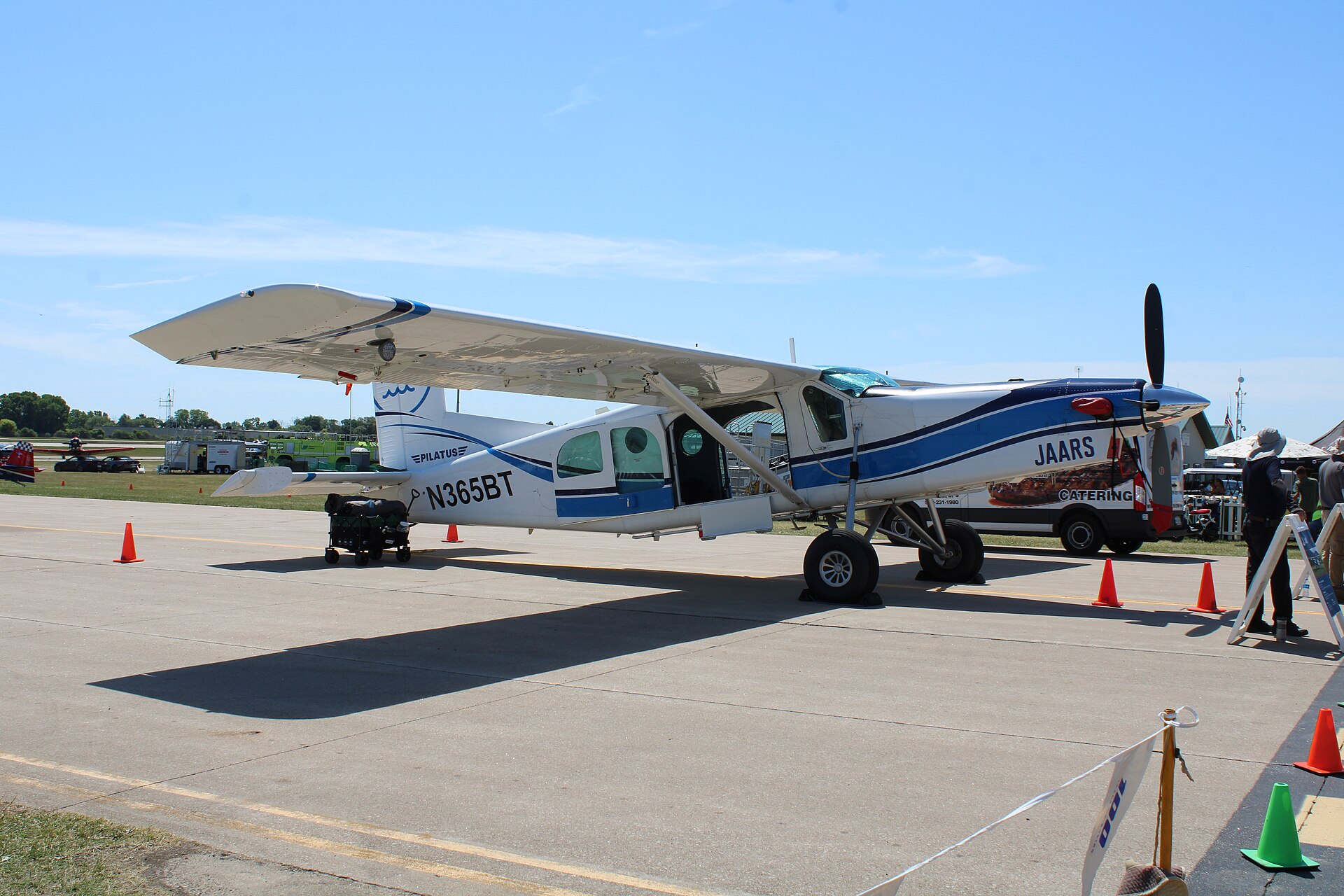
PC-6 Porter N365BT, photographed in 2023. · Photo: ZLEA via Wikimedia Commons, CC BY-SA 4.0
Pilatus · Turboprop
PC-6 Porter
The final and most common version of the PC-6 family, which ran from piston engines to PT6 turboprops.
Few aircraft can use a 1,500-foot grass strip, a snowfield or a lake the way a Porter can. As transport it is slow, short-legged and spartan, so buy one for where it can land, not how fast it gets there.
Buy it if
You need to reach backcountry strips, water or snow, run a skydiving or survey operation, or want a tough utility aircraft that clears a 50-foot obstacle in about 1,444 feet.
Skip it if
Most of your trips are airport-to-airport journeys over 300 miles, you want a pressurized cabin, a toilet or a quiet ride, or you need to fly in icing conditions, which the Porter is not approved for.
Biggest compromise
Speed and range. The Porter cruises at about 115 to 125 knots and carries 170 gallons in its standard tanks, so four passengers with proper fuel reserves go roughly 330 nautical miles.
The numbers that matter
Purchase price
$1.15M
typical asking · $808K–$2.25M
What it costs per year
$398K
at 300 hrs · one professional pilot
How far it flies
500 nm
200–330 nm with passengers
How fast
125 kt
high-speed cruise
Seats
6
6 typical, up to 10
Pilots needed
1
Flown by one pilot; dual controls are an option, common on skydiving and training aircraft.
Price
What one costs to buy
Typical asking price
$1,153,667
Where asking prices sit
Low
$808K
Typical
$1.15M
High
$2.25M
Most asking prices fall inside this band.
Other sites
Priced vs call
with a price / call for price
Only three of five advertised Porters show prices, from a 1986 skydiving aircraft to a 2015 glass-cockpit example; build year drives price.
Price vs its family and alternatives
Scroll to explore · select a jet for details
PC-6 Porter · This aircraft
$1.15M
The least expensive here; next up is the DHC-2 Turbo Beaver (conversion).
For sale now
None listed right now
Cost to own
What it costs per year to run
300hours / year
Per year
Per flight hour
Estimate — your operator will quote actual numbers.
Fuel, airframe and propeller maintenance, engine overhaul reserve and landing fees, tie-downs and miscellaneous rise as you fly more. One professional pilot, recurrent training, hangar, insurance and subscriptions and databases stay the same however much you fly.
Where the money goes
- One professional pilot$105,25026%
- Recurrent training$10,0003%
- Hangar$21,0005%
- Insurance$21,0005%
- Subscriptions and databases$4,5001%
- Fuel$109,03227%
- Airframe and propeller maintenance$84,99921%
- Engine overhaul reserve$34,0509%
- Landing fees, tie-downs and miscellaneous$8,0002%
Fuel is the biggest single cost at 27% of the total.
The JetGrade
63 out of 100 — Below its class average
Peer group: Cessna Caravan 208, Daher Kodiak 100 Series III, Viking DHC-2 Turbo Beaver, Texas Turbines DHC-3 Turbo Otter, Pacific Aerospace P-750 XSTOL
Seven categories at a glance
- - - 70 = typical— This aircraft
Strongest on airport access, weakest on speed & trip time.
Grades are editorial opinions about the model, not any specific aircraft. Sponsors and affiliates have no input. Reviewed 2026-09-30.
Where it flies
Sample trips and reach
Typical trips on a map
Nonstop
Fuel stop likely
Out of reach
1 of 6 sample trips are comfortable nonstops.
Sample flight times
- 2.2 hr
Carlsbad → Las Vegas
205 nm · Nonstop with fuel to spare
- 6.0 hr
Carlsbad → Aspen
625 nm · One fuel stop; copes well with Aspen's elevation
- 7.3 hr
Santa Ana → San José del Cabo
765 nm · Two fuel stops down the Baja peninsula
- 8.5 hr
Teterboro → West Palm Beach
900 nm · Two fuel stops along the East Coast
Dallas → Teterboro
1,190 nm · Three fuel stops; about 11 hours flying
Carlsbad → Teterboro
2,100 nm · Six fuel stops; about 20 hours flying
Lineage
What came before and after
From 1959
Pilatus PC-6 Porter (piston)
Original Lycoming piston-engine Porter; first flew in May 1959.
From 1961
PC-6/A Turbo Porter
First turbine Porter, powered by a Turbomeca Astazou engine.
PC-6/B and B1 Turbo Porter
Switched to Pratt & Whitney PT6 engines, the long-term standard.
Approved 1970
PC-6/B2-H2 Turbo Porter
PT6A-27 engine and a 4,850 lb maximum takeoff weight.

1985–2022
PC-6/B2-H4 Turbo Porter
Heavier 6,173 lb version with longer wingtips; built until 2022.
What changed from the PC-6/B2-H2 Turbo Porter
- Maximum takeoff weight rose from 4,850 lb to 6,173 lb.
- Extended composite wingtips lengthened the span to 52 ft 1 in.
- Larger dorsal fin plus strengthened door area and lower fuselage.
- Revised main landing gear shock absorbers for the higher weights.
- Same PT6A-27 engine with revised torque and propeller speed limits.
- Late-production aircraft offered a Garmin G950 glass cockpit.
Size and cabin
How big it is, inside and out
Outside
Silhouette · scaled to length
Length
Wingspan
Height
Inside the cabin
Cabin length
Width
Height
Compare
How it stacks up
This aircraft
PC-6 Porter
- JetGrade
- 63
- Price
- $1.15M
- Cost per year
- $398K
- Range
- 500 nm
- Speed
- 125 kt
- Seats
- 6
- Cabin length
- 7′ 6″
- Pilots
- 1
- Years built
- 1959–2022
← Before
PC-6/B2-H2 Turbo Porter
Not yet graded
Alternative
- JetGrade
- 70
- Cost per year
- $185K
- Range
- 1,132 nm
- Speed
- 174 kt
- Seats
- 6
- Cabin length
- 15′ 10″
- Pilots
- 1
- Years built
- 2021–now
Alternative
- JetGrade
- 75
- Price
- $2.25M
- Cost per year
- $448K
- Range
- 1,070 nm
- Speed
- 186 kt
- Seats
- 8
- Cabin length
- 12′ 9″
- Pilots
- 1
- Years built
- 1985–now
Alternative
DHC-2 Turbo Beaver (conversion)
- JetGrade
- 63
- Price
- $1.84M–$2.05M guide
- Cost per year
- $392K
- Range
- 608 nm
- Speed
- 153 kt
- Seats
- 7
- Pilots
- 1
- Years built
- 1967
- Daher Kodiak 100 instead: A newer design that cruises roughly 55 knots faster with a bigger cabin, while still built for short, rough strips.
- Cessna Caravan 208 instead: Far more common, so parts, shops and resale are easier, with about double the published range, at the cost of short-field ability.
- Viking DHC-2 Turbo Beaver instead: A smaller classic bush turboprop with fewer seats, popular with float operators and a little faster in cruise.
Gold marks the best figure in each row.
Owning one
What to know before you buy
Engines & inspections
1 × Pratt & Whitney Canada PT6A-27 · 550 shp each
No APUEngine hours until overhaul
- 100-hour and annual inspection · 100 hr
- Engine hot section inspection · 1,800 hr
- Propeller overhaul · 3,000 hr
- Seven-year airframe inspection · 3,500 hr
- Trim actuator replacement · 3,500 hr
- Engine overhaul · 3,600 hr
- Fourteen-year airframe overhaul · 7,000 hr
Some Porters run an approved program that extends the overhaul interval; confirm the paperwork transfers with the aircraft.
Known issues
Tail hinge and trim directives
Several safety directives cover tail hinge brackets, hinge bolts and trim; missing work can ground the aircraft.
Wing strut and fitting checks
Repeat inspections of wing struts, bearings and wing-to-fuselage fittings are mandatory and can find costly wear.
Corrosion on older airframes
Owners report corrosion in wing struts and skin seams on older and ex-military aircraft; repairs can be expensive.
Pre-buy checklist
0 of 10 checked
Pilatus ended production in 2022 and has committed to supporting the fleet for at least 20 years. In the US, Wipaire in Minnesota is a known Porter specialist; confirm which Pilatus service centers work on the type.
Review
The full review
Strengths
- Clears a 50-foot obstacle in about 1,444 feet at maximum weight and lands over one in about 1,033 feet.
- Carries up to about 2,650 lb of people or cargo, with up to 10 passenger seats behind the pilot.
- Works from grass, gravel, snow and water, with factory skis and amphibious floats available.
Limitations
- Cruises at about 115 to 125 knots, far behind a Caravan or Kodiak at roughly 180 knots.
- Unpressurized, with no toilet and a plain utility cabin; long flights above 12,500 feet need oxygen.
- Only about 30 are registered in the US, so parts specialists, shops and buyers are scarce.
The Pilatus PC-6 Porter is a single-engine utility aircraft that Pilatus built in Switzerland from 1959 until the last one was delivered in December 2022, after 604 were made. It started with a piston engine, gained turbine power in 1961 and settled on the Pratt & Whitney Canada PT6A-27 turboprop, flat rated to 550 shaft horsepower. The version most buyers will meet is the PC-6/B2-H4 Turbo Porter, approved in 1985, which raised maximum takeoff weight to 6,173 lb and added longer wingtips and a larger tail fin. It is a very different aircraft from Pilatus's pressurized PC-12 business turboprop.
Pilot's take
The Porter rewards a pilot who respects its quirks. The powerful pitch trim must be set correctly before every takeoff, and the PT6 needs a careful hand to stay within torque limits. In return it offers remarkable slow-flight control, steep approaches with a reversible propeller for braking, and the ability to put down on strips most aircraft would never attempt. It is a tailwheel aircraft, so transition training with an experienced Porter instructor is money well spent, and insurers will expect it.
Who this is for
Owners and operators who need a go-anywhere workhorse: skydiving centers, backcountry lodges, float and ski operators, survey and relief outfits, and pilots who value landing almost anywhere over getting there quickly.

Ask about this aircraft
Answers come only from our research file on the PC-6 Porter.
Your earlier questionsOwners
Private to verified ownersOwn a Pilatus PC-6 Porter? Verify with its FAA registration to join the owners' thread and the real-cost poll.