
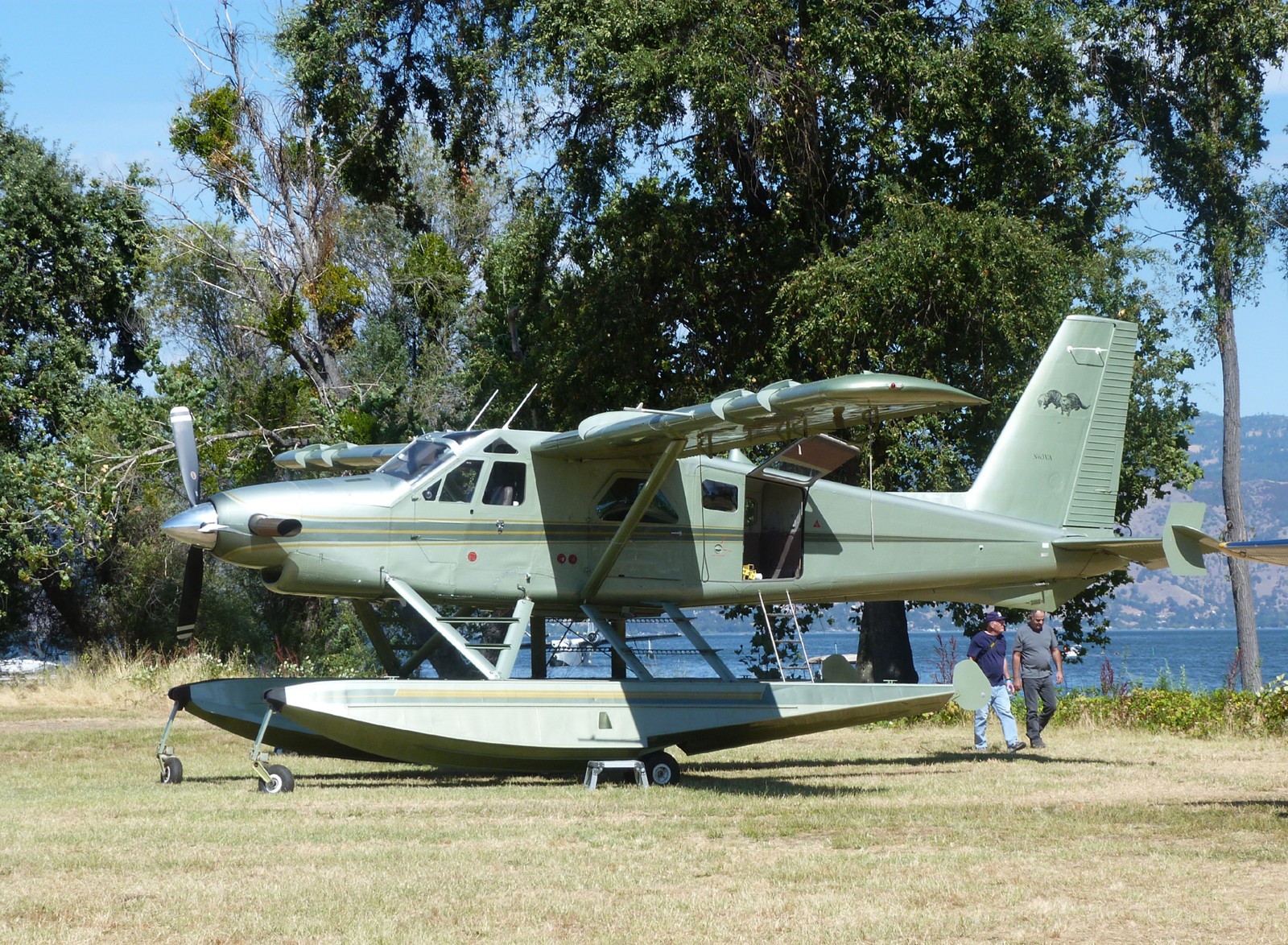
A turbine-converted Beaver on floats, photographed in September 2011. · Bill Larkins · CC BY-SA 2.0 (https://creativecommons.org/licenses/by-sa/2.0) · resized
Viking · Turboprop
DHC-2 Turbo Beaver (conversion)
An aftermarket turbine version of the 1948–1967 Beaver, built to the factory Turbo-Beaver standard.
The classic bush plane made easier to live with: smoother, better in the cold and stronger off short water. It is slow, small inside and old, so buy it for where it can land, not how far it goes.
Buy it if
You fly to lakes, gravel bars or short strips, need room for six or seven people or a big load of gear, and want a proven design with lasting resale demand.
Skip it if
Most trips run airport to airport over 300 nm, you want a quiet cabin or a toilet, or you would rather not manage an old airframe's corrosion inspections.
Biggest compromise
1M to $2M, for an airframe built between 1948 and 1967. Condition depends on decades of past use and repairs, so the inspection, corrosion history and records matter more than engine hours.
The numbers that matter
Purchase price
$1.84M–$2.05M
guide value (Business Jet Traveler aircraft directory)
What it costs per year
$392K
at 300 hrs · one professional pilot
How far it flies
608 nm
550–608 nm with passengers
How fast
153 kt
high-speed cruise
Seats
7
7 typical, up to 10 passengers
Pilots needed
1
Flown by one pilot; floatplane flying needs a seaplane rating and tailwheel experience.
Price
What one costs to buy
Guide value
$1.84M–$2.05M
Other sites
Priced vs call
with a price / call for price
Only one of three advertised conversions shows a price: $1.095M on wheels, with amphibious floats $200,000 extra. Published guide values run $1.85M–$2.05M.
Price vs its family and alternatives
Scroll to explore · select a jet for details
DHC-2 Turbo Beaver (conversion) · This aircraft
$1.84M–$2.05M guide
Guide value, not a listed asking price.
Sits between the DHC-3 Turbo Otter (conversion) and the Caravan (208).
For sale now
None listed right now
Cost to own
What it costs per year to run
300hours / year
Per year
Per flight hour
Estimate — your operator will quote actual numbers.
Fuel, airframe, propeller and float maintenance, engine program or overhaul reserve and landing fees, docking and miscellaneous rise as you fly more. One professional pilot, recurrent and egress training, hangar or seaplane base, insurance and subscriptions and databases stay the same however much you fly.
Where the money goes
- One professional pilot$92,50024%
- Recurrent and egress training$7,5002%
- Hangar or seaplane base$22,5006%
- Insurance$52,50013%
- Subscriptions and databases$3,5001%
- Fuel$101,88026%
- Airframe, propeller and float maintenance$60,00015%
- Engine program or overhaul reserve$42,00011%
- Landing fees, docking and miscellaneous$10,0003%
Fuel is the biggest single cost at 26% of the total.
The JetGrade
63 out of 100 — Below its class average
Peer group: Cessna Caravan 208, Daher Kodiak 100 Series I, Pilatus PC-6 Porter, DHC-3 Turbo Otter (conversion)
Seven categories at a glance
- - - 70 = typical— This aircraft
Strongest on airport access, weakest on range & payload.
Grades are editorial opinions about the model, not any specific aircraft. Sponsors and affiliates have no input. Reviewed 2026-10-04.
Where it flies
Sample trips and reach
Typical trips on a map
Nonstop
Fuel stop likely
Out of reach
1 of 6 sample trips are comfortable nonstops.
Sample flight times
- 2.0 hr
Carlsbad → Las Vegas
205 nm · Easy nonstop over desert mountains
- 5.3 hr
Carlsbad → Aspen
625 nm · One stop; oxygen needed over the Rockies
- 6.3 hr
Santa Ana → San José del Cabo
765 nm · Needs one fuel stop down Baja
- 7.3 hr
Teterboro → West Palm Beach
900 nm · One fuel stop along the coast
- 9.7 hr
Dallas → Teterboro
1,190 nm · Two fuel stops; a long day
Carlsbad → Teterboro
2,100 nm · Three or more stops; not a practical trip
Lineage
What came before and after
1948–1967
DHC-2 Beaver (piston)
Original bush plane with a 450 hp radial engine; about 1,600 built.
1965–1967
DHC-2 Mk III Turbo-Beaver (factory)
Factory turbine version with a longer nose and cabin; 60 built.

1980s–present
DHC-2 Turbo Beaver (conversion)
Piston Beavers re-engined with PT6 turboprops by Viking, Wipaire and others.
2023–present
Valdor BX Turbo Beaver
Canadian conversion pairing a PT6A-34 with further airframe upgrades.
What changed from the DHC-2 Beaver (piston)
- 450 hp radial replaced by a 680 hp Pratt & Whitney Canada PT6A-34 or -27 turboprop.
- Maximum weight rises from 5,100 lb to 6,000 lb with Viking's gross weight kit.
- Cabin extension adds 29 cu ft; an optional larger Alaska door takes bulky cargo.
- Larger tail, elevator finlets and wing fences improve control at low speeds.
- Jet fuel with belly refueling, upgraded electrical system and a modernized instrument panel.
- Three-blade reversing Hartzell propeller shortens takeoffs and eases water handling.
Size and cabin
How big it is, inside and out
Outside
Length
Wingspan
Inside the cabin
Height
Compare
How it stacks up
This aircraft
DHC-2 Turbo Beaver (conversion)
- JetGrade
- 63
- Price
- $1.84M–$2.05M guide
- Cost per year
- $392K
- Range
- 608 nm
- Speed
- 153 kt
- Seats
- 7
- Pilots
- 1
- Years built
- 1967
← Before
DHC-2 Beaver (piston)
Not yet graded
Alternative
- JetGrade
- 75
- Price
- $2.25M
- Cost per year
- $448K
- Range
- 1,070 nm
- Speed
- 186 kt
- Seats
- 8
- Cabin length
- 12′ 9″
- Pilots
- 1
- Years built
- 1985–now
Alternative
- JetGrade
- 73
- Cost per year
- $427K
- Range
- 1,132 nm
- Speed
- 174 kt
- Seats
- 8
- Cabin length
- 15′ 10″
- Pilots
- 1
- Years built
- 2007–2018
Alternative
DHC-3 Turbo Otter (conversion)
- JetGrade
- 68
- Price
- $1.5M–$1.7M guide
- Cost per year
- $451K
- Range
- 650 nm
- Speed
- 144 kt
- Seats
- 10
- Cabin length
- 16′ 5″
- Pilots
- 1
- Years built
- 1951–1967
- Cessna Caravan 208 instead: More cabin, more range and a far larger service network, with much newer airframes; less nimble on short water.
- Daher Kodiak 100 Series I instead: A modern purpose-built bush turboprop with similar short-field ability, longer range and a far newer airframe.
- DHC-3 Turbo Otter (conversion) instead: The Beaver's bigger sibling carries roughly 50 percent more on floats, for operators who fill every seat.
Gold marks the best figure in each row.
Owning one
What to know before you buy
Engines & inspections
1 × Pratt & Whitney Canada PT6A-34 (some PT6A-27) · 680 shp each
No APUEngine hours until overhaul
- Float strut fitting check · 110 hr
- Engine overhaul · 3,600 hr
- Annual inspection every 12 months
- Wing strut fitting check every 12 months
Pratt & Whitney Canada offers pay-per-hour coverage and a published flat-rate overhaul, $387,000 for the PT6A-34 in 2026.
Known issues
Saltwater airframe corrosion
A 2023 directive requires a structured corrosion inspection program; float-flown Beavers can need major structural repairs.
Wing strut fitting cracks
Lower wing strut fittings can crack from corrosion; saltwater aircraft need yearly checks, and cracked struts must be replaced.
Float fitting cracks
Certain float strut fittings had to be replaced under a 2020 directive, followed by checks every 110 hours.
Pre-buy checklist
0 of 9 checked
De Havilland Aircraft of Canada holds the Beaver type certificate and sells new parts with round-the-clock support; specialist shops such as Kenmore Air and Wipaire add approved parts and expertise.
Review
The full review
Strengths
- Short-field and water ability: a 1,026 ft takeoff from land on amphibious floats at the full 6,000 lb weight.
- Close to 3,000 lb useful load on wheels, with wide rear doors built for drums and bulky cargo.
- Proven 680 hp PT6 turbine: easy cold starts, jet fuel and a 3,600-hour overhaul interval.
Limitations
- Slow and short-legged: 153 knots at best and about 608 nm with reserves.
- Cabin about 4 ft 11 in tall, unpressurized, loud and without a toilet.
- Airframes are 59 to 78 years old; corrosion and fitting inspections are mandatory and can be costly.
The Turbo Beaver is a de Havilland Canada DHC-2 Beaver, the classic postwar bush plane, with its 450 hp radial engine replaced by a Pratt & Whitney Canada PT6 turboprop. De Havilland built 60 Turbo-Beavers at the factory before the line closed in 1967. Since then Viking Air in Victoria, British Columbia, and shops such as Wipaire in Minnesota have converted piston Beavers to turbine power. Viking says its conversion uses the original factory tooling and matches the factory Turbo-Beaver: a 680 hp PT6A-34 or -27, a longer cabin, a bigger tail and a 6,000 lb maximum weight, up from 5,100 lb for a piston Beaver on wheels.
Pilot's take
From the left seat, the Turbo Beaver keeps what pilots love about the Beaver and removes most of the radial's chores. The PT6 starts cleanly in the cold, the reversing propeller makes docking and short-field stops far easier, and there is power to spare on small lakes. It is still a 1940s design: heavy controls, slow cruise and a lot of noise. On floats, take water skills and underwater escape training seriously, because many floatplane accidents are survivable only if everyone gets out quickly. Plan mountain trips around oxygen and weather, not range.
Who this is for
Lodge owners, outfitters, float-flying families and commercial operators in Alaska, Canada and the Pacific Northwest who need a rugged single-pilot aircraft for short, remote legs and are comfortable maintaining a classic.

Ask about this aircraft
Answers come only from our research file on the DHC-2 Turbo Beaver (conversion).
Your earlier questionsOwners
Private to verified ownersOwn a Viking DHC-2 Turbo Beaver (conversion)? Verify with its FAA registration to join the owners' thread and the real-cost poll.