
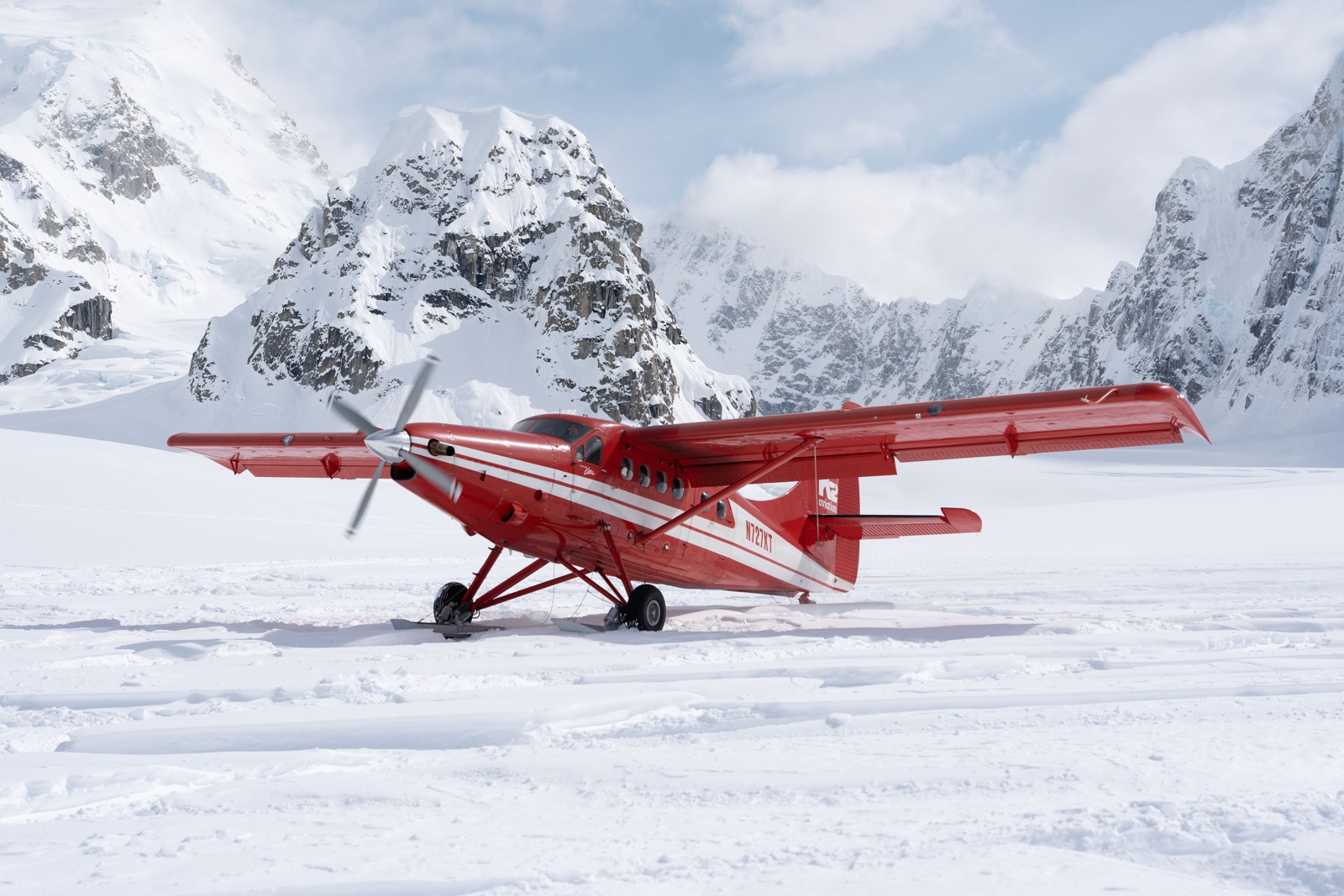
K2 Aviation DHC-3T Vazar turbine-converted Otter N727KT on skis at Denali Base Camp, photographed by Quintin Soloviev. · Quintin Soloviev · CC BY 4.0 (https://creativecommons.org/licenses/by/4.0) · resized
de Havilland Canada · Turboprop
DHC-3 Turbo Otter (conversion)
A turbine-powered rebuild of the 1950s de Havilland Canada Otter, offered by several converters since 1986.
The Turbo Otter is the floatplane operator's truck: a huge, square cabin, short-water manners and a proven turbine. It is slow, short-legged and built on airframes from 1951 to 1967, so buy the paperwork and structure first, then the engine.
Buy it if
You need to move up to ten people or bulky freight into lakes, fjords, glaciers or gravel strips, your legs are under about 400 nautical miles, and hauling capacity matters more than speed.
Skip it if
Your trips are mostly paved-runway flights over 400 nautical miles, you want a pressurized cabin or a toilet, or you are not ready to budget for the inspections an airframe built before 1968 needs.
Biggest compromise
Every Turbo Otter is a re-engined airframe built between 1951 and 1967, and the ones for sale in 2026 show 14,500 to 22,500 hours. The turbine is modern, but the wings, struts, tail and floats are not, and directives on the tail trim actuator and wing structure make records and corrosion checks as important as the engine.
The numbers that matter
Purchase price
$1.5M–$1.7M
guide value (Conklin & de Decker; Sunset Aviation Insurance)
What it costs per year
$451K
at 300 hrs · one professional pilot
How far it flies
650 nm
400–430 nm with passengers
How fast
144 kt
high-speed cruise
Seats
10
10 typical (up to 11)
Pilots needed
1
One pilot; no type rating needed, though insurers price float and turbine experience heavily.
Price
What one costs to buy
Guide value
$1.5M–$1.7M
Other sites
Priced vs call
with a price / call for price
Two Alaska-based Garrett-engine Otters from one seller ask $3.0M each; a PT6 Otter in Ontario lists at 1.7 million, sale pending. Published values run $1.5–1.7M.
Price vs its family and alternatives
Scroll to explore · select a jet for details
DHC-3 Turbo Otter (conversion) · This aircraft
$1.5M–$1.7M guide
Guide value, not a listed asking price.
The least expensive here; next up is the Caravan (208).
For sale now
None listed right now
Cost to own
What it costs per year to run
300hours / year
Per year
Per flight hour
Estimate — your operator will quote actual numbers.
Fuel, airframe, propeller and float maintenance, engine overhaul and hot section reserve and landing, dock fees, cleaning and miscellaneous rise as you fly more. One professional pilot, recurrent and seaplane training, hangar or moorage, insurance and subscriptions and databases stay the same however much you fly.
Where the money goes
- One professional pilot$112,50025%
- Recurrent and seaplane training$10,0002%
- Hangar or moorage$26,0006%
- Insurance$52,50012%
- Subscriptions and databases$6,0001%
- Fuel$110,30424%
- Airframe, propeller and float maintenance$84,99919%
- Engine overhaul and hot section reserve$40,5009%
- Landing, dock fees, cleaning and miscellaneous$8,0002%
One professional pilot is the biggest single cost at 25% of the total.
The JetGrade
68 out of 100 — Below its class average
Peer group: Cessna Caravan 208, Daher Kodiak 100 Series III, Pilatus PC-6 Porter, Viking DHC-2 Turbo Beaver, Pacific Aerospace P-750 XSTOL
Seven categories at a glance
- - - 70 = typical— This aircraft
Strongest on airport access, weakest on speed & trip time.
Grades are editorial opinions about the model, not any specific aircraft. Sponsors and affiliates have no input. Reviewed 2026-10-04.
Where it flies
Sample trips and reach
Typical trips on a map
Nonstop
Fuel stop likely
Out of reach
1 of 6 sample trips are comfortable nonstops.
Sample flight times
- 2.0 hr
Carlsbad → Las Vegas
205 nm · Comfortable nonstop with four passengers
- 5.7 hr
Carlsbad → Aspen
625 nm · One stop; mountain weather and oxygen limit it
- 6.7 hr
Santa Ana → San José del Cabo
765 nm · One fuel stop in Baja California
- 8.3 hr
Teterboro → West Palm Beach
900 nm · Two fuel stops along the East Coast
- 10.4 hr
Dallas → Teterboro
1,190 nm · Two fuel stops; a full day of flying
Carlsbad → Teterboro
2,100 nm · Four or more stops; not a practical trip
Lineage
What came before and after
1951–1967
DHC-3 Otter (piston)
Original bush hauler with a 600 hp radial engine; 466 built.

1986–present
DHC-3 Turbo Otter (conversion)
The same airframe re-engined with a 750 to 900 shp turbine.
What changed from the DHC-3 Otter (piston)
- A 750 shp PT6A or 900 shp Garrett turbine replaces the 600 hp radial engine.
- Useful load rises by about 400 to 730 lb, depending on the conversion.
- A longer, slimmer nose stretches the aircraft from 41 ft 10 in to about 45 to 46 ft.
- Climb improves from about 735 fpm to 1,000 to 1,600 fpm, depending on engine and floats.
- Overhaul intervals stretch from about 1,200 hours for the radial to 4,000 hours or more.
Size and cabin
How big it is, inside and out
Outside
Silhouette · scaled to length
Length
Wingspan
Height
Inside the cabin
Cabin length
Width
Height
Compare
How it stacks up
This aircraft
DHC-3 Turbo Otter (conversion)
- JetGrade
- 68
- Price
- $1.5M–$1.7M guide
- Cost per year
- $451K
- Range
- 650 nm
- Speed
- 144 kt
- Seats
- 10
- Cabin length
- 16′ 5″
- Pilots
- 1
- Years built
- 1951–1967
← Before
DHC-3 Otter (piston)
Not yet graded
Alternative
- JetGrade
- 75
- Price
- $2.25M
- Cost per year
- $448K
- Range
- 1,070 nm
- Speed
- 186 kt
- Seats
- 8
- Cabin length
- 12′ 9″
- Pilots
- 1
- Years built
- 1985–now
Alternative
- JetGrade
- 70
- Cost per year
- $185K
- Range
- 1,132 nm
- Speed
- 174 kt
- Seats
- 6
- Cabin length
- 15′ 10″
- Pilots
- 1
- Years built
- 2021–now
- Cessna Caravan 208 instead: A much newer airframe with 1,070 nm range, up to 186 knots and a huge service network, but a smaller cabin and longer runway needs.
- Daher Kodiak 100 Series III instead: A factory-new short-field utility turboprop with about 1,130 nm range and 174 knots, backed by a current manufacturer and modern avionics.
Gold marks the best figure in each row.
Owning one
What to know before you buy
Engines & inspections
1 × Pratt & Whitney Canada PT6A-34 (Vazar reference); Garrett TPE331-10 on Texas Turbines aircraft · 750 shp each
No APUEngine hours until overhaul
- Tail trim actuator check · 110 hr
- Actuator retention fix · 330 hr
- PT6A hot section inspection · 2,000 hr
- Garrett hot section inspection · 2,500 hr
- PT6A overhaul · 4,000 hr
- Garrett engine overhaul · 5,000 hr
- Annual inspection every 12 months
Pay-per-hour engine plans exist for both engine families; confirm a converted engine can be enrolled before counting on one.
Known issues
Tail trim actuator directive
A missing lock ring caused a fatal 2022 crash; checks every 110 hours continue until a $2,240 retention fix is fitted.
Wing strut and spar directives
Transport Canada directives cover wing struts, strut bolts, spar fittings and wing skins; cracking or corrosion here can ground the aircraft.
Corrosion on old float aircraft
Floatplanes built in the 1950s and 1960s need careful corrosion checks of the spar, struts, tail and float fittings.
Pre-buy checklist
0 of 10 checked
Pratt & Whitney Canada supports the PT6A worldwide, and De Havilland Aircraft of Canada, the type certificate holder, still supplies Otter parts. Airframe know-how sits mainly with float operators and shops in Alaska, British Columbia, Washington and Ontario.
Review
The full review
Strengths
- Big, boxy cabin of about 345 cubic feet seats ten passengers, more than a Caravan's 254 cubic feet.
- Carries about 2,560 lb with full standard tanks, so ten seats and full fuel can work on wheels.
- Turbine conversions add 400 to 730 lb of useful load over the 600 hp piston Otter and climb faster.
Limitations
- Slow: about 115 to 125 knots on floats and roughly 144 knots on wheels, versus up to 186 for a Caravan.
- Short legs: about 430 nautical miles with four passengers and reserves on wheels, and less on floats.
- Airframes are 59 to 75 years old, with tail actuator checks every 110 hours until a fix is installed.
The Turbo Otter is not a model that a factory builds. It is a de Havilland Canada DHC-3 Otter, a large single-engine bush plane built between 1951 and 1967, that has been re-engined with a turbine under a supplemental type certificate (an approved aftermarket modification). Only 466 Otters were built. The most common conversion, from Vazar since 1986, fits a 750 shp Pratt & Whitney Canada PT6A-34 or PT6A-135A. Texas Turbine Conversions offers a 900 shp Garrett TPE331-10, and the type certificate holder, now De Havilland Aircraft of Canada, approved its own PT6 version in 2009. Figures on this page refer to PT6 aircraft unless stated.
Pilot's take
From the cockpit, the Turbo Otter is a large tailwheel aircraft whose turbine gives it far more climb than the original radial: 1,000 to 1,600 feet per minute depending on conversion and floats. Water takeoffs are short, and the reversing propeller helps when docking. Loading is the daily discipline: ten seats and big doors make it easy to fill the cabin, so weight and balance has to be checked every flight. Cruise is unhurried at 115 to 125 knots on floats. We would want float and turbine experience, plus time with an Otter-experienced instructor, before carrying passengers.
Who this is for
Floatplane and bush operators, lodges and remote-property owners who need to carry ten people or a load of freight off water, snow or short strips, and who have a shop nearby that knows Otters.

Ask about this aircraft
Answers come only from our research file on the DHC-3 Turbo Otter (conversion).
Your earlier questionsOwners
Private to verified ownersOwn a de Havilland Canada DHC-3 Turbo Otter (conversion)? Verify with its FAA registration to join the owners' thread and the real-cost poll.