
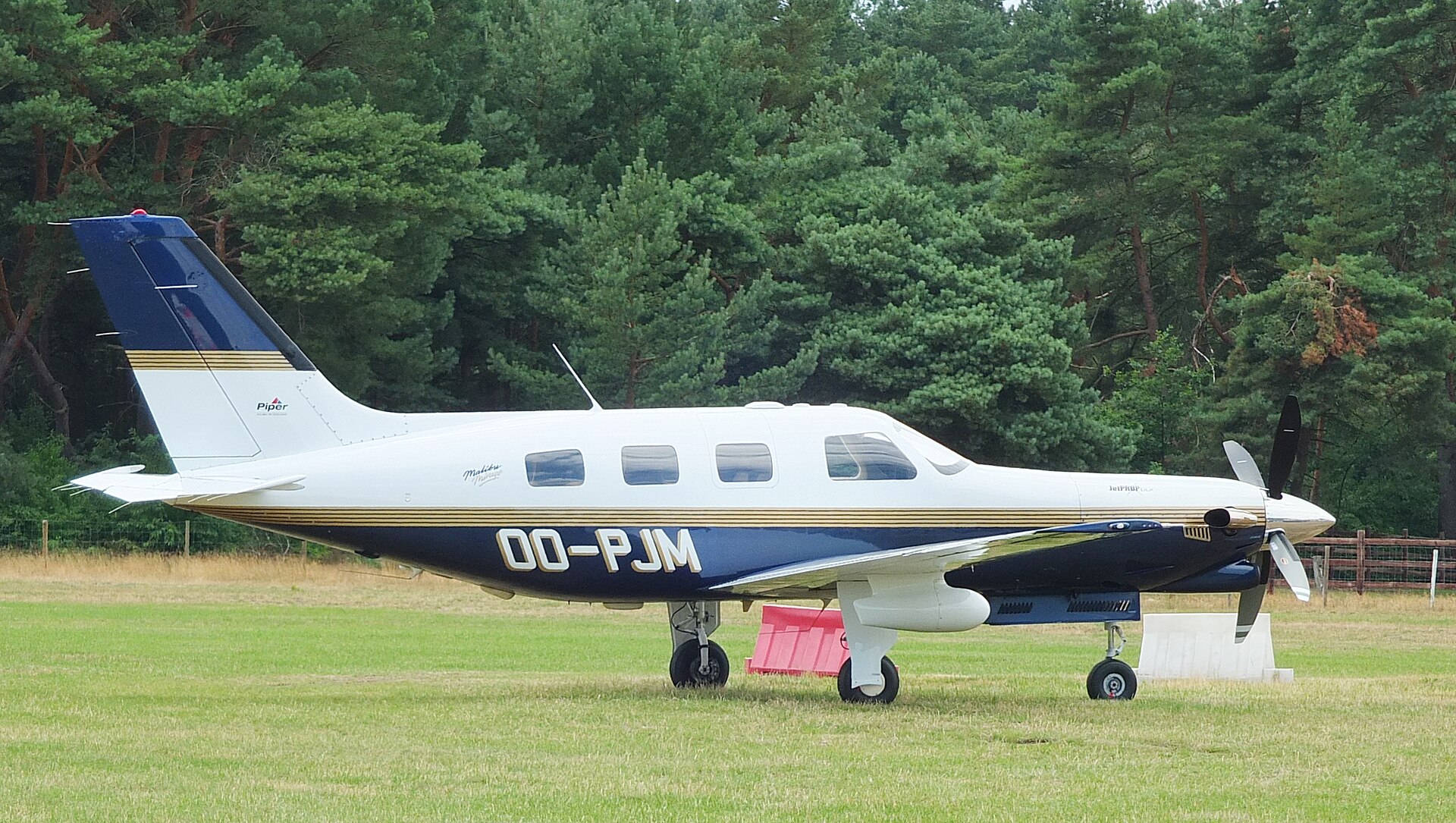
PA-46 JetPROP DLX OO-PJM, photographed in 2015. · Photo: Ad Meskens via Wikimedia Commons, CC BY-SA 4.0
Piper · Turboprop
PA-46 JetPROP DLX
An aftermarket turbine conversion of Piper's piston Malibu and Mirage, offered since 1998 alongside Piper's own factory turboprops.
The JetPROP DLX is the least expensive way into a pressurized PT6 turboprop, asking about $0.88M to $1.15M and cruising near 260 knots on little fuel. Its weakness is payload: plan on two or three people aboard, not five.
Buy it if
You fly yourself, usually with one or two passengers, and want turbine reliability, a fast climb and Meridian-like speed for less money and less fuel than a factory turboprop single.
Skip it if
You regularly carry four adults with bags, want long legs with a full cabin, or prefer a factory-built airplane with its manufacturer behind it. A Meridian, TBM or Pilatus PC-12 carries more.
Biggest compromise
Payload. A typical JetPROP weighs about 3,100 lb empty, so full tanks leave only 200–300 lb for the pilot and everyone else.
The numbers that matter
Purchase price
$1.05M
typical asking · $879K–$1.15M
What it costs per year
$347K
at 300 hrs · one professional pilot
How far it flies
1,000 nm
Four 200 lb adults leave room for only about 30 gallons; about 540 nm with two passengers
How fast
260 kt
high-speed cruise
Seats
4
4 typical; weight limits most trips
Pilots needed
1
Single-pilot airplane, nearly always flown by its owner; insurers expect turbine transition training.
Price
What one costs to buy
Typical asking price
$1,050,000
Where asking prices sit
Low
$879K
Typical
$1.05M
High
$1.15M
Most asking prices fall inside this band.
Other sites
Priced vs call
with a price / call for price
Seven of 16 listings show a price, from $879,000 to $1.145M; low engine time and modern Garmin panels command the top.
Price vs its family and alternatives
Scroll to explore · select a jet for details
PA-46 JetPROP DLX · This aircraft
$1.05M
The least expensive here; next up is the Meridian (PA-46-500TP).
For sale now
None listed right now
Cost to own
What it costs per year to run
300hours / year
Per year
Per flight hour
Estimate — your operator will quote actual numbers.
Fuel, maintenance and engine overhaul reserve rise as you fly more. One professional pilot, recurrent training, hangar, insurance and subscriptions and databases stay the same however much you fly.
Where the money goes
Partial estimate- One professional pilot$120,25035%
- Recurrent training$3,7851%
- Hangar$20,9006%
- Insurance$18,0005%
- Subscriptions and databases$1,6960%
- Fuel$85,49425%
- Maintenance$70,20020%
- Engine overhaul reserve$27,0008%
One professional pilot is the biggest single cost at 35% of the total.
The JetGrade
63 out of 100 — Below its class average
Peer group: Piper Meridian (PA-46-500TP), Daher / Socata TBM 700A, Daher / Socata TBM 700B, Cessna P210 Silver Eagle (conversion)
Seven categories at a glance
- - - 70 = typical— This aircraft
Strongest on airport access, weakest on range & payload.
Grades are editorial opinions about the model, not any specific aircraft. Sponsors and affiliates have no input. Reviewed 2026-10-04.
Where it flies
Sample trips and reach
Typical trips on a map
Depends on weight or weather
Out of reach
0 of 6 sample trips are comfortable nonstops.
Sample flight times
- 1.3 hr
Carlsbad → Las Vegas
205 nm · Four adults only in light examples; easy with three
Carlsbad → Aspen
625 nm · One stop with two aboard; mountain airport
Santa Ana → San José del Cabo
765 nm · One stop with two aboard; nonstop with one
Teterboro → West Palm Beach
900 nm · One stop with two aboard
Dallas → Teterboro
1,190 nm · Two stops with two aboard
Carlsbad → Teterboro
2,100 nm · Three stops with two aboard
Lineage
What came before and after
1984–1988
PA-46-310P Malibu
The original pressurized piston PA-46; many became JetPROPs.
1989 onward
PA-46-350P Malibu Mirage
Piston PA-46 with a new engine; the most common donor airframe.

1998–present
JetPROP DLX (conversion)
PT6A-34 or -35 turbine conversion, about 260 knots on 31–34 gallons an hour.
What changed from the PA-46-350P Malibu Mirage
- A Pratt & Whitney PT6A-34 or -35 turbine, flat rated to 560 shp, replaces the piston engine.
- A four-blade Hartzell propeller that reverses pitch to shorten landings and help on the ramp.
- Fuel grows from 120 to about 151 gallons with a header tank and extra wing capacity.
- Maximum takeoff weight is 4,300 lb, with landing weight limited to 4,100 lb.
- Burns jet fuel instead of avgas, about 31–34 gallons an hour in cruise.
- A lower-cost DL version with a 550 shp PT6A-21 followed in 2003.
Size and cabin
How big it is, inside and out
Outside
Silhouette · scaled to length
Length
Wingspan
Height
Inside the cabin
Cabin length
Width
Height
Compare
How it stacks up
This aircraft
PA-46 JetPROP DLX
- JetGrade
- 63
- Price
- $1.05M
- Cost per year
- $347K
- Range
- 1,000 nm
- Speed
- 260 kt
- Seats
- 4
- Cabin length
- 12′ 3″
- Pilots
- 1
- Years built
- 1998–now
← Before
PA-46-350P Malibu Mirage
Not yet graded
Alternative
- JetGrade
- 63
- Price
- $1.28M
- Cost per year
- $418K
- Range
- 1,000 nm
- Speed
- 260 kt
- Seats
- 4
- Cabin length
- 12′ 3″
- Pilots
- 1
- Years built
- 2000–2015
Alternative
- JetGrade
- 67
- Cost per year
- $395K
- Range
- 1,550 nm
- Speed
- 300 kt
- Seats
- 4
- Cabin length
- 13′ 4″
- Pilots
- 1
- Years built
- 1990–1999
Alternative
- JetGrade
- 77
- Price
- $2.9M
- Cost per year
- $515K
- Range
- 1,500 nm
- Speed
- 265 kt
- Seats
- 6
- Cabin length
- 16′ 11″
- Pilots
- 1
- Years built
- 1996–2005
- Piper Meridian (PA-46-500TP) instead: Piper's factory turboprop on the same cabin, with newer airframes, 170 gallons of fuel and more payload, for roughly $235,000 more.
- Daher / Socata TBM 700A instead: About 40 knots faster with more range and a larger cabin door, at a similar price but much higher fuel burn.
- Pilatus PC-12/45 instead: A far larger cabin with a cargo door and real payload, for a much higher purchase price and fuel burn.
Gold marks the best figure in each row.
Owning one
What to know before you buy
Engines & inspections
1 × Pratt & Whitney Canada PT6A-35 (early aircraft PT6A-34) · 560 shp each
No APUEngine hours until overhaul
- Fuel nozzle service · 400 hr
- Starter-generator overhaul · 1,000 hr
- Engine overhaul · 3,600 hr
- Annual inspection every 12 months
- Engine trend data review every 12 months
Pratt & Whitney Canada lists hot section plans for the PT6A-21 and -34; ask what a specific engine qualifies for before buying.
Known issues
Engine overhaul exposure
Overhaul estimates run from about $230,000 to over $400,000 at 2026 prices, up to 40% of a typical asking price.
Hot starts
A hot start can damage the turbine section; review engine trend data and borescope the hot section before buying.
Generator wiring chafe
A 2009 Rocket Engineering bulletin requires checking generator wiring near the oil door hinge for chafing and fire risk.
Pre-buy checklist
0 of 10 checked
Rocket Engineering in Spokane, Washington, holds the conversion approval, issues service bulletins and lists authorized JetPROP shops in North America, Europe and Brazil; independent PT6A shops maintain the engine.
Review
The full review
Strengths
- Burns about 31–34 gallons an hour at roughly 260 knots, less fuel than a Meridian at the same speed.
- Climbs around 2,500 feet a minute and needs about 1,200 ft to clear a 50 ft obstacle.
- Asks run $879,000 to $1.145M; the typical $1.05M sits about $235,000 below a typical Meridian.
Limitations
- With full fuel, a typical example carries only about 200–300 lb, including the pilot.
- The cabin is about 4 ft 2 in wide and 3 ft 10 in tall, with 130 lb of baggage allowance.
- Airframes date from 1984 to 2009, and conversion support depends on one company, Rocket Engineering.
The JetPROP DLX is not a factory airplane. It is a Piper PA-46 Malibu or Malibu Mirage, originally built with a piston engine, that Rocket Engineering of Spokane, Washington, rebuilt around a Pratt & Whitney Canada PT6A turbine under an FAA-approved modification first certified in 1998. About 280 DLX conversions were completed, plus a lower-cost DL version with a smaller PT6A-21 engine from 2003. Piper's own factory turboprop, the Meridian, arrived in 2000 and shares the same basic cabin.
Pilot's take
Pilots describe the JetPROP as a hot rod: strong climb, quick cruise in the mid-20,000s and reverse thrust that shortens the landing roll. The catches are discipline items. Speed builds fast, and the redline of about 173 knots is easy to exceed at high power. Starts need attention, because a hot start can damage the engine. Most of all, weight and balance has to be worked out before every trip, since full tanks and a full cabin cannot travel together. Flown light and planned carefully, it is a fast, efficient owner-flown turboprop.
Who this is for
Owner-pilots moving up from a piston Malibu, Mirage or Bonanza who usually fly alone or with one or two passengers, want jet fuel and turbine reliability, and value climb and economy over cabin size.

Ask about this aircraft
Answers come only from our research file on the PA-46 JetPROP DLX (conversion).
Your earlier questionsOwners
Private to verified ownersOwn a Piper PA-46 JetPROP DLX? Verify with its FAA registration to join the owners' thread and the real-cost poll.