
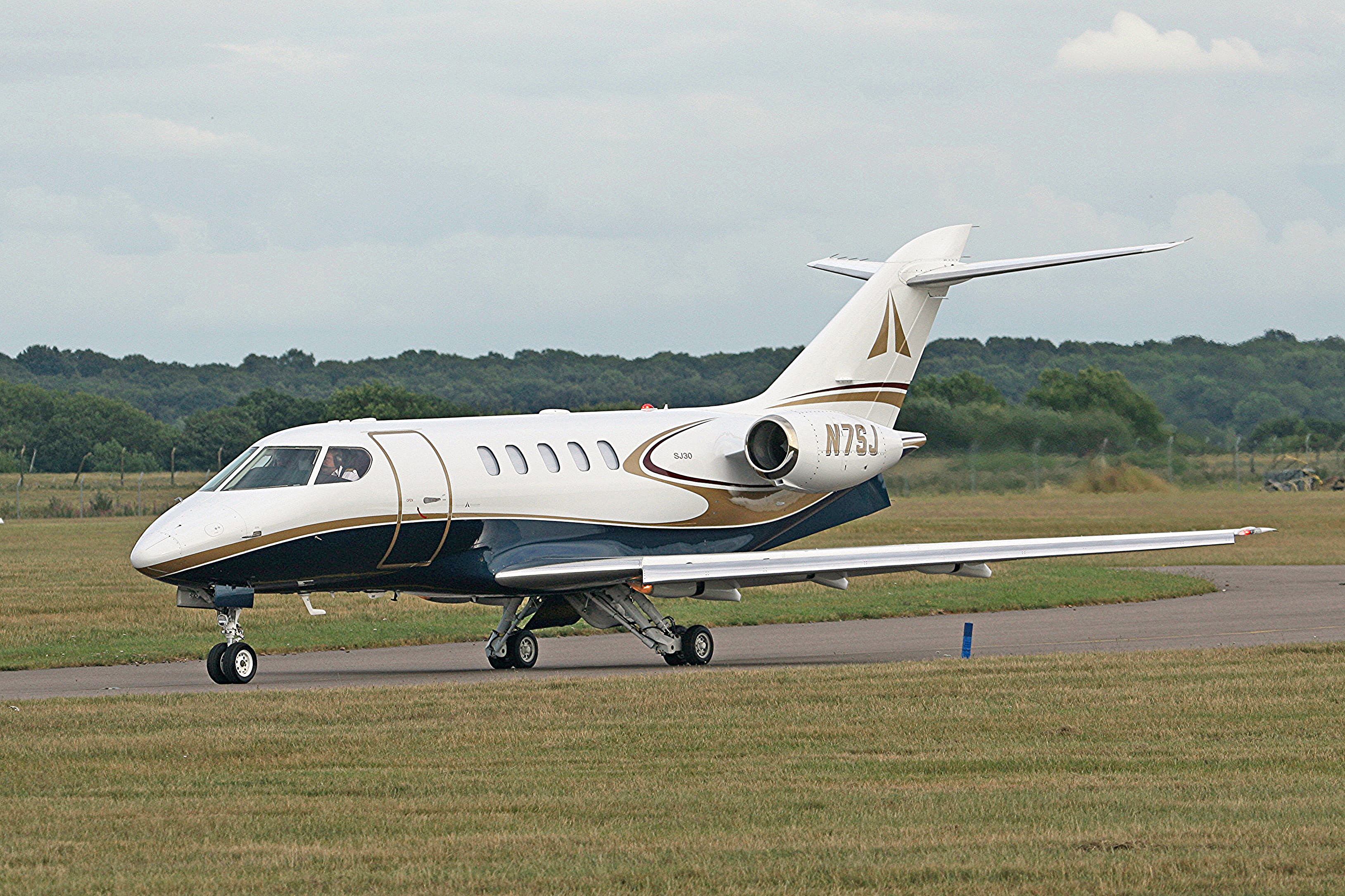
SJ30-2 N7SJ at Coventry, England, in February 2010. · Photo: Rob Hodgkins, CC BY-SA 2.0, via Wikimedia Commons
SyberJet · Light Jet
SJ30-2
The only SJ30 version ever delivered to customers; later SJ30i and SJ30x plans stalled, and SyberJet now plans the larger SJ36.
On paper the SJ30-2 outruns and outranges the light jets of its era, with a sea-level cabin up to 41,000 ft. In practice only four reached customers, none is for sale, and support depends almost entirely on SyberJet.
Buy it if
You are a collector-minded owner who values speed and long legs above everything, can fly or crew a rare single-pilot type, and have a direct relationship with SyberJet for parts and maintenance.
Skip it if
You need a jet you can buy, finance, insure, crew and resell without difficulty, want a large shop network, or regularly carry more than four passengers with bags.
Biggest compromise
Support and availability. Fewer than a dozen SJ30s were built and only four went to customers.
The numbers that matter
What it costs per year
$1.16M
at 300 hrs · two professional pilots
How far it flies
2,500 nm
About 2,205 nm with 4 passengers; about 1,635 nm at maximum payload
How fast
481 kt
high-speed cruise
Seats
4
4 club seats; up to 6 passengers
Pilots needed
1
Certified for one pilot with a working autopilot and yaw damper, or two pilots.
Price
What one costs to buy
Typical asking price
$0
Other sites
Priced vs call
with a price / call for price
No SJ30-2 was listed for sale in September 2026. New aircraft sold for roughly $7M–$8.3M; no recent resale prices are published.
Price vs its family and alternatives
Scroll to explore · select a jet for details
For sale now
None listed right now
Cost to own
What it costs per year to run
300hours / year
Per year
Per flight hour
Estimate — your operator will quote actual numbers.
Fuel, airframe maintenance, engine program and landing, handling and trip costs rise as you fly more. Two professional pilots, recurrent training, hangar, insurance and maintenance tracking and services stay the same however much you fly.
Where the money goes
- Two professional pilots$288,18525%
- Recurrent training$33,0523%
- Hangar$35,4193%
- Insurance$25,7392%
- Maintenance tracking and services$61,0335%
- Fuel$386,56833%
- Airframe maintenance$143,10012%
- Engine program$136,80012%
- Landing, handling and trip costs$52,5005%
Fuel is the biggest single cost at 33% of the total.
The JetGrade
56 out of 100 — Well below its class
Peer group: Cessna Citation CJ3, Beechcraft Premier IA, Learjet 40, Embraer Phenom 300
Seven categories at a glance
- - - 70 = typical— This aircraft
Strongest on speed & trip time, weakest on reliability & support.
Grades are editorial opinions about the model, not any specific aircraft. Sponsors and affiliates have no input. Reviewed 2026-09-30.
Where it flies
Sample trips and reach
Typical trips on a map
Nonstop
Depends on weight or weather
Out of reach
5 of 8 sample trips are comfortable nonstops.
Sample flight times
- 0.9 hr
Carlsbad → Las Vegas
205 nm · Short hop, well within range
- 1.8 hr
Carlsbad → Aspen
625 nm · Hot-and-high; depends on weight and weather
- 2.1 hr
Santa Ana → San José del Cabo
765 nm
- 2.3 hr
Teterboro → West Palm Beach
900 nm
- 3.2 hr
Dallas → Teterboro
1,190 nm · Comfortably within range with four passengers
- 3.7 hr
Teterboro → San Juan
1,410 nm · Over-water leg, well within range
- 5.6 hr
Carlsbad → Teterboro
2,100 nm · Near the four-passenger limit; winds decide
Los Angeles → Honolulu
2,215 nm · Beyond four-passenger range; only possible nearly empty
Lineage
What came before and after
First flew 1991
SJ30 prototype (SJ30-1)
Shorter original Swearingen prototype; never certified or delivered.

2006–2009
SJ30-2
Stretched, certified production version; four delivered to customers.

Planned for 2032
SJ36
Larger successor with a mockup due in October 2026.
What changed from the SJ30 prototype (SJ30-1)
- Fuselage stretched by 4 ft 4 in for a longer cabin.
- Wingspan increased by 6 ft, with dihedral replacing the prototype's anhedral.
- Landing gear made seven inches taller and nearly a foot wider.
- Williams FJ44-2A engines of 2,300 lb thrust each.
Size and cabin
How big it is, inside and out
Outside
Silhouette · scaled to length
Length
Wingspan
Height
Inside the cabin
Cabin length
Width
Height
Compare
How it stacks up
This aircraft
SJ30-2
- JetGrade
- 56
- Cost per year
- $1.16M
- Range
- 2,500 nm
- Speed
- 481 kt
- Seats
- 4
- Cabin length
- 12′ 6″
- Pilots
- 1
- Years built
- 2006–2009
← Before
SJ30 prototype (SJ30-1)
Not yet graded
After →
- JetGrade
- Not yet graded
- Range
- 2,500 nm
- Speed
- 486 kt
- Seats
- 4
- Cabin length
- 12′ 6″
- Pilots
- 1
- Years built
- 2015
Alternative
- JetGrade
- 71
- Cost per year
- $955K
- Range
- 1,875 nm
- Speed
- 417 kt
- Seats
- 6
- Cabin length
- 15′ 8″
- Pilots
- 1
- Years built
- 2004–2014
Alternative
- JetGrade
- 66
- Cost per year
- $981K
- Range
- 1,300 nm
- Speed
- 451 kt
- Seats
- 6
- Cabin length
- 13′ 6″
- Pilots
- 1
- Years built
- 2005–2012
Alternative
- JetGrade
- 70
- Cost per year
- $1.27M
- Range
- 1,971 nm
- Speed
- 453 kt
- Seats
- 7
- Cabin length
- 17′ 2″
- Pilots
- 1
- Years built
- 2009–2017
- Cessna Citation CJ3 instead: Slower at about 417 kt, but a longer 15 ft 8 in cabin, a huge service network and a liquid market around $5M.
- Beechcraft Premier IA instead: The same FJ44-2A engines and about 450 kt, with a taller, wider cabin, but roughly half the range with four passengers.
- Embraer Phenom 300 instead: A roomier cabin with an enclosed lavatory and broad factory support, cruising near 450 kt, for buyers who need more seats.
Gold marks the best figure in each row.
Owning one
What to know before you buy
Engines & inspections
2 × Williams International FJ44-2A · 2,300 lbf each
No APUEngine hours until overhaul
- Engine hot section inspection · 1,750 hr
- Engine overhaul · 3,500 hr
- Emergency gear bottle every 180 months
Williams' TAP Blue pay-per-hour plan covers FJ44 engines and raises overhaul to 5,000 hours; check each aircraft's enrollment and transfer terms.
Known issues
Very small, concentrated fleet
Fewer than a dozen were built and five of six US-registered aircraft belong to one company, so parts and know-how come mainly from SyberJet.
Manufacturer's uncertain history
The maker went through bankruptcy in 2010 and several ownership changes; long-term parts and engineering support depends on SyberJet's future.
Engine turbine disk directive
A 2022 FAA directive requires early removal of certain FJ44-2A turbine disks; the FAA estimated about $19,500 per engine.
Pre-buy checklist
0 of 10 checked
SyberJet's maintenance subsidiary in Cedar City, Utah, maintains the aircraft still flying, and Williams International supports the FJ44-2A engines. There is no wider network of factory service centers.
Review
The full review
Strengths
- Cruises at about 475–486 kt (up to 560 mph), faster than any other light jet of its generation.
- About 2,200 nm with four passengers and reserves: Los Angeles to New York nonstop in good conditions.
- Sea-level cabin pressure up to 41,000 ft, and about 1,800 ft at its 49,000 ft ceiling.
Limitations
- The cabin is 12 ft 6 in long and 4 ft 4 in tall, with four club seats and a belted toilet.
- With full fuel it carries only about 280 lb, so long trips mean one passenger or less fuel.
- Only four aircraft reached customers and production ended in 2009, so support rests mainly with SyberJet.
The SJ30-2 is the production version of a light jet first drawn up by Ed Swearingen in the 1980s. A shorter prototype, the SJ30, flew in 1991. The stretched SJ30-2 won FAA certification in October 2005 under Sino Swearingen, and the first customer aircraft was delivered in November 2006. The company became Emivest Aerospace, filed for bankruptcy in 2010 and re-emerged as SyberJet in 2011. Production stopped in 2009 after only four aircraft had reached customers, and fewer than a dozen airframes were built in all, including prototypes. SyberJet later announced the SJ30i and SJ30x with new cockpits and engines, but neither entered service, and it now plans a larger jet, the SJ36.
Pilot's take
Pilots who have flown the SJ30-2 describe it as quick, maneuverable and long-legged, with a high-speed swept wing that rewards precise flying. It climbs to 37,000 ft in about 16 minutes, and the 12 psi cabin makes long legs noticeably easier on everyone aboard. Single-pilot operation depends on a working autopilot, yaw damper and rudder bias system, so their status matters before every flight. At heavy weights it wants long runways, especially on hot days. With so few aircraft flying, crews should expect training and technical help to come from a very small pool of people.
Who this is for
Experienced owner-pilots or small flight departments who want the fastest, longest-legged light jet of its era, fly one to four people, and are comfortable owning a near-orphan type with a single support source.

Ask about this aircraft
Answers come only from our research file on the SJ30 (Sino Swearingen SJ30-2).
Your earlier questionsOwners
Private to verified ownersOwn a SyberJet SJ30-2? Verify with its FAA registration to join the owners' thread and the real-cost poll.