
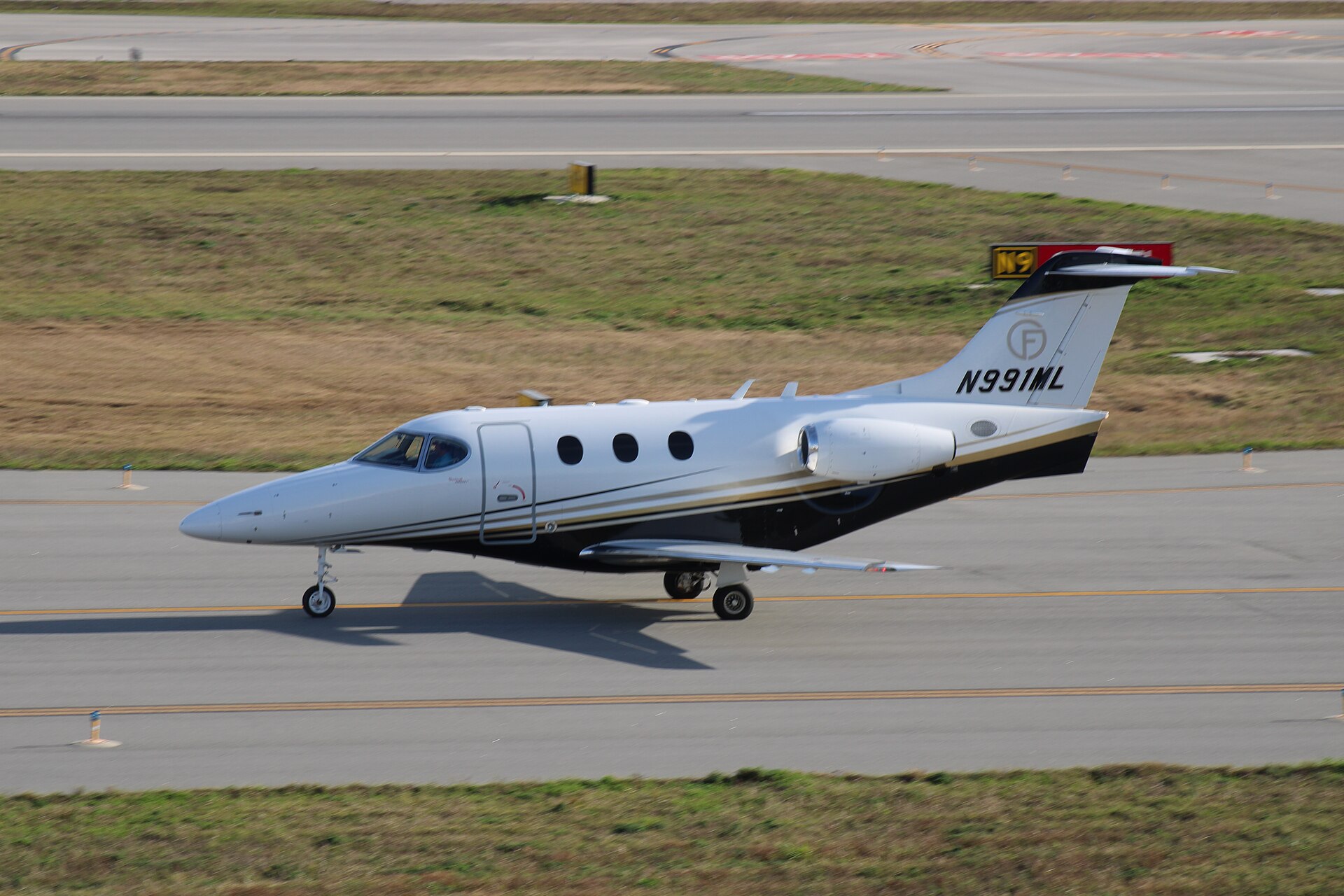
Premier IA N991ML, photographed in 2023. · Photo: ZLEA via Wikimedia Commons, CC BY-SA 4.0
Beechcraft · Light Jet
Premier IA (390)
The second and final version of Beechcraft's composite-fuselage Premier, built from 2005 to 2012.
The Premier IA delivers near-midsize speed and a wide cabin for the price of an older Citation. The trade-offs are short legs with a full load, no thrust reversers and out-of-production status, so engine program and records drive value.
Buy it if
You usually fly one to four people on trips under about 1,000 nm, want to get there fast, prefer a wider cabin than any Citation CJ, and have a good specialist shop nearby.
Skip it if
You regularly fill all six seats, need nonstop range past about 1,100 nm, often use short or high-elevation runways, or want the deepest factory support network. Look at a CJ2+ or CJ3 instead.
Biggest compromise
Payload with full tanks. With a typical 8,600 lb empty weight, full fuel leaves only about 320 lb for people and bags, roughly two adults.
The numbers that matter
Purchase price
$1.8M–$2.5M
guide value (JETNET asking-price data on AvBuyer and Guardian Jet market data)
What it costs per year
$981K
at 300 hrs · one professional pilot
How far it flies
1,105 nm
850–1,105 nm with passengers
How fast
451 kt
high-speed cruise
Seats
6
6 passengers in a club layout
Pilots needed
1
Certified for one pilot by design; the FAA's 2026 Citation single-pilot change does not affect it.
Price
What one costs to buy
Guide value
$1.8M–$2.5M
Other sites
Priced vs call
with a price / call for price
None of the ten Premier IAs listed shows a price. Published market data puts asking prices at about $1.8M–2.5M, depending on year and engine program.
Price vs its family and alternatives
Scroll to explore · select a jet for details
Premier IA (390) · This aircraft
$1.8M–$2.5M guide
Guide value, not a listed asking price.
Sits between the Hawker 400XP (400A) and the Citation CJ2+ (525A).
For sale now
None listed right now
Cost to own
What it costs per year to run
300hours / year
Per year
Per flight hour
Estimate — your operator will quote actual numbers.
Fuel, airframe maintenance, engine program or reserve and crew travel, landing and handling fees rise as you fly more. One professional pilot, salary and benefits, recurrent pilot training, hangar, hull and liability insurance and charts, databases and other fixed costs stay the same however much you fly.
Where the money goes
- One professional pilot, salary and benefits$197,76620%
- Recurrent pilot training$30,7103%
- Hangar$28,3393%
- Hull and liability insurance$17,7642%
- Charts, databases and other fixed costs$9,9671%
- Fuel$340,65635%
- Airframe maintenance$152,18116%
- Engine program or reserve$135,90314%
- Crew travel, landing and handling fees$67,5007%
Fuel is the biggest single cost at 35% of the total.
The JetGrade
66 out of 100 — Below its class average
Peer group: Cessna Citation CJ2 (525A), Cessna Citation CJ2+ (525A), Cessna Citation CJ3 (525B), Hawker 400XP, Cessna Citation Bravo (550B)
Seven categories at a glance
- - - 70 = typical— This aircraft
Strongest on speed & trip time, weakest on range & payload.
Grades are editorial opinions about the model, not any specific aircraft. Sponsors and affiliates have no input. Reviewed 2026-09-29.
Where it flies
Sample trips and reach
Typical trips on a map
Nonstop
Depends on weight or weather
Fuel stop likely
3 of 6 sample trips are comfortable nonstops.
Sample flight times
- 0.9 hr
Carlsbad → Las Vegas
205 nm
- 2.0 hr
Carlsbad → Aspen
625 nm · High-elevation airport; depends on weight and weather
- 2.3 hr
Santa Ana → San José del Cabo
765 nm
- 3.0 hr
Teterboro → West Palm Beach
900 nm · Nonstop with four at long-range cruise
- 4.0 hr
Dallas → Teterboro
1,190 nm · Needs one stop with four passengers
- 6.7 hr
Carlsbad → Teterboro
2,100 nm · Usually two stops; one possible when lightly loaded
Lineage
What came before and after


2005–2012
Premier IA
Better brakes, a pilot-controlled lift dump, a third screen and a quieter cabin.
Cancelled 2011
Premier II (cancelled)
A planned longer-range version that was never certified or built.
What changed from the Premier I
- Added a third cockpit display and Collins IFIS with electronic charts and weather overlays.
- New brake master cylinder and improved anti-skid for smoother, more predictable braking.
- Lift dump became a pilot-operated lever, replacing an automatic system that could fail after bounces.
- Restyled seats, more headroom, LED lighting and an acoustic liner for a quieter cabin.
- A new exterior finish stops carbon fiber from showing through the paint.
Size and cabin
How big it is, inside and out
Outside
Silhouette · scaled to length
Length
Wingspan
Height
Inside the cabin
Cabin length
Width
Height
Compare
How it stacks up
This aircraft
Premier IA (390)
- JetGrade
- 66
- Price
- $1.8M–$2.5M guide
- Cost per year
- $981K
- Range
- 1,300 nm
- Speed
- 451 kt
- Seats
- 6
- Cabin length
- 13′ 6″
- Pilots
- 1
- Years built
- 2005–2012
← Before
- JetGrade
- 68
- Price
- $1.5M–$1.7M guide
- Cost per year
- $961K
- Range
- 1,365 nm
- Speed
- 451 kt
- Seats
- 6
- Cabin length
- 13′ 7″
- Pilots
- 1
- Years built
- 2001–2005
Alternative
- JetGrade
- Not yet graded
- Price
- $3.9M
- Range
- 1,613 nm
- Speed
- 418 kt
- Seats
- 5
- Years built
- 2006–2016
Alternative
- JetGrade
- 67
- Price
- $1.79M–$2.1M guide
- Cost per year
- $1.27M
- Range
- 1,510 nm
- Speed
- 450 kt
- Seats
- 7
- Cabin length
- 15′ 6″
- Pilots
- 2
- Years built
- 2003–2010
Alternative
- JetGrade
- 71
- Price
- $5.2M
- Cost per year
- $955K
- Range
- 1,875 nm
- Speed
- 417 kt
- Seats
- 6
- Cabin length
- 15′ 8″
- Pilots
- 1
- Years built
- 2004–2014
- Cessna Citation CJ2+ (525A) instead: Slower with a narrower cabin, but carries more with full tanks, flies farther with passengers and has Textron's factory service network behind it.
- Hawker 400XP instead: Similar speed and a private aft lavatory for less money, but it needs two pilots and burns noticeably more fuel.
- Cessna Citation CJ3 (525B) instead: Costs roughly twice as much, but carries more, flies about 1,875 nm on full tanks and keeps strong resale and support.
Gold marks the best figure in each row.
Owning one
What to know before you buy
Engines & inspections
2 × Williams FJ44-2A · 2,300 lbf each
No APUEngine hours until overhaul
- Engine and lubrication checks · 200 hr
- A inspection · 600 hr
- A and B inspection · 1,200 hr
- Engine hot section · 2,500 hr
- Engine overhaul · 5,000 hr
The 5,000-hour overhaul and 2,500-hour hot section apply on Williams' TAP programs; engines off program use a 3,500-hour overhaul.
Known issues
Out-of-production orphan jet
Production ended in 2012 and Textron never restarted it; support is workable today but thinner than for Citations.
Hydraulic pump directives
Two FAA directives target hydraulic tubing and engine-driven pumps; one fix costs about $17,600 per pump.
Composite fuselage repairs
The carbon-fiber fuselage needs specialist repair shops; hidden damage or poor past repairs can be costly.
Pre-buy checklist
0 of 8 checked
Textron Aviation holds the type certificate, and the Williams engines and Collins avionics are shared with many jets. Independent shops handle much of the work, and owners report parts are generally obtainable.
Review
The full review
Strengths
- Cruises at up to 451 knots and climbs at about 4,000 feet per minute, among the quickest light jets.
- The cabin is 5 ft 6 in wide and 5 ft 5 in tall, wider than any Citation CJ.
- Certified for a single pilot from the start, with asking prices around $1.8M–2.5M.
Limitations
- Full-fuel payload is only about 320 lb, and four passengers cut range to about 1,105 nm.
- No thrust reversers and a 3,792 ft takeoff distance limit short and high-elevation runways.
- Out of production since 2012, with thinner factory support and fewer specialist shops than Citations.
The Premier IA is the second and final version of Beechcraft's Model 390 Premier, the light jet Raytheon launched with a carbon-fiber fuselage and a swept metal wing. The original Premier I entered service in 2001; the IA replaced it in late 2005 and was built until Hawker Beechcraft's bankruptcy ended jet production in 2012. About 163 were built and roughly 153 are still flying. A stretched Premier II was planned but never certified, so the IA is the end of the line.
Pilot's take
We like how the Premier IA flies like a bigger jet: quick climbs, a 451-knot cruise and a cockpit laid out for one pilot with three big screens. The trade is discipline. Weight and balance matter on every trip, because full tanks leave little room for passengers. Without thrust reversers, the anti-skid brakes and lift dump do the stopping, so pilots need to know the abnormal procedures cold, especially a go-around with lift dump deployed. Treat recurrent training seriously and it is a rewarding, efficient machine for short and medium trips.
Who this is for
An owner-pilot or small company moving two to four people on regional trips of 300 to 1,000 nm, who values speed and cabin width over range and budgets about $1M a year with a professional pilot.

Ask about this aircraft
Answers come only from our research file on the Premier IA.
Your earlier questionsOwners
Private to verified ownersOwn a Beechcraft Premier IA (390)? Verify with its FAA registration to join the owners' thread and the real-cost poll.