
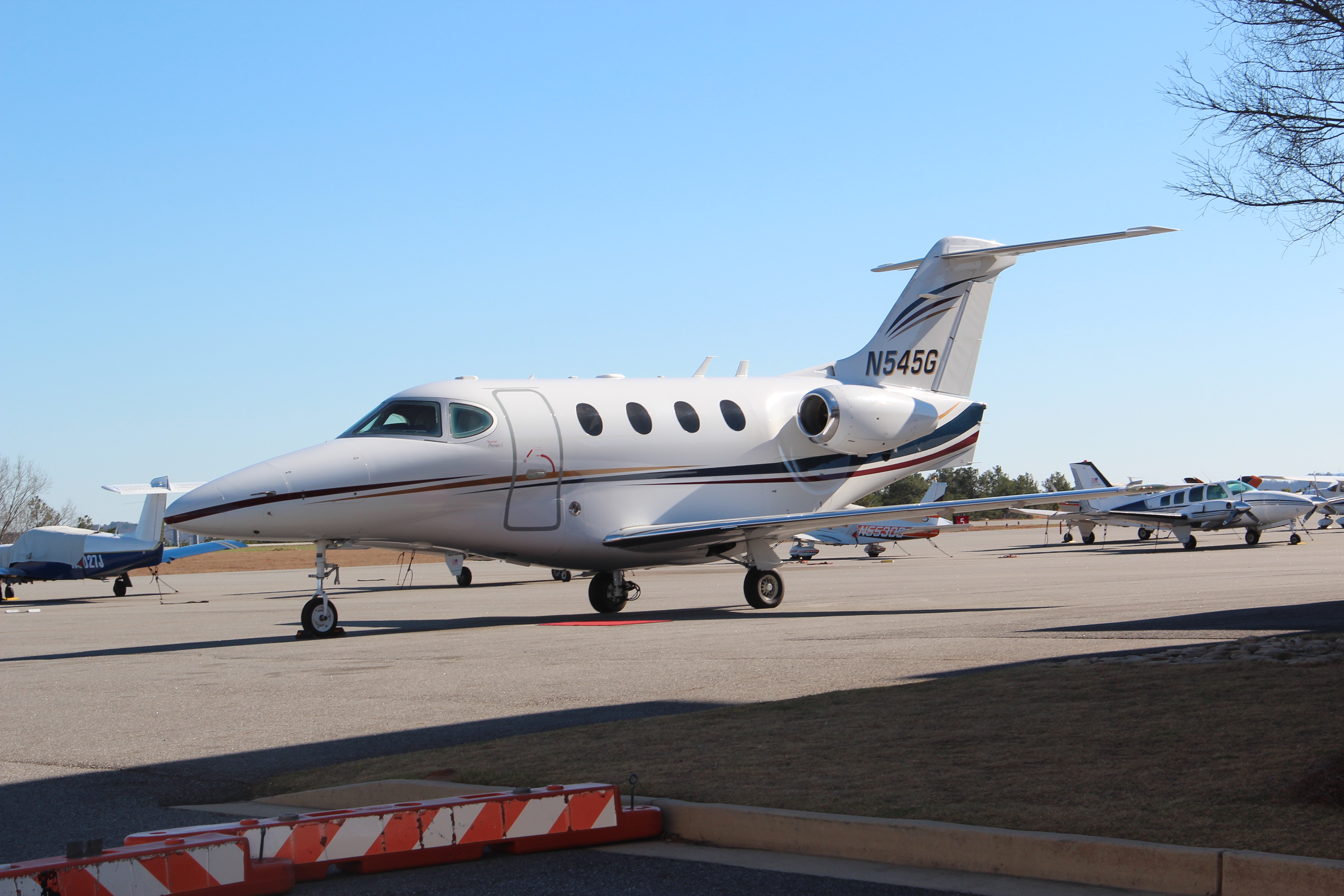
Premier I N545G parked at Cherokee County Regional Airport, Georgia, in February 2017. · Thomson200, CC0 1.0, via Wikimedia Commons
Beechcraft · Light Jet
Premier I (390)
First of two Premier versions; a clean-sheet design with no earlier model.
The Premier I pairs 451-knot speed with the widest cabin among single-pilot jets of its era, for roughly $1.3M to $1.7M. The catch: little payload with full fuel, longer runways than a Citation CJ, and early-build quirks that need checking.
Buy it if
You usually carry one to four people on trips under about 1,000 nm, value speed and cabin width over range, and want a single-pilot jet for well under $2M.
Skip it if
You often fill all six seats with bags, use runways shorter than about 4,000 ft, or want the deep service network and easier resale of a Citation CJ.
Biggest compromise
Payload. With full tanks the Premier I carries only about 420 lb, so filling the seats means cutting fuel, and six passengers can go roughly 790 nm.
The numbers that matter
Purchase price
$1.5M–$1.7M
guide value (AvBuyer price guide)
What it costs per year
$961K
at 300 hrs · one professional pilot
How far it flies
1,365 nm
787–1,158 nm with passengers
How fast
451 kt
high-speed cruise
Seats
6
6 passenger seats
Pilots needed
1
Certified for one pilot; many owners still fly with two.
Price
What one costs to buy
Guide value
$1.5M–$1.7M
Other sites
Priced vs call
with a price / call for price
Only two of nine listings show a price ($1.315M and $1.695M). AvBuyer's price guide puts 2001 to 2005 aircraft around $1.5M to $1.7M.
Price vs its family and alternatives
Scroll to explore · select a jet for details
Premier I (390) · This aircraft
$1.5M–$1.7M guide
Guide value, not a listed asking price.
The least expensive here; next up is the Hawker 400XP (400A).
For sale now
None listed right now
Cost to own
What it costs per year to run
300hours / year
Per year
Per flight hour
Estimate — your operator will quote actual numbers.
Fuel, airframe maintenance, scheduled + unscheduled, engine program or reserve (both engines) and crew travel, landing, handling and misc rise as you fly more. One professional pilot, salary and benefits, recurrent type training, hangar and hull and liability insurance stay the same however much you fly.
Where the money goes
- One professional pilot, salary and benefits$200,33821%
- Recurrent type training$30,7103%
- Hangar$28,3393%
- Hull and liability insurance$17,1242%
- Fuel$335,01635%
- Airframe maintenance, scheduled + unscheduled$152,48116%
- Engine program or reserve (both engines)$127,00513%
- Crew travel, landing, handling and misc$69,9677%
Fuel is the biggest single cost at 35% of the total.
The JetGrade
68 out of 100 — Below its class average
Peer group: Cessna Citation CJ2 (525A), Cessna Citation CJ1+ (525), Hawker 400XP, Cessna Citation Bravo (550B)
Seven categories at a glance
- - - 70 = typical— This aircraft
Strongest on speed & trip time, weakest on reliability & support.
Grades are editorial opinions about the model, not any specific aircraft. Sponsors and affiliates have no input. Reviewed 2026-09-29.
Where it flies
Sample trips and reach
Typical trips on a map
Nonstop
Depends on weight or weather
Fuel stop likely
3 of 6 sample trips are comfortable nonstops.
Sample flight times
- 0.9 hr
Carlsbad → Las Vegas
205 nm · Short hop at high-speed cruise
- 2.0 hr
Carlsbad → Aspen
625 nm · High-elevation arrival; runway and weather dependent
- 2.3 hr
Santa Ana → San José del Cabo
765 nm · Comfortable nonstop with four passengers
- 2.6 hr
Teterboro → West Palm Beach
900 nm · Nonstop with four; headwinds reduce margin
- 3.7 hr
Dallas → Teterboro
1,190 nm · Just beyond four-passenger range; tailwinds may allow nonstop
- 6.1 hr
Carlsbad → Teterboro
2,100 nm · One stop mid-continent; winter westbound may need two
Lineage
What came before and after

2001–2005
Beechcraft Premier I
Original carbon-fiber single-pilot jet with a 451-knot cruise.

Size and cabin
How big it is, inside and out
Outside
Silhouette · scaled to length
Length
Wingspan
Height
Inside the cabin
Cabin length
Width
Height
Compare
How it stacks up
This aircraft
Premier I (390)
- JetGrade
- 68
- Price
- $1.5M–$1.7M guide
- Cost per year
- $961K
- Range
- 1,365 nm
- Speed
- 451 kt
- Seats
- 6
- Cabin length
- 13′ 7″
- Pilots
- 1
- Years built
- 2001–2005
After →
- JetGrade
- 66
- Price
- $1.8M–$2.5M guide
- Cost per year
- $981K
- Range
- 1,300 nm
- Speed
- 451 kt
- Seats
- 6
- Cabin length
- 13′ 6″
- Pilots
- 1
- Years built
- 2005–2012
Alternative
- JetGrade
- 71
- Price
- $3.02M
- Cost per year
- $857K
- Range
- 1,600 nm
- Speed
- 410 kt
- Seats
- 6
- Pilots
- 1
- Years built
- 2000–2006
Alternative
- JetGrade
- 67
- Price
- $1.79M–$2.1M guide
- Cost per year
- $1.27M
- Range
- 1,510 nm
- Speed
- 450 kt
- Seats
- 7
- Cabin length
- 15′ 6″
- Pilots
- 2
- Years built
- 2003–2010
- Cessna Citation CJ2 (525A) instead: Slower at about 410 knots, but more range with four, shorter runways and a much larger service network, for roughly twice the price.
- Beechcraft Premier IA instead: Same speed and cabin with a manual lift dump, better brakes, a third cockpit screen and a nicer interior; costs more to buy.
- Hawker 400XP instead: Similar speed with thrust reversers and more payload, but it needs two pilots and burns far more fuel.
Gold marks the best figure in each row.
Owning one
What to know before you buy
Engines & inspections
2 × Williams International FJ44-2A · 2,300 lbf each
No APUEngine hours until overhaul
- 200-hour routine inspection · 200 hr
- A inspection · 600 hr
- A and B inspection · 1,200 hr
- Tail section inspection · 1,200 hr
- Engine hot section inspection · 2,500 hr
- Engine overhaul · 3,500 hr
- Wing inspection · 3,600 hr
Nearly every listed aircraft is on Williams TAP Blue, which extends the overhaul interval to 5,000 hours. Confirm enrollment level and transfer terms.
Known issues
Lift dump failures
The early automatic lift dump sometimes failed, lengthening landings about 53%. Most aircraft now have a manual system.
Grabby early brakes
Cable-operated brakes were grabby; the Premier IA's redesigned master cylinder fixed it, and upgrades exist.
Hydraulic pump directive
An FAA directive required checking and replacing some engine-driven hydraulic pumps, about $17,600 each.
Pre-buy checklist
0 of 9 checked
Textron Aviation supports the Premier line, and its Williams engines and Collins avionics are shared with other jets. Fewer shops know the type well than know the Citations.
Review
The full review
Strengths
- Cruises at 451 knots and reaches 41,000 ft in about 23 minutes, the fastest single-pilot jet of its era.
- Cabin is 5 ft 6 in wide and 5 ft 5 in tall, with an enclosed aft lavatory.
- Priced listings ask $1.3M to $1.7M, well below the $2.75M-plus sellers ask for a Citation CJ2.
Limitations
- Only about 420 lb of payload with full fuel; six passengers cut range to roughly 790 nm.
- Needs about 3,792 ft for takeoff at sea level at maximum weight, and has no thrust reversers.
- Only about 133 were built, and early aircraft had lift dump and grabby brake problems.
The Premier I was Raytheon Beechcraft's attempt to build a faster, roomier alternative to Cessna's CitationJet line. It was certified in March 2001 and about 133 were built before the improved Premier IA replaced it in 2005. Its fuselage is made of carbon fiber rather than aluminum, which let Beechcraft give it the widest and tallest cabin of any jet certified for a single pilot at the time. Two Williams FJ44-2A engines of 2,300 lb of thrust each sit on the rear fuselage under a T-tail.
Pilot's take
The Premier I rewards a disciplined pilot. It climbs quickly, cruises near 450 knots and is certified for one pilot, so a well-trained owner can handle it. The things to respect are on the ground: approach speeds run higher than in a CitationJet, there are no thrust reversers, and stopping depends on the lift dump spoilers and brakes working as designed. Know which lift dump system your aircraft has, practice the procedure for when it fails, and plan runways with margin. Treated that way, it is a quick, capable airplane.
Who this is for
An owner-pilot or small company flying one to four people 300 to 1,000 nm at a time, who wants jet speed and a roomy cabin on a modest budget and will keep an experienced pilot and a capable shop on call.

Ask about this aircraft
Answers come only from our research file on the Premier I.
Your earlier questionsOwners
Private to verified ownersOwn a Beechcraft Premier I (390)? Verify with its FAA registration to join the owners' thread and the real-cost poll.