
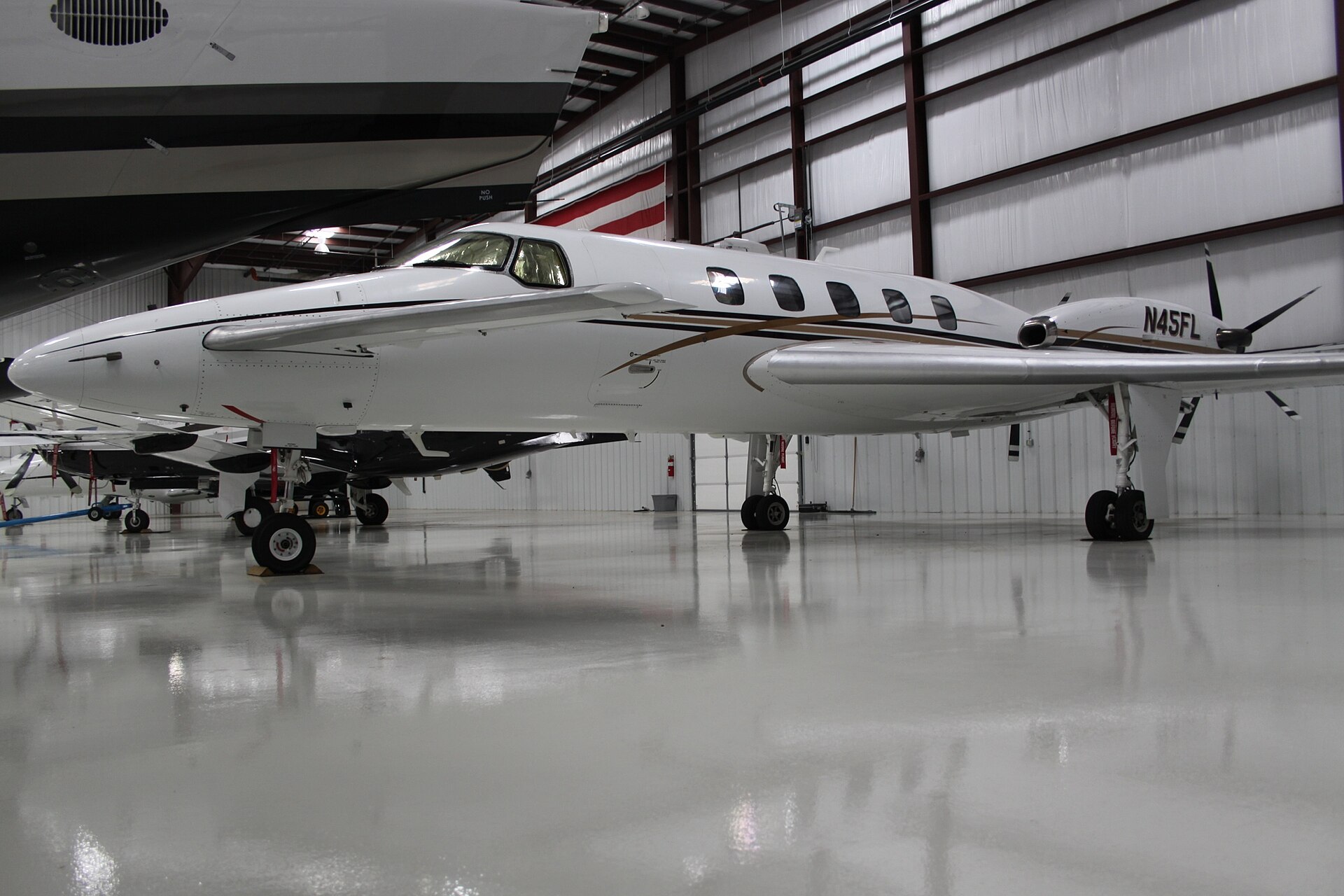
Starship 2000A N45FL, photographed in 2012. · Photo: Aeroprints.com via Wikimedia Commons, CC BY-SA 3.0
Beechcraft · Turboprop
Starship 2000A
The improved second and final version of Beech's composite Starship, built from 1992 to 1995.
The Starship 2000A is a fast, quiet and roomy turboprop that its maker abandoned in 2003. With no factory parts, few pilots and no real market, it is a collector's aircraft for a committed specialist, not practical business transport.
Buy it if
You want one of aviation's great design experiments, have access to the small specialist network that keeps the survivors flying, and can treat downtime and parts hunts as part of the experience.
Skip it if
You need dependable business transport, a resale market or a maintenance shop near home. A King Air 350 or Piaggio Avanti does the same job with factory support behind it.
Biggest compromise
Support. Beechcraft stopped supporting the Starship in 2003 and destroyed most of the fleet, so parts, repairs and pilot training now come from a handful of private owners and one Texas repair station.
The numbers that matter
What it costs per year
$980K
at 300 hrs · one professional pilot
How far it flies
1,517 nm
About 1,300 nm with a light load with passengers
How fast
331 kt
high-speed cruise
Seats
6
6 passengers (earlier Model 2000: 8)
Pilots needed
1
One pilot may fly it with a single-pilot type rating and working autopilot and flight management system.
Price
What one costs to buy
Typical asking price
$0
Other sites
Priced vs call
with a price / call for price
No Starship was advertised for sale in October 2026. The few that change hands sell privately, and no published value guide tracks the type.
Price vs its family and alternatives
Scroll to explore · select a jet for details
For sale now
None listed right now
Cost to own
What it costs per year to run
300hours / year
Per year
Per flight hour
Estimate — your operator will quote actual numbers.
Fuel, airframe maintenance, engine overhaul set-aside and propellers, tires and cockpit repairs rise as you fly more. Pilot salary and benefits, training, hangar, insurance and databases and subscriptions stay the same however much you fly.
Where the money goes
- Pilot salary and benefits$180,00018%
- Training$32,5003%
- Hangar$45,0005%
- Insurance$42,5004%
- Databases and subscriptions$10,0001%
- Fuel$249,00025%
- Airframe maintenance$210,00021%
- Engine overhaul set-aside$176,00118%
- Propellers, tires and cockpit repairs$35,0004%
Fuel is the biggest single cost at 25% of the total.
The JetGrade
55 out of 100 — Well below its class
Peer group: Piaggio P.180 Avanti (I), Beechcraft King Air 350, Beechcraft King Air 300, Piper Cheyenne 400LS, Cessna Conquest II (441)
Seven categories at a glance
- - - 70 = typical— This aircraft
Strongest on cabin & passenger comfort, weakest on reliability & support.
Grades are editorial opinions about the model, not any specific aircraft. Sponsors and affiliates have no input. Reviewed 2026-10-04.
Where it flies
Sample trips and reach
Typical trips on a map
Nonstop
Depends on weight or weather
Fuel stop likely
4 of 6 sample trips are comfortable nonstops.
Sample flight times
- 1.1 hr
Carlsbad → Las Vegas
205 nm
- 2.5 hr
Carlsbad → Aspen
625 nm · Hot-and-high Aspen; summer loads depend on weather
- 2.9 hr
Santa Ana → San José del Cabo
765 nm
- 3.4 hr
Teterboro → West Palm Beach
900 nm
- 4.3 hr
Dallas → Teterboro
1,190 nm · Near practical range; strong headwinds may need a stop
- 7.7 hr
Carlsbad → Teterboro
2,100 nm · Needs one stop, typically mid-continent
Lineage
What came before and after
1989–1992
Starship 1 (Model 2000)
Original eight-seat Starship; most were later destroyed by the factory.

1992–1995
Starship 2000A
Six-seat cabin, quieter, heavier and longer-legged; the final version built.
What changed from the Starship 1 (Model 2000)
- Six roomier seats replaced eight; the toilet moved to the back and the front closet grew.
- Maximum takeoff weight rose 500 lb to 14,900 lb; full-fuel payload rose about 300 lb.
- Removing fuel standpipes added about 31 gallons of usable fuel, extending range.
- Stall strips came off the front wing, cutting stall speed by up to 9 knots.
- Tuned dampers and extra insulation cut average cabin noise by about 6 decibels.
- Redesigned exhaust stacks improved airflow; the 1,200 shp PT6A-67A engines stayed.
Size and cabin
How big it is, inside and out
Outside
Silhouette · scaled to length
Length
Wingspan
Height
Inside the cabin
Cabin length
Width
Height
Compare
How it stacks up
This aircraft
Starship 2000A
- JetGrade
- 55
- Cost per year
- $980K
- Range
- 1,517 nm
- Speed
- 331 kt
- Seats
- 6
- Cabin length
- 22′ 0″
- Pilots
- 1
- Years built
- 1992–1995
← Before
Starship 1 (Model 2000)
Not yet graded
Alternative
- JetGrade
- 67
- Price
- $1.74M
- Cost per year
- $1.12M
- Range
- 1,750 nm
- Speed
- 395 kt
- Seats
- 6
- Cabin length
- 14′ 11″
- Pilots
- 1
- Years built
- 1990–2005
Alternative
- JetGrade
- 76
- Price
- $3.25M
- Cost per year
- $1.13M
- Range
- 1,806 nm
- Speed
- 312 kt
- Seats
- 8
- Cabin length
- 19′ 6″
- Pilots
- 1
- Years built
- 1990–2009
- Piaggio P.180 Avanti (I) instead: Another rear-propeller, three-wing turboprop, but faster and still supported by its manufacturer, with an active used market.
- Beechcraft King Air 350 instead: The conventional Beechcraft choice: longer range, bigger payload, full factory support and a deep resale market.
Gold marks the best figure in each row.
Owning one
What to know before you buy
Engines & inspections
2 × Pratt & Whitney Canada PT6A-67A · 1,200 shp each
Engine hours until overhaul
- Wing cove panel check · 50 hr
- Engine overhaul · 3,000 hr
No factory pay-per-hour engine plan was found for Starship engines; owners budget overhauls themselves through independent shops.
Known issues
No factory support
Beechcraft ended support in 2003 and destroyed most of the fleet; parts come from privately held stock.
Very few qualified pilots
There are no simulators or examiners; type training takes 80 to 100 hours in the aircraft itself.
Aging glass cockpit
The 1990s Collins displays need specialist navigation databases and scarce spares; a modern retrofit was costed at several hundred thousand dollars.
Pre-buy checklist
0 of 10 checked
Beechcraft ended factory support in 2003. The surviving aircraft rely on a Texas repair station that maintains the active fleet and on a privately owned stock of original parts bought from Raytheon.
Review
The full review
Strengths
- Cruises at 310 to 330 knots on about 95 gallons an hour, quicker than most turboprops of its era.
- Cabin measures 22 ft long, 5 ft 6 in wide and 5 ft 4 in tall, seating six.
- Quiet enough above 25,000 ft that its pilot-owner flies without a headset; Beech claimed a 6-decibel noise cut.
Limitations
- No factory support since 2003; parts come from a private stock bought from Raytheon.
- Only about five remain airworthy, and none were advertised for sale in October 2026.
- Type training takes 80 to 100 hours in the aircraft, with no simulator or examiners available.
The Beechcraft Starship 2000A is the second and final version of Beech's radical business turboprop. Shaped with help from Burt Rutan's Scaled Composites, the Starship flew in full scale in 1986 with a carbon-fiber airframe, a movable front wing called a canard, a swept main wing at the back with fins at its tips, and two Pratt & Whitney Canada PT6A-67A engines of 1,200 shp each turning five-blade propellers that push rather than pull. The original Model 2000 entered service in 1989. The 2000A arrived in 1992 with a roomier six-seat cabin, the toilet moved to the back, more usable fuel, 500 lb more takeoff weight and about 6 decibels less cabin noise. Beech built 53 Starships in all, about 32 of them as 2000As, and ended production in 1995.
Pilot's take
From the left seat, the Starship flies like a conventional twin: stable on instruments, quick in the climb and gentle in the stall, where it bucks mildly rather than dropping a wing. The challenges sit around the flying. There is no simulator, so all training happens in the aircraft, and staying sharp means flying it often. The canard design demands clean wings before takeoff, and the 1990s cockpit rewards a pilot who knows its habits. We would want a mentor from the small group of current Starship pilots before taking one anywhere serious.
Who this is for
A well-funded enthusiast or collector who already has a relationship with the remaining Starship specialists, and who values the design and the flying more than schedule reliability, resale or low running costs.

Ask about this aircraft
Answers come only from our research file on the Starship 2000A.
Your earlier questionsOwners
Private to verified ownersOwn a Beechcraft Starship 2000A? Verify with its FAA registration to join the owners' thread and the real-cost poll.