
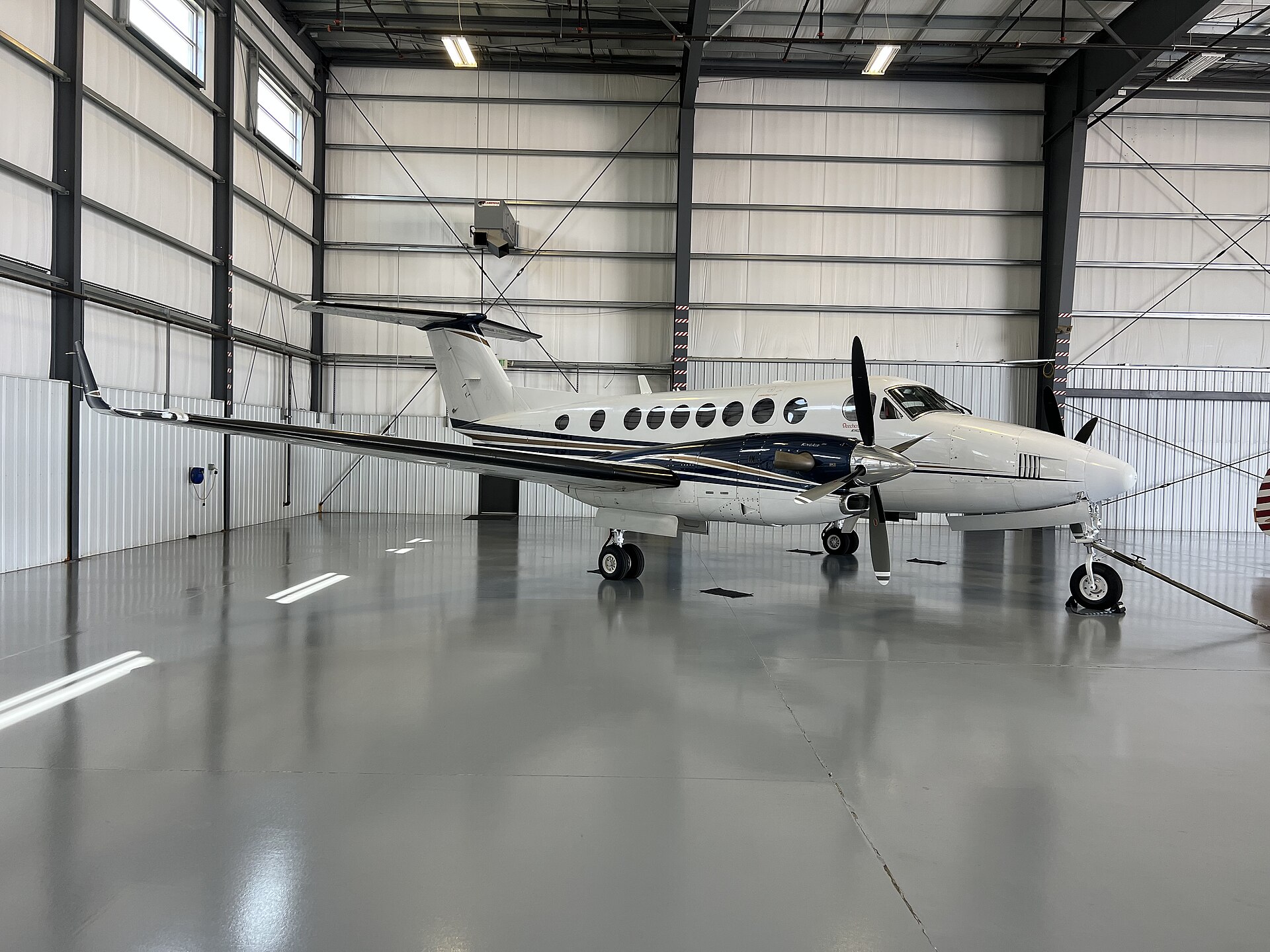
King Air 350 N545KA, photographed in 2023. · Photo: ZLEA via Wikimedia Commons, CC BY-SA 4.0
Beechcraft · Turboprop
King Air 350 (B300)
Third model of the King Air 300 series, between the King Air 300 and the 350i.
The 350 is the classic King Air at its biggest: it carries eight people with full fuel, uses 3,300 ft runways and is supported almost everywhere. The trade-offs are two thirsty engines, a cabin you cannot stand in, and costly avionics upgrades on older examples.
Buy it if
You regularly fly six to eight people 300 to 1,200 nm, use shorter or high-elevation runways, want two engines, and value a big support network more than jet speed.
Skip it if
Most trips carry two or three people, you want to stand up in the cabin, or you often cross the country and would rather pay more for a much faster jet.
Biggest compromise
Running costs. Two PT6A-60A engines burn roughly 110 to 136 gallons an hour, and each needs a hot section inspection every 1,800 hours and an overhaul every 3,600 hours.
The numbers that matter
Purchase price
$3.25M
typical asking · $1.5M–$6M
What it costs per year
$1.13M
at 300 hrs · two professional pilots
How far it flies
1,806 nm
1,440–1,537 nm with passengers
How fast
312 kt
high-speed cruise
Seats
8
8 typical (up to 11 executive)
Pilots needed
1
Certified for one pilot with a type rating; many operators fly it with two.
Price
What one costs to buy
Typical asking price
$3,250,000
Where asking prices sit
Low
$1.5M
Typical
$3.25M
High
$6M
Most asking prices fall inside this band.
Other sites
5.9% of the fleet
6-month move
Priced vs call
with a price / call for price
Engine time and upgrades drive the spread: survey-restricted or high-time aircraft ask under $2.2M, while re-engined Garmin-equipped examples ask up to $6.0M.
Price vs its family and alternatives
Scroll to explore · select a jet for details
King Air 350 (B300) · This aircraft
$3.25M
Sits between the King Air 300 and the PC-12 NG (/47E).
For sale now
None listed right now
Cost to own
What it costs per year to run
300hours / year
Per year
Per flight hour
Estimate — your operator will quote actual numbers.
Fuel, airframe maintenance, scheduled and unscheduled and engine program or reserves (two engines) rise as you fly more. Two professional pilots, annual recurrent training, hangar, hull and liability insurance and navigation, weather and tracking subscriptions stay the same however much you fly.
Where the money goes
- Two professional pilots$407,00036%
- Annual recurrent training$32,5003%
- Hangar$29,5003%
- Hull and liability insurance$25,6182%
- Navigation, weather and tracking subscriptions$16,0001%
- Fuel$313,28128%
- Airframe maintenance, scheduled and unscheduled$172,50015%
- Engine program or reserves (two engines)$132,00012%
Two professional pilots is the biggest single cost at 36% of the total.
The JetGrade
76 out of 100 — Clearly above its class
Peer group: King Air B200, King Air 250, Pilatus PC-12 NG, Piaggio P.180 Avanti II
Seven categories at a glance
- - - 70 = typical— This aircraft
Strongest on range & payload, weakest on running costs.
Grades are editorial opinions about the model, not any specific aircraft. Sponsors and affiliates have no input. Reviewed 2026-10-04.
Where it flies
Sample trips and reach
Typical trips on a map
Nonstop
Depends on weight or weather
Fuel stop likely
Out of reach
5 of 8 sample trips are comfortable nonstops.
Sample flight times
- 1.0 hr
Carlsbad → Las Vegas
205 nm · Short hop; plenty of margin
- 2.4 hr
Carlsbad → Aspen
625 nm · High-elevation arrival; common King Air destination
- 2.9 hr
Santa Ana → San José del Cabo
765 nm · Comfortable nonstop with a full cabin
- 3.3 hr
Teterboro → West Palm Beach
900 nm · Nonstop with typical loads
- 4.4 hr
Dallas → Teterboro
1,190 nm · Nonstop in still air; strong headwinds may need a stop
- 5.3 hr
Teterboro → San Juan
1,410 nm · Near maximum range; winds and load decide
- 7.8 hr
Carlsbad → Teterboro
2,100 nm · One stop, typically mid-continent
Los Angeles → Honolulu
2,215 nm · Beyond range with no stop possible
Lineage
What came before and after


1990–2009
King Air 350
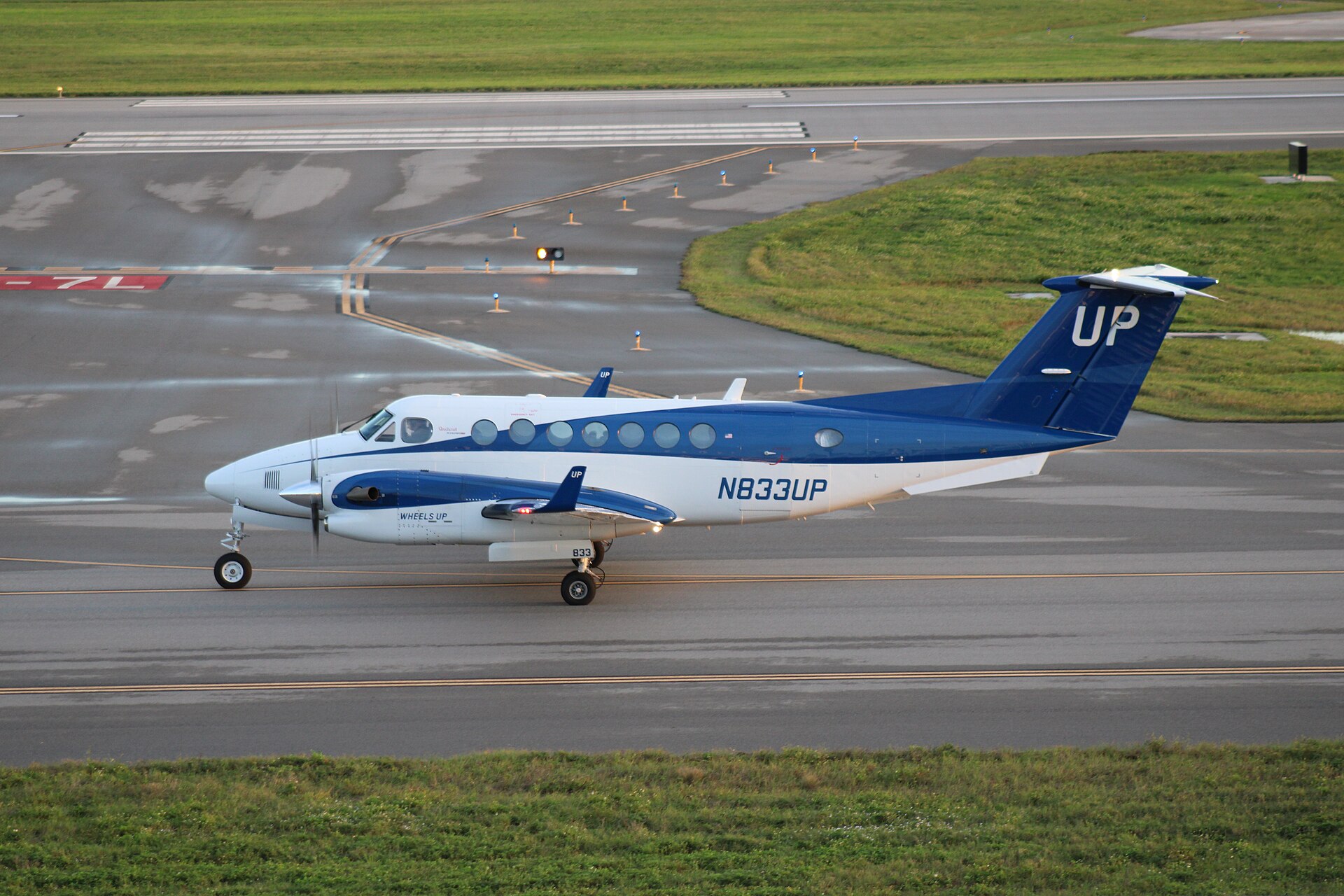
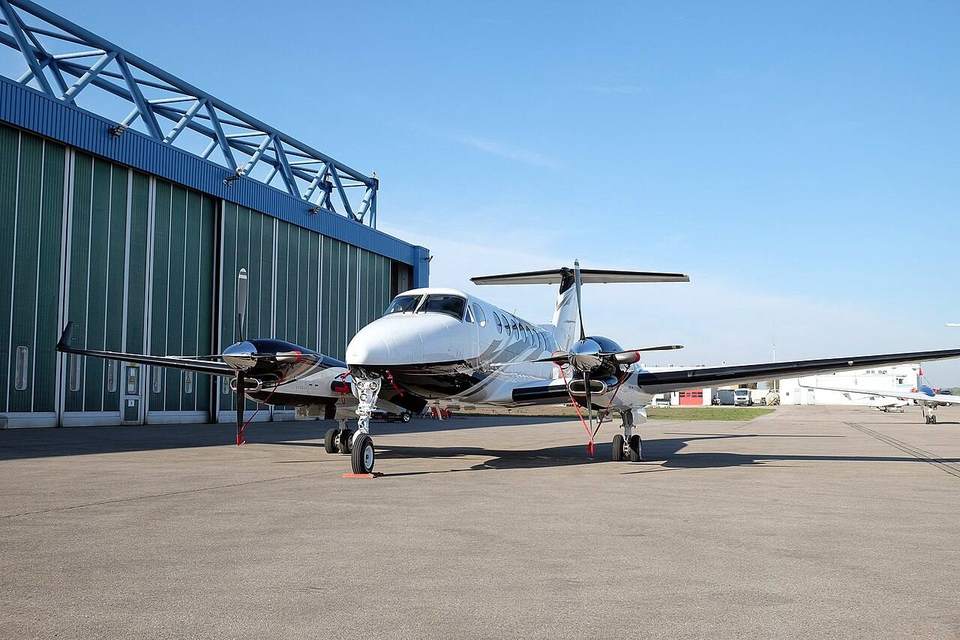
Stretched cabin, winglets and 15,000 lb maximum weight.
What changed from the King Air 300
- Fuselage stretched 34 in (0.86 m) for a longer cabin with extra windows.
- Winglets added at the wingtips.
- Certified at 15,000 lb maximum takeoff and landing weight.
- Seats eight in double club layout, with room for up to 11 executive seats.
Size and cabin
How big it is, inside and out
Outside
Silhouette · scaled to length
Length
Wingspan
Height
Inside the cabin
Cabin length
Width
Height
Compare
How it stacks up
This aircraft
King Air 350 (B300)
- JetGrade
- 76
- Price
- $3.25M
- Cost per year
- $1.13M
- Range
- 1,806 nm
- Speed
- 312 kt
- Seats
- 8
- Cabin length
- 19′ 6″
- Pilots
- 1
- Years built
- 1990–2009
← Before
- JetGrade
- 73
- Price
- $1.75M–$1.86M guide
- Cost per year
- $1.07M
- Range
- 1,965 nm
- Speed
- 315 kt
- Seats
- 8
- Cabin length
- 16′ 8″
- Pilots
- 1
- Years built
- 1984–1994
After →
- JetGrade
- 72
- Cost per year
- $1.03M
- Range
- 1,806 nm
- Speed
- 312 kt
- Seats
- 8
- Cabin length
- 19′ 6″
- Pilots
- 1
- Years built
- 2009–2020
Alternative
- JetGrade
- 79
- Price
- $4.42M
- Cost per year
- $524K
- Range
- 1,830 nm
- Speed
- 280 kt
- Seats
- 6
- Cabin length
- 16′ 11″
- Pilots
- 1
- Years built
- 2008–2020
Alternative
- JetGrade
- 71
- Price
- $5.2M
- Cost per year
- $955K
- Range
- 1,875 nm
- Speed
- 417 kt
- Seats
- 6
- Cabin length
- 15′ 8″
- Pilots
- 1
- Years built
- 2004–2014
- Beechcraft King Air 350i instead: The same airframe and engines built from 2009, with a quieter updated cabin and newer avionics, at a noticeably higher price.
- Pilatus PC-12 NG instead: One engine instead of two cuts running costs sharply; you give up some speed, cabin length and twin-engine redundancy.
- Cessna Citation CJ3 instead: A light jet that cruises much faster above most weather, in exchange for a smaller cabin and longer runway needs.
Gold marks the best figure in each row.
Owning one
What to know before you buy
Engines & inspections
2 × Pratt & Whitney Canada PT6A-60A · 1,050 shp each
No APUEngine hours until overhaul
- Phase inspection · 200 hr
- Engine hot section inspection · 1,800 hr
- Engine overhaul · 3,600 hr
- Landing gear inspection every 72 months
Many aircraft are enrolled in Pratt & Whitney Canada's ESP hourly program; confirm coverage level and transfer terms for each engine.
Known issues
Engine overhaul timing
Two PT6A-60A engines each need overhaul every 3,600 hours; an aircraft near that point can face a seven-figure bill.
Wing structure inspections
A 2026 FAA rule tightened wing inspections on 350s converted to 16,500 lb; confirm compliance and any findings.
Aging Pro Line II avionics
Aircraft built before about 2003 often keep 1990s Collins screens; upgrading to Garmin or Collins glass is a major expense.
Pre-buy checklist
0 of 9 checked
Textron Aviation and a large network of independent King Air shops support the 350 across North America and abroad, and Pratt & Whitney Canada supports the PT6 engine worldwide.
Review
The full review
Strengths
- Carries about 1,600 lb with full fuel, enough for eight passengers on most trips.
- Takes off in about 3,300 ft at maximum weight, opening short and high-elevation runways many jets cannot use.
- More than 600 still flying, with a deep Textron and PT6 service network keeping parts and mechanics easy to find.
Limitations
- Cabin height is 4 ft 9 in, so passengers stoop to move around.
- Two engines burn roughly 110–136 gallons an hour, about $1,000 an hour in fuel at September 2026 prices.
- Cruises around 300 kt, so a coast-to-coast trip takes about eight hours with a fuel stop.
The King Air 350 is the largest of the classic King Airs, built by Beechcraft from 1990 to 2009. It took the King Air 300, stretched the fuselage by 34 inches, added winglets and was certified at 15,000 lb. About 680 were built, counting the cargo-door 350C, and more than 600 are still flying. Beechcraft replaced it with the 350i, which kept the airframe and engines but brought a new cabin, and later with the 360.
Pilot's take
From the cockpit, the 350 feels like a bigger, stronger King Air rather than a different airplane. The PT6A-60As give it a strong climb, and the systems will be familiar to anyone who has flown a B200. It is certified for a single pilot, but it is a 15,000 lb, type-rated twin with demanding engine-failure handling, so we see two-pilot crews as the norm for professional operations. Older Pro Line II panels work but feel dated; aircraft upgraded to Pro Line 21, Fusion or Garmin G1000 NXi are far easier to manage in today's airspace.
Who this is for
Companies, families and operators who move six to eight people on regional trips of 300–1,200 nm, often into smaller airports, and want two engines, a proven airframe and strong resale demand from charter and special-mission buyers.

Ask about this aircraft
Answers come only from our research file on the King Air 350.
Your earlier questionsOwners
Private to verified ownersOwn a Beechcraft King Air 350 (B300)? Verify with its FAA registration to join the owners' thread and the real-cost poll.