
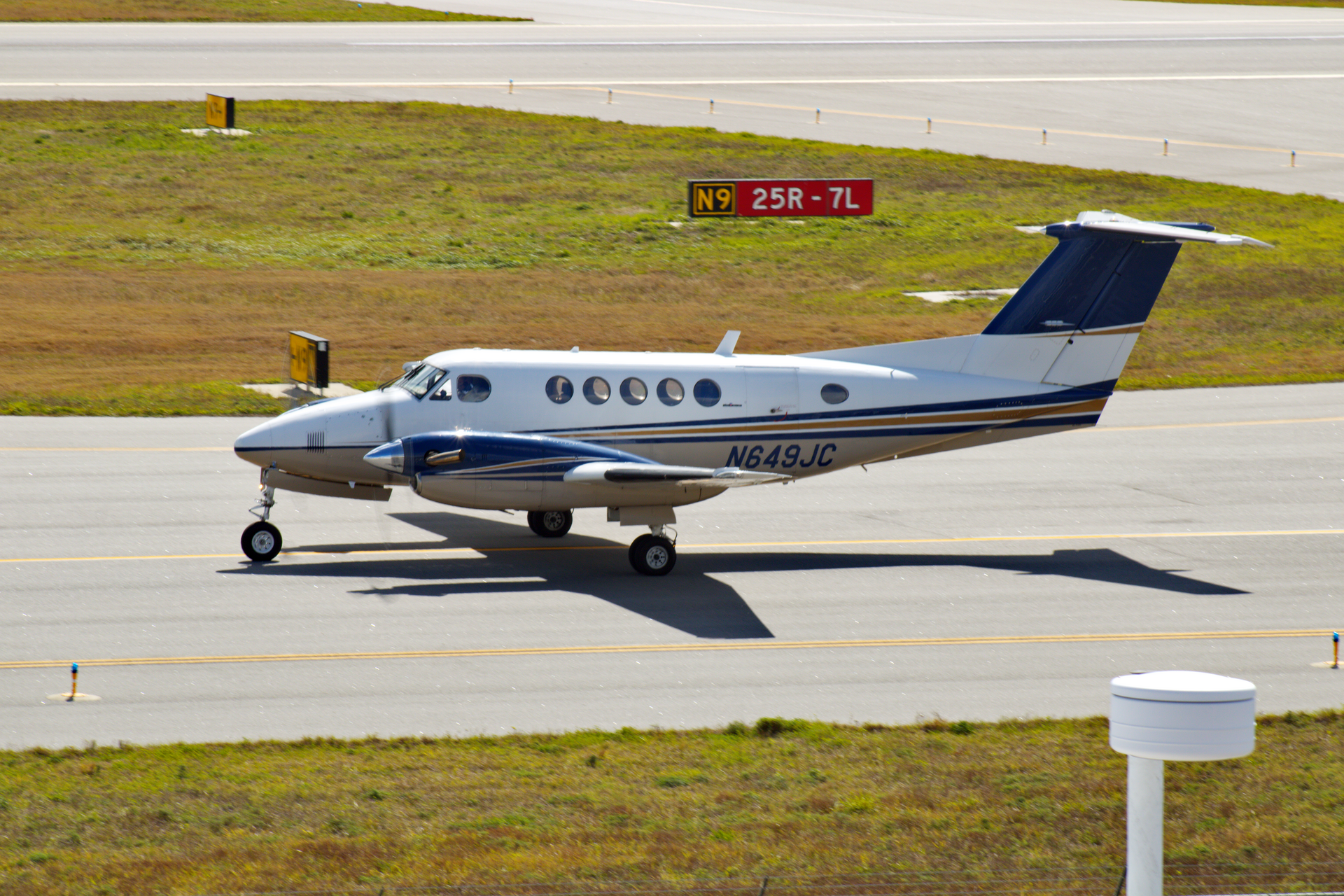
King Air 200 N649JC, photographed in 2023. · Photo: ZLEA via Wikimedia Commons, CC BY-SA 4.0
Beechcraft · Turboprop
King Air 200
The first Super King Air, built 1974–1981, and the parent of the B200, 250 and 260.
The 200 gives you the King Air cabin, durable PT6 engines and 1,000-plus nm range for far less than a later B200. Engines decide its value: stock high-time examples ask about $0.9M, re-engined ones with Garmin panels up to $2.4M.
Buy it if
You carry four to six people 300 to 1,000 nm, want two engines and a real cabin with a toilet, and would rather spend on engines and avionics than on a newer airframe.
Skip it if
You often fly past 1,100 nm with a full cabin, want a stand-up cabin or jet speed, or cannot plan for two engine overhauls or an engine upgrade within a few years.
Biggest compromise
Age. Every 200 is at least 45 years old, so its value rides on engine times, structural inspections and upgrades.
The numbers that matter
Purchase price
$1.28M
typical asking · $895K–$2.4M
What it costs per year
$729K
at 300 hrs · one professional pilot
How far it flies
1,490 nm
1,075–1,250 nm with passengers
How fast
289 kt
high-speed cruise
Seats
6
6 typical, up to 13 certified
Pilots needed
1
Certified for one pilot; insurers favor experienced pilots with simulator training, and charter often uses two.
Price
What one costs to buy
Typical asking price
$1,282,500
Where asking prices sit
Low
$895K
Typical
$1.28M
High
$2.4M
Most asking prices fall inside this band.
Other sites
Priced vs call
with a price / call for price
Fourteen of 23 listings show asks, from $895,000 to $2.4M. Engine upgrades and Garmin panels explain most of the spread; PlanePhD's guide value is about $937,000.
Price vs its family and alternatives
Scroll to explore · select a jet for details
King Air 200 · This aircraft
$1.28M
Sits between the King Air 100 / A100 and the Conquest II (441).
For sale now
None listed right now
Cost to own
What it costs per year to run
300hours / year
Per year
Per flight hour
Estimate — your operator will quote actual numbers.
Fuel, maintenance and engine reserves rise as you fly more. One professional pilot, hangar and insurance stay the same however much you fly.
Where the money goes
Partial estimate- One professional pilot$125,00017%
- Hangar$39,4005%
- Insurance$17,5002%
- Fuel$252,78035%
- Maintenance$129,00018%
- Engine reserves$165,00023%
Fuel is the biggest single cost at 35% of the total.
The JetGrade
72 out of 100 — Slightly above its class
Peer group: King Air B200, Cessna Conquest II, Piper Cheyenne III / IIIA, King Air B100, Pilatus PC-12/45 (cross-check, single engine)
Seven categories at a glance
- - - 70 = typical— This aircraft
Strongest on cabin & passenger comfort, weakest on running costs.
Grades are editorial opinions about the model, not any specific aircraft. Sponsors and affiliates have no input. Reviewed 2026-10-04.
Where it flies
Sample trips and reach
Typical trips on a map
Nonstop
Depends on weight or weather
Fuel stop likely
3 of 6 sample trips are comfortable nonstops.
Sample flight times
- 1.2 hr
Carlsbad → Las Vegas
205 nm · Short hop, well within range
- 2.8 hr
Carlsbad → Aspen
625 nm · Mountain airport; summer loads depend on weather
- 3.3 hr
Santa Ana → San José del Cabo
765 nm · Nonstop with four aboard, well within range
- 3.9 hr
Teterboro → West Palm Beach
900 nm · Nonstop with four; headwinds can tighten reserves
- 5.3 hr
Dallas → Teterboro
1,190 nm · Near maximum range; strong headwinds may force a stop
- 8.8 hr
Carlsbad → Teterboro
2,100 nm · Needs one stop, typically mid-continent
Lineage
What came before and after
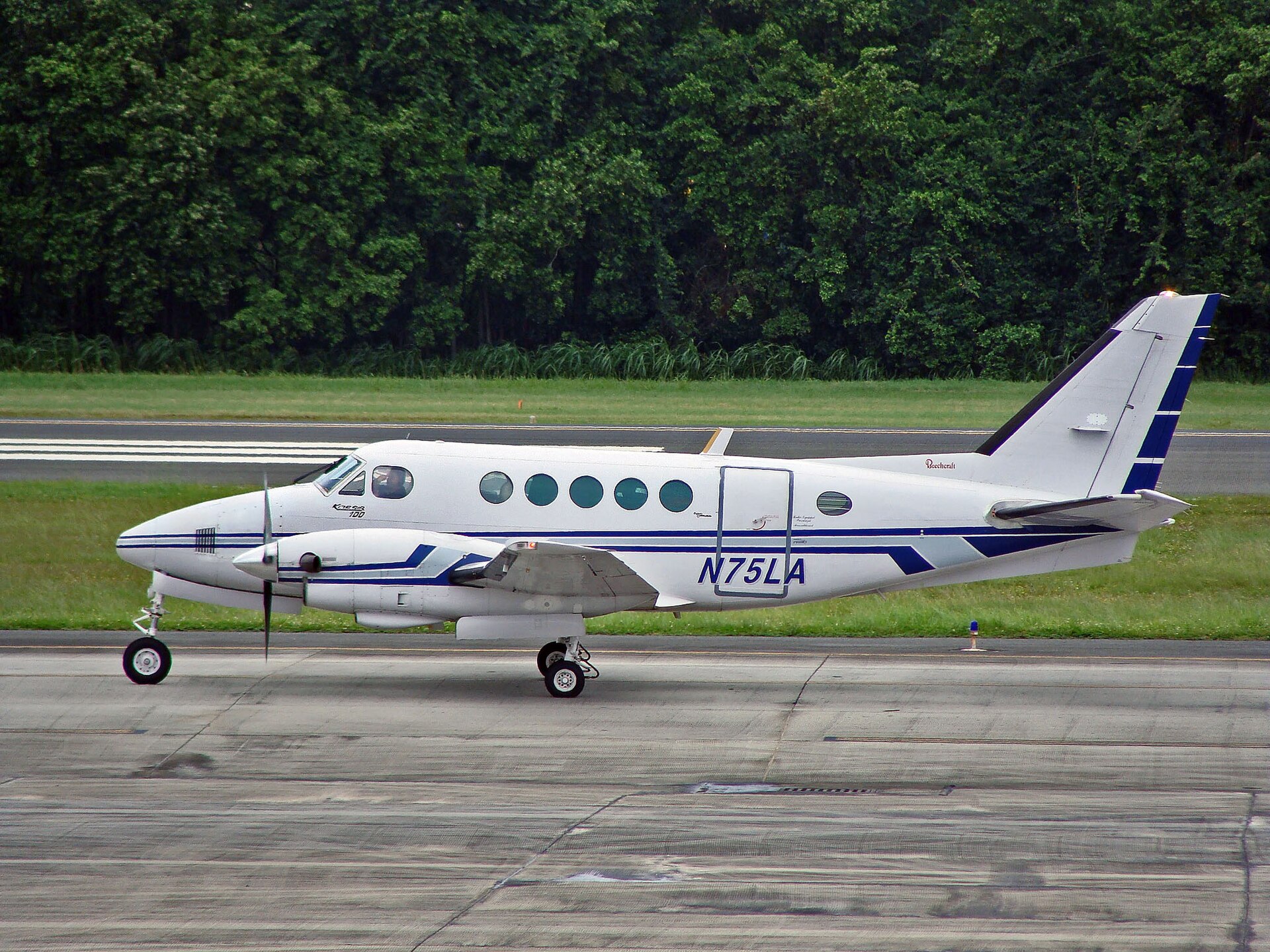

1974–1981
King Air 200
T-tail, longer wing and 850 shp PT6A-41 engines.


What changed from the King Air 100 / A100
- A T-tail replaced the 100 series' conventional tail.
- Wingspan grew 4 ft 3 in to 54 ft 6 in, holding 60 more gallons of fuel.
- 850 shp PT6A-41 engines, mounted higher and farther outboard, with larger propellers.
- Fuselage about 3 ft 10 in longer than the A100's.
- Maximum takeoff weight of 12,500 lb.
- Pressurized to about a 10,000 ft cabin at 31,000 ft.
Size and cabin
How big it is, inside and out
Outside
Silhouette · scaled to length
Length
Wingspan
Height
Inside the cabin
Cabin length
Width
Height
Compare
How it stacks up
This aircraft
King Air 200
- JetGrade
- 72
- Price
- $1.28M
- Cost per year
- $729K
- Range
- 1,490 nm
- Speed
- 289 kt
- Seats
- 6
- Cabin length
- 16′ 8″
- Pilots
- 1
- Years built
- 1974–1981
← Before
- JetGrade
- 71
- Price
- $522K–$670K guide
- Cost per year
- $638K
- Range
- 1,100 nm
- Speed
- 240 kt
- Seats
- 6
- Cabin length
- 16′ 8″
- Pilots
- 1
- Years built
- 1969–1979
After →
- JetGrade
- 74
- Price
- $1.85M
- Cost per year
- $827K
- Range
- 1,580 nm
- Speed
- 291 kt
- Seats
- 7
- Cabin length
- 16′ 8″
- Pilots
- 1
- Years built
- 1981–2009
Alternative
- JetGrade
- 72
- Price
- $1.36M
- Cost per year
- $671K
- Range
- 2,000 nm
- Speed
- 314 kt
- Seats
- 7
- Cabin length
- 12′ 10″
- Pilots
- 1
- Years built
- 1977–1986
Alternative
- JetGrade
- 77
- Price
- $2.9M
- Cost per year
- $515K
- Range
- 1,500 nm
- Speed
- 265 kt
- Seats
- 6
- Cabin length
- 16′ 11″
- Pilots
- 1
- Years built
- 1996–2005
- King Air B200 instead: Same cabin with PT6A-42 engines, stronger high-altitude power and 6.5 psi pressurization for a lower cabin; built through 2007, so newer examples cost more.
- Cessna Conquest II instead: About 300 kt and up to 1,720 nm, but a smaller 245 cu ft cabin and Garrett engines instead of PT6s.
- Pilatus PC-12/45 instead: One PT6 engine, lower running costs and a big cargo door, but slower at about 268 kt, with pre-owned examples averaging near $3M.
Gold marks the best figure in each row.
Owning one
What to know before you buy
Engines & inspections
2 × Pratt & Whitney Canada PT6A-41 · 850 shp each
No APUEngine hours until overhaul
- Phase inspection · 200 hr
- Nose gear fork check · 200 hr
- Starter-generator overhaul · 1,000 hr
- Engine hot section inspection · 1,800 hr
- Engine overhaul · 3,600 hr
- Propeller overhaul · 4,000 hr
The factory hot section program covers this engine, but few listings show an hourly engine program, so budget for overhauls or an engine upgrade.
Known issues
Aging engines and upgrade decision
Original PT6A-41s are decades old. A near-term overhaul or -42, -52 or -61 conversion can cost a large share of the aircraft's value.
Wing attachment and fuel-bay structure
Wing bolts, attach fittings and bonded fuel-bay skin panels need periodic inspection; corrosion or damage there is expensive.
Aft fuselage stringer cracking
Stringers near the rear pressure bulkhead must be checked every 500 landings until a modification is installed.
Pre-buy checklist
0 of 9 checked
Textron Aviation service centers and many independent King Air shops support the 200, and Garmin's G1000 NXi panel upgrade is approved for it. CAE and SimCom offer simulator training.
Review
The full review
Strengths
- A 303 cu ft cabin, 4 ft 9 in tall and 16 ft 8 in long, seats six plus a belted toilet.
- About 1,075 nm with every seat filled and roughly 1,250 nm with four aboard, with standard instrument reserves.
- Certified for one pilot, with two 850 shp PT6A-41 engines and a large King Air service network.
Limitations
- With full tanks it carries only about 395 lb of people and bags, so long trips mean fewer passengers.
- Planning for an engine failure on takeoff needs about 5,300 ft at full weight; Raisbeck mods cut that to 3,800 ft.
- Original PT6A-41 engines are decades old; an overhaul or upgrade can cost a large share of the price.
The Super King Air 200 is where the modern King Air began. Beechcraft flew the first one in October 1972, won FAA approval in December 1973 and delivered the first customer aircraft in February 1974. It took the cabin of the King Air 100 series and added a T-tail, a wing stretched to 54 ft 6 in with 60 more gallons of fuel, and two 850 shp Pratt & Whitney Canada PT6A-41 engines. More than 830 were built before the B200 replaced it in 1981, and the B200, 250 and 260 that followed all share its basic shape.
Pilot's take
The 200 flies like a bigger, steadier King Air 90: honest handling, a stable instrument platform and PT6 engines that start and run predictably. The workload is reasonable for one pilot, but an engine failure at takeoff weight demands a sharp, practiced response, so simulator training every year is worth more than any option on the panel. Stock PT6A-41s feel flat above the mid-twenties on warm days, which is why so many aircraft now carry -42, -52 or -61 conversions. Watch the cabin altitude in the high twenties and know the oxygen system well.
Who this is for
A business owner or small company flying four to six people on regional trips of 300 to 1,000 nm, with one professional pilot or an experienced owner-pilot, who values two engines and a roomy cabin over newest-model speed.

Ask about this aircraft
Answers come only from our research file on the King Air 200.
Your earlier questionsOwners
Private to verified ownersOwn a Beechcraft King Air 200? Verify with its FAA registration to join the owners' thread and the real-cost poll.