
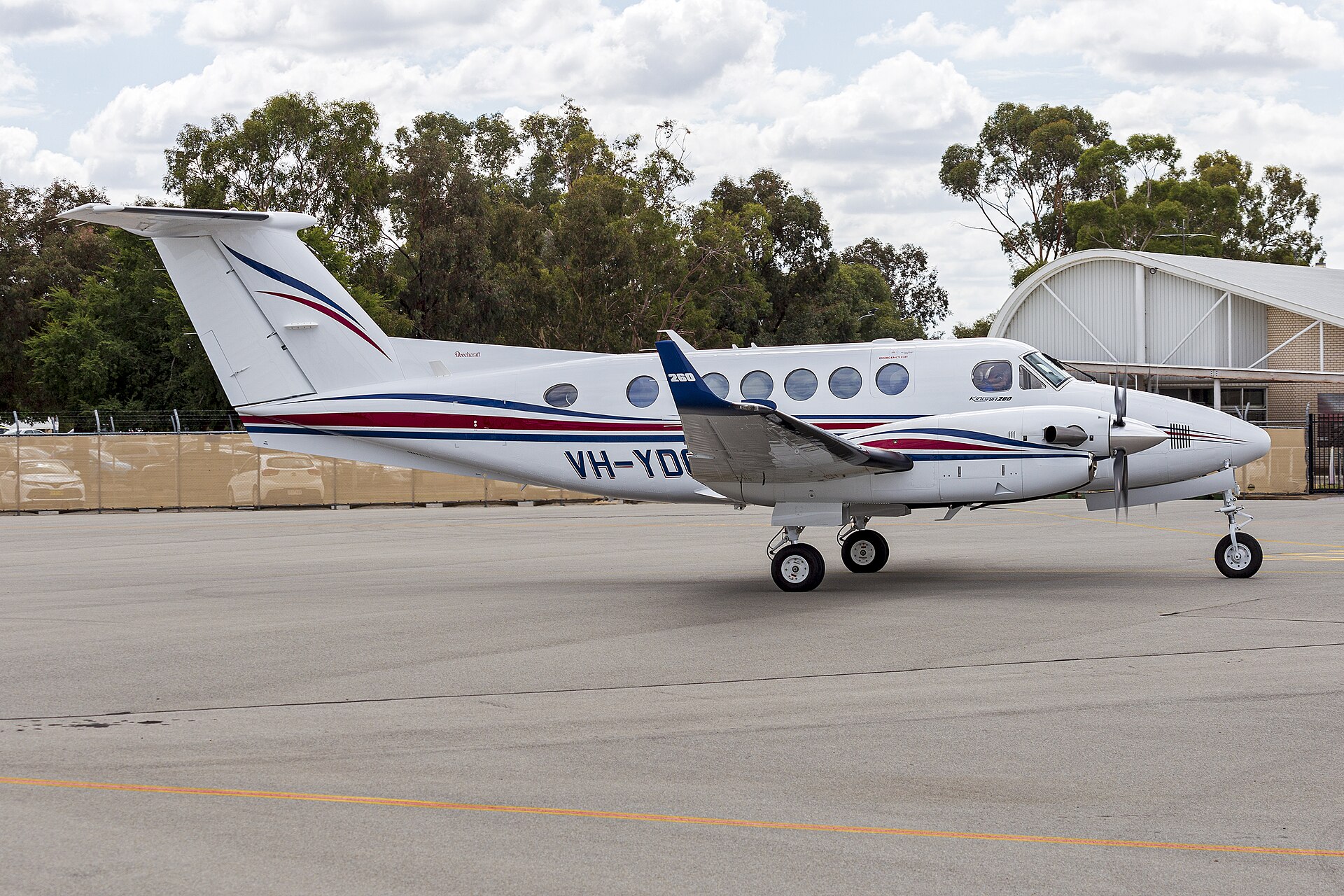
Beechcraft King Air 260 VH-YDQ, photographed in 2022. · Photo: Robert Myers via Wikimedia Commons, CC BY-SA 3.0 au
Beechcraft · Turboprop
King Air 260
The fifth and latest version of the King Air 200 line, built since 2021 and sold below the larger King Air 360.
The 260 is the most refined version of the King Air 200 line: proven engines, a modern touchscreen cockpit and an autothrottle that eases single-pilot work. It is not cheap to buy or run, and a full cabin cuts its range sharply.
Buy it if
You want a twin-engine aircraft that can use short or high-elevation runways, usually carry four to six people on trips under about 900 nm, and value the King Air's support network and resale strength.
Skip it if
You regularly fly more than 1,000 nm with a full cabin, want a stand-up cabin or enclosed toilet, or would rather spend less on fuel with a single-engine Pilatus PC-12 NGX.
Biggest compromise
Fuel versus people. The 260 can lift 3,760 lb of fuel and payload combined, but full tanks alone weigh about 3,645 lb, leaving only about 115 lb of payload.
The numbers that matter
What it costs per year
$780K
at 300 hrs · one professional pilot
How far it flies
1,720 nm
750–1,038 nm with passengers
How fast
310 kt
high-speed cruise
Seats
7
7 typical, 8 using the toilet seat
Pilots needed
1
Certified for one pilot; many fly single-pilot, though some operators and insurers prefer two.
Price
What one costs to buy
Typical asking price
$0
Other sites
Priced vs call
with a price / call for price
None of the five 260s listed in October 2026 shows a price; JETNET puts the lowest ask at $6.5M. It listed at $7.78M new in 2023.
Price vs its family and alternatives
Scroll to explore · select a jet for details
For sale now
None listed right now
Cost to own
What it costs per year to run
300hours / year
Per year
Per flight hour
Estimate — your operator will quote actual numbers.
Fuel, airframe maintenance, engine hourly program or reserve and trip expenses rise as you fly more. One professional pilot, recurrent training, hangar, insurance and subscriptions and other fixed costs stay the same however much you fly.
Where the money goes
Partial estimate- One professional pilot$196,70625%
- Recurrent training$25,1963%
- Hangar$28,1554%
- Insurance$29,2924%
- Subscriptions and other fixed costs$30,0004%
- Fuel$248,18432%
- Airframe maintenance$107,70014%
- Engine hourly program or reserve$73,2009%
- Trip expenses$42,0005%
Fuel is the biggest single cost at 32% of the total.
The JetGrade
69 out of 100 — Below its class average
Peer group: Pilatus PC-12 NGX, Beechcraft King Air 250, Beechcraft King Air 360 / 360ER, Piaggio P.180 Avanti EVO
Seven categories at a glance
- - - 70 = typical— This aircraft
Strongest on reliability & support, weakest on range & payload.
Grades are editorial opinions about the model, not any specific aircraft. Sponsors and affiliates have no input. Reviewed 2026-10-04.
Where it flies
Sample trips and reach
Typical trips on a map
Nonstop
Fuel stop likely
4 of 6 sample trips are comfortable nonstops.
Sample flight times
- 1.1 hr
Carlsbad → Las Vegas
205 nm · Short hop, well within range
- 2.6 hr
Carlsbad → Aspen
625 nm · Mountain airport; weather matters more than runway
- 3.1 hr
Santa Ana → San José del Cabo
765 nm · Comfortable nonstop with four aboard
- 3.6 hr
Teterboro → West Palm Beach
900 nm · Nonstop with four aboard; modest fuel margin
- 4.6 hr
Dallas → Teterboro
1,190 nm · Beyond four-passenger range; one stop typical
- 8.1 hr
Carlsbad → Teterboro
2,100 nm · Two stops typical with four aboard
Lineage
What came before and after


2021–present
King Air 260
Autothrottle, digital pressurization and touchscreen Pro Line Fusion standard.
What changed from the King Air 250
- ThrustSense autothrottle is standard, guarding against overspeed, underspeed, over-torque and over-temperature.
- Digital pressurization, managed through the flight management system, with readouts on the main displays.
- Collins Pro Line Fusion with three 14-inch touchscreens and MultiScan weather radar comes standard.
- Pressure-mapped seats; new cabinetry, LED lighting and USB ports from 2022.
- CoolView cabin windows added to new aircraft from early 2024.
- Same PT6A-52 engines, 310-knot top speed and 1,720 nm range as the 250.
Size and cabin
How big it is, inside and out
Outside
Silhouette · scaled to length
Length
Wingspan
Height
Inside the cabin
Cabin length
Width
Height
Compare
How it stacks up
This aircraft
King Air 260
- JetGrade
- 69
- Cost per year
- $780K
- Range
- 1,720 nm
- Speed
- 310 kt
- Seats
- 7
- Cabin length
- 16′ 8″
- Pilots
- 1
- Years built
- 2021–now
← Before
- JetGrade
- 70
- Price
- $3.1M–$4.95M guide
- Cost per year
- $825K
- Range
- 1,720 nm
- Speed
- 310 kt
- Seats
- 7
- Cabin length
- 16′ 8″
- Pilots
- 1
- Years built
- 2011–2020
Alternative
- JetGrade
- 80
- Price
- $7.39M
- Cost per year
- $608K
- Range
- 1,889 nm
- Speed
- 290 kt
- Seats
- 6
- Cabin length
- 16′ 11″
- Pilots
- 1
- Years built
- 2020–2025
Alternative
Beechcraft King Air 360 / 360ER
- JetGrade
- Not yet graded
- Range
- 1,806 nm
- Speed
- 312 kt
- Seats
- 8
- Years built
- 2020
- Beechcraft King Air 250 instead: Nearly the same airframe, engines and range, with asks of about $3.3M to $5.5M; you give up the standard autothrottle and digital pressurization.
- Pilatus PC-12 NGX instead: One engine instead of two, but a roomier cabin, a big cargo door, an available enclosed toilet and lower fuel bills.
- Beechcraft King Air 360 instead: The bigger King Air: a longer cabin, more power and more payload, at a higher price and higher operating cost.
Gold marks the best figure in each row.
Owning one
What to know before you buy
Engines & inspections
2 × Pratt & Whitney Canada PT6A-52 · 850 shp each
No APUEngine hours until overhaul
- Phase inspections · 200 hr
- Fuel nozzle flow check · 400 hr
- Starter-generator overhaul · 1,000 hr
- Engine overhaul · 3,600 hr
- Landing gear actuator inspection every 30 months
- Wing bolt inspection every 60 months
- Oxygen bottle hydrostatic test every 60 months
Hourly engine plans spread overhaul and hot-section costs across flying hours; ESP has no minimum hours and transfers with the aircraft. Confirm the tier.
Known issues
Rudder pushrod rivet directive
A 2025 directive requires a prompt inspection of rudder pushrod rivets on a handful of 2022 and 2023 aircraft; check compliance.
Factory warranties ending
Five-year warranties on structure, avionics and engines are expiring on the earliest aircraft; engine program enrollment now matters most.
Wing bolt inspections
King Air 200-series wing bolts need inspection every five years and lubrication yearly; findings can mean costly bolt replacement.
Pre-buy checklist
0 of 10 checked
Textron Aviation runs a large factory service network with mobile service units and a 24-hour support line, and says it ships 99.6% of in-stock parts the same day. PT6 engines are supported worldwide.
Review
The full review
Strengths
- Clears a 50 ft obstacle in 2,111 ft at maximum weight, and needs about 3,099 ft at a hot 5,000 ft airport.
- Autothrottle with overspeed and underspeed protection, three 14-inch touchscreens and digital pressurization come standard.
- Two 850 shp PT6A-52 engines backed by Textron's service network, which ships 99.6% of in-stock parts the same day.
Limitations
- With full fuel it carries only about 115 lb of payload; four passengers cut range to about 1,040 nm.
- The cabin is 4 ft 9 in tall and 4 ft 6 in wide; the toilet is a belted seat.
- Two engines burn roughly 92 to 124 gallons an hour; we estimate about $780,000 a year at 300 hours.
The King Air 260 is the latest version of Beechcraft's King Air 200 line, the twin-engine turboprop family that has defined its class since 1974. Textron Aviation announced it in December 2020, the FAA certified it in March 2021, and deliveries began that year. Legally it is a B200GT, the same type certificate as the King Air 250 it replaced, and it sits below the larger King Air 360 in Textron's lineup. Industry shipment reports show roughly 135 delivered to civil customers through mid-2026, and the US Navy has ordered up to 64 as T-54A trainers.
Pilot's take
We see the 260 as the King Air that finally manages its own power. The autothrottle holds speeds through climb, cruise and approach and protects the engines from over-torque and over-temperature, which matters most when one pilot is handling weather, traffic and a busy airport alone. The airplane is still a King Air: stable, forgiving and comfortable on short or high runways, with two engines that keep options open after a failure. The discipline it asks for is weight planning. With a full cabin, the fuel you can carry drops quickly, and that, more than speed, decides how far you go.
Who this is for
Companies and experienced owners who fly four to six people 300 to 900 nm, often into short, high or icy airports, and want two engines, a proven support network and a model with strong resale demand.

Ask about this aircraft
Answers come only from our research file on the Beechcraft King Air 260.
Your earlier questionsOwners
Private to verified ownersOwn a Beechcraft King Air 260? Verify with its FAA registration to join the owners' thread and the real-cost poll.