
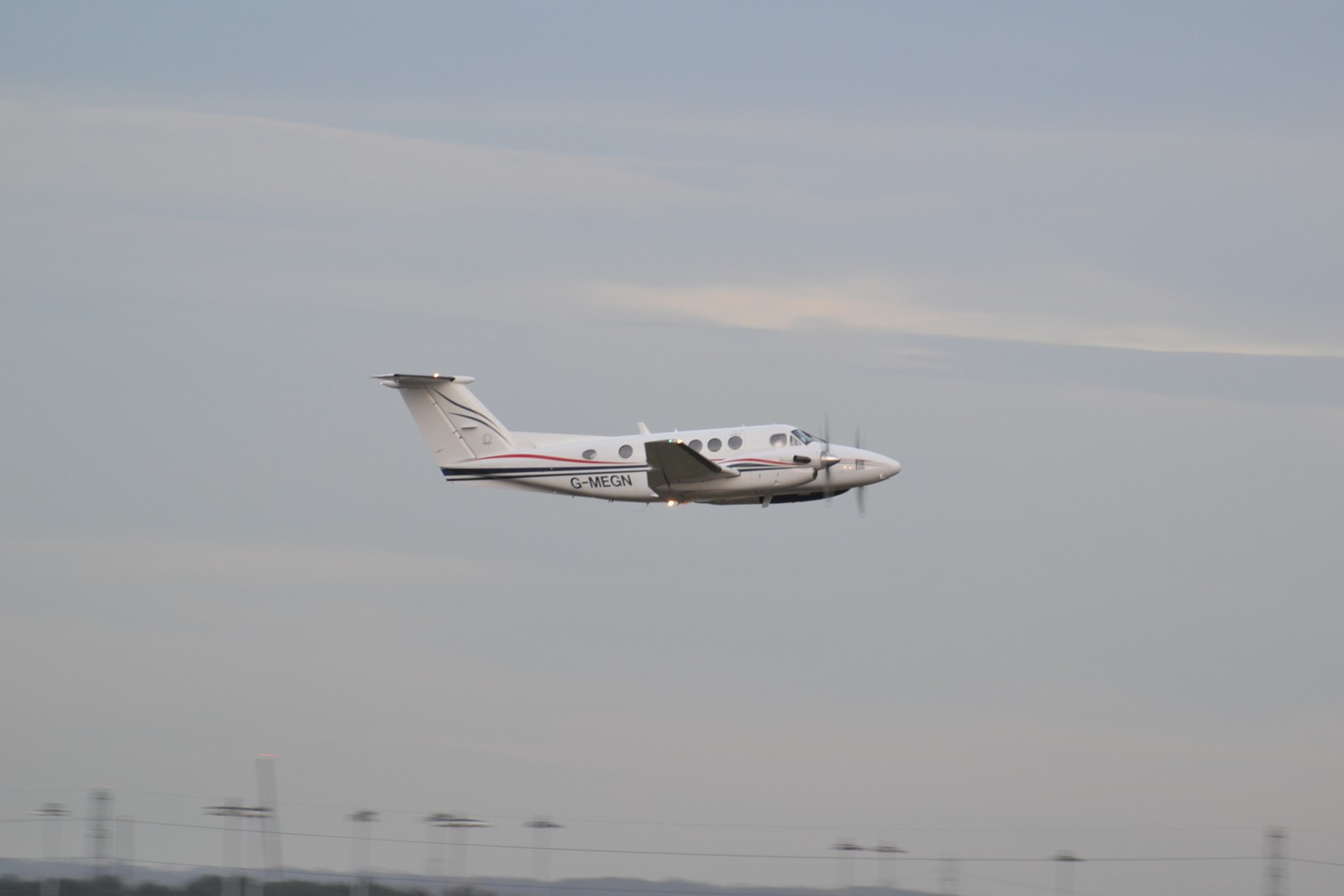
King Air B200 G-MEGN departing Birmingham, England, in 2014. · Alec Wilson from Solihull, United Kingdom · CC BY-SA 2.0 (https://creativecommons.org/licenses/by-sa/2.0) · resized
Beechcraft · Turboprop
King Air B200
The second and longest-built King Air 200, between the original 200 and the faster B200GT.
The B200 gives more cabin, payload and engine redundancy than single-engine turboprops at a similar price, with service support almost everywhere. Expect about $830,000 a year for 300 hours, and choose an example on engines, records and cockpit rather than year.
Buy it if
You regularly fly five to seven people 300 to 1,000 nm, want two engines over water, mountains and at night, use shorter or rougher runways, and value a deep pool of mechanics, parts and pilots.
Skip it if
Most trips carry one to three people, where a single-engine turboprop costs far less, or you need jet speed, a stand-up cabin, an enclosed lavatory or nonstop coast-to-coast range.
Biggest compromise
Two engines burning about 110 gallons an hour, each needing hot-section inspections and eventual overhauls, push yearly costs to roughly $830,000 at 300 hours with one pilot. That buys redundancy and cabin space, but cruise speed stays around 275 to 290 knots, well short of a light jet.
The numbers that matter
Purchase price
$1.85M
typical asking · $1.75M–$2.95M
What it costs per year
$827K
at 300 hrs · one professional pilot
How far it flies
1,580 nm
800–1,100 nm with passengers
How fast
291 kt
high-speed cruise
Seats
7
7 typical; up to 13 in commuter layouts
Pilots needed
1
Certified for one pilot; corporate and charter operators often fly it with two.
Price
What one costs to buy
Typical asking price
$1,850,000
Where asking prices sit
Low
$1.75M
Typical
$1.85M
High
$2.95M
Most asking prices fall inside this band.
Other sites
Priced vs call
with a price / call for price
Five dollar asks span $1.75M to $2.95M, typical $1.85M. AvPay says airworthy B200s recently sold for $1.8M to $3.0M depending on engines and cockpit.
Price vs its family and alternatives
Scroll to explore · select a jet for details
King Air B200 · This aircraft
$1.85M
Sits between the King Air 200 and the King Air B200GT.
For sale now
None listed right now
Cost to own
What it costs per year to run
300hours / year
Per year
Per flight hour
Estimate — your operator will quote actual numbers.
Fuel, airframe and propeller maintenance, engine program or overhaul reserve and landing fees, crew travel and miscellaneous rise as you fly more. One professional pilot, recurrent simulator training, hangar, insurance and subscriptions and databases stay the same however much you fly.
Where the money goes
- One professional pilot$170,00021%
- Recurrent simulator training$16,0002%
- Hangar$36,0004%
- Insurance$31,0004%
- Subscriptions and databases$8,5001%
- Fuel$273,90033%
- Airframe and propeller maintenance$151,50018%
- Engine program or overhaul reserve$115,50014%
- Landing fees, crew travel and miscellaneous$25,0003%
Fuel is the biggest single cost at 33% of the total.
The JetGrade
74 out of 100 — Slightly above its class
Peer group: Cessna Conquest II (441), Piper Cheyenne IIIA, Mitsubishi MU-2 Marquise, Piaggio P.180 Avanti
Seven categories at a glance
- - - 70 = typical— This aircraft
Strongest on reliability & support, weakest on running costs.
Grades are editorial opinions about the model, not any specific aircraft. Sponsors and affiliates have no input. Reviewed 2026-10-04.
Where it flies
Sample trips and reach
Typical trips on a map
Nonstop
Depends on weight or weather
Fuel stop likely
3 of 6 sample trips are comfortable nonstops.
Sample flight times
- 1.2 hr
Carlsbad → Las Vegas
205 nm · Short hop with plenty of fuel to spare
- 2.7 hr
Carlsbad → Aspen
625 nm · Mountain airport; summer heat limits departure weight
- 3.2 hr
Santa Ana → San José del Cabo
765 nm · Nonstop with four aboard and reserves
- 3.7 hr
Teterboro → West Palm Beach
900 nm · Nonstop with four; strong headwinds can force a stop
- 5.2 hr
Dallas → Teterboro
1,190 nm · Usually one stop with four; nonstop when lightly loaded
- 8.5 hr
Carlsbad → Teterboro
2,100 nm · One stop eastbound; westbound winter winds often need two
Lineage
What came before and after
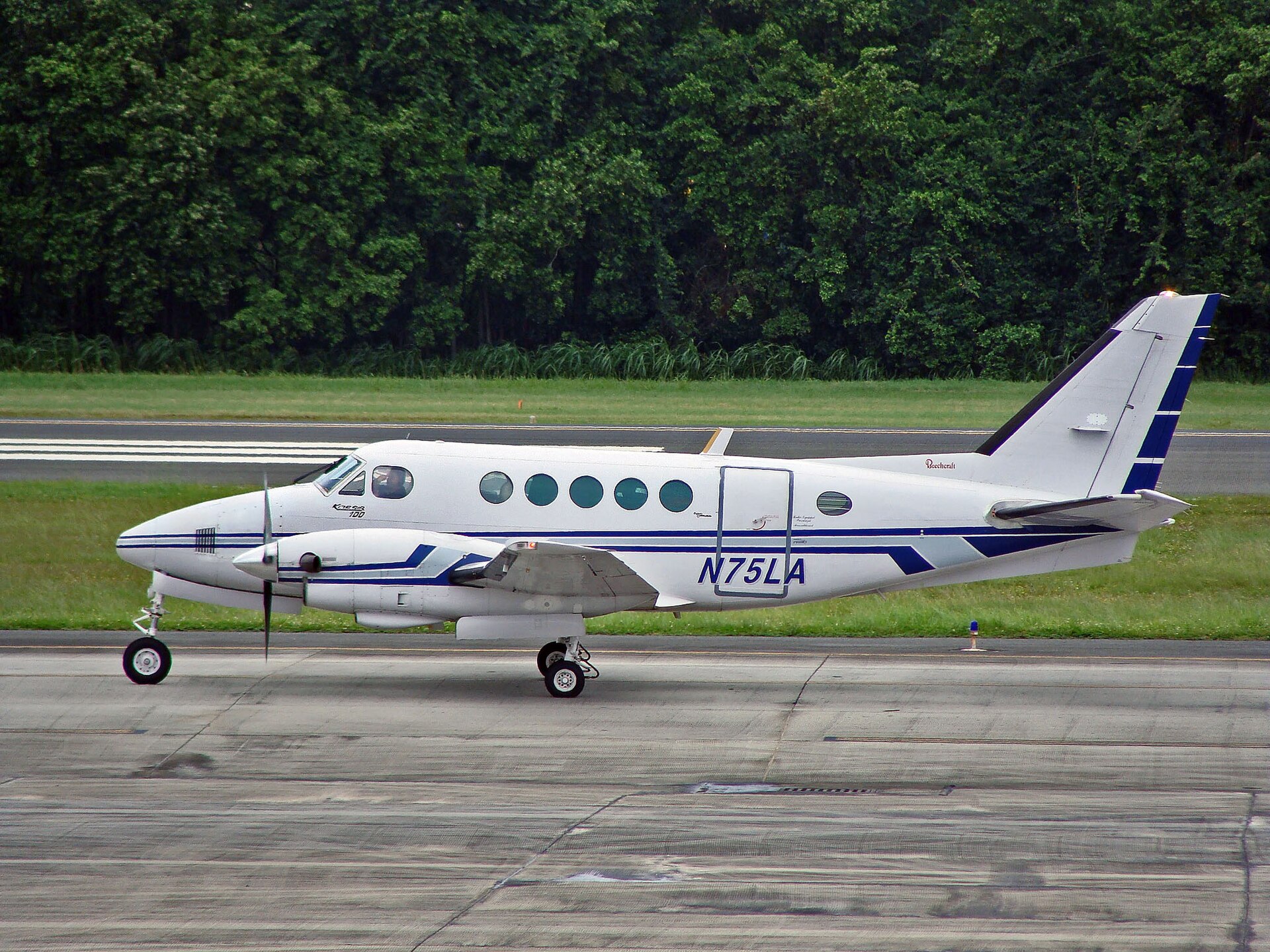


1981–2009
King Air B200
PT6A-42 engines and higher cabin pressure; the long-running best seller.


What changed from the King Air 200
- PT6A-42 engines replace the 200's PT6A-41s, at the same 850 shaft horsepower.
- Maximum cabin pressure rises from 6.0 to 6.5 psi, giving a lower cabin altitude.
- Hydraulic landing gear replaced the electro-mechanical system from the mid-1980s.
- Later aircraft raised the aft baggage limit from 410 to 550 lb.
- Four-blade propellers became standard in 1993.
- Collins EFIS screens arrived in 1995 and Pro Line 21 glass from 2003.
Size and cabin
How big it is, inside and out
Outside
Silhouette · scaled to length
Length
Wingspan
Height
Inside the cabin
Cabin length
Width
Height
Compare
How it stacks up
This aircraft
King Air B200
- JetGrade
- 74
- Price
- $1.85M
- Cost per year
- $827K
- Range
- 1,580 nm
- Speed
- 291 kt
- Seats
- 7
- Cabin length
- 16′ 8″
- Pilots
- 1
- Years built
- 1981–2009
← Before
- JetGrade
- 72
- Price
- $1.28M
- Cost per year
- $729K
- Range
- 1,490 nm
- Speed
- 289 kt
- Seats
- 6
- Cabin length
- 16′ 8″
- Pilots
- 1
- Years built
- 1974–1981
After →
- JetGrade
- 72
- Price
- $2.2M–$2.5M guide
- Cost per year
- $1.08M
- Range
- 1,650 nm
- Speed
- 307 kt
- Seats
- 8
- Cabin length
- 16′ 8″
- Pilots
- 1
- Years built
- 2007–2011
Alternative
- JetGrade
- 70
- Price
- $3.1M–$4.95M guide
- Cost per year
- $825K
- Range
- 1,720 nm
- Speed
- 310 kt
- Seats
- 7
- Cabin length
- 16′ 8″
- Pilots
- 1
- Years built
- 2011–2020
Alternative
- JetGrade
- 79
- Price
- $3M–$4.25M guide
- Cost per year
- $524K
- Range
- 1,660 nm
- Speed
- 265 kt
- Seats
- 6
- Cabin length
- 16′ 11″
- Pilots
- 1
- Years built
- 2006–2008
- King Air B200GT instead: Same cabin with PT6A-52 engines for about 305 knots, better hot-day climb and no 10,000 ft airport-elevation takeoff limit; costs more to buy.
- King Air 250 instead: Younger airframe with winglets and composite propellers for shorter takeoffs and more useful load, at a higher purchase price.
- Pilatus PC-12/47 instead: One engine, a taller cabin and a big cargo door; lower fuel and engine costs, but no second engine to fall back on.
Gold marks the best figure in each row.
Owning one
What to know before you buy
Engines & inspections
2 × Pratt & Whitney Canada PT6A-42 · 850 shp each
No APUEngine hours until overhaul
- Phase inspections, four phases · 200 hr
- Starter-generator overhaul · 1,000 hr
- Engine hot section inspection · 1,800 hr
- Engine overhaul · 3,600 hr
- Wing attach fitting modification · 8,300 hr
- Wing bolt inspection every 60 months
- Landing gear actuator check every 30 months
- Brake hose replacement every 60 months
Pay-per-hour engine plans spread hot-section and overhaul costs; confirm enrollment, coverage and transfer terms. Many aircraft now carry upgraded Blackhawk engines.
Known issues
Wing attach fitting directive
Some mid-1980s aircraft must have a wing-fitting modification by about 8,300 to 9,500 hours, which means removing the wings.
Wing bolt inspections
Wing bolts need detailed checks every five years and yearly lubrication; corrosion or damage findings mean costly downtime.
Wide hot-section cost spread
Owners report engine hot-section inspections from $15,000 to $150,000 per side, depending on worn turbine parts.
Pre-buy checklist
0 of 10 checked
Textron Aviation operates company-owned service centers and more than 30 mobile service units, and many independent shops specialize in King Airs. The PT6A-42 engine is supported worldwide, and upgrade kits are widely available.
Review
The full review
Strengths
- Seven-seat cabin 16 ft 8 in long, with a belted toilet and 55 cubic feet of baggage reachable in flight.
- Clears a 50 ft obstacle in about 2,580 ft of runway and carries roughly 2,700 lb of people and bags.
- More than 2,800 King Air 200-series aircraft built, so parts, shops, pilots and upgrades are easy to find.
Limitations
- Burns about 110 gallons an hour; budget roughly $2,750 per flight hour with one professional pilot.
- Cabin is 4 ft 9 in tall, so passengers stoop, and the toilet is a belted seat rather than a room.
- With full fuel only about 660 lb remains for pilot and passengers, so long trips trade seats for fuel.
The King Air B200 is the second version of Beechcraft's T-tail King Air 200, the twin turboprop that defined the cabin-class business turboprop. It replaced the original 200 in 1981, swapping in Pratt & Whitney Canada PT6A-42 engines and raising cabin pressure from 6.0 to 6.5 psi. Beechcraft built B200s until the B200GT arrived in 2008, with a few later examples, and the 200 series has passed 2,800 aircraft. That scale is the B200's quiet advantage: almost every shop, simulator center and charter company knows it.
Pilot's take
The B200 is honest and predictable. It feels heavier than smaller turboprops but settles into a stable approach, and its manners are well known to instructors everywhere. Engine failure on takeoff is the scenario to train for: rudder boost and autofeather help, yet the airplane still needs prompt, correct pilot inputs, which is why insurers favor simulator-based recurrent training. Systems are conventional and well documented. Owners who add Raisbeck strakes, swept propellers or modern Garmin autopilots tend to like the result, and the pressurization keeps the cabin comfortable well into the twenties.
Who this is for
Companies, families and owner-operators who regularly carry five to seven people 300 to 1,000 nm, value two engines over speed, and want an aircraft any King Air shop can maintain. It also suits medical, survey and charter work.

Ask about this aircraft
Answers come only from our research file on the King Air B200.
Your earlier questionsOwners
Private to verified ownersOwn a Beechcraft King Air B200? Verify with its FAA registration to join the owners' thread and the real-cost poll.