
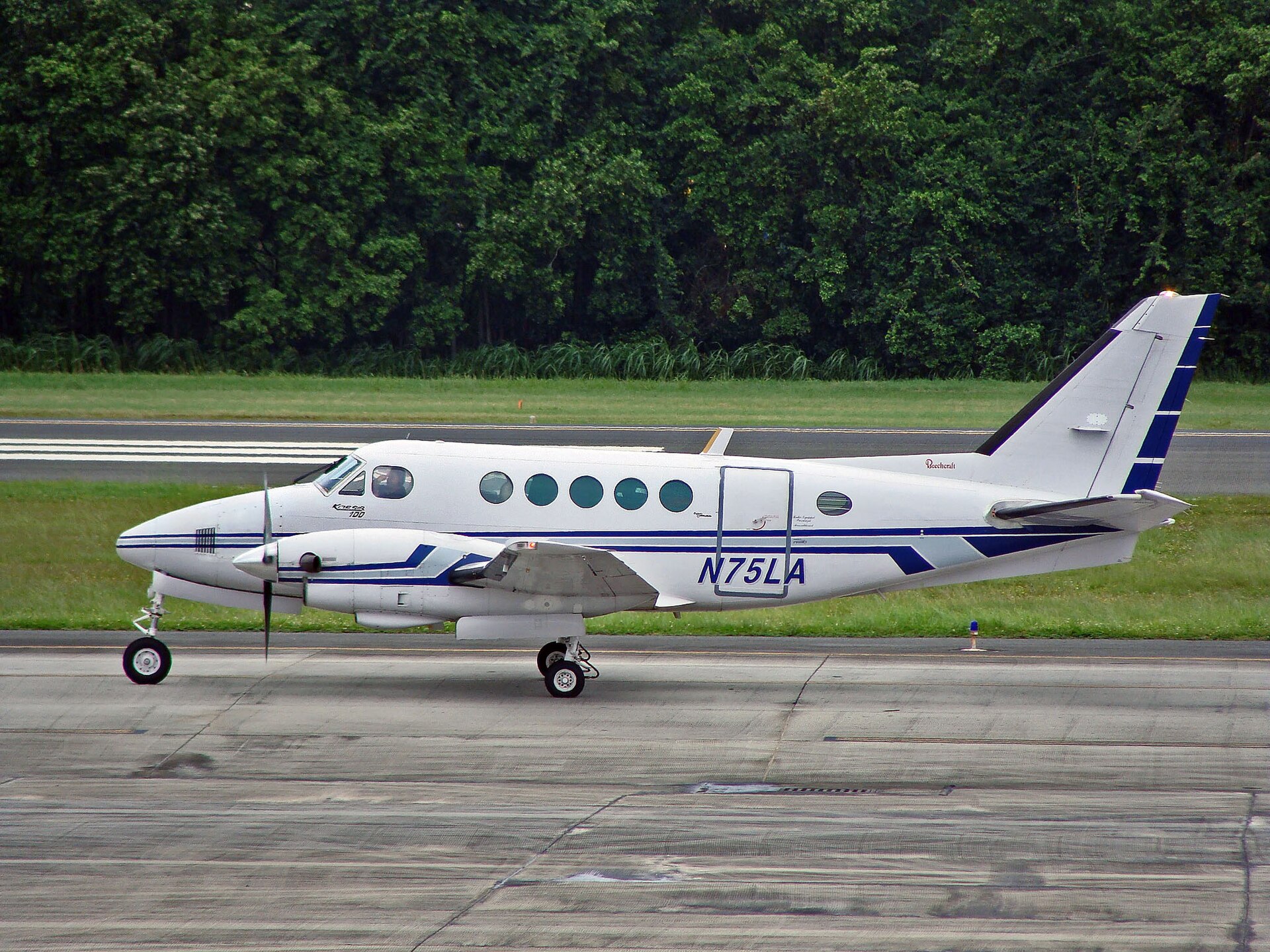
King Air 100 N75LA, photographed in 2009. · Photo: Tomás Del Coro via Wikimedia Commons, CC BY-SA 2.0
Beechcraft · Turboprop
King Air 100 / A100
The first stretched King Air: the Model 100 arrived in 1969 and the A100 followed in 1972 with more fuel and weight.
The 100 and A100 give you the cabin size of a King Air 200 for roughly $520,000 to $700,000. You give up speed, altitude and cabin comfort up high, and every example is 47 to 57 years old, so the wing records matter most.
Buy it if
You want a roomy twin turboprop for four to six people and bags on 200 to 800 nm trips, value two engines over speed, and can budget about $640,000 a year at 300 hours with a hired pilot.
Skip it if
You want to cruise above 25,000 ft or at 250 kt or more, plan regular 900 nm legs with every seat full, or want a model with plenty of examples for sale.
Biggest compromise
Pressurization. 6 psi, so the cabin climbs to about 10,000 ft at the 24,850 ft ceiling and sits near 7,600 ft at 21,000 ft.
The numbers that matter
Purchase price
$522K–$670K
guide value (PlanePhD and Aircraft Cost Calculator)
What it costs per year
$638K
at 300 hrs · one professional pilot
How far it flies
1,100 nm
875–900 nm with passengers
How fast
240 kt
high-speed cruise
Seats
6
6 typical (up to 13 commuter)
Pilots needed
1
Flown by one pilot in private use; charter operators often fly it with two.
Price
What one costs to buy
Guide value
$522K–$670K
Other sites
Priced vs call
with a price / call for price
Only one of two listings shows a price: $695,000 for a 1971 Model 100. Published guide values run about $522,000 to $670,000.
Price vs its family and alternatives
Scroll to explore · select a jet for details
King Air 100 / A100 · This aircraft
$522K–$670K guide
Guide value, not a listed asking price.
Sits between the King Air 90 / A90 (1964–1968) and the King Air B100.
For sale now
None listed right now
Cost to own
What it costs per year to run
300hours / year
Per year
Per flight hour
Estimate — your operator will quote actual numbers.
Fuel, airframe maintenance, engine overhaul reserve and propeller reserve and trip costs rise as you fly more. One professional pilot, recurrent training, hangar, insurance and subscriptions and databases stay the same however much you fly.
Where the money goes
- One professional pilot$86,25014%
- Recurrent training$15,0002%
- Hangar$30,0005%
- Insurance$14,0002%
- Subscriptions and databases$8,5001%
- Fuel$234,32437%
- Airframe maintenance$165,00026%
- Engine overhaul reserve$70,95011%
- Propeller reserve and trip costs$14,0002%
Fuel is the biggest single cost at 37% of the total.
The JetGrade
71 out of 100 — Slightly above its class
Peer group: King Air C90, King Air E90, King Air B100, Piper Cheyenne II, Rockwell Commander 690 / 690A
Seven categories at a glance
- - - 70 = typical— This aircraft
Strongest on cabin & passenger comfort, weakest on running costs.
Grades are editorial opinions about the model, not any specific aircraft. Sponsors and affiliates have no input. Reviewed 2026-10-04.
Where it flies
Sample trips and reach
Typical trips on a map
Nonstop
Depends on weight or weather
Fuel stop likely
2 of 6 sample trips are comfortable nonstops.
Sample flight times
- 1.3 hr
Carlsbad → Las Vegas
205 nm · Short hop, well within range
- 3.1 hr
Carlsbad → Aspen
625 nm · Mountain airport; summer departures may need less weight
- 3.7 hr
Santa Ana → San José del Cabo
765 nm · Nonstop with four; little spare fuel for headwinds
- 4.7 hr
Teterboro → West Palm Beach
900 nm · At the edge of range; plan one stop
- 6.0 hr
Dallas → Teterboro
1,190 nm · One stop, typically in the Southeast or Midwest
- 10.3 hr
Carlsbad → Teterboro
2,100 nm · Two stops across the country
Lineage
What came before and after


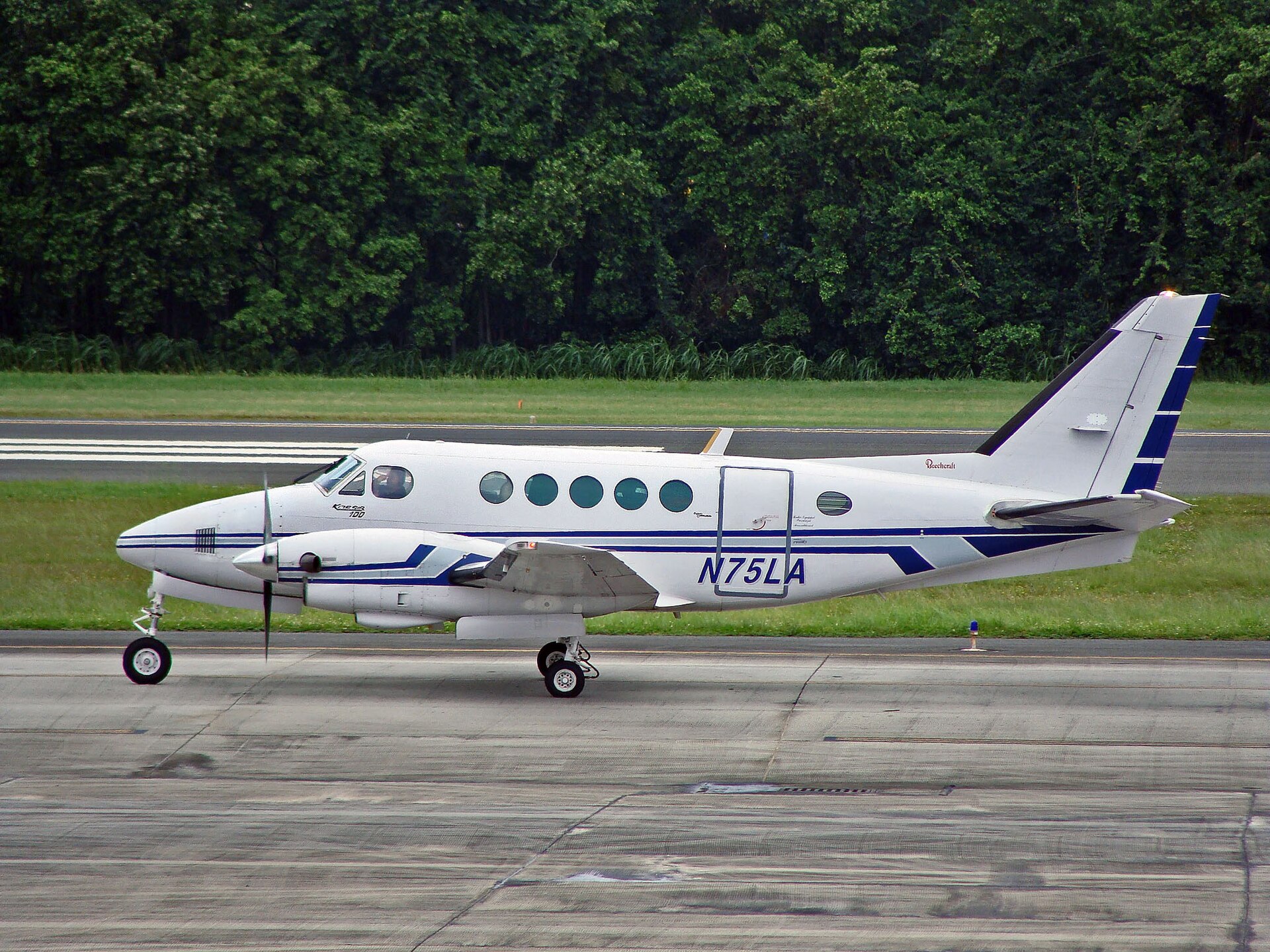
1969–1979
King Air 100 / A100
Cabin about 4 ft longer and 680 shp engines; A100 added fuel.
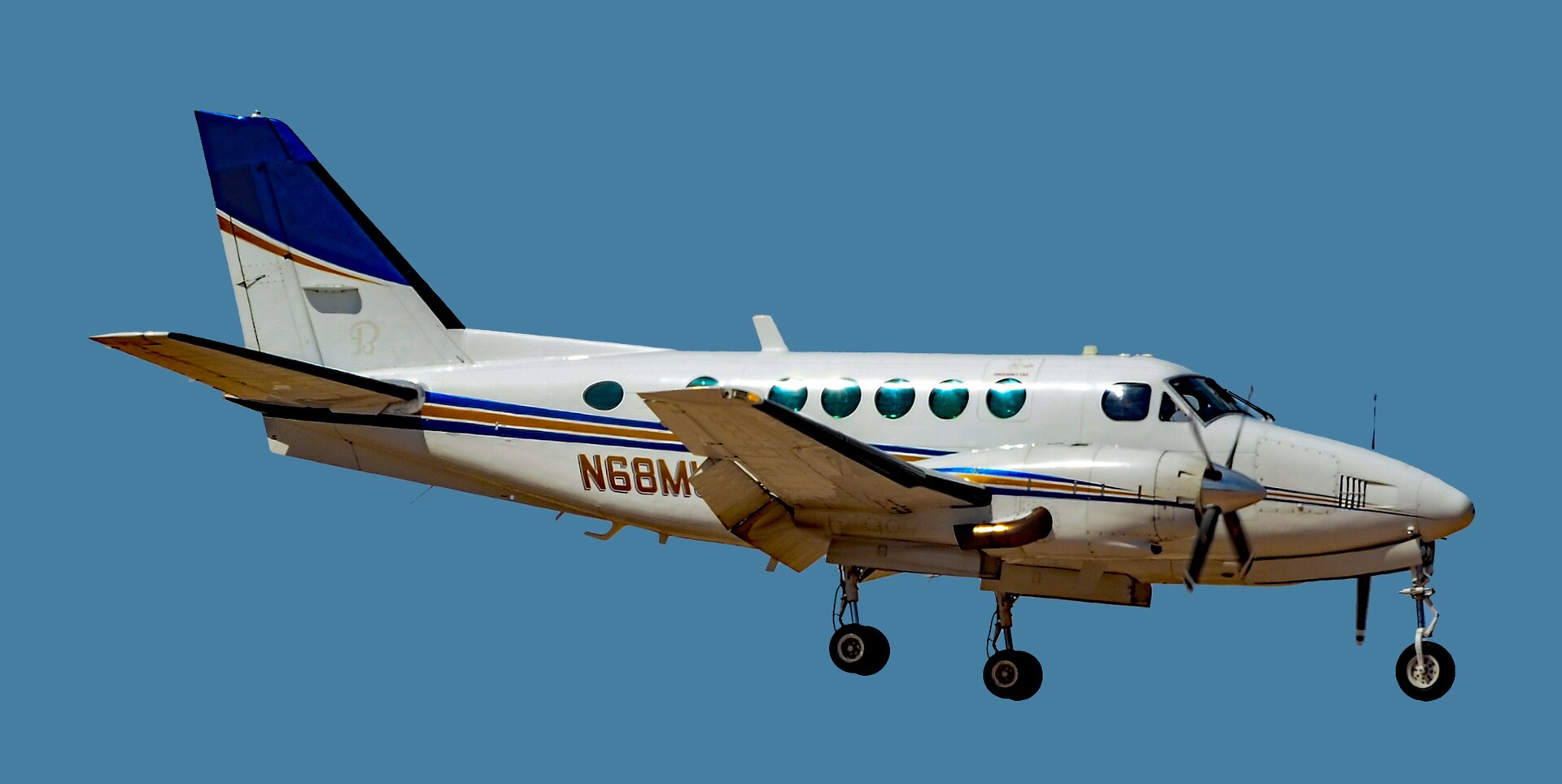
What changed from the King Air B90
- Fuselage stretched about 50 in, giving a cabin roughly 4 ft longer than the 90 series.
- Two Pratt & Whitney PT6A-28 engines of 680 shp each.
- Shorter-span wing, landing gear and tail taken from the Beech 99 airliner.
- The A100 raised fuel capacity from 374 to 470 gallons.
- The A100 raised maximum takeoff weight from 10,600 to 11,500 lb.
- The A100 made four-blade propellers standard, lowering cabin noise and vibration.
Size and cabin
How big it is, inside and out
Outside
Silhouette · scaled to length
Length
Wingspan
Height
Inside the cabin
Cabin length
Width
Height
Compare
How it stacks up
This aircraft
King Air 100 / A100
- JetGrade
- 71
- Price
- $522K–$670K guide
- Cost per year
- $638K
- Range
- 1,100 nm
- Speed
- 240 kt
- Seats
- 6
- Cabin length
- 16′ 8″
- Pilots
- 1
- Years built
- 1969–1979
← Before
- JetGrade
- 63
- Price
- $383K–$383K guide
- Cost per year
- $512K
- Range
- 1,250 nm
- Speed
- 225 kt
- Seats
- 5
- Cabin length
- 12′ 4″
- Pilots
- 1
- Years built
- 1968–1970
After →
- JetGrade
- 67
- Price
- $668K–$880K guide
- Cost per year
- $675K
- Range
- 1,325 nm
- Speed
- 265 kt
- Seats
- 6
- Cabin length
- 16′ 8″
- Pilots
- 1
- Years built
- 1976–1983
Alternative
- JetGrade
- 72
- Price
- $1.28M
- Cost per year
- $729K
- Range
- 1,490 nm
- Speed
- 289 kt
- Seats
- 6
- Cabin length
- 16′ 8″
- Pilots
- 1
- Years built
- 1974–1981
Alternative
- JetGrade
- 69
- Price
- $775K
- Cost per year
- $609K
- Range
- 900 nm
- Speed
- 223 kt
- Seats
- 5
- Cabin length
- 12′ 5″
- Pilots
- 1
- Years built
- 1971–1983
- King Air B100 instead: The same airframe with Garrett engines, about 15 to 20 kt faster. Recent asks run about $675,500 to $895,000.
- King Air 200 instead: The same cabin size with a T-tail, more power and higher cruise altitudes, for a higher purchase price.
- King Air C90 instead: A cabin about 4 ft shorter, but far more were built, so there are many more examples to choose from.
Gold marks the best figure in each row.
Owning one
What to know before you buy
Engines & inspections
2 × Pratt & Whitney Canada PT6A-28 · 680 shp each
No APUEngine hours until overhaul
- Phase inspections · 200 hr
- Wing spar inspection directive · 1,000 hr
- Engine hot section inspection · 1,800 hr
- Propeller overhaul · 3,000 hr
- Engine overhaul · 3,600 hr
- Wing bolt inspection every 60 months
- Landing gear inspection every 72 months
Neither 100-series listing we found mentions an engine program. Most owners set money aside each hour, so price both engine overhauls into any offer.
Known issues
Wing spar fatigue inspections
Spar caps and attach fittings need detailed inspections every 1,000 hours unless Beechcraft's spar kit is installed.
Poor repairs near the spar
The FAA warned that some fuselage crack repairs drilled through wing spar caps; check the repair history closely.
Wing fitting washer directive
A 2020 directive requires a check of lower wing fitting washers; cracked fittings can cost about $24,600 to replace.
Pre-buy checklist
0 of 10 checked
The PT6A engine family is supported by overhaul shops worldwide, but parts and know-how for a 1970s airframe depend on choosing an experienced King Air shop.
Review
The full review
Strengths
- A 303 cu ft cabin, 16 ft 8 in long, with the same cross-section as a King Air 200.
- Carries about 951 lb with full tanks, enough for four passengers and bags on trips near 900 nm.
- Guide values of about $520,000 to $670,000 buy a large-cabin twin for less than many used King Air 90s.
Limitations
- Realistic cruise is about 235 kt, 15 to 20 kt slower than the Garrett-powered King Air B100.
- Only 4.6 psi pressurization, so the cabin reaches about 10,000 ft at the 24,850 ft ceiling.
- Wing spar inspections every 1,000 hours unless Beechcraft's spar kit is installed, plus a 2020 wing fitting directive.
The King Air 100 was Beechcraft's first stretched King Air. It first flew in 1969, taking the 90-series design, adding about 50 inches to the fuselage and fitting 680 shp Pratt & Whitney PT6A-28 engines. The A100 replaced it in 1972 with 470 gallons of fuel instead of 374, a maximum takeoff weight of 11,500 lb instead of 10,600 lb, and four-blade propellers as standard. Beechcraft built 89 Model 100s and 157 A100s before A100 production ended in 1979, while the Garrett-powered B100 carried the same airframe on until 1983.
Pilot's take
The 100-series feels like a bigger airplane than the 90s and 200s around it. Control forces are heavier, it slows quickly in the flare, and lowering the flaps brings a pronounced pitch-up that needs a firm hand on the trim. None of that is hard once trained, but it rewards pilots who fly it often. Plan on cruising in the low 20s at about 235 kt with a cabin near 8,000 ft, and respect single-engine performance on hot days at high airports, where 680 shp engines leave little margin.
Who this is for
An owner, small company or charter operator flying 150 to 400 hours a year with four to six passengers on regional trips, who wants two engines and a big cabin for well under $1M.

Ask about this aircraft
Answers come only from our research file on the King Air 100 / A100.
Your earlier questionsOwners
Private to verified ownersOwn a Beechcraft King Air 100 / A100? Verify with its FAA registration to join the owners' thread and the real-cost poll.