
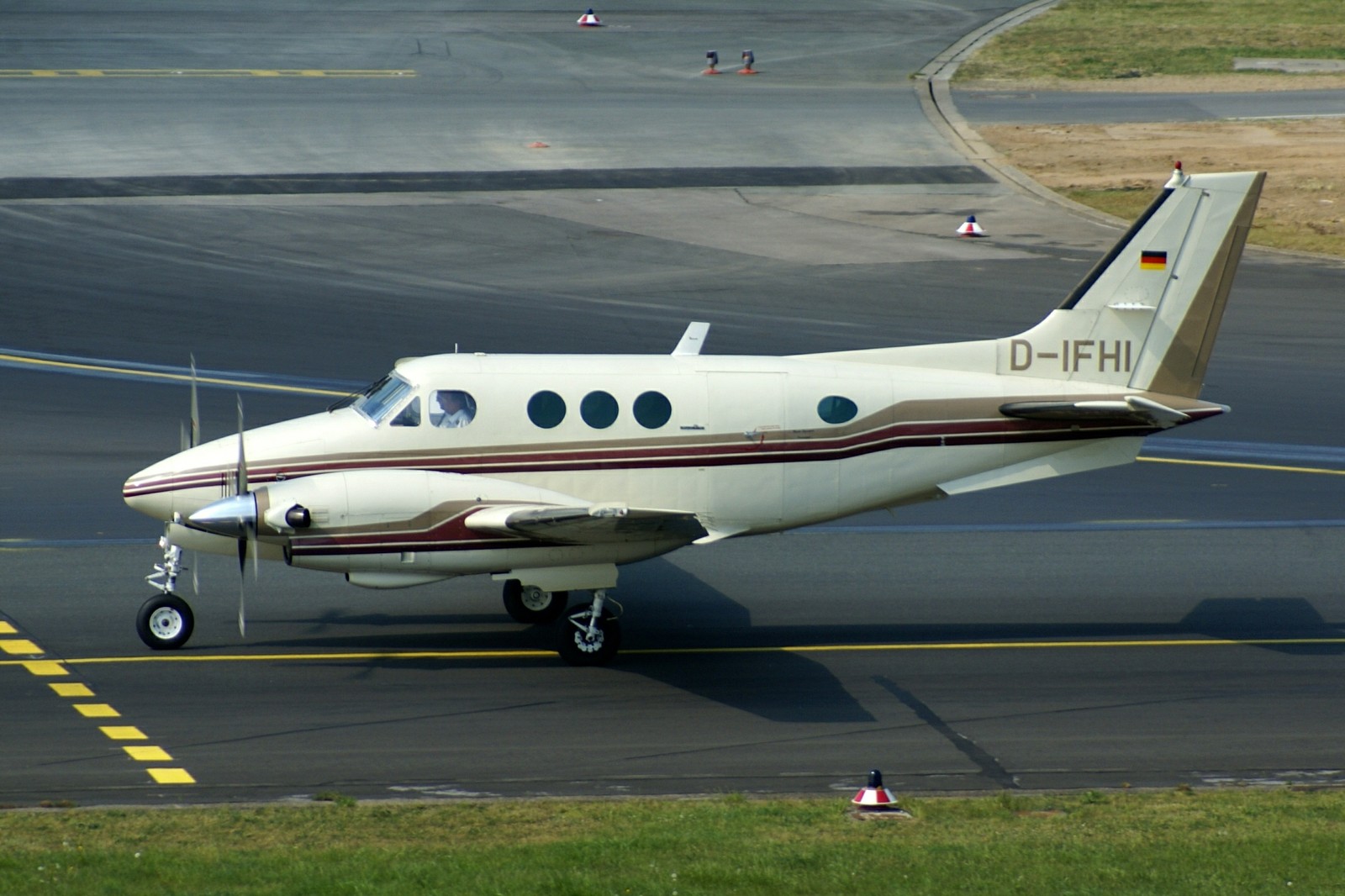
A King Air C90 taxiing at Düsseldorf, with its three-blade propellers and straight wing. · Eric Salard · CC BY-SA 2.0 (https://creativecommons.org/licenses/by-sa/2.0) · resized
Beechcraft · Turboprop
King Air C90
Fourth version of the King Air 90, built 1971–1983 between the B90 and the C90A.
The C90 gives you King Air toughness, two engines and a real cabin for the price of a new piston single. It is slow, short-legged and old, and its engines and wing-spar history decide whether an example is a bargain or a money pit.
Buy it if
You fly two to five people 200–700 nm at a time, want two engines and a pressurized cabin, use short or rough runways, and can spend $600,000–$1M to buy plus a healthy engine fund.
Skip it if
Your trips regularly run past 800 nm, you need an enclosed lavatory or a stand-up cabin, you want a modern cockpit from the factory, or a surprise $300,000 engine bill would hurt.
Biggest compromise
Age and engines. Every C90 is now 43 to 55 years old, and each engine costs roughly $250,000–$350,000 to overhaul.
The numbers that matter
Purchase price
$775K
typical asking · $399K–$995K
What it costs per year
$609K
at 300 hrs · one professional pilot
How far it flies
900 nm
840–880 nm with passengers
How fast
223 kt
high-speed cruise
Seats
5
5 typical, plus a belted toilet seat
Pilots needed
1
Certified for one pilot; many are owner-flown, and some insurers or operators prefer two.
Price
What one costs to buy
Typical asking price
$775,000
Where asking prices sit
Low
$399K
Typical
$775K
High
$995K
Most asking prices fall inside this band.
Other sites
Priced vs call
with a price / call for price
Nine priced listings ask $399,000–$995,000; engine time and panel upgrades explain most of the spread. Value estimates run $534,000–$929,000 by year.
Price vs its family and alternatives
Scroll to explore · select a jet for details
King Air C90 · This aircraft
$775K
Sits between the King Air 90 / A90 (1964–1968) and the King Air C90A.
For sale now
None listed right now
Cost to own
What it costs per year to run
300hours / year
Per year
Per flight hour
Estimate — your operator will quote actual numbers.
Fuel, maintenance and engine reserve rise as you fly more. One professional pilot, recurrent training, hangar, insurance and subscriptions and databases stay the same however much you fly.
Where the money goes
- One professional pilot$130,00021%
- Recurrent training$10,0002%
- Hangar$27,0004%
- Insurance$27,5005%
- Subscriptions and databases$5,5001%
- Fuel$179,24429%
- Maintenance$146,40024%
- Engine reserve$82,95014%
Fuel is the biggest single cost at 29% of the total.
The JetGrade
69 out of 100 — Below its class average
Peer group: Beechcraft King Air E90, Piper Cheyenne II, Cessna Conquest I, Mitsubishi MU-2 short body
Seven categories at a glance
- - - 70 = typical— This aircraft
Strongest on cabin & passenger comfort, weakest on speed & trip time.
Grades are editorial opinions about the model, not any specific aircraft. Sponsors and affiliates have no input. Reviewed 2026-10-04.
Where it flies
Sample trips and reach
Typical trips on a map
Nonstop
Depends on weight or weather
Fuel stop likely
1 of 6 sample trips are comfortable nonstops.
Sample flight times
- 1.4 hr
Carlsbad → Las Vegas
205 nm · Easy nonstop with a full cabin
- 3.6 hr
Carlsbad → Aspen
625 nm · High-altitude Aspen; depends on weight, weather, terrain
- 4.2 hr
Santa Ana → San José del Cabo
765 nm · Near range limit; headwinds may force a stop
- 5.3 hr
Teterboro → West Palm Beach
900 nm · One stop, typically in the Carolinas
- 6.7 hr
Dallas → Teterboro
1,190 nm · One stop, typically mid-route
- 11.6 hr
Carlsbad → Teterboro
2,100 nm · Two stops; a full travel day
Lineage
What came before and after


1971–1983
King Air C90
King Air 100 pressurization system; C90-1 added higher cabin pressure.


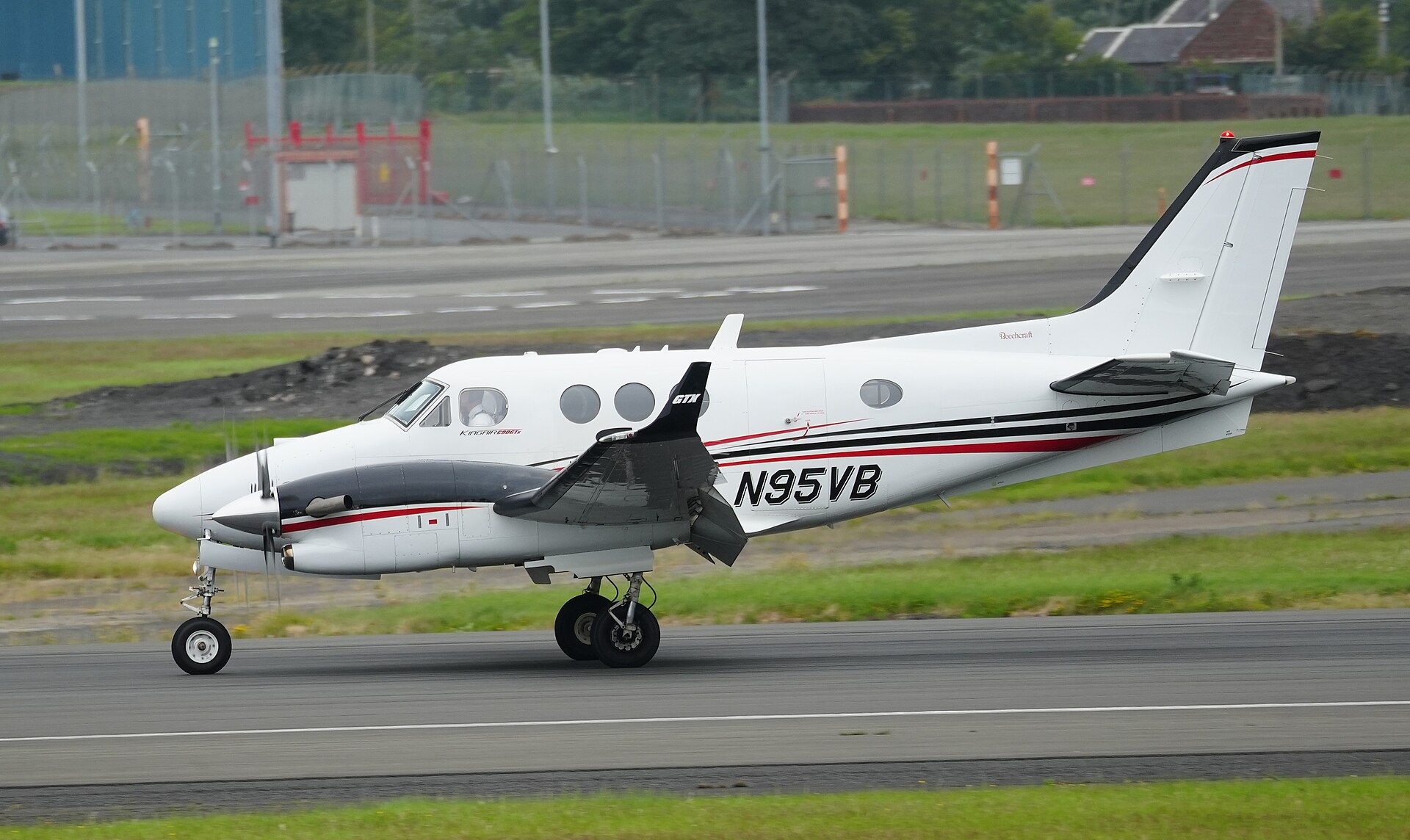
What changed from the King Air B90
- Pressurization and electric heating system borrowed from the larger King Air 100.
- PT6A-20A engines at launch, PT6A-21 from about 1976; both 550 shp.
- Bleed-air pressurization replaced the older system but made the cabin noisier.
- Same wing, fuel system and 9,650 lb maximum weight as the B90.
- 1982 C90-1 raised cabin pressure differential from 4.6 to 5.0 psi.
- C90-1 added a stronger tailplane and a King Air 200-style door.
Size and cabin
How big it is, inside and out
Outside
Silhouette · scaled to length
Length
Wingspan
Height
Inside the cabin
Cabin length
Width
Height
Compare
How it stacks up
This aircraft
King Air C90
- JetGrade
- 69
- Price
- $775K
- Cost per year
- $609K
- Range
- 900 nm
- Speed
- 223 kt
- Seats
- 5
- Cabin length
- 12′ 5″
- Pilots
- 1
- Years built
- 1971–1983
← Before
- JetGrade
- 63
- Price
- $383K–$383K guide
- Cost per year
- $512K
- Range
- 1,250 nm
- Speed
- 225 kt
- Seats
- 5
- Cabin length
- 12′ 4″
- Pilots
- 1
- Years built
- 1968–1970
After →
- JetGrade
- 71
- Price
- $1.42M
- Cost per year
- $550K
- Range
- 1,120 nm
- Speed
- 247 kt
- Seats
- 6
- Cabin length
- 12′ 4″
- Pilots
- 1
- Years built
- 1984–1992
Alternative
- JetGrade
- 69
- Price
- $435K–$540K guide
- Cost per year
- $505K
- Range
- 1,510 nm
- Speed
- 283 kt
- Seats
- 5
- Cabin length
- 8′ 5″
- Pilots
- 1
- Years built
- 1974–1981
Alternative
- JetGrade
- 77
- Price
- $2.9M
- Cost per year
- $515K
- Range
- 1,500 nm
- Speed
- 265 kt
- Seats
- 6
- Cabin length
- 16′ 11″
- Pilots
- 1
- Years built
- 1996–2005
- Beechcraft King Air C90A instead: Same cabin with a stronger bonded wing spar, rudder boost and better engine cowlings; costs more but avoids the C90's spar inspection burden.
- Piper Cheyenne II instead: About 60 knots faster with similar payload, but a smaller cabin, roughly 720 nm with seats full, and a smaller support network.
- Pilatus PC-12/45 instead: One engine instead of two, but a larger cabin with cargo door and enclosed toilet, longer range and much younger airframes, at a far higher price.
Gold marks the best figure in each row.
Owning one
What to know before you buy
Engines & inspections
2 × Pratt & Whitney Canada PT6A-21 (PT6A-20A on early aircraft) · 550 shp each
No APUEngine hours until overhaul
- Phase inspection · 200 hr
- Starter-generator overhaul · 1,000 hr
- Engine hot section inspection · 1,800 hr
- Engine overhaul · 3,600 hr
- Wing spar-cap inspection every 12 months
- Landing gear actuator check every 30 months
Most C90s fund engines through owner reserves; Pratt & Whitney's ESP lists the PT6A-21 on later C90s, so ask whether an older airframe qualifies.
Known issues
Bolted wing spar inspections
Spar caps and lower fittings need recurring checks; cracked fittings cost about $20,000–$25,000 per side to replace.
Engine cost swings
Hot sections run $15,000–$150,000 per engine and overhauls $250,000–$350,000; early PT6A-20A parts are scarcer.
Obsolete original avionics
Factory-era panels are outdated; a Garmin display, navigator and autopilot retrofit is now the norm.
Pre-buy checklist
0 of 10 checked
Textron Aviation's company-owned service centers and many independent King Air shops support the C90, and parts are plentiful thanks to a large salvage market.
Review
The full review
Strengths
- A pressurized twin turboprop for $575,000–$990,000 asking on most priced listings in October 2026.
- Carries four adults and bags comfortably: 3,885 lb useful load and about 900 lb of payload with full tanks.
- Backed by the King Air network: Textron service centers, deep parts supply and proven 3,600-hour PT6 engines.
Limitations
- Slow for a twin turboprop at about 217–223 knots, so a 700 nm trip takes close to four hours.
- About 840 nm with every seat full and standard fuel reserves; Dallas to New York needs a stop.
- Cabin is 4 ft 10 in tall with a curtained, belted toilet seat, and noisier than later King Airs.
The King Air C90 is the 1971–1983 version of Beechcraft's smallest King Air, a pressurized twin turboprop that seats five passengers in a club cabin behind one or two pilots. It followed the B90, kept that model's 50 ft 3 in wing and 9,650 lb maximum weight, and added the pressurization and heating system from the larger King Air 100. Beechcraft built 507 C90s and then 54 of the improved C90-1 in 1982 and 1983, before the C90A arrived with a redesigned wing spar and new engine cowlings.
Pilot's take
The C90 flies like a heavier, steadier piston twin: predictable on approach, forgiving in the flare and comfortable on a rough runway. It is not quick, and on a hot day at a high airport the 550 shp engines run out of breath early, so careful performance planning matters. The moment to respect is an engine failure right after liftoff. With no rudder boost, the pilot has to hold a lot of rudder and get the dead propeller feathered quickly. Recurrent training in type is money well spent. Fuel management also needs attention, because the wing-to-nacelle transfer pumps are switched on by hand.
Who this is for
An owner-pilot or small company stepping up from a piston twin, flying 150–400 hours a year on regional trips with up to five passengers, who values two engines and runway flexibility over speed and keeps a real engine reserve.

Ask about this aircraft
Answers come only from our research file on the Beechcraft King Air C90.
Your earlier questionsOwners
Private to verified ownersOwn a Beechcraft King Air C90? Verify with its FAA registration to join the owners' thread and the real-cost poll.