
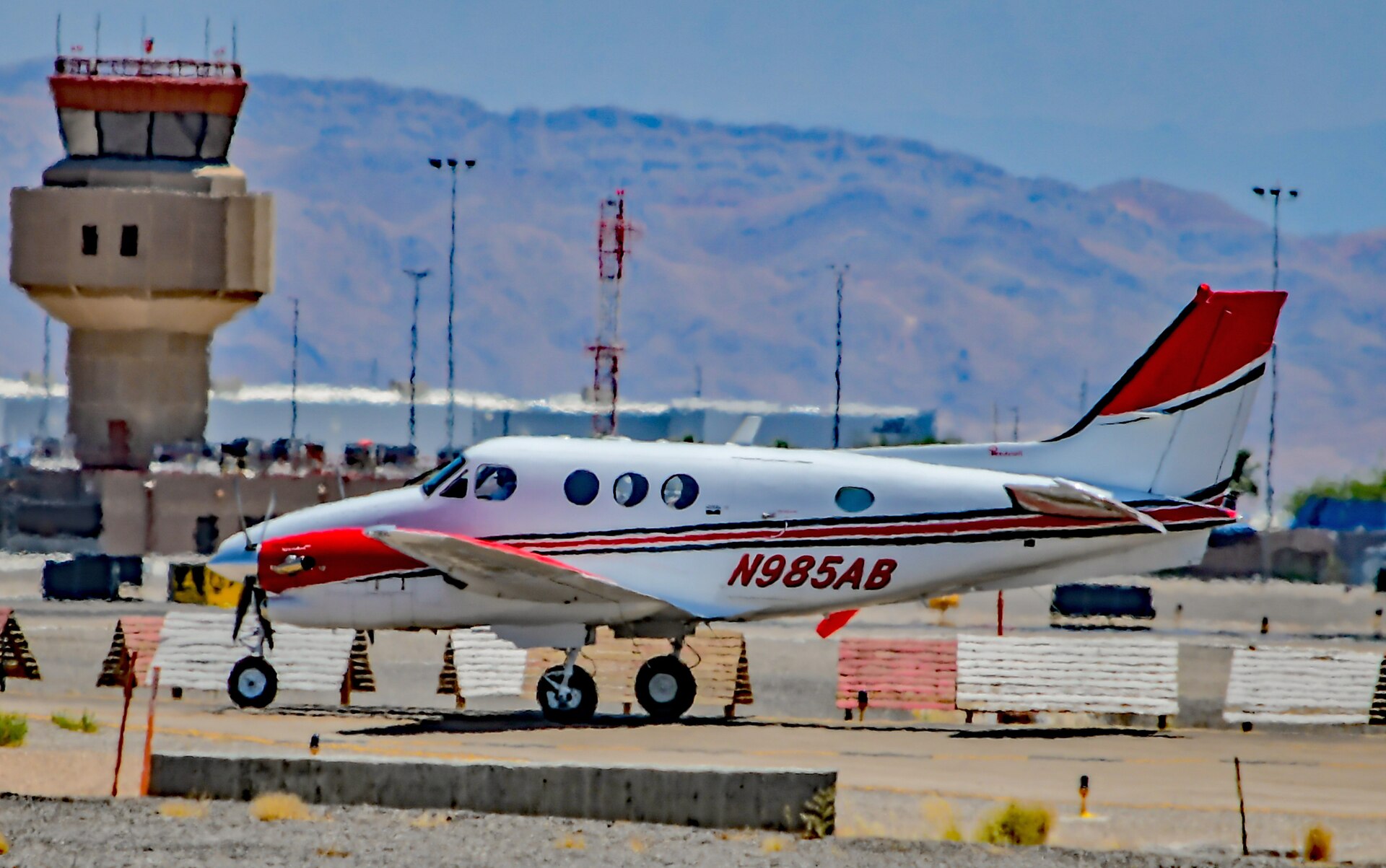
King Air C90A N985AB, photographed in 2025. · Photo: Tomás Del Coro via Wikimedia Commons, CC BY-SA 4.0
Beechcraft · Turboprop
King Air C90A
The third C90 version, built 1984–1992 between the C90-1 and the quieter C90B.
The C90A delivers King Air toughness, two engines and the best support network in its class for roughly $0.7–1.5M. It is slower and shorter-legged than rival twins, so buy it for regional trips rather than long distances.
Buy it if
You fly two to four people 200–800 nm at a time, want two engines and a tall cabin, and value an airplane that almost any King Air shop in the country can maintain.
Skip it if
You regularly fly more than 800 nm with four aboard, need jet-like speed, or want a quiet cabin and modern glass cockpit without paying extra for upgrades.
Biggest compromise
Speed and reach. A stock C90A cruises at roughly 225–247 knots and carries only about 590 lb with full fuel, so four people and bags mean less fuel and roughly 835 nm of range.
The numbers that matter
Purchase price
$1.42M
typical asking · $1.4M–$1.45M
What it costs per year
$550K
at 300 hrs · one professional pilot
How far it flies
1,120 nm
About 830–840 nm with four passengers
How fast
247 kt
high-speed cruise
Seats
6
6 typical in executive layout
Pilots needed
1
Certified for one pilot, and no type rating is needed because it weighs under 12,500 lb.
Price
What one costs to buy
Typical asking price
$1,415,000
Where asking prices sit
Low
$1.4M
Typical
$1.42M
High
$1.45M
Most asking prices fall inside this band.
Other sites
Priced vs call
with a price / call for price
All three priced C90As have upgraded engines and ask $1.40–1.45M; a stock-engine 1987 example was recently advertised at $729,500.
Price vs its family and alternatives
Scroll to explore · select a jet for details
King Air C90A · This aircraft
$1.42M
Sits between the Conquest I (425) and the King Air C90GT.
For sale now
None listed right now
Cost to own
What it costs per year to run
300hours / year
Per year
Per flight hour
Estimate — your operator will quote actual numbers.
Fuel, airframe maintenance and engine reserve or program rise as you fly more. One professional pilot, recurrent training, hangar, hull and liability insurance and charts, databases and tracking stay the same however much you fly.
Where the money goes
- One professional pilot$86,25016%
- Recurrent training$8,2502%
- Hangar$29,4005%
- Hull and liability insurance$18,7003%
- Charts, databases and tracking$7,5001%
- Fuel$183,22233%
- Airframe maintenance$131,17824%
- Engine reserve or program$85,20916%
Fuel is the biggest single cost at 33% of the total.
The JetGrade
71 out of 100 — Slightly above its class
Peer group: Piper Cheyenne II, Piper Cheyenne IIXL, Cessna Conquest I (425), Mitsubishi MU-2 Marquise, Beechcraft King Air E90
Seven categories at a glance
- - - 70 = typical— This aircraft
Strongest on reliability & support, weakest on speed & trip time.
Grades are editorial opinions about the model, not any specific aircraft. Sponsors and affiliates have no input. Reviewed 2026-10-04.
Where it flies
Sample trips and reach
Typical trips on a map
Nonstop
Depends on weight or weather
Fuel stop likely
1 of 6 sample trips are comfortable nonstops.
Sample flight times
- 1.3 hr
Carlsbad → Las Vegas
205 nm · Easy nonstop with fuel to spare
- 3.3 hr
Carlsbad → Aspen
625 nm · Mountain airport; depends on weight and weather
- 4.0 hr
Santa Ana → San José del Cabo
765 nm · Near the limit with four aboard; winds matter
- 5.1 hr
Teterboro → West Palm Beach
900 nm · One stop with four aboard, typically the Carolinas
- 6.4 hr
Dallas → Teterboro
1,190 nm · One stop, typically in the Ohio Valley
- 11.0 hr
Carlsbad → Teterboro
2,100 nm · Two stops; a long day across the country
Lineage
What came before and after


1982–1983
King Air C90-1
New tailplane, more cabin pressure and a larger cabin door.

1984–1992
King Air C90A
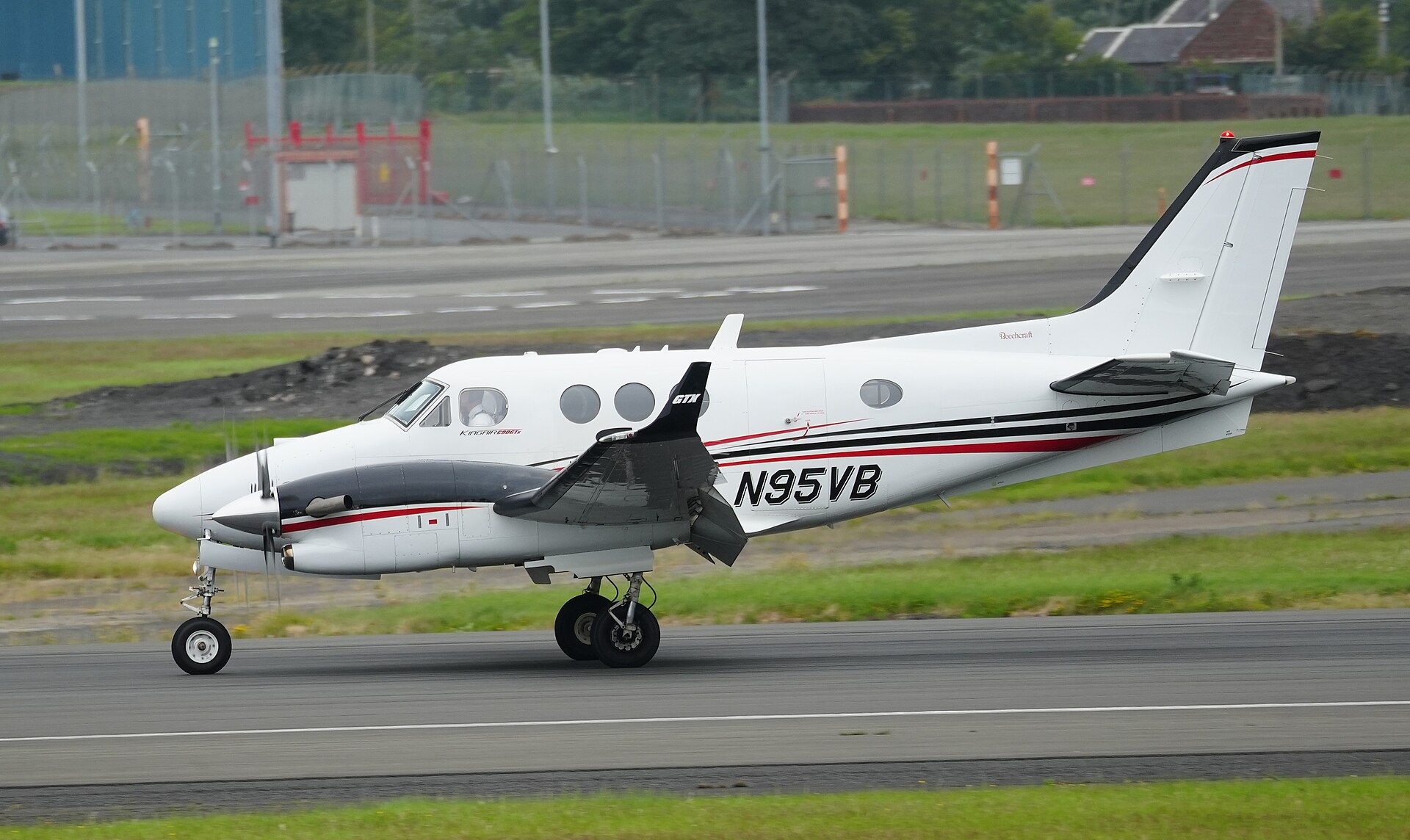
Pitot cowlings, hydraulic gear and a bonded wing spar.


What changed from the King Air C90 / C90-1
- Redesigned pitot-style engine cowlings from the F90-1 reduce drag and add cruise speed.
- Hydraulic landing gear with a hand pump for emergency extension.
- Improved electrical system plus the F90-1 pressurization and heating system.
- Rudder boost added to ease handling if an engine fails.
- Bonded wing spar caps with shear fittings instead of bolted fittings.
- Later aircraft approved for 10,100 lb takeoff weight, up from 9,650 lb.
Size and cabin
How big it is, inside and out
Outside
Silhouette · scaled to length
Length
Wingspan
Height
Inside the cabin
Cabin length
Width
Height
Compare
How it stacks up
This aircraft
King Air C90A
- JetGrade
- 71
- Price
- $1.42M
- Cost per year
- $550K
- Range
- 1,120 nm
- Speed
- 247 kt
- Seats
- 6
- Cabin length
- 12′ 4″
- Pilots
- 1
- Years built
- 1984–1992
← Before
- JetGrade
- 69
- Price
- $775K
- Cost per year
- $609K
- Range
- 900 nm
- Speed
- 223 kt
- Seats
- 5
- Cabin length
- 12′ 5″
- Pilots
- 1
- Years built
- 1971–1983
After →
- JetGrade
- 70
- Price
- $2.52M
- Cost per year
- $605K
- Range
- 1,049 nm
- Speed
- 246 kt
- Seats
- 6
- Cabin length
- 12′ 8″
- Pilots
- 1
- Years built
- 1992–2005
Alternative
- JetGrade
- 67
- Price
- $1.23M
- Cost per year
- $531K
- Range
- 1,240 nm
- Speed
- 262 kt
- Seats
- 5
- Cabin length
- 10′ 7″
- Pilots
- 1
- Years built
- 1980–1986
Alternative
- JetGrade
- 72
- Price
- $770K–$860K guide
- Cost per year
- $586K
- Range
- 1,490 nm
- Speed
- 248 kt
- Seats
- 5
- Cabin length
- 12′ 5″
- Pilots
- 1
- Years built
- 1972–1981
- Beechcraft King Air C90B / C90SE instead: Same airframe with four-blade propellers and vibration absorbers for a much quieter cabin; costs more to buy.
- Cessna Conquest I (425) instead: About 265 knots and longer range in a similar price bracket, with a lower cabin and different engines.
- Beechcraft King Air E90 instead: The same cabin with 680 shp PT6A-28 engines for stronger climb; older, built 1972–1981.
Gold marks the best figure in each row.
Owning one
What to know before you buy
Engines & inspections
2 × Pratt & Whitney Canada PT6A-21 · 550 shp each
No APUEngine hours until overhaul
- Phase inspections 1–4 · 200 hr
- Engine fuel nozzle check · 400 hr
- Engine hot section inspection · 1,800 hr
- Engine overhaul · 3,600 hr
- Wing bolt inspection every 60 months
- Cabin structural inspection every 72 months
- Landing gear actuator service every 30 months
- Engine and brake hoses every 60 months
Pratt & Whitney Canada offers flat-rate overhauls and hot-section credits for this engine; many owners have converted to PT6A-135A engines.
Known issues
Engine overhaul exposure
Two PT6A-21 overhauls cost at least $638,000 at 2026 flat rates, so engine time largely sets the price.
Wing fitting inspection records
Wing attach fittings need recurring inspections; an older King Air C90 broke up after a repair against factory guidance.
Lower weight on early aircraft
The earliest C90As are limited to 9,650 lb takeoff weight, 450 lb less than later aircraft.
Pre-buy checklist
0 of 9 checked
Textron Aviation and a large network of independent King Air shops support the C90A, and Pratt & Whitney Canada's PT6 network handles the engines. Parts are widely available, though often expensive.
Review
The full review
Strengths
- Tall cabin for its class at about 4 ft 9 in, with a four-seat club and an aft baggage area.
- PT6A-21 engines with a 3,600-hour overhaul interval and the largest turboprop service network behind them.
- Certified for one pilot and under 12,500 lb, so no type rating is needed to fly it.
Limitations
- Slow for a twin at about 225–247 knots, 20–50 knots behind the Conquest I and MU-2 Marquise.
- Only about 590 lb of payload with full fuel; four passengers means trading fuel for people.
- A flat-rate engine overhaul costs $319,000 per engine in 2026, so engine time drives price.
The King Air C90A is the 1984–1992 version of Beechcraft's smallest King Air, the twin-engine turboprop line that has been in production in some form since 1964. Beechcraft built 235 of them. It sits between the C90-1 and the C90B, which kept the same airframe but added four-blade propellers and a quieter cabin. Compared with the C90-1, the C90A brought redesigned engine cowlings borrowed from the F90-1, hydraulic landing gear, an improved electrical system, a rudder boost to ease engine-out handling and a bonded wing spar. Later aircraft were approved for a 10,100 lb takeoff weight, up from 9,650 lb.
Pilot's take
The C90A feels like what it is: a stable, forgiving King Air that rewards smooth hands and careful planning. The rudder boost helps if an engine quits, but single-engine climb is modest at roughly 550–630 fpm, so takeoff planning matters on hot days and at high airports. Plan cruise in the low-to-mid 200-knot range and a fuel stop beyond about 800 nm with a full cabin. The hydraulic gear and straightforward systems are easy to learn, and the PT6s are tolerant if you watch temperatures on start. Most of what separates a good C90A from a tired one is in the logbooks, not the panel.
Who this is for
Owner-pilots stepping up from piston twins and small companies flying regional trips of 200–800 nm with two to five passengers, who value the King Air name, two engines and easy maintenance more than speed.

Ask about this aircraft
Answers come only from our research file on the King Air C90A.
Your earlier questionsOwners
Private to verified ownersOwn a Beechcraft King Air C90A? Verify with its FAA registration to join the owners' thread and the real-cost poll.