
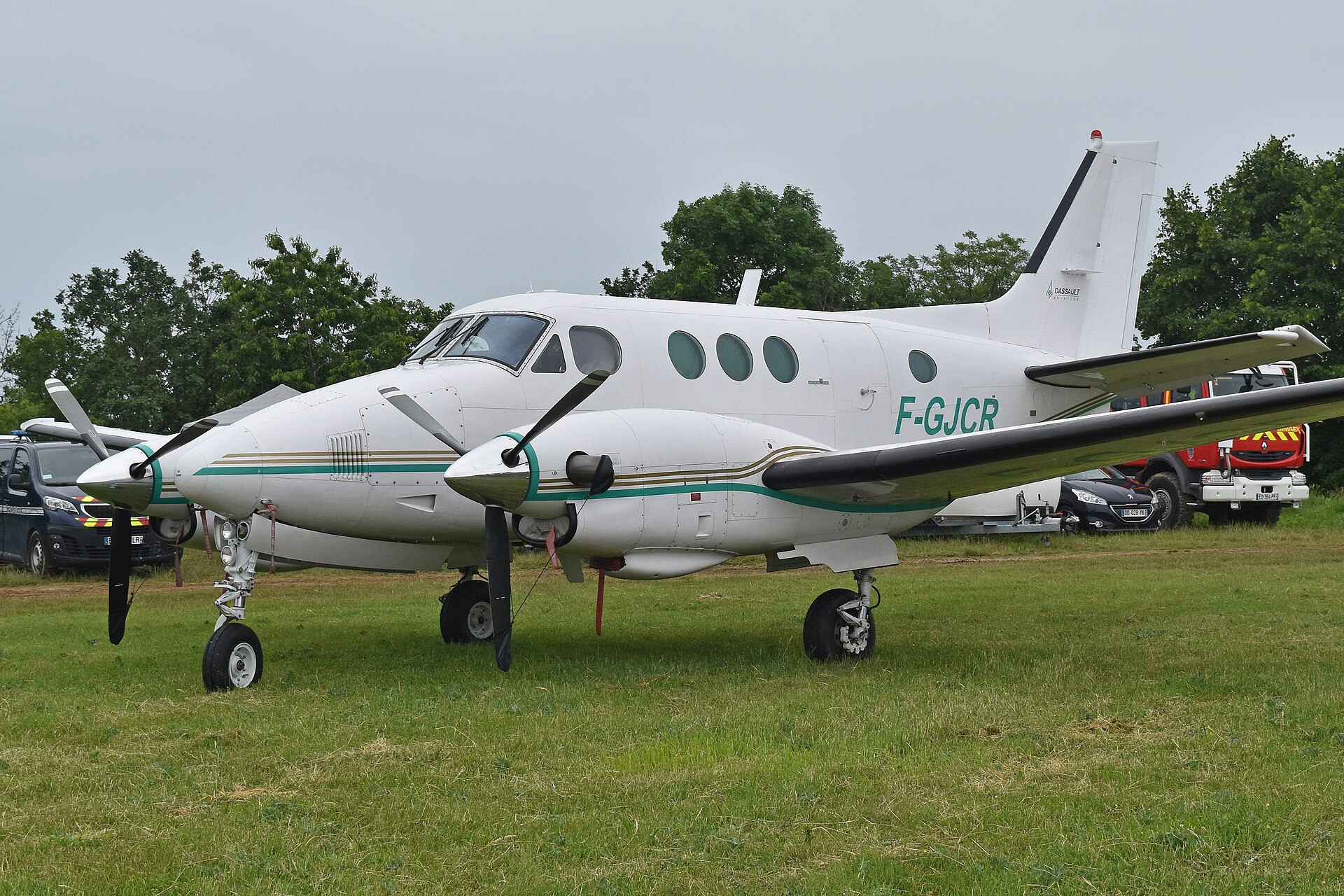
King Air E90 F-GJCR, photographed in 2019. · Photo: Alan Wilson via Wikimedia Commons, CC BY-SA 2.0
Beechcraft · Turboprop
King Air E90
The higher-powered, longer-range version of the C90, built alongside it from 1972 to 1981.
The E90 is the strongest of the 1970s round-tail small King Airs: stronger engines and 474 gallons of fuel give about 800 nm with four aboard, and it uses short runways. The trade-offs are age, modest speed and two costly engines.
Buy it if
You want a pressurized twin that one pilot can fly into short or high-elevation airports, carrying four or five people 700–800 nm, for well under $1M, with King Air service support nearly everywhere.
Skip it if
You need more than about 250 knots, a stand-up cabin, a private lavatory or seats-full trips beyond about 700 nm, or cannot absorb a $285,000 engine overhaul on an $800,000 aircraft.
Biggest compromise
The engines can be worth more than the airframe. A flat-rate overhaul for one PT6A-28 is listed at $285,000, so a pair costs about $570,000 against typical guide values of $770,000–$860,000.
The numbers that matter
Purchase price
$770K–$860K
guide value (Conklin & de Decker and Aircraft Cost Calculator)
What it costs per year
$586K
at 300 hrs · one professional pilot
How far it flies
1,490 nm
730–800 nm with passengers
How fast
248 kt
high-speed cruise
Seats
5
5 typical; up to 7
Pilots needed
1
Certified for one pilot; many are flown by their owners or a single professional pilot.
Price
What one costs to buy
Guide value
$770K–$860K
Other sites
Priced vs call
with a price / call for price
Only two of six listings show prices: $450,000 for a high-time aircraft in Zambia and $1.1M for one re-engined with GE H80s. Guides average $770,000–$860,000.
Price vs its family and alternatives
Scroll to explore · select a jet for details
King Air E90 · This aircraft
$770K–$860K guide
Guide value, not a listed asking price.
Sits between the King Air C90 and the King Air F90 / F90-1.
For sale now
None listed right now
Cost to own
What it costs per year to run
300hours / year
Per year
Per flight hour
Estimate — your operator will quote actual numbers.
Fuel, maintenance and engine and propeller reserve rise as you fly more. One professional pilot, hangar and insurance stay the same however much you fly.
Where the money goes
Partial estimate- One professional pilot$130,00022%
- Hangar$45,0008%
- Insurance$37,5006%
- Fuel$207,27035%
- Maintenance$90,00015%
- Engine and propeller reserve$76,50013%
Fuel is the biggest single cost at 35% of the total.
The JetGrade
72 out of 100 — Slightly above its class
Peer group: King Air C90, Piper Cheyenne II, Cessna Conquest I, Rockwell Commander 690 / 690A, Mitsubishi MU-2 (short body)
Seven categories at a glance
- - - 70 = typical— This aircraft
Strongest on airport access, weakest on speed & trip time.
Grades are editorial opinions about the model, not any specific aircraft. Sponsors and affiliates have no input. Reviewed 2026-10-04.
Where it flies
Sample trips and reach
Typical trips on a map
Nonstop
Depends on weight or weather
Fuel stop likely
1 of 6 sample trips are comfortable nonstops.
Sample flight times
- 1.2 hr
Carlsbad → Las Vegas
205 nm · Short hop, well within range
- 3.0 hr
Carlsbad → Aspen
625 nm · Mountain airport; depends on weight and weather
- 3.5 hr
Santa Ana → San José del Cabo
765 nm · Near its limit with four aboard; winds matter
- 4.2 hr
Teterboro → West Palm Beach
900 nm · Needs one stop with four aboard
- 5.4 hr
Dallas → Teterboro
1,190 nm · Needs one stop, typically mid-route
- 9.3 hr
Carlsbad → Teterboro
2,100 nm · Two stops with four aboard
Lineage
What came before and after


1972–1981
King Air E90
C90 cabin with stronger engines and the A100 fuel system.
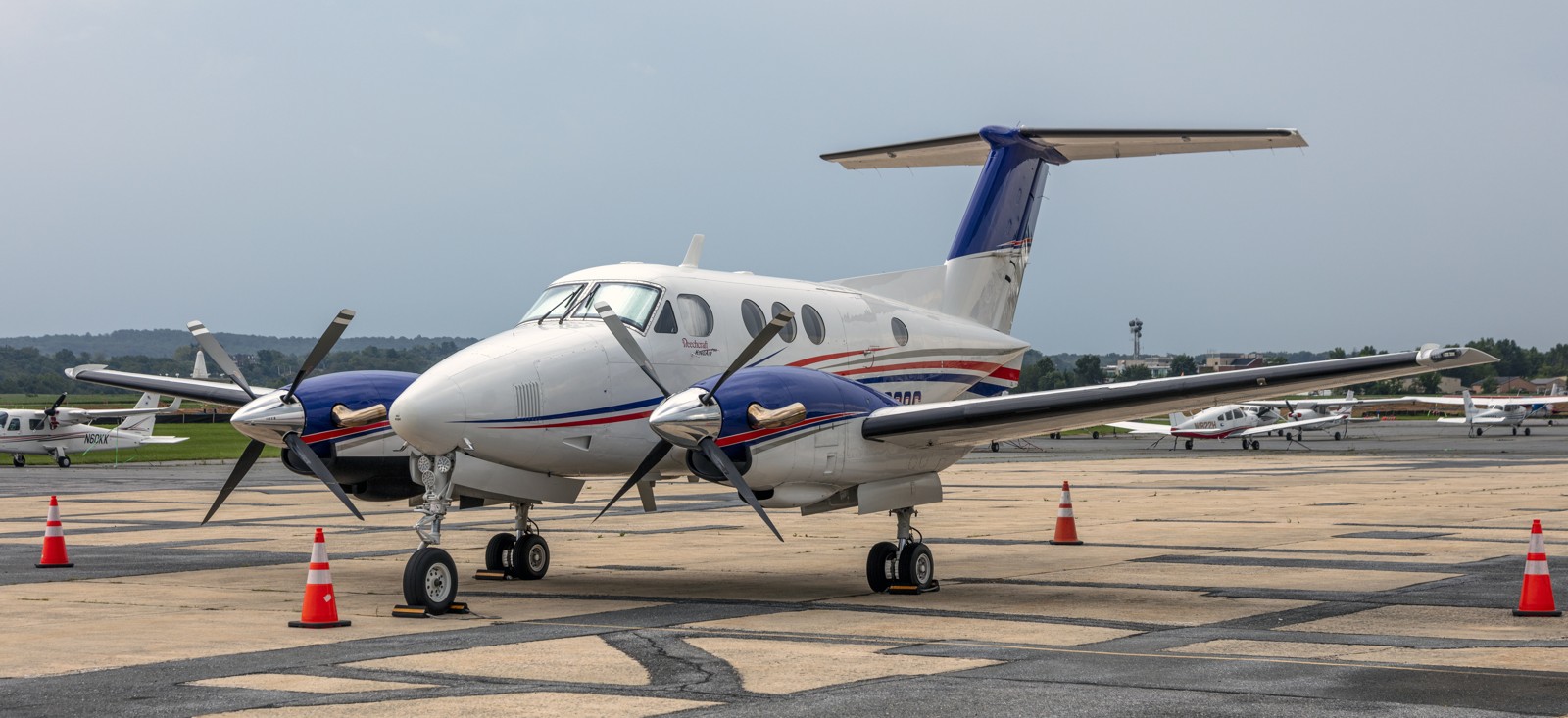
What changed from the King Air C90
- PT6A-28 engines rated 680 shp and limited to 550 shp replace the C90's lower-powered engines.
- Usable fuel rises to 474 gallons from the C90's 384, adding about 90 gallons.
- Fuel system from the King Air A100, with engine-driven boost pumps and a simpler transfer pump.
- Maximum takeoff weight of 10,100 lb.
- Instrument panel layout taken from the King Air A100.
- C90 cabin carried over; polarized round passenger windows became standard.
Size and cabin
How big it is, inside and out
Outside
Silhouette · scaled to length
Length
Wingspan
Height
Inside the cabin
Cabin length
Width
Height
Compare
How it stacks up
This aircraft
King Air E90
- JetGrade
- 72
- Price
- $770K–$860K guide
- Cost per year
- $586K
- Range
- 1,490 nm
- Speed
- 248 kt
- Seats
- 5
- Cabin length
- 12′ 5″
- Pilots
- 1
- Years built
- 1972–1981
← Before
- JetGrade
- 69
- Price
- $775K
- Cost per year
- $609K
- Range
- 900 nm
- Speed
- 223 kt
- Seats
- 5
- Cabin length
- 12′ 5″
- Pilots
- 1
- Years built
- 1971–1983
After →
- JetGrade
- 72
- Price
- $1.25M
- Cost per year
- $612K
- Range
- 1,576 nm
- Speed
- 266 kt
- Seats
- 6
- Cabin length
- 12′ 5″
- Pilots
- 1
- Years built
- 1979–1985
Alternative
- JetGrade
- 74
- Price
- $2M–$3M guide
- Cost per year
- $505K
- Range
- 1,650 nm
- Speed
- 269 kt
- Seats
- 6
- Cabin length
- 16′ 9″
- Pilots
- 1
- Years built
- 1994–1996
- King Air C90 instead: Same cabin and usually cheaper, but 90 fewer gallons of fuel and less engine power; fine if your trips are short.
- King Air F90 / F90-1 instead: The T-tail step-up model, with 750 shp engines and faster cruise and climb, at a higher price and a smaller fleet.
- Pilatus PC-12 instead: One engine, a larger cabin and a big cargo door, for buyers who do not need two engines.
Gold marks the best figure in each row.
Owning one
What to know before you buy
Engines & inspections
2 × Pratt & Whitney Canada PT6A-28 · 550 shp each
No APUEngine hours until overhaul
- Phase inspections · 200 hr
- Engine hot section inspection · 1,800 hr
- Propeller overhaul · 3,000 hr
- Engine overhaul · 3,600 hr
- Landing gear inspection every 72 months
Each engine is rated 680 shp but limited to 550. Pratt & Whitney Canada hot-section offers cover it, and some engines run extended intervals on a factory program.
Known issues
Engine overhauls rival airframe value
Two PT6A-28 overhauls cost about $570,000 at a $285,000 flat rate, close to a typical E90's value.
Aging 1972–1981 airframes
Every E90 is over 40 years old, so corrosion, wiring and records quality vary widely between aircraft.
Avionics vary by aircraft
Factory 1970s avionics have mostly been replaced; check what is installed, how well, and what remains original.
Pre-buy checklist
0 of 10 checked
King Air service centers and PT6 engine shops are widespread, so parts, inspections and overhauls are easy to source even for a 1970s airframe.
Review
The full review
Strengths
- 474 gallons of usable fuel, 90 more than the C90, gives about 730 nm with every seat filled and reserves.
- Climbs at 1,870 fpm and clears a 50 ft obstacle in about 2,024 ft at its 10,100 lb maximum weight.
- Engines rated 680 shp but limited to 550 keep full takeoff power on hot days and at altitude.
Limitations
- Cruises near 248 knots, so New Jersey to Palm Beach with four aboard needs a fuel stop and over four hours flying.
- Cabin is 4 ft 10 in tall, and the toilet is a belted aft seat rather than a private room.
- Every E90 was built between 1972 and 1981, so corrosion, wiring and logbooks need a careful pre-buy inspection.
The King Air E90 is a twin-engine, pressurized turboprop that Beechcraft built from 1972 to 1981, delivering 347 of them. It combined the fuselage and cabin of the King Air C90 with stronger Pratt & Whitney Canada PT6A-28 engines and the fuel system and instrument panel of the larger King Air A100. It sold alongside the C90 as the faster, longer-legged small King Air until the T-tail F90 arrived in 1979 as the new step-up model.
Pilot's take
The E90 flies like the C90 it came from, with more power and more fuel. Engines limited well below their full rating mean full takeoff power on a hot day at a high airport, and 474 gallons let you plan real legs instead of hopping. The fuel system is easy to manage once you learn one habit: leave the auxiliary transfer off until the main tanks have burned down a little, or it can vent fuel overboard. It is certified for one pilot and rewards a pilot who stays current on engine-failure training. At 248 knots it is not quick, but it is steady and comfortable on short runways.
Who this is for
Owner-pilots and small companies stepping up from a piston twin or single-engine turboprop who fly two to five people 200–700 nm, use short or high-elevation airports, and value King Air support over speed.

Ask about this aircraft
Answers come only from our research file on the King Air E90.
Your earlier questionsOwners
Private to verified ownersOwn a Beechcraft King Air E90? Verify with its FAA registration to join the owners' thread and the real-cost poll.