

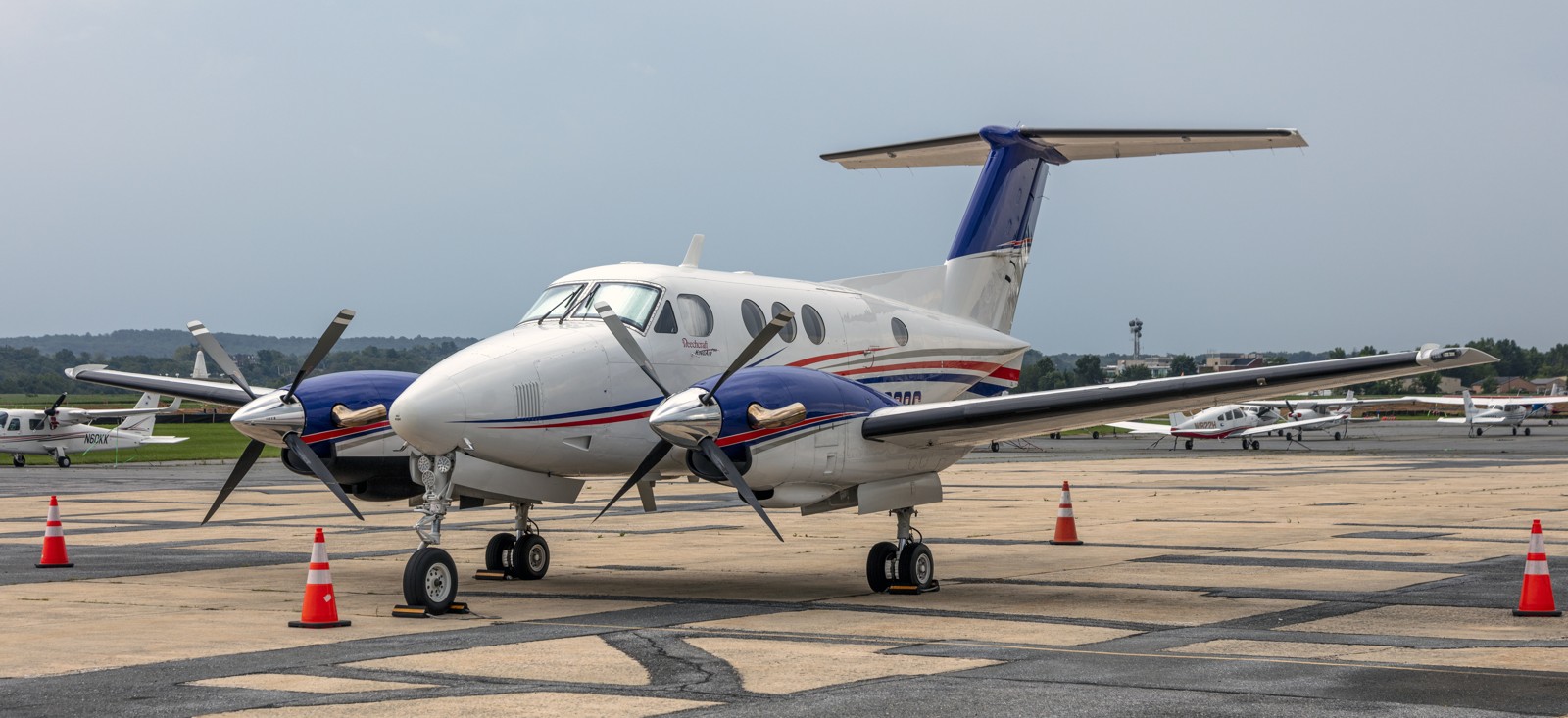
A 1981 King Air F90 on the ramp, showing its T-tail and four-blade propellers. · Acroterion · CC BY-SA 4.0 (https://creativecommons.org/licenses/by-sa/4.0) · resized
Beechcraft · Turboprop
King Air F90 / F90-1
A faster branch of the King Air 90 family, built 1979–1985 between the E90 and the King Air 200.
The F90 is the quickest of the classic King Air 90s, with strong climb, short-runway manners and the huge King Air support network behind it. Its cabin is no bigger than a C90's, and engine time decides most of what you pay.
Buy it if
You fly yourself or with one hired pilot on 300–900 nm trips with up to five passengers, and want twin-engine redundancy, pressurization and 265-knot speed for roughly $1–2 million.
Skip it if
You need a stand-up cabin, a closed lavatory or regular nonstops beyond about 1,000 nm with a full cabin, or you want a Garmin G1000 NXi cockpit, which is not offered for this model.
Biggest compromise
You get a fast, strong airframe wrapped around a small cabin: 4 ft 10 in tall and 12 ft 5 in long, with a toilet seat at the back rather than a closed lavatory. Six adults feel cramped, and when both engines need overhaul the bill can pass $700,000.
The numbers that matter
Purchase price
$1.25M
typical asking · $996K–$1.95M
What it costs per year
$612K
at 300 hrs · one professional pilot
How far it flies
1,576 nm
940–1,150 nm with passengers
How fast
266 kt
high-speed cruise
Seats
6
6 typical, up to 8
Pilots needed
1
Certified for one pilot with no type rating needed; insurers expect yearly King Air simulator training.
Price
What one costs to buy
Typical asking price
$1,250,000
Where asking prices sit
Low
$996K
Typical
$1.25M
High
$1.95M
Most asking prices fall inside this band.
Other sites
6-month move
Priced vs call
with a price / call for price
Eight of 15 current listings show prices, from $996,000 to $1.95 million; engine time, engine upgrades and Garmin avionics explain most of the spread.
Price vs its family and alternatives
Scroll to explore · select a jet for details
King Air F90 / F90-1 · This aircraft
$1.25M
Sits between the Conquest I (425) and the King Air C90A.
For sale now
None listed right now
Cost to own
What it costs per year to run
300hours / year
Per year
Per flight hour
Estimate — your operator will quote actual numbers.
Fuel, airframe and propeller maintenance, engine program or overhaul reserve and other operating costs rise as you fly more. One professional pilot, recurrent training, hangar, insurance and subscriptions and databases stay the same however much you fly.
Where the money goes
- One professional pilot$135,00022%
- Recurrent training$11,5002%
- Hangar$36,0006%
- Insurance$25,0004%
- Subscriptions and databases$7,5001%
- Fuel$195,33032%
- Airframe and propeller maintenance$112,50018%
- Engine program or overhaul reserve$79,66813%
- Other operating costs$10,0002%
Fuel is the biggest single cost at 32% of the total.
The JetGrade
72 out of 100 — Slightly above its class
Peer group: Beechcraft King Air C90B / C90SE, Beechcraft King Air E90, Cessna Conquest I (425), Piper Cheyenne IIXL (PA-31T2)
Seven categories at a glance
- - - 70 = typical— This aircraft
Strongest on airport access, weakest on running costs.
Grades are editorial opinions about the model, not any specific aircraft. Sponsors and affiliates have no input. Reviewed 2026-10-04.
Where it flies
Sample trips and reach
Typical trips on a map
Nonstop
Depends on weight or weather
Fuel stop likely
3 of 6 sample trips are comfortable nonstops.
Sample flight times
- 1.2 hr
Carlsbad → Las Vegas
205 nm · Easy nonstop with a full cabin
- 2.8 hr
Carlsbad → Aspen
625 nm · High-altitude airport; summer departures may need lighter loads
- 3.3 hr
Santa Ana → San José del Cabo
765 nm · Nonstop with four passengers
- 4.2 hr
Teterboro → West Palm Beach
900 nm · Nonstop with four; slower cruise protects fuel reserves
- 5.4 hr
Dallas → Teterboro
1,190 nm · One stop likely with four passengers
- 9.7 hr
Carlsbad → Teterboro
2,100 nm · One stop needed, typically mid-continent
Lineage
What came before and after


1979–1985
King Air F90 / F90-1
T-tail, shorter wing and 750 shp engines: the fast 90.


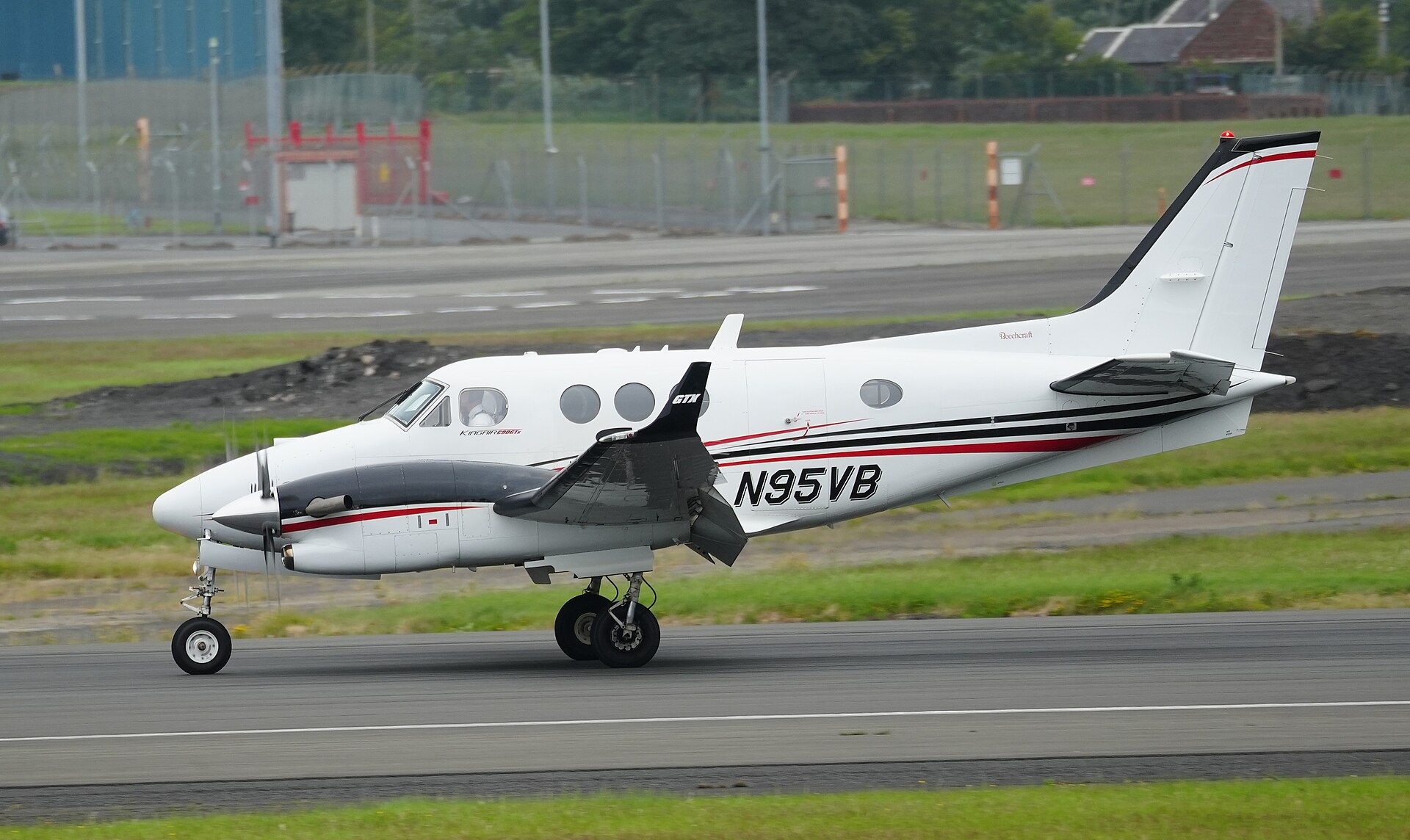
What changed from the King Air E90
- PT6A-135 engines flat-rated to 750 shp each; the F90-1 moves to the PT6A-135A.
- A T-tail like the King Air 200's replaces the conventional tail.
- A shorter 45 ft 11 in wing replaces the longer 90-series wing.
- Dual-wheel main landing gear.
- First King Air with a multi-bus electrical system and automatic load shedding.
- Four-blade propellers chosen to reduce cabin noise.
Size and cabin
How big it is, inside and out
Outside
Silhouette · scaled to length
Length
Wingspan
Height
Inside the cabin
Cabin length
Width
Height
Compare
How it stacks up
This aircraft
King Air F90 / F90-1
- JetGrade
- 72
- Price
- $1.25M
- Cost per year
- $612K
- Range
- 1,576 nm
- Speed
- 266 kt
- Seats
- 6
- Cabin length
- 12′ 5″
- Pilots
- 1
- Years built
- 1979–1985
← Before
- JetGrade
- 72
- Price
- $770K–$860K guide
- Cost per year
- $586K
- Range
- 1,490 nm
- Speed
- 248 kt
- Seats
- 5
- Cabin length
- 12′ 5″
- Pilots
- 1
- Years built
- 1972–1981
Alternative
- JetGrade
- 70
- Price
- $2.52M
- Cost per year
- $605K
- Range
- 1,049 nm
- Speed
- 246 kt
- Seats
- 6
- Cabin length
- 12′ 8″
- Pilots
- 1
- Years built
- 1992–2005
Alternative
- JetGrade
- 74
- Price
- $1.85M
- Cost per year
- $827K
- Range
- 1,580 nm
- Speed
- 291 kt
- Seats
- 7
- Cabin length
- 16′ 8″
- Pilots
- 1
- Years built
- 1981–2009
Alternative
- JetGrade
- 67
- Price
- $1.23M
- Cost per year
- $531K
- Range
- 1,240 nm
- Speed
- 262 kt
- Seats
- 5
- Cabin length
- 10′ 7″
- Pilots
- 1
- Years built
- 1980–1986
- Beechcraft King Air C90B / C90SE instead: Same cabin size, a bigger fleet and a Garmin G1000 NXi upgrade path; slower, but easier to find and equip with a modern cockpit.
- Beechcraft King Air B200 instead: Longer cabin with more seats, more range and more speed, for buyers who outgrow the 90-series cabin and can fund higher costs.
- Cessna Conquest I (425) instead: A similar-era pressurized twin with Garrett engines instead of PT6s; compare it if fuel burn matters more than King Air support depth.
Gold marks the best figure in each row.
Owning one
What to know before you buy
Engines & inspections
2 × Pratt & Whitney Canada PT6A-135 (F90) / PT6A-135A (F90-1) · 750 shp each
No APUEngine hours until overhaul
- Phase inspection · 200 hr
- Starter-generator overhaul · 1,000 hr
- Engine hot section inspection · 1,800 hr
- Engine overhaul · 3,600 hr
- Landing gear inspection every 72 months
- Wing bolt lubrication every 12 months
- Gear actuator inspection every 30 months
- Brake hose replacement every 60 months
The hourly ESP plan covers PT6A-135A engines, including converted F90s; confirm eligibility for original engines. Otherwise set aside about $265 per flight hour.
Known issues
Engine overhaul cost
Overhaul is priced from $358,000 per engine, so two tired engines can equal much of the aircraft's value.
Wing fitting directive
A 2021 directive requires checking a lower wing fitting washer; a cracked fitting costs about $20,000–25,000 per side to replace.
Electromechanical landing gear
On most F90s a seized gear motor blocks manual extension, so gear maintenance history matters.
Pre-buy checklist
0 of 10 checked
King Air expertise is widespread, Textron Aviation service centers still refurbish F90s, and specialists such as Blackhawk, Raisbeck and Elliott Aviation support engine and airframe upgrades.
Review
The full review
Strengths
- Cruises at about 265 knots, or 279 knots on the F90-1, with a 31,000 ft ceiling.
- Climbs about 2,380 feet per minute and takes off in roughly 1,900–2,100 feet at full weight.
- Pratt & Whitney PT6A engines with a 3,600-hour overhaul interval and King Air know-how in most US shops.
Limitations
- Cabin is 4 ft 10 in tall and 4 ft 6 in wide, the same as smaller King Air 90s.
- Engine overhauls are priced from $358,000 each, so engine hours drive the purchase price.
- With every seat filled and standard IFR fuel reserves, range drops to about 940 nm.
The King Air F90 is the hot rod of the classic King Air 90 family. Beechcraft built it from 1979 to 1985 by taking the familiar 90-series cabin and adding a T-tail like the King Air 200's, a shorter and stronger wing, dual-wheel main landing gear and more powerful Pratt & Whitney Canada PT6A-135 engines, each flat-rated to 750 shaft horsepower. About 236 were built: roughly 203 original F90s and 33 F90-1s. The F90-1, from 1983, added PT6A-135A engines, low-drag pitot-style cowlings and tapered exhaust stacks. There was no direct successor; Beechcraft steered buyers toward the King Air B200 instead.
Pilot's take
From the cockpit, the F90 feels like a King Air 90 with more muscle. The 750 shp engines give brisk climbs to about 23,000 ft, where the airplane settles near 265 knots on roughly 85 gallons an hour. The T-tail and dual-wheel gear make landings predictable, and reversing propellers shorten the rollout. Two habits matter: know the manual gear-extension limits of the electromechanical system, and respect icing, because the boots and procedures belong to their era. Single-pilot workload is reasonable with a modern Garmin panel and autopilot, heavier with original instruments. Expect insurers to want type-specific simulator training every year.
Who this is for
Owner-pilots stepping up from a piston twin or single-engine turboprop, and small companies flying two to five people on regional trips, who want King Air dependability and more speed than a C90 for less than a King Air 200.

Ask about this aircraft
Answers come only from our research file on the King Air F90 / F90-1.
Your earlier questionsOwners
Private to verified ownersOwn a Beechcraft King Air F90 / F90-1? Verify with its FAA registration to join the owners' thread and the real-cost poll.