
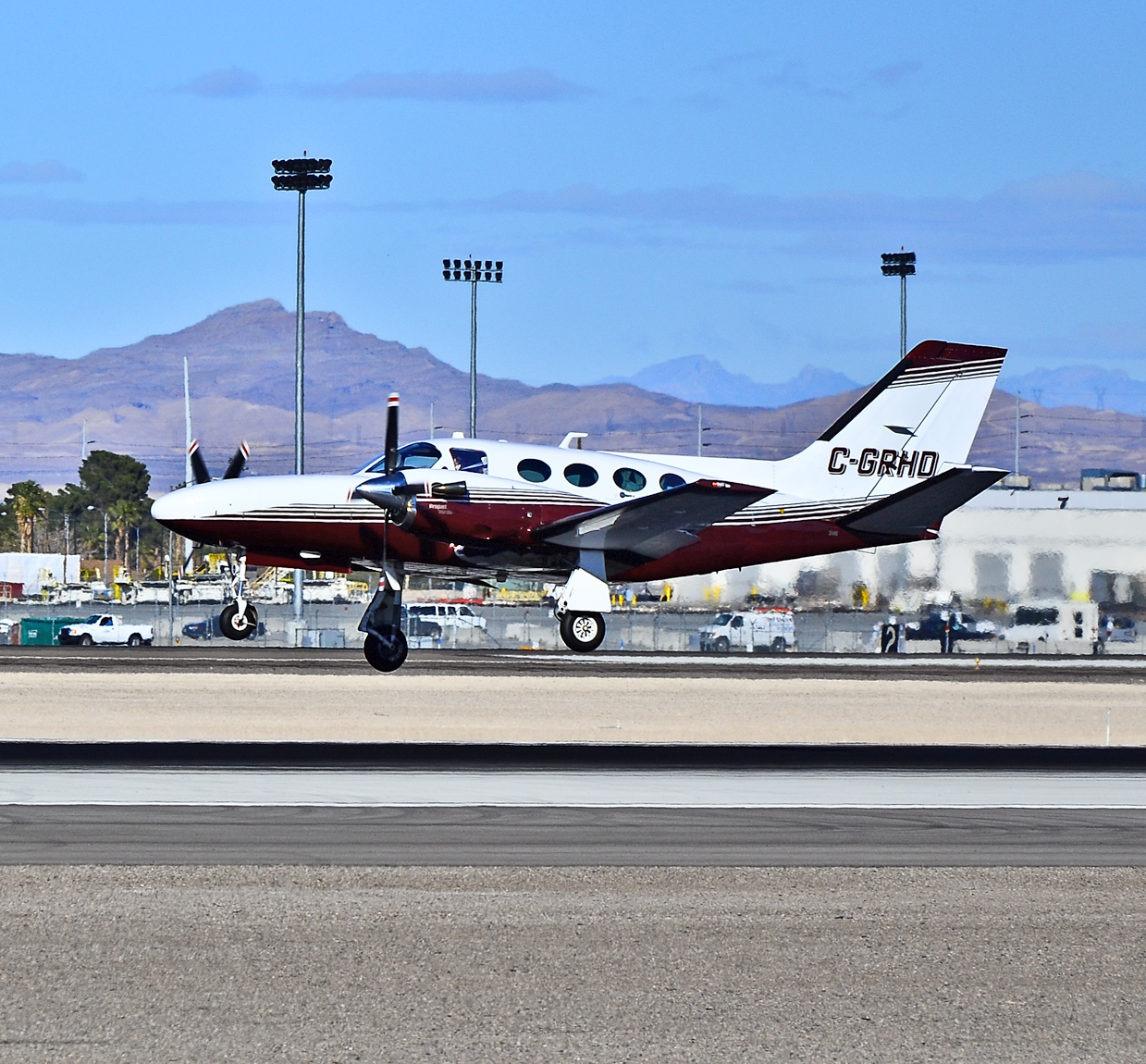
Cessna Conquest I C-GRHD, a 1983 example of the 236 built. · Photo: Tomás Del Coro, CC BY-SA 2.0, via Wikimedia Commons
Cessna · Turboprop
Conquest I (425)
Cessna's turboprop version of the 421 piston twin, and the smaller sibling of the Conquest II.
The Conquest I is faster and thriftier than the King Air 90s it was built to beat, with a well-pressurized cabin and solid Cessna parts support. The trade-offs are a tight cabin, light payload with full fuel, and an expensive aging-aircraft inspection program.
Buy it if
You fly yourself or with one pilot, usually carry three or four people 300 to 900 nm, want 250-plus knots without jet costs, and can find an example with its inspection program already done.
Skip it if
You need standing headroom, an enclosed toilet, full seats with full fuel, or nonstop coast-to-coast range, or you cannot absorb a six-figure inspection or engine bill in your first years of ownership.
Biggest compromise
Payload. With full tanks a typical Conquest I carries only about 750 to 820 lb, roughly three or four adults with light bags.
The numbers that matter
Purchase price
$1.23M
typical asking · $819K–$1.9M
What it costs per year
$531K
at 300 hrs · one professional pilot
How far it flies
1,240 nm
700–900 nm with passengers
How fast
262 kt
high-speed cruise
Seats
5
5 typical, up to 7
Pilots needed
1
Flown by one pilot; no type rating needed, but insurers expect formal Conquest training.
Price
What one costs to buy
Typical asking price
$1,225,000
Where asking prices sit
Low
$819K
Typical
$1.23M
High
$1.9M
Most asking prices fall inside this band.
Other sites
Priced vs call
with a price / call for price
Five checked asks run $819,000 to $1,895,000; the two highest have Blackhawk engine upgrades. Published guide values sit near $945,000 to $965,000.
Price vs its family and alternatives
Scroll to explore · select a jet for details
Conquest I (425) · This aircraft
$1.23M
Sits between the Cheyenne II (PA-31T) and the Conquest II (441).
For sale now
None listed right now
Cost to own
What it costs per year to run
300hours / year
Per year
Per flight hour
Estimate — your operator will quote actual numbers.
Fuel, airframe maintenance, engine overhaul and hot section reserve and propellers, inspection repeats and trip costs rise as you fly more. One professional pilot, recurrent training, hangar, insurance and subscriptions and databases stay the same however much you fly.
Where the money goes
- One professional pilot$99,85719%
- Recurrent training$9,5002%
- Hangar$31,5006%
- Insurance$20,5004%
- Subscriptions and databases$6,0001%
- Fuel$160,86030%
- Airframe maintenance$105,00020%
- Engine overhaul and hot section reserve$68,25013%
- Propellers, inspection repeats and trip costs$30,0006%
Fuel is the biggest single cost at 30% of the total.
The JetGrade
67 out of 100 — Below its class average
Peer group: King Air C90, King Air C90A, King Air E90, Piper Cheyenne II, Mitsubishi MU-2 Solitaire
Seven categories at a glance
- - - 70 = typical— This aircraft
Strongest on speed & trip time, weakest on range & payload.
Grades are editorial opinions about the model, not any specific aircraft. Sponsors and affiliates have no input. Reviewed 2026-10-08.
Where it flies
Sample trips and reach
Typical trips on a map
Nonstop
Depends on weight or weather
Fuel stop likely
2 of 6 sample trips are comfortable nonstops.
Sample flight times
- 1.2 hr
Carlsbad → Las Vegas
205 nm · Short hop, well within range
- 3.0 hr
Carlsbad → Aspen
625 nm · High mountain airport; depends on weight and weather
- 3.5 hr
Santa Ana → San José del Cabo
765 nm · Nonstop with four aboard and reserves
- 4.0 hr
Teterboro → West Palm Beach
900 nm · At its limit; headwinds or heavy loads need a stop
- 5.7 hr
Dallas → Teterboro
1,190 nm · One stop with four aboard
- 9.8 hr
Carlsbad → Teterboro
2,100 nm · Two stops; a long travel day
Lineage
What came before and after
1967–1985
Cessna 421 Golden Eagle
Pressurized piston twin whose airframe the Conquest I is built on.

1980–1986
Conquest I (425)
Turboprop 421, sold as the Corsair until 1983; 236 built.
What changed from the Cessna 421 Golden Eagle
- Two 450 shp Pratt & Whitney PT6A-112 turboprops replace 375 hp geared piston engines.
- Maximum takeoff weight rose from 7,450 lb to 8,600 lb.
- Usable fuel grew to 366 gallons, about double the standard 421 tanks.
- Wing about 3 ft wider, with 10 sq ft more area.
- Sold as the Corsair until 1983, when higher weights brought the Conquest I name.
Size and cabin
How big it is, inside and out
Outside
Silhouette · scaled to length
Length
Wingspan
Height
Inside the cabin
Cabin length
Width
Height
Compare
How it stacks up
This aircraft
Conquest I (425)
- JetGrade
- 67
- Price
- $1.23M
- Cost per year
- $531K
- Range
- 1,240 nm
- Speed
- 262 kt
- Seats
- 5
- Cabin length
- 10′ 7″
- Pilots
- 1
- Years built
- 1980–1986
← Before
Cessna 421 Golden Eagle
Not yet graded
Alternative
- JetGrade
- 71
- Price
- $1.42M
- Cost per year
- $550K
- Range
- 1,120 nm
- Speed
- 247 kt
- Seats
- 6
- Cabin length
- 12′ 4″
- Pilots
- 1
- Years built
- 1984–1992
Alternative
- JetGrade
- 72
- Price
- $1.36M
- Cost per year
- $671K
- Range
- 2,000 nm
- Speed
- 314 kt
- Seats
- 7
- Cabin length
- 12′ 10″
- Pilots
- 1
- Years built
- 1977–1986
Alternative
- JetGrade
- 69
- Price
- $435K–$540K guide
- Cost per year
- $505K
- Range
- 1,510 nm
- Speed
- 283 kt
- Seats
- 5
- Cabin length
- 8′ 5″
- Pilots
- 1
- Years built
- 1974–1981
- King Air C90A instead: Bigger cabin, more payload and the largest support network of any turboprop twin, at roughly 30 kt less speed and higher fuel burn.
- Cessna Conquest II (441) instead: Cessna's larger Garrett-powered sibling seats more people, flies faster and farther, and costs more to buy and run.
- Piper Cheyenne II instead: A close rival of similar size and speed on PT6A engines; compare individual aircraft on engine time, inspections and avionics.
Gold marks the best figure in each row.
Owning one
What to know before you buy
Engines & inspections
2 × Pratt & Whitney Canada PT6A-112 · 450 shp each
No APUEngine hours until overhaul
- Carry-through spar cap directive · 50 hr
- Wing spar cap directive · 300 hr
- Engine hot section inspection · 1,800 hr
- Aging-aircraft inspection repeats · 2,500 hr
- Engine overhaul · 3,600 hr
- Annual or phase inspection every 12 months
Pratt & Whitney lists only a hot-section program for this engine. Many owners reserve hourly or upgrade to Blackhawk PT6A-135A engines.
Known issues
Wing spar cap cracking
Two directives require repeat spar cap inspections; one needs checks every 50 hours once the spar cap passes 11,000 hours.
Costly aging-aircraft inspections
Cessna's inspection program for older aircraft removes the wings; a first full pass has cost $110,000 to $300,000.
Engine overhaul and hot section
No flat-rate overhaul is listed for this engine; overhauls have run about $350,000 each, hot sections $20,000 to $55,000.
Pre-buy checklist
0 of 10 checked
Textron Aviation still supports the Conquest I, and owners rate parts support well. Specialist Conquest shops handle the aging-aircraft inspections, and PT6 engine shops are found worldwide.
Review
The full review
Strengths
- Cruises about 260 kt near 18,000 ft, roughly 35 kt faster than a King Air C90, on about 70 gallons an hour.
- Strong 5.0 psi pressurization keeps the cabin near 9,600 ft while cruising at 26,000 ft.
- Flat-rated 450 shp engines and Cessna 421 roots make it an easy single-pilot step up from piston twins.
Limitations
- Full-fuel payload is only about 820 lb, so four passengers with bags already cuts into fuel and range.
- The cabin is about 10 ft 7 in long and 4 ft 3 in tall, with a belted toilet seat only.
- Cessna's aging-aircraft inspection program takes the wings off and has cost $110,000 to $300,000 to complete.
The Conquest I is Cessna's Model 425, a twin turboprop built from 1980 to 1986. It began as the Corsair, a turbine-powered version of the 421 Golden Eagle piston twin, and was renamed Conquest I in 1983 when Cessna raised its maximum takeoff weight from 8,200 lb to 8,600 lb. Every earlier Corsair was brought up to the same standard. Cessna built 236, and about 160 remain on the US registry. It sits below the larger, Garrett-powered Conquest II in Cessna's lineup and competed directly with the King Air C90 and Piper's Cheyennes.
Pilot's take
The Conquest I feels like a 421 with far more muscle. The flat-rated PT6s give strong climb to the high teens and an easy cruise near 260 kt, and the cockpit is laid out well for one pilot. It is heavy in pitch and needs frequent trim with power and speed changes, and the flare deserves respect because tail authority fades as power comes off. Ice protection is capable, but the record shows instrument weather and icing are where pilots get caught. Recurrent simulator training is a sound investment.
Who this is for
An owner-pilot or small company flying 150 to 400 hours a year with two to four passengers on 300 to 900 nm trips, stepping up from a piston twin and wanting speed and pressurization on a modest fuel bill.

Ask about this aircraft
Answers come only from our research file on the Conquest I (425).
Your earlier questionsOwners
Private to verified ownersOwn a Cessna Conquest I (425)? Verify with its FAA registration to join the owners' thread and the real-cost poll.