
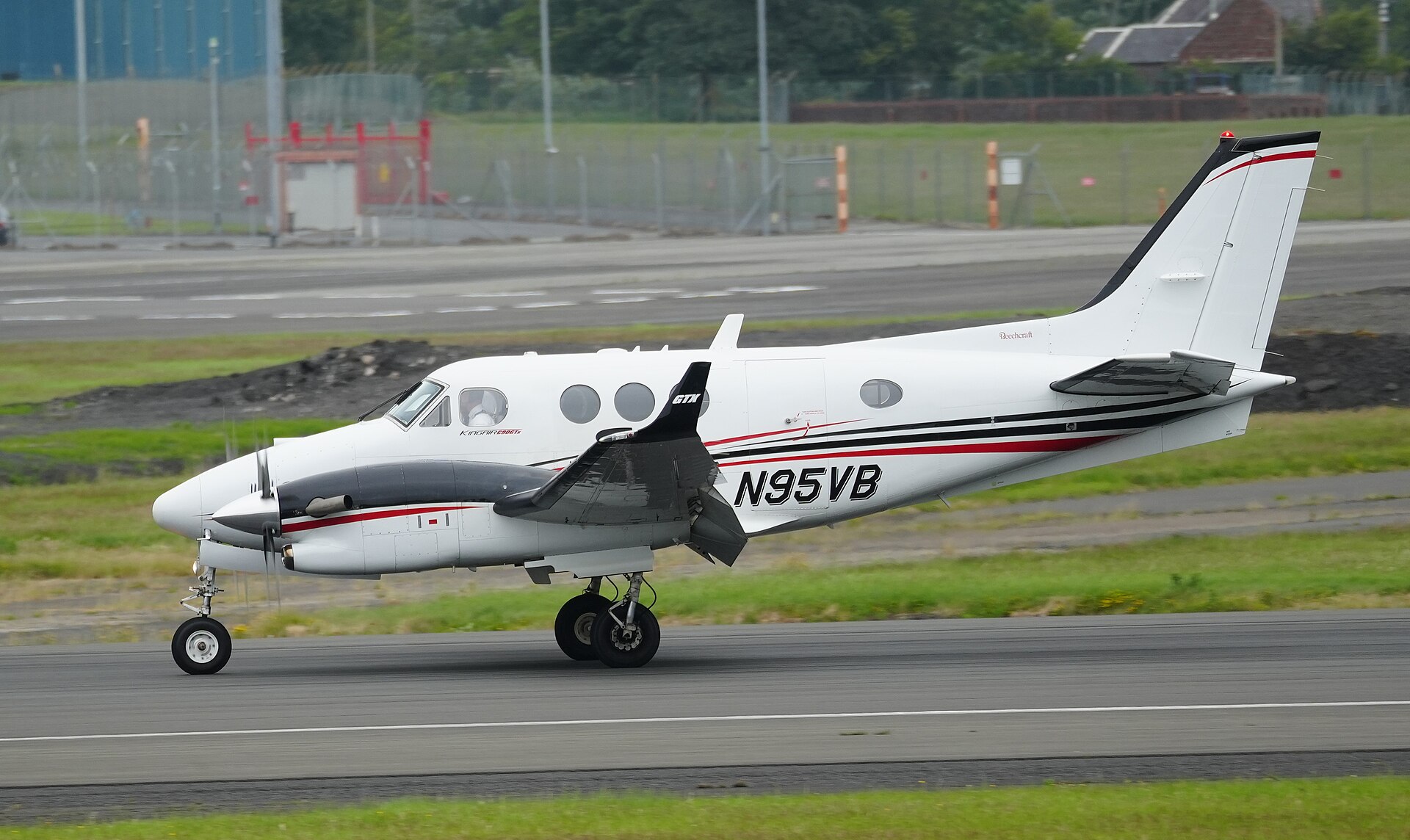
Beechcraft King Air C90GTx N95VB, photographed in 2025. · Photo: Jonathan Payne via Wikimedia Commons, CC BY-SA 2.0
Beechcraft · Turboprop
King Air C90GTx
The eighth and final version of the King Air 90 line, built from 2010 until Textron ended production in 2021.
The C90GTx is the most capable King Air 90 built, adding winglets and a higher takeoff weight to the GTi. It offers two engines, short-runway ability and strong factory support, but trails single-engine rivals on range, speed and running cost.
Buy it if
You want two engines, usually fly one to five people on trips under about 900 nm, use shorter runways, and value the King Air support network over outright speed or range.
Skip it if
You regularly fly more than 1,000 nm, want a cabin you can stand in, or care most about hourly cost; a single-engine Pilatus PC-12 NG or TBM goes farther on less fuel.
Biggest compromise
Range with people aboard. Beechcraft quotes 1,260 nm, but with four passengers and NBAA IFR reserves (the standard fuel safety margin) a C90GTx plans about 975 nm, and about 903 nm with every seat full.
The numbers that matter
Purchase price
$2.7M–$3.13M
guide value (PlanePHD and Guardian Jet estimates)
What it costs per year
$644K
at 300 hrs · one professional pilot
How far it flies
1,260 nm
903–975 nm with passengers
How fast
272 kt
high-speed cruise
Seats
5
5 typical; up to 7
Pilots needed
1
Flown by one pilot; owner-pilots and single professional pilots are common.
Price
What one costs to buy
Guide value
$2.7M–$3.13M
Other sites
4% of the fleet
Priced vs call
with a price / call for price
Only one of four C90GTx listings found in October 2026 shows a price: $3.195M for a 2011 with 1,660 hours. Published value estimates run about $2.7–3.1M.
Price vs its family and alternatives
Scroll to explore · select a jet for details
King Air C90GTx · This aircraft
$2.7M–$3.13M guide
Guide value, not a listed asking price.
Sits between the King Air C90GTi and the King Air 250.
For sale now
None listed right now
Cost to own
What it costs per year to run
300hours / year
Per year
Per flight hour
Estimate — your operator will quote actual numbers.
Fuel, airframe maintenance and engine reserve or hourly program rise as you fly more. One professional pilot, hangar and insurance stay the same however much you fly.
Where the money goes
Partial estimate- One professional pilot$86,25013%
- Hangar$29,0005%
- Insurance$24,6884%
- Fuel$254,70040%
- Airframe maintenance$144,00022%
- Engine reserve or hourly program$105,00016%
Fuel is the biggest single cost at 40% of the total.
The JetGrade
65 out of 100 — Below its class average
Peer group: Pilatus PC-12 NG, Beechcraft King Air 250, Piaggio P.180 Avanti II, Daher TBM 940, Beechcraft King Air C90GTi
Seven categories at a glance
- - - 70 = typical— This aircraft
Strongest on reliability & support, weakest on range & payload.
Grades are editorial opinions about the model, not any specific aircraft. Sponsors and affiliates have no input. Reviewed 2026-10-04.
Where it flies
Sample trips and reach
Typical trips on a map
Nonstop
Depends on weight or weather
Fuel stop likely
3 of 6 sample trips are comfortable nonstops.
Sample flight times
- 1.2 hr
Carlsbad → Las Vegas
205 nm · Short hop, well within range
- 2.9 hr
Carlsbad → Aspen
625 nm · Mountain airport; weather matters more than runway
- 3.5 hr
Santa Ana → San José del Cabo
765 nm · Nonstop with four aboard
- 4.0 hr
Teterboro → West Palm Beach
900 nm · Nonstop with four aboard in light winds
- 5.1 hr
Dallas → Teterboro
1,190 nm · Needs one stop, typically mid-route
- 9.1 hr
Carlsbad → Teterboro
2,100 nm · Needs two stops across the country
Lineage
What came before and after


1992–2005
King Air C90B / C90SE
Four-blade propellers and a quieter cabin; the SE was simpler.


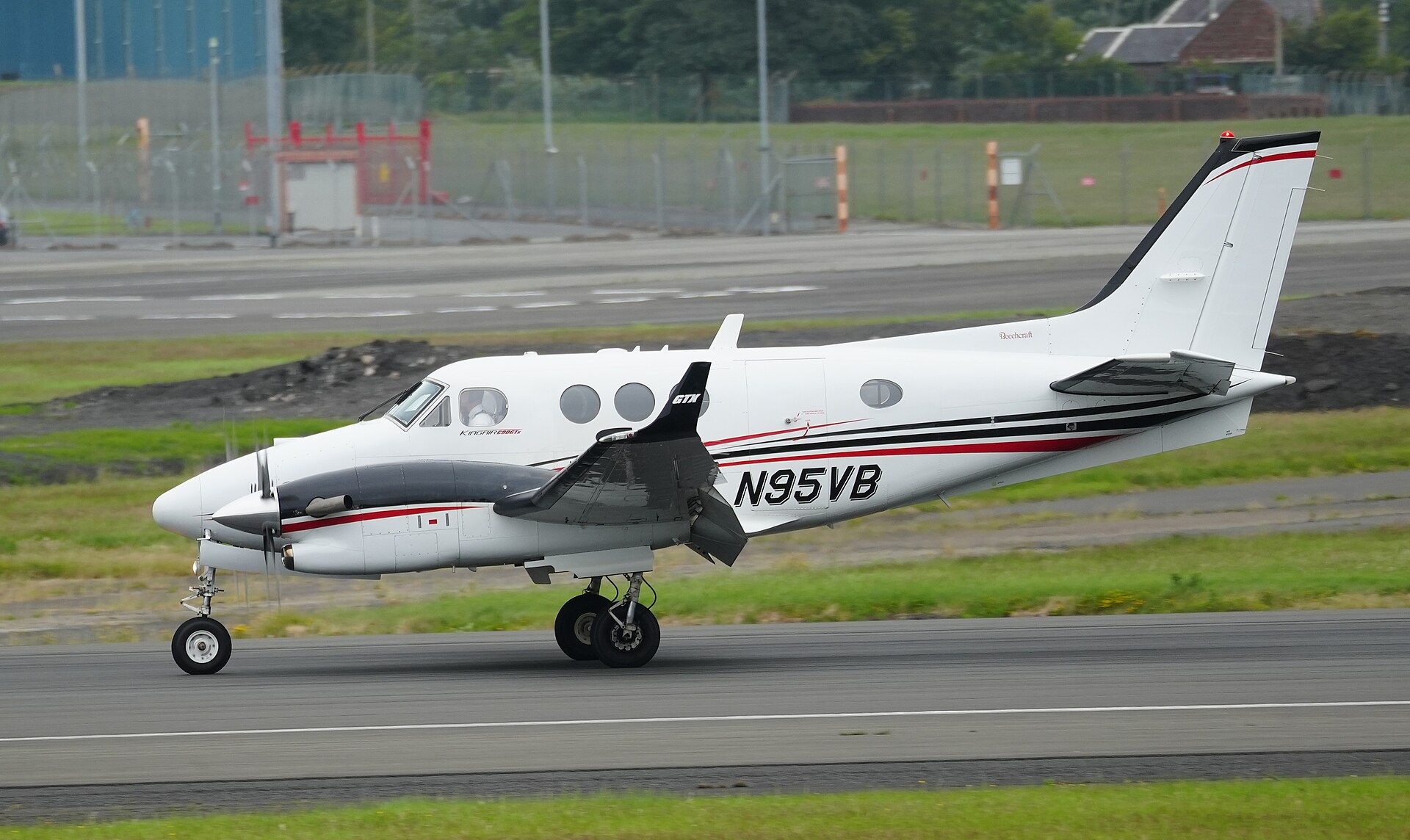
2010–2021
King Air C90GTx
Winglets and a 10,485 lb takeoff weight; the final King Air 90.
What changed from the King Air C90GTi
- Composite winglets became factory standard, improving climb and fuel efficiency.
- Maximum takeoff weight rose 385 lb to 10,485 lb; useful load rose about 350 lb.
- Carries four passengers about 195 nm farther than the GTi at high-speed cruise.
- Full tanks leave about 737 lb for passengers and bags after the pilot.
- Kept the Collins Pro Line 21 cockpit introduced on the GTi.
- Same two 550 shp PT6A-135A engines and four-blade Hartzell propellers.
Size and cabin
How big it is, inside and out
Outside
Silhouette · scaled to length
Length
Wingspan
Height
Inside the cabin
Cabin length
Width
Height
Compare
How it stacks up
This aircraft
King Air C90GTx
- JetGrade
- 65
- Price
- $2.7M–$3.13M guide
- Cost per year
- $644K
- Range
- 1,260 nm
- Speed
- 272 kt
- Seats
- 5
- Cabin length
- 12′ 7″
- Pilots
- 1
- Years built
- 2010–2021
← Before
- JetGrade
- 66
- Price
- $2.35M–$3.23M guide
- Cost per year
- $734K
- Range
- 1,321 nm
- Speed
- 271 kt
- Seats
- 6
- Cabin length
- 12′ 7″
- Pilots
- 1
- Years built
- 2008–2010
Alternative
- JetGrade
- 79
- Price
- $4.42M
- Cost per year
- $524K
- Range
- 1,830 nm
- Speed
- 280 kt
- Seats
- 6
- Cabin length
- 16′ 11″
- Pilots
- 1
- Years built
- 2008–2020
Alternative
- JetGrade
- 70
- Price
- $3.1M–$4.95M guide
- Cost per year
- $825K
- Range
- 1,720 nm
- Speed
- 310 kt
- Seats
- 7
- Cabin length
- 16′ 8″
- Pilots
- 1
- Years built
- 2011–2020
Alternative
- JetGrade
- 71
- Cost per year
- $574K
- Range
- 1,730 nm
- Speed
- 330 kt
- Seats
- 4
- Cabin length
- 13′ 3″
- Pilots
- 1
- Years built
- 2019–2022
- Pilatus PC-12 NG instead: One engine instead of two, but a much bigger cabin with a cargo door and roughly 1,800 nm of range.
- Beechcraft King Air 250 instead: The next King Air up: a larger cabin, about 310 knots and roughly 1,700 nm of range, for a higher price and running cost.
- Daher TBM 940 instead: Single-engine and far faster at 330 knots, burning about 60 to 65 gallons an hour; the cabin is smaller and has no standard toilet.
Gold marks the best figure in each row.
Owning one
What to know before you buy
Engines & inspections
2 × Pratt & Whitney Canada PT6A-135A · 550 shp each
No APUEngine hours until overhaul
- Phase 1–4 inspections · 200 hr
- Engine hot section · 1,800 hr
- Engine overhaul · 3,600 hr
- Propeller overhaul · 4,000 hr
- Landing gear inspection every 72 months
- Wing bolt inspection every 60 months
- Fluid and brake hoses every 60 months
Pratt & Whitney Canada's hourly ESP plan is offered on the PT6A-135A and some listed aircraft are enrolled; confirm coverage tier and transfer before buying.
Known issues
Engine overhauls coming due
Each PT6A-135A needs an overhaul at 3,600 hours; listed aircraft show 1,360 to 2,919 engine hours, and one was just overhauled.
Hot section inspections
Each engine needs a hot section inspection every 1,800 hours; check timing and any over-temperature events.
Six-year gear inspection
The landing gear inspection comes every six years and takes about two weeks of downtime.
Pre-buy checklist
0 of 10 checked
Textron Aviation reports 20 company-owned service centers, more than 300 authorized facilities and over 50 mobile service units, and says C90GTx owners keep factory parts and service support after production ended.
Review
The full review
Strengths
- Two 550 shp Pratt & Whitney PT6A-135A engines give twin-engine redundancy and a 272-knot maximum cruise.
- Takes off in 1,984 ft at sea level and maximum weight, opening small and short runways.
- Backed by 20 Textron service centers, more than 300 authorized shops and over 50 mobile service units.
Limitations
- Plans about 975 nm with four passengers and IFR reserves, well short of single-engine rivals.
- The cabin is 4 ft 9 in tall and 4 ft 6 in wide, a sit-down space.
- Two engines burn about 97 to 103 gallons an hour, and each needs an overhaul at 3,600 hours.
The King Air C90GTx is the last of the King Air 90 line that began in 1964. Beechcraft first delivered it in 2010 as an update of the C90GTi, making composite winglets standard and raising maximum takeoff weight by 385 lb to 10,485 lb. Textron Aviation ended production in March 2021, saying it wanted to reduce overlap with its newer King Air 260 and 360. Guardian Jet counts about 198 in service.
Pilot's take
From the cockpit, the C90GTx is a known quantity: a conventional King Air layout with two PT6A-135A engines and a Collins Pro Line 21 panel. The winglets help most in the climb and on heavy departures, and the 1,984 ft takeoff figure gives real options at short fields. The trade is planning. With four aboard and IFR reserves, legs beyond about 900 nm call for a stop, and a strong headwind shrinks that further. Engine-out proficiency matters, as in any light twin. For regional work it is a steady, forgiving airplane with few surprises.
Who this is for
Owner-pilots stepping up from piston twins, and companies or utility operators flying one to five people on regional trips, who want two engines and a familiar King Air and can accept about 900 nm between fuel stops.

Ask about this aircraft
Answers come only from our research file on the Beechcraft King Air C90GTx.
Your earlier questionsOwners
Private to verified ownersOwn a Beechcraft King Air C90GTx? Verify with its FAA registration to join the owners' thread and the real-cost poll.