
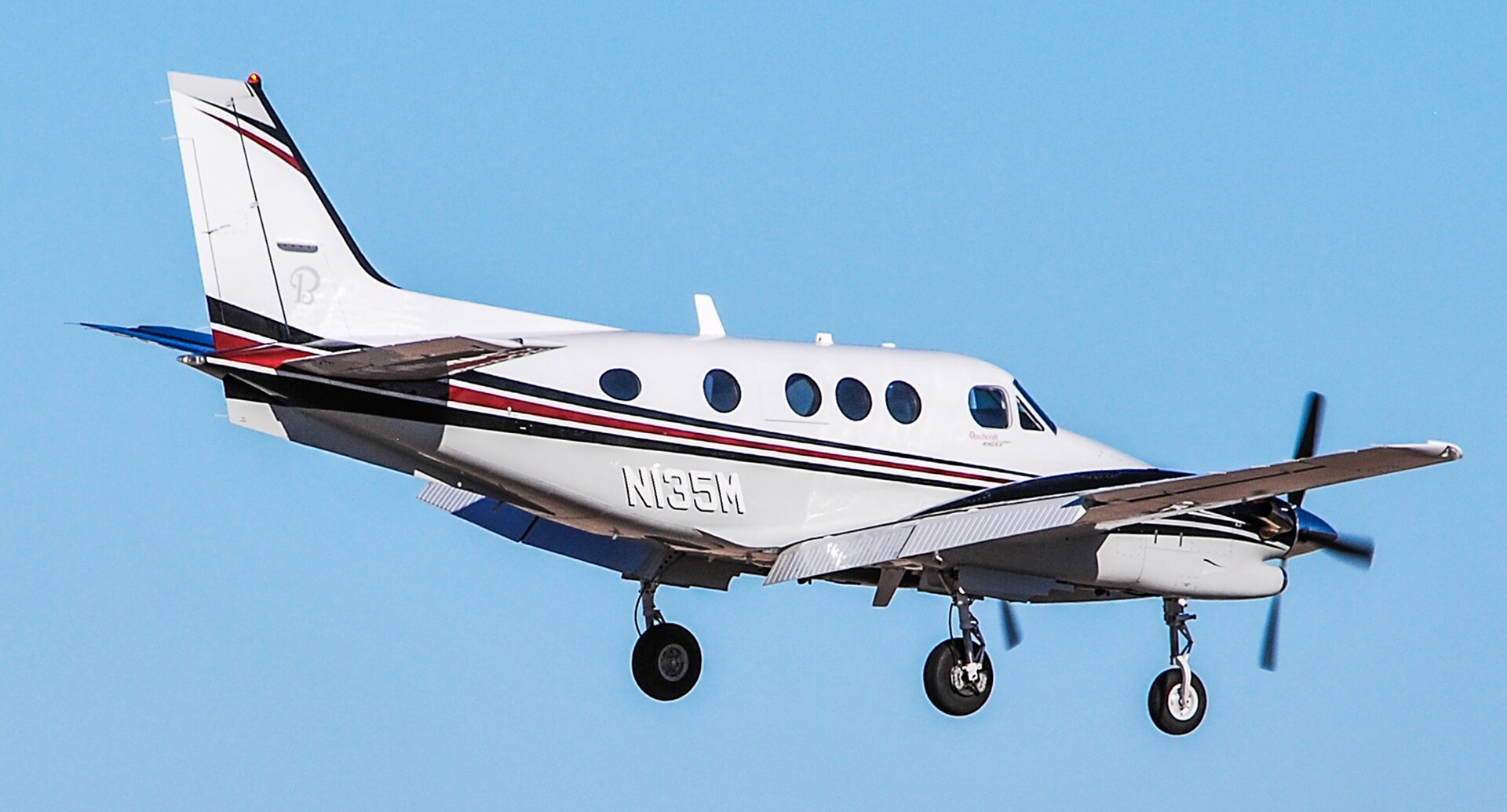
King Air C90GT N135M, photographed in 2020. · Photo: Tomás Del Coro via Wikimedia Commons, CC BY-SA 4.0
Beechcraft · Turboprop
King Air C90GT
Fifth model of the pressurized C90 line, between the C90B and the glass-cockpit C90GTi.
The C90GT delivers the faster-climbing King Air 90 for less than a C90GTi. It suits trips under about 800 nm with four or five aboard; budget for engine overhauls and, on many aircraft, a cockpit upgrade.
Buy it if
You want two engines and King Air support for regular 200–800 nm trips with four or five passengers, often into short or high airports, flown single-pilot or by one hired pilot.
Skip it if
You need more than about 950 nm with four aboard, a true private washroom, or a modern cockpit without a six-figure upgrade; a C90GTi or a Pilatus PC-12 NG fits better.
Biggest compromise
The cockpit and the engine clock. Every C90GT left the factory with Collins Pro Line II, a 1990s-generation display system, and upgrades to Garmin G1000 NXi cost several hundred thousand dollars.
The numbers that matter
Purchase price
$2.13M–$2.38M
guide value (Aircraft Cost Calculator and PlanePhD)
What it costs per year
$721K
at 300 hrs · one professional pilot
How far it flies
981 nm
670–957 nm with passengers
How fast
271 kt
high-speed cruise
Seats
5
5 typical, up to 7
Pilots needed
1
Certified for one pilot, and no type rating is required in the US.
Price
What one costs to buy
Guide value
$2.13M–$2.38M
Other sites
Priced vs call
with a price / call for price
Neither C90GT advertised in October 2026 shows a price. Published guide values run about $2.13M–$2.38M; engine times and avionics swing real prices widely.
Price vs its family and alternatives
Scroll to explore · select a jet for details
King Air C90GT · This aircraft
$2.13M–$2.38M guide
Guide value, not a listed asking price.
Sits between the King Air C90A and the King Air C90B / C90SE.
For sale now
None listed right now
Cost to own
What it costs per year to run
300hours / year
Per year
Per flight hour
Estimate — your operator will quote actual numbers.
Fuel, airframe maintenance, engine program or reserve and landing fees, handling and trip costs rise as you fly more. One professional pilot, recurrent training, hangar, insurance and charts, databases and other fixed costs stay the same however much you fly.
Where the money goes
- One professional pilot$158,70822%
- Recurrent training$17,4152%
- Hangar$25,1563%
- Insurance$17,3002%
- Charts, databases and other fixed costs$7,5371%
- Fuel$221,75731%
- Airframe maintenance$130,65018%
- Engine program or reserve$105,00015%
- Landing fees, handling and trip costs$37,5005%
Fuel is the biggest single cost at 31% of the total.
The JetGrade
64 out of 100 — Below its class average
Peer group: King Air C90GTi, King Air C90GTx, Pilatus PC-12 NG, Daher TBM 850 G1000 / Elite, Piaggio P.180 Avanti II
Seven categories at a glance
- - - 70 = typical— This aircraft
Strongest on reliability & support, weakest on range & payload.
Grades are editorial opinions about the model, not any specific aircraft. Sponsors and affiliates have no input. Reviewed 2026-10-04.
Where it flies
Sample trips and reach
Typical trips on a map
Nonstop
Depends on weight or weather
Fuel stop likely
2 of 6 sample trips are comfortable nonstops.
Sample flight times
- 1.2 hr
Carlsbad → Las Vegas
205 nm · Short hop; well within range
- 2.8 hr
Carlsbad → Aspen
625 nm · Mountain airport; plan weight on hot days
- 3.4 hr
Santa Ana → San José del Cabo
765 nm · Close to its four-passenger limit; winds matter
- 4.8 hr
Teterboro → West Palm Beach
900 nm · Nonstop only at slow cruise with a light load
- 5.4 hr
Dallas → Teterboro
1,190 nm · Needs one stop, typically mid-route
- 9.3 hr
Carlsbad → Teterboro
2,100 nm · Needs two stops; westerly winds help eastbound
Lineage
What came before and after


2006–2008
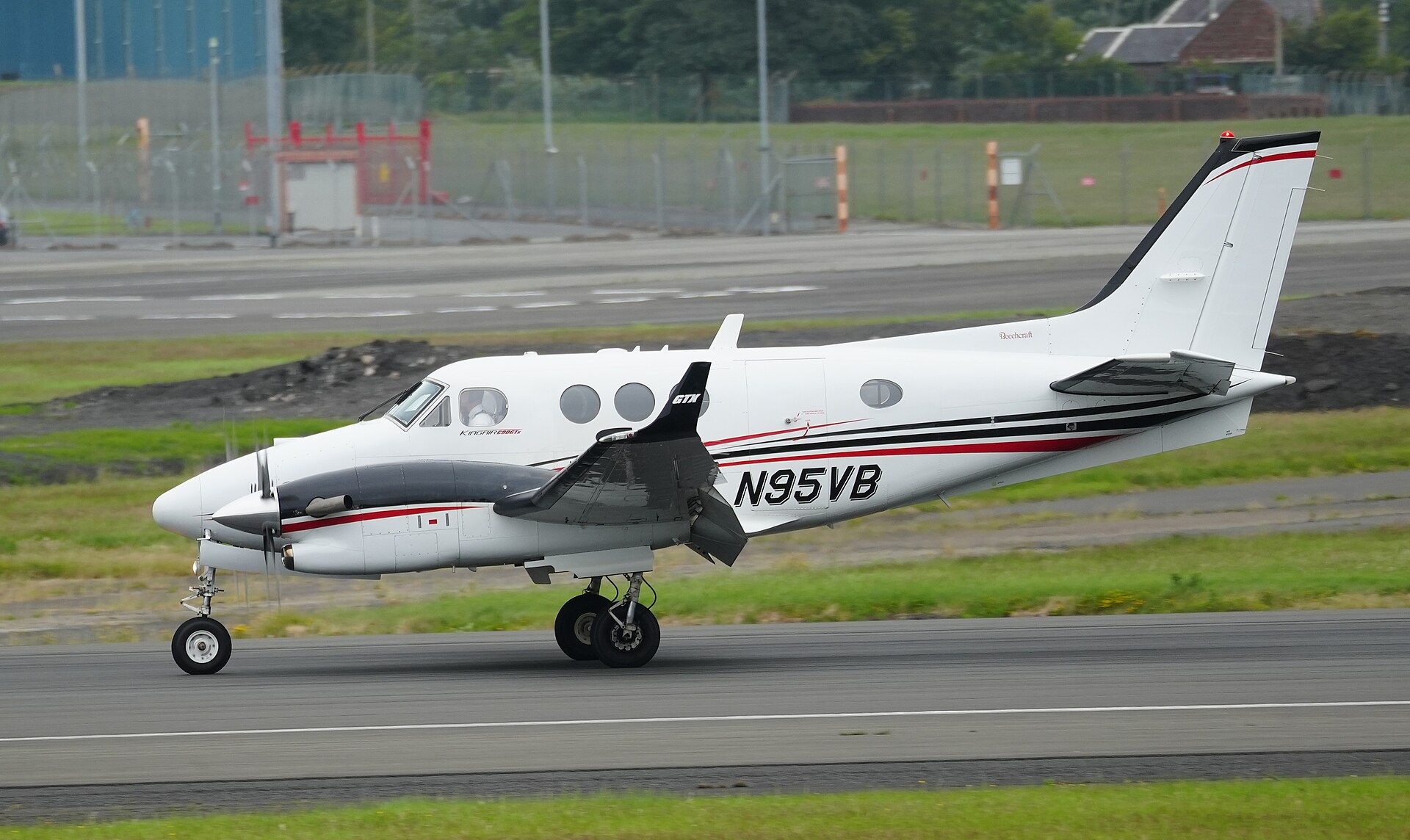
King Air C90GT
PT6A-135A engines for faster climb and cruise.

What changed from the King Air C90B / C90SE
- PT6A-135A engines, designed for 750 shp but held to 550 shp, replace the PT6A-21.
- Top cruise rises about 26 kt, to roughly 272 kt.
- Climb to 30,000 ft takes about half as long as the C90B.
- Takeoff distance about 312 ft shorter than the C90B.
- Keeps the C90B's Collins Pro Line II cockpit.
- Heated, pressurized aft baggage area you can reach in flight.
Size and cabin
How big it is, inside and out
Outside
Silhouette · scaled to length
Length
Wingspan
Height
Inside the cabin
Cabin length
Width
Height
Compare
How it stacks up
This aircraft
King Air C90GT
- JetGrade
- 64
- Price
- $2.13M–$2.38M guide
- Cost per year
- $721K
- Range
- 981 nm
- Speed
- 271 kt
- Seats
- 5
- Cabin length
- 12′ 6″
- Pilots
- 1
- Years built
- 2006–2008
← Before
- JetGrade
- 70
- Price
- $2.52M
- Cost per year
- $605K
- Range
- 1,049 nm
- Speed
- 246 kt
- Seats
- 6
- Cabin length
- 12′ 8″
- Pilots
- 1
- Years built
- 1992–2005
After →
- JetGrade
- 66
- Price
- $2.35M–$3.23M guide
- Cost per year
- $734K
- Range
- 1,321 nm
- Speed
- 271 kt
- Seats
- 6
- Cabin length
- 12′ 7″
- Pilots
- 1
- Years built
- 2008–2010
Alternative
- JetGrade
- 79
- Price
- $4.42M
- Cost per year
- $524K
- Range
- 1,830 nm
- Speed
- 280 kt
- Seats
- 6
- Cabin length
- 16′ 11″
- Pilots
- 1
- Years built
- 2008–2020
- King Air C90GTi instead: Same engines and airframe with the Collins Pro Line 21 cockpit from the factory; costs more, but avoids an avionics upgrade decision.
- Pilatus PC-12 NG instead: One engine instead of two, but roughly 1,600 nm with four aboard, a bigger cabin with a cargo door and lower running costs.
- King Air C90B / C90SE instead: Same cabin with the older PT6A-21 engines; slower and slower to climb, but usually cheaper to buy.
Gold marks the best figure in each row.
Owning one
What to know before you buy
Engines & inspections
2 × Pratt & Whitney Canada PT6A-135A · 550 shp each
No APUEngine hours until overhaul
- Phase inspection · 200 hr
- Hot section inspection · 1,800 hr
- Engine overhaul · 3,600 hr
- Landing gear six-year inspection every 72 months
- Propeller overhaul every 72 months
Hourly engine programs run about $130 per engine-hour; ask whether coverage is in place and transfers with the sale.
Known issues
Engines near overhaul
Several advertised aircraft show 3,200–3,700 engine hours against a 3,600-hour overhaul costing about $350,000–$450,000 per engine.
Aging Pro Line II cockpit
The factory Collins displays are a 1990s design; a Garmin G1000 NXi upgrade costs several hundred thousand dollars.
Six-year landing gear inspection
A major gear inspection is due every six years or 8,000 cycles; check when it is next due.
Pre-buy checklist
0 of 10 checked
King Air shops and PT6A engine support are widespread across the US and abroad; the bigger question is long-term parts and repair support for the original Collins Pro Line II displays.
Review
The full review
Strengths
- Engines held to 550 shp from a 750 shp design climb to 30,000 ft in about 22–25 minutes.
- About 271 kt at top cruise, roughly 25 kt faster than the C90B it replaced.
- Clears a 50 ft obstacle in about 2,392 ft at maximum weight, with a second engine for redundancy.
Limitations
- Only about 387 lb of payload with full tanks, so the longest trips mean fewer passengers.
- The cabin is 4 ft 9 in tall and 4 ft 6 in wide, with a belted toilet seat aft.
- Many examples are near the 3,600-hour engine overhaul, about $350,000–$450,000 per engine.
The King Air C90GT is the 2006–2008 version of Beechcraft's smallest King Air, the 90 series that has flown since the 1960s. It sits between the C90B, which it replaced, and the C90GTi, which added a modern glass cockpit in 2008. About 98 were built. The big change was under the cowlings: Pratt & Whitney Canada PT6A-135A engines, designed for 750 shp but held to 550 shp, replaced the C90B's PT6A-21s.
Pilot's take
From the left seat, the C90GT feels like a King Air 90 with more muscle. Because the engines are held well below their design power, takeoff and climb stay strong on hot days and at mountain airports, and it reaches the high 20s quickly. Handling is classic King Air: stable and forgiving, with reverse thrust that makes short runways comfortable. The workload issue is the original Pro Line II cockpit, which is older than its glass look suggests; we would want a modern GPS navigator or a full Garmin retrofit for single-pilot work in busy airspace. Engine-failure training on a light twin deserves regular practice.
Who this is for
Owner-pilots stepping up from a single-engine turboprop, and small companies with one pilot and up to five passengers on regional trips of 200–800 nm, who value twin-engine redundancy and King Air support over cabin size or the newest avionics.

Ask about this aircraft
Answers come only from our research file on the King Air C90GT.
Your earlier questionsOwners
Private to verified ownersOwn a Beechcraft King Air C90GT? Verify with its FAA registration to join the owners' thread and the real-cost poll.