
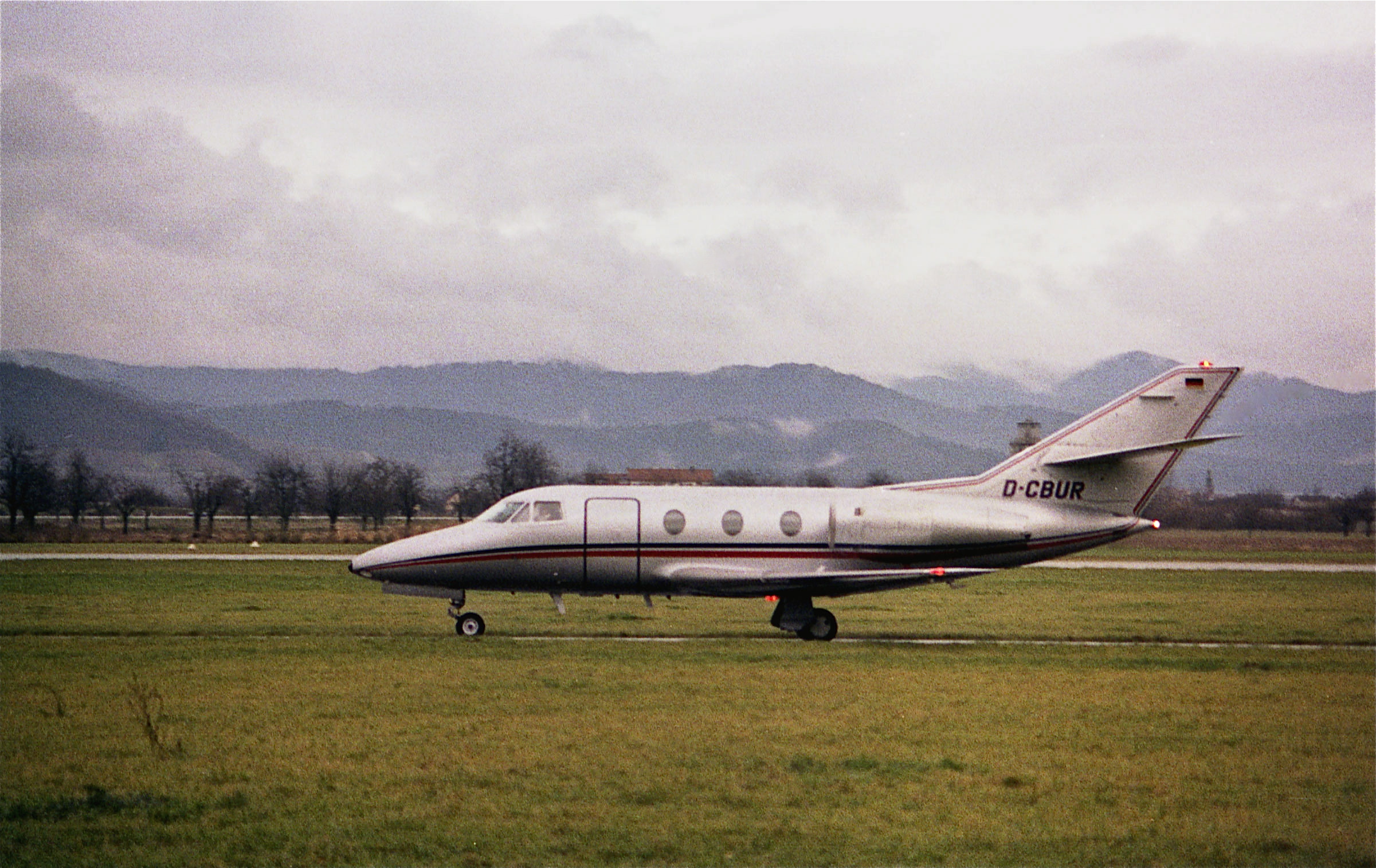
Falcon 10 D-CBUR taxiing at Offenburg, Germany, in 1982. · Photo: Peter Nath / Wikimedia Commons, CC BY-SA 4.0
Dassault · Light Jet
Falcon 10
The first of two versions of Dassault's smallest jet; the heavier Falcon 100 followed.
Still one of the quickest light jets ever built and cheap to buy at about half a million dollars, but a cramped cabin, no real lavatory and heavy inspection bills make it a jet for enthusiasts with deep maintenance budgets.
Buy it if
You want real speed on trips of 500 to 1,200 nm for up to four people, you value Dassault handling and build quality, and you can fund a C-check and landing gear work that may exceed the purchase price.
Skip it if
Your passengers need a private lavatory or a taller cabin, you want predictable maintenance costs, or you regularly need more than about 1,500 nm between stops.
Biggest compromise
Maintenance cost against aircraft value. One published estimate puts a C-check near $175,000 and landing gear work near $300,000, on a jet with guide values of about $450,000 to $600,000.
The numbers that matter
Purchase price
$450K–$600K
guide value (Broker guide values (evoJets, Air Charter Advisors))
What it costs per year
$1.53M
at 300 hrs · two professional pilots
How far it flies
1,600 nm
1,482–1,520 nm with passengers
How fast
454 kt
high-speed cruise
Seats
6
6 typical, 9 certified maximum
Pilots needed
2
Plan on two pilots; single-pilot operation needs extra equipment listed in the flight manual.
Price
What one costs to buy
Guide value
$450K–$600K
Other sites
Priced vs call
with a price / call for price
The one Falcon 10 advertised shows no price; broker guide values run about $450,000 to $600,000, and that aircraft once asked $450,000.
Price vs its family and alternatives
Scroll to explore · select a jet for details
Falcon 10 · This aircraft
$450K–$600K guide
Guide value, not a listed asking price.
The least expensive here; next up is the Falcon 100.
For sale now
None listed right now
Cost to own
What it costs per year to run
300hours / year
Per year
Per flight hour
Estimate — your operator will quote actual numbers.
Fuel, airframe maintenance, engine program and landing, handling and crew travel rise as you fly more. Two pilots, recurrent training, hangar, insurance, management and subscriptions and databases stay the same however much you fly.
Where the money goes
- Two pilots$250,69116%
- Recurrent training$35,7862%
- Hangar$35,1362%
- Insurance$20,0001%
- Management$24,0002%
- Subscriptions and databases$12,4781%
- Fuel$594,72039%
- Airframe maintenance$337,78822%
- Engine program$137,1609%
- Landing, handling and crew travel$86,4006%
Fuel is the biggest single cost at 39% of the total.
The JetGrade
64 out of 100 — Below its class average
Peer group: Learjet 35A, Cessna Citation S/II, Cessna Citation II, Beechcraft Beechjet 400A
Seven categories at a glance
- - - 70 = typical— This aircraft
Strongest on speed & trip time, weakest on value & resale.
Grades are editorial opinions about the model, not any specific aircraft. Sponsors and affiliates have no input. Reviewed 2026-09-29.
Where it flies
Sample trips and reach
Typical trips on a map
Nonstop
Depends on weight or weather
Fuel stop likely
4 of 6 sample trips are comfortable nonstops.
Sample flight times
- 1.0 hr
Carlsbad → Las Vegas
205 nm · Short hop at any weight
- 2.0 hr
Carlsbad → Aspen
625 nm · Hot-and-high; depends on weight and weather
- 2.3 hr
Santa Ana → San José del Cabo
765 nm · Nonstop with typical loads
- 2.6 hr
Teterboro → West Palm Beach
900 nm · Comfortable nonstop for four passengers
- 3.3 hr
Dallas → Teterboro
1,190 nm · Nonstop in still air with reserve margin
- 6.0 hr
Carlsbad → Teterboro
2,100 nm · Needs one stop, typically mid-continent
Lineage
What came before and after
1973–1983
Dassault Falcon 10
Original light Falcon with analog cockpit and 454 kt cruise.

Size and cabin
How big it is, inside and out
Outside
Silhouette · scaled to length
Length
Wingspan
Height
Inside the cabin
Cabin length
Width
Height
Compare
How it stacks up
This aircraft
Falcon 10
- JetGrade
- 64
- Price
- $450K–$600K guide
- Cost per year
- $1.53M
- Range
- 1,600 nm
- Speed
- 454 kt
- Seats
- 6
- Cabin length
- 12′ 10″
- Pilots
- 2
- Years built
- 1973–1983
After →
- JetGrade
- 62
- Price
- $591K–$690K guide
- Cost per year
- $1.55M
- Range
- 1,620 nm
- Speed
- 476 kt
- Seats
- 7
- Cabin length
- 12′ 8″
- Pilots
- 2
- Years built
- 1983–1990
Alternative
- JetGrade
- 67
- Price
- $581K–$920K guide
- Cost per year
- $1.31M
- Range
- 2,196 nm
- Speed
- 451 kt
- Seats
- 6
- Cabin length
- 12′ 11″
- Pilots
- 2
- Years built
- 1974–1993
Alternative
- JetGrade
- 71
- Price
- $949K
- Cost per year
- $937K
- Range
- 1,840 nm
- Speed
- 385 kt
- Seats
- 6
- Pilots
- 2
- Years built
- 1984–1988
Alternative
- JetGrade
- 68
- Price
- $1.2M
- Cost per year
- $1.33M
- Range
- 1,885 nm
- Speed
- 458 kt
- Seats
- 7
- Cabin length
- 15′ 7″
- Pilots
- 2
- Years built
- 1990–2003
- Learjet 35A instead: Similar speed with about 400 nm more seats-full range, and 676 built means a much larger used market and parts pool.
- Cessna Citation S/II instead: About 65 knots slower, but a cabin roughly three feet longer, simpler systems and a lower published hourly cost.
- Beechcraft Beechjet 400A instead: Nearly as fast, with a cabin about three feet longer and a belted lavatory, though its seats-full range is shorter.
Gold marks the best figure in each row.
Owning one
What to know before you buy
Engines & inspections
2 × Honeywell (Garrett) TFE731-2-1C · 3,230 lbf each
No APUEngine hours until overhaul
- A inspection · 300 hr
- Anti-ice hose replacement · 350 hr
- A2 inspection · 600 hr
- A4 and B inspection · 1,200 hr
- Engine mid-life inspection · 1,400 hr
- Engine core inspection · 4,200 hr
- C inspection every 72 months
- C2 (12-year) inspection every 144 months
Honeywell's pay-per-hour plan still covers these engines; enrollment and time to the next core inspection drive value.
Known issues
Inspections rival aircraft value
A C-check near $175,000 and landing gear work near $300,000 compare with guide values of $450,000 to $600,000.
Engine program status
Off-plan engines carry the full inspection cost, and viable spare TFE731-2 engines have been scarce.
Leaking hydraulic actuators
Flap, slat and brake actuators tend to leak, and only one or two US shops repair them.
Pre-buy checklist
0 of 10 checked
Dassault still supports its classic Falcons and a Falcon 10 training course exists, but hydraulic component repairs go to very few shops and the shrinking fleet means fewer technicians know the type.
Review
The full review
Strengths
- High-speed cruise around 454 knots, with reported top speeds near 490 knots, quicker than most light jets of its era.
- Climbs at about 4,600 feet per minute to a 45,000 ft ceiling, above much of the weather.
- Leading-edge slats and slotted flaps give a published takeoff field length near 4,400 ft and slow, stable approaches.
Limitations
- Cabin is about 12 ft 10 in long and 4 ft 10 in tall; most aircraft have only a pull-out emergency toilet.
- Published operating costs sit near the top of its class; our estimate is about $5,100 an hour at 300 hours.
- About 35% of the 226 Falcon 10s and 100s built were retired by 2018, thinning parts supply and resale.
The Dassault Falcon 10 is the smallest business jet Dassault has built. It first flew in 1970, entered service in 1973 and sold alongside the larger Falcon 20, though Dassault's engineers redesigned almost everything rather than simply shrinking the bigger jet. About 189 Falcon 10s were built before the heavier Falcon 100, with early glass displays and an outside baggage hold, took over the line. Together the two versions total 226 aircraft.
Pilot's take
Pilots describe the Falcon 10 as a sports car among light jets: crisp controls, a climb near 4,600 feet per minute and cruise speeds few jets of its era can match. The slats and flaps make approaches slow and stable for a swept-wing jet. The catch is workload. Original panels are 1970s analog, and upgraded aircraft vary widely, so every cockpit needs its own familiarization. Crews should confirm whether thrust reversers are fitted and that the checklist matches, because a 2023 overrun traced back to a mismatched checklist. Plan on two pilots with real Falcon training; the airplane rewards precision.
Who this is for
A pilot-minded owner or small operator who flies two to four people on regional trips, values speed and handling over cabin space, and can budget for major inspections with an experienced Falcon shop.

Ask about this aircraft
Answers come only from our research file on the Dassault Falcon 10.
Your earlier questionsOwners
Private to verified ownersOwn a Dassault Falcon 10? Verify with its FAA registration to join the owners' thread and the real-cost poll.