
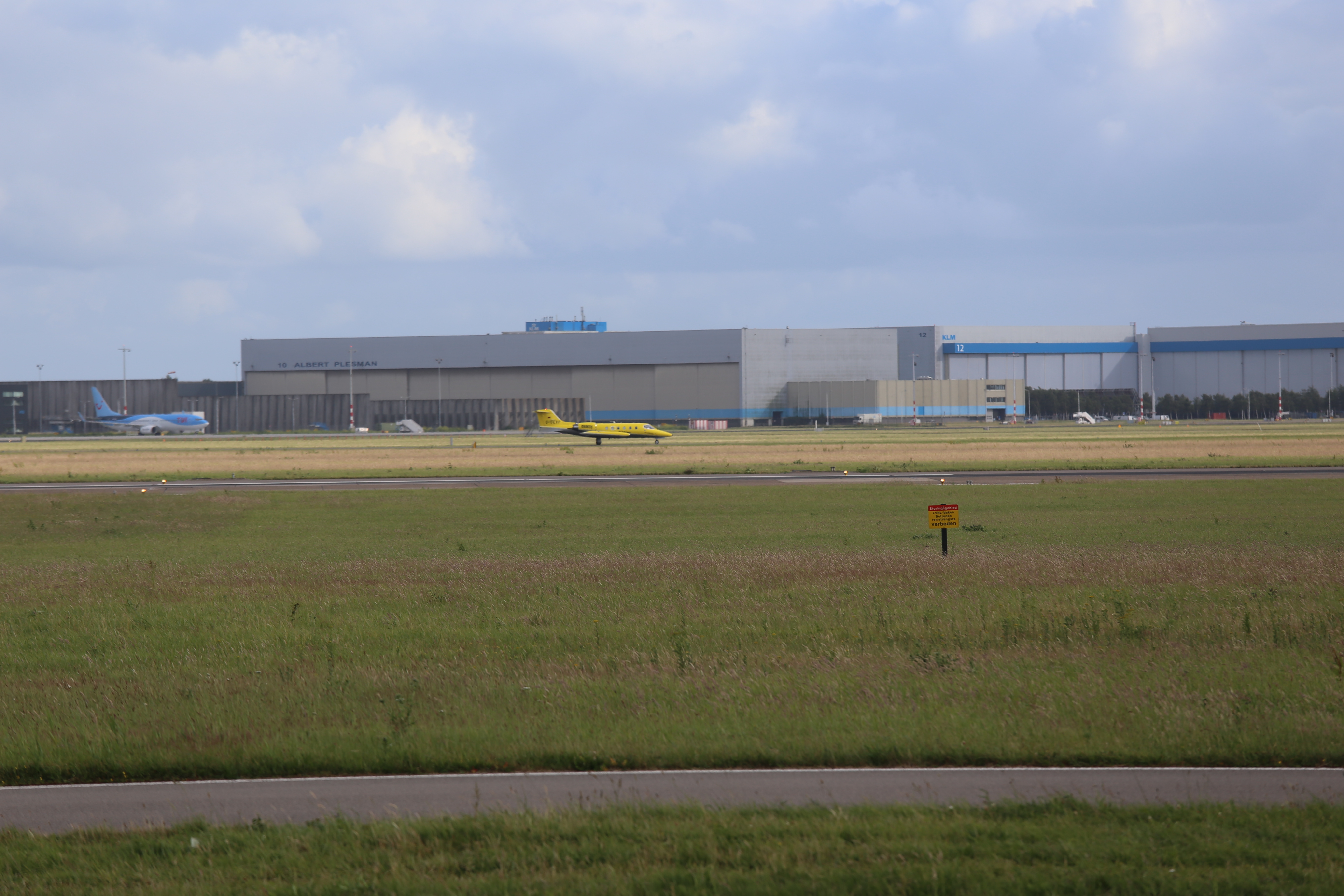
Learjet 35A D-CEXP, an air-ambulance jet, at Amsterdam Schiphol in 2018. · Photo: Pasci23456, CC0 1.0, via Wikimedia Commons
Learjet · Light Jet
Learjet 35 / 35A
The fan-engined third generation of the original Learjet line, between the Learjet 25 and the Learjet 31A.
Few jets this cheap go this far this fast. The 35A still outruns and outclimbs most light jets of its era, but its low, narrow cabin, two-pilot crew and heavy 12-year inspections make it a mission tool more than a comfortable family jet.
Buy it if
You need to move up to six people 1,500–2,000 nm quickly on a small purchase budget, you have access to experienced Learjet pilots and shops, and speed matters more than cabin space.
Skip it if
Your passengers expect to stand up or use a private lavatory, you want one pilot up front, you fly from runways shorter than about 5,000 ft, or you cannot absorb a surprise six-figure inspection bill.
Biggest compromise
The cabin. At 4 ft 4 in tall and 4 ft 11 in wide, passengers stoop to their seats, and the only toilet is a belted seat behind a curtain.
The numbers that matter
Purchase price
$581K–$920K
guide value (PlanePHD and Aircraft Bluebook)
What it costs per year
$1.31M
at 300 hrs · two professional pilots
How far it flies
2,196 nm
1,930–2,000 nm with passengers
How fast
451 kt
high-speed cruise
Seats
6
6 typical, up to 8
Pilots needed
2
Always flown by two pilots; the 35 and 35A were never approved for single-pilot operation.
Price
What one costs to buy
Guide value
$581K–$920K
Other sites
4.9% of the fleet
6-month move
Priced vs call
with a price / call for price
Only one of eight listings shows a price: $395,000 for a 1989 jet. JETNET shows asks of $380,000–$1.5M; guide values run $0.58–0.92M.
Price vs its family and alternatives
Scroll to explore · select a jet for details
Learjet 35 / 35A · This aircraft
$581K–$920K guide
Guide value, not a listed asking price.
Sits between the Learjet 25 / 25B / 25C / 25D and the Learjet 31A.
For sale now
None listed right now
Cost to own
What it costs per year to run
300hours / year
Per year
Per flight hour
Estimate — your operator will quote actual numbers.
Fuel, airframe maintenance, engine program or reserve and crew travel, landing and handling rise as you fly more. Two professional pilots, recurrent training, hangar, insurance, management and subscriptions and misc fixed stay the same however much you fly.
Where the money goes
- Two professional pilots$200,58215%
- Recurrent training$22,9262%
- Hangar$21,9992%
- Insurance$17,9201%
- Management$48,0004%
- Subscriptions and misc fixed$10,0411%
- Fuel$466,99236%
- Airframe maintenance$225,60017%
- Engine program or reserve$230,40018%
- Crew travel, landing and handling$67,5005%
Fuel is the biggest single cost at 36% of the total.
The JetGrade
67 out of 100 — Below its class average
Peer group: Cessna Citation II, Cessna Citation V, Beechcraft Beechjet 400A, Learjet 31A, Dassault Falcon 10
Seven categories at a glance
- - - 70 = typical— This aircraft
Strongest on speed & trip time, weakest on cabin & passenger comfort.
Grades are editorial opinions about the model, not any specific aircraft. Sponsors and affiliates have no input. Reviewed 2026-09-29.
Where it flies
Sample trips and reach
Typical trips on a map
Nonstop
Depends on weight or weather
Fuel stop likely
Out of reach
5 of 8 sample trips are comfortable nonstops.
Sample flight times
- 0.9 hr
Carlsbad → Las Vegas
205 nm
- 1.8 hr
Carlsbad → Aspen
625 nm · Hot-and-high; depends on weight and weather
- 2.2 hr
Santa Ana → San José del Cabo
765 nm
- 2.5 hr
Teterboro → West Palm Beach
900 nm
- 3.1 hr
Dallas → Teterboro
1,190 nm
- 3.6 hr
Teterboro → San Juan
1,410 nm · Over-water leg comfortably within range
- 5.6 hr
Carlsbad → Teterboro
2,100 nm · Needs one stop; strong tailwinds sometimes allow nonstop
Los Angeles → Honolulu
2,215 nm · Beyond range, with no fuel stop en route
Lineage
What came before and after

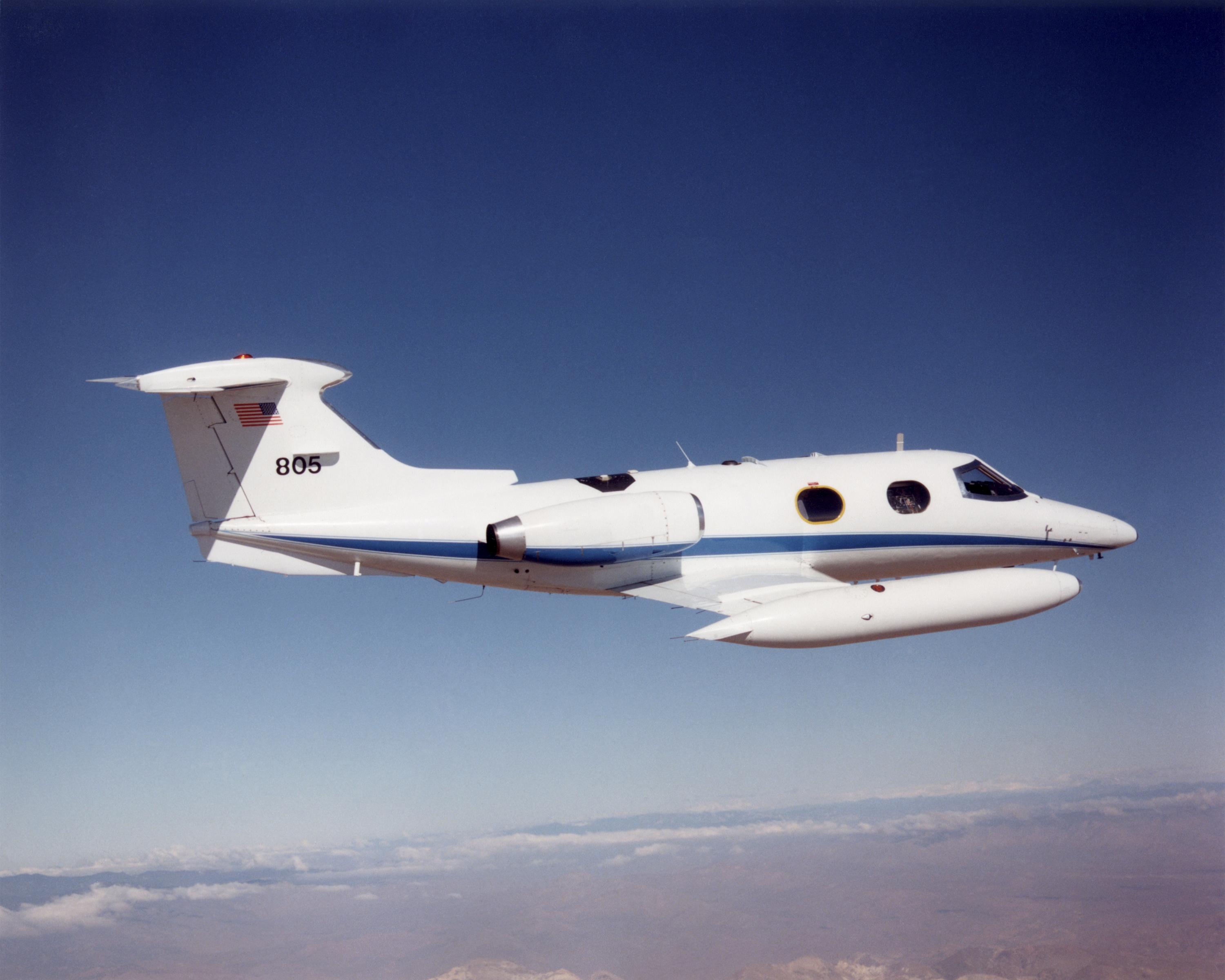
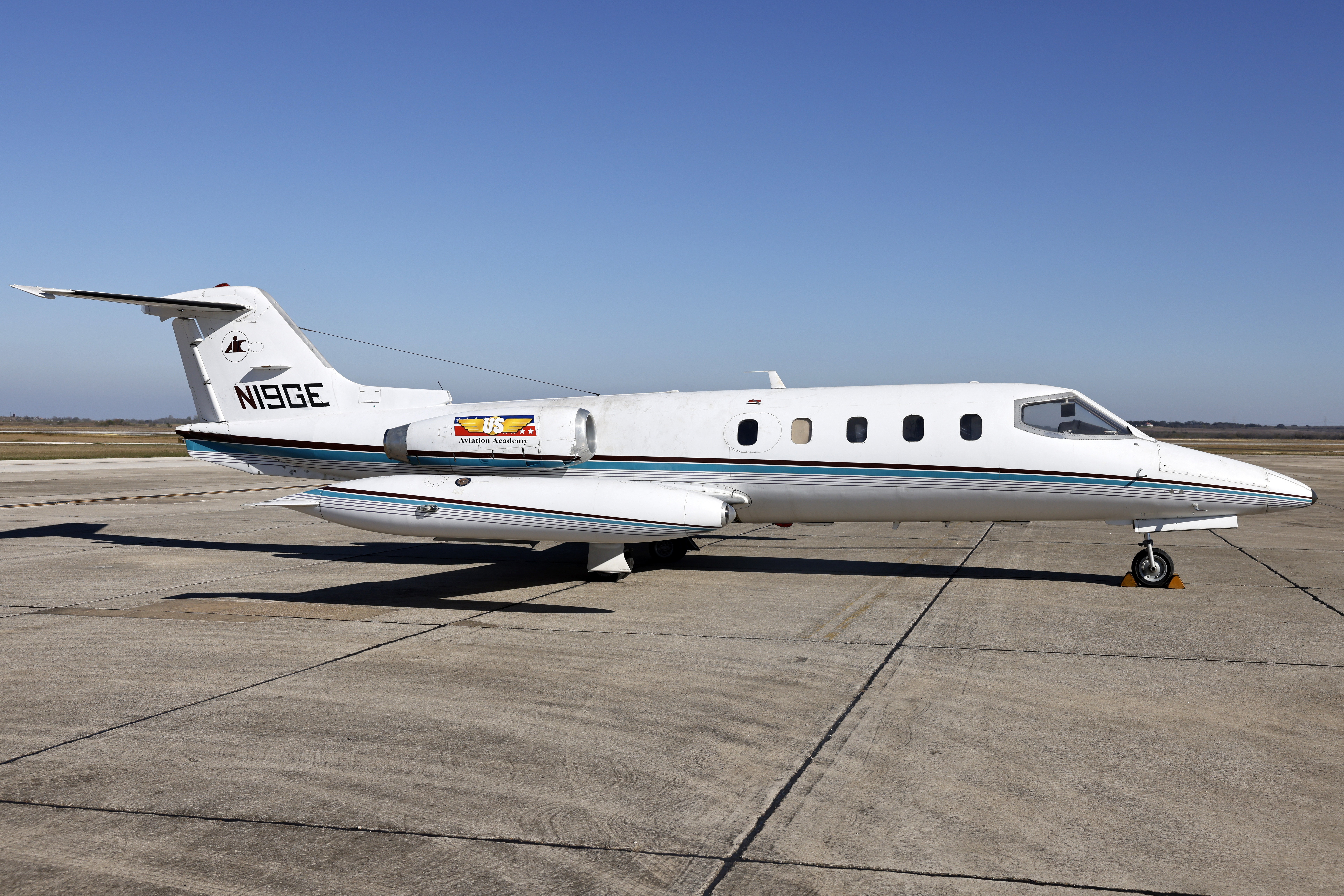

1974–1993
Learjet 35 / 35A
Turbofans and a longer wing bring roughly 2,000 nm range.
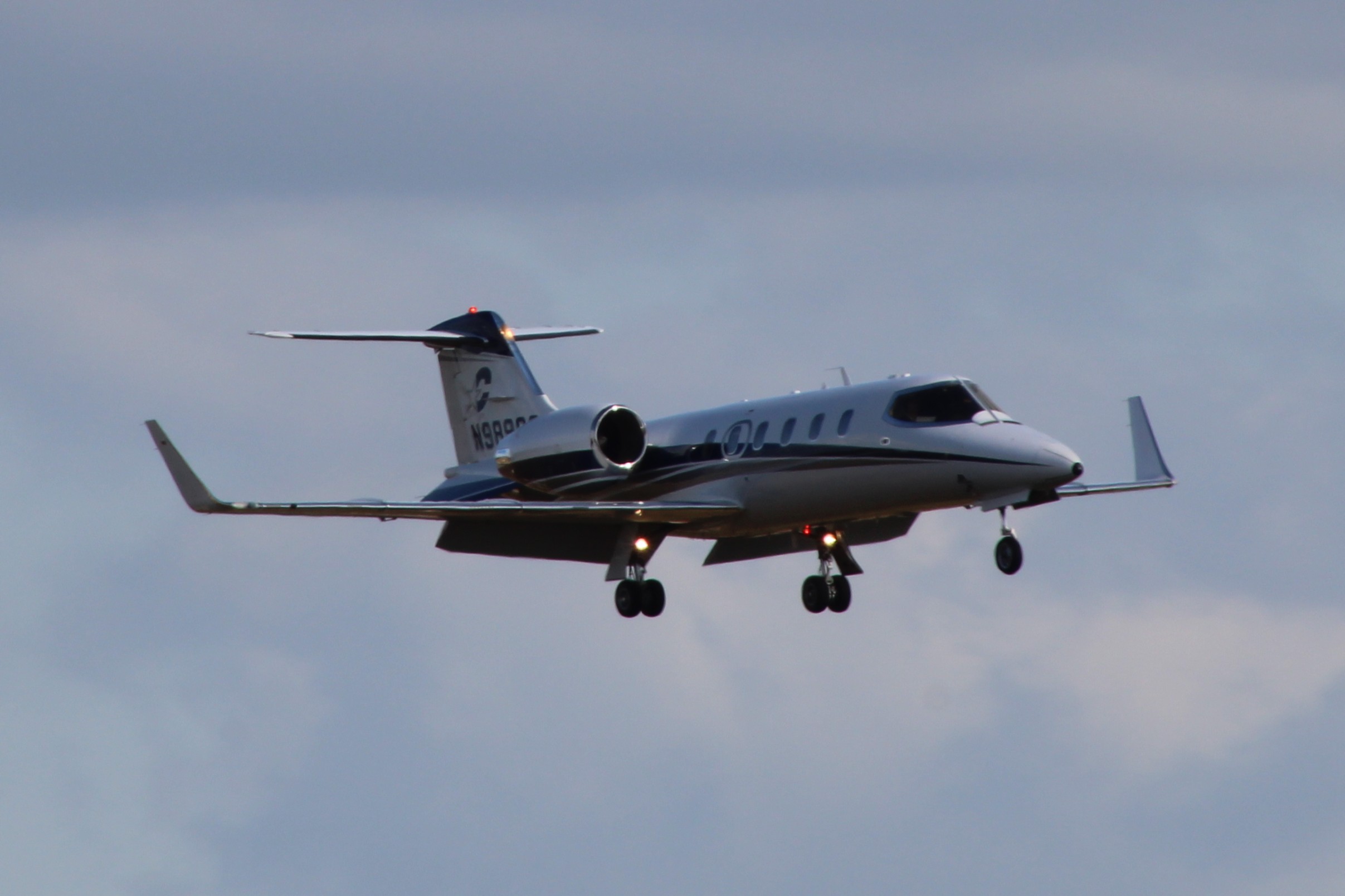

What changed from the Learjet 25
- Garrett TFE731 turbofans replace the 25's turbojets, burning roughly a quarter less fuel in cruise.
- About two feet added to each wingtip for more lift and fuel efficiency.
- Fuselage stretched about 13 inches ahead of the wing.
- Maximum takeoff weight rises from 15,000 lb to as much as 18,300 lb.
- Range grows to about 2,000 nm with four passengers.
Size and cabin
How big it is, inside and out
Outside
Silhouette · scaled to length
Length
Wingspan
Height
Inside the cabin
Cabin length
Width
Height
Compare
How it stacks up
This aircraft
Learjet 35 / 35A
- JetGrade
- 67
- Price
- $581K–$920K guide
- Cost per year
- $1.31M
- Range
- 2,196 nm
- Speed
- 451 kt
- Seats
- 6
- Cabin length
- 12′ 11″
- Pilots
- 2
- Years built
- 1974–1993
← Before
- JetGrade
- 54
- Price
- $150K–$400K guide
- Cost per year
- $1.24M
- Range
- 1,535 nm
- Speed
- 464 kt
- Seats
- 7
- Cabin length
- 12′ 0″
- Pilots
- 2
- Years built
- 1967–1982
After →
- JetGrade
- 64
- Price
- $760K
- Cost per year
- $1.47M
- Range
- 1,290 nm
- Speed
- 459 kt
- Seats
- 7
- Cabin length
- 12′ 11″
- Pilots
- 2
- Years built
- 1991–2003
Alternative
- JetGrade
- 72
- Price
- $2.19M
- Cost per year
- $1.31M
- Range
- 1,734 nm
- Speed
- 420 kt
- Seats
- 7
- Cabin length
- 17′ 5″
- Pilots
- 2
- Years built
- 1994–1999
Alternative
- JetGrade
- 65
- Price
- $2.8M
- Cost per year
- $1.95M
- Range
- 2,390 nm
- Speed
- 465 kt
- Seats
- 7
- Cabin length
- 17′ 8″
- Pilots
- 2
- Years built
- 1993–2007
- Learjet 31A instead: Same fuselage and engine family with a newer wing, delta fins and gentler low-speed handling, in exchange for some range.
- Cessna Citation Ultra instead: A roomier cabin, shorter runway needs and strong factory support, at the cost of some speed and range.
- Learjet 60 instead: A stand-up midsize cabin and longer range with the same Learjet climb, for a higher price and budget.
Gold marks the best figure in each row.
Owning one
What to know before you buy
Engines & inspections
2 × Honeywell (Garrett) TFE731-2-2B · 3,500 lbf each
No APUEngine hours until overhaul
- A inspection · 300 hr
- B inspection · 600 hr
- C inspection · 1,200 hr
- Engine midpoint inspection (MPI) · 1,400 hr
- Engine overhaul (CZI) · 4,200 hr
- 12,000-hour inspection · 12,000 hr
- 12-year inspection every 144 months
Many jets are on Honeywell's hourly engine plan. Without one, overhauls and life-limited engine parts can cost six figures per engine.
Known issues
12-year inspection cost
The 12-year and 12,000-hour inspections run roughly $80,000–100,000-plus in labor and ground the jet for weeks.
Engine overhaul exposure
Without an hourly engine plan, TFE731 overhauls and life-limited discs can cost six figures per engine.
Spoiler life records
A 2022 directive grounds jets whose spoilers lack valid life records; each replacement assembly costs about $50,000.
Pre-buy checklist
0 of 10 checked
Bombardier still holds the type certificate and says it supports Learjets, and many independent US shops specialise in the 35. Parts for older 30-series jets largely come through specialist distributors.
Review
The full review
Strengths
- Cruises at about 450 knots and climbs to 45,000 ft, faster than most light jets of its generation.
- Carries full fuel plus about 1,990 lb of payload, so range barely shrinks as seats fill.
- Guide values of roughly $580,000–920,000 are a fraction of newer jets with similar speed and range.
Limitations
- Cabin is 4 ft 4 in tall with a curtained belted-seat toilet, cramped for trips over two hours.
- Needs about 5,000 ft of runway at maximum weight at sea level, and paved runways only.
- The 12-year inspection alone can pass $90,000 in labor and take the jet out of service for weeks.
The Learjet 35 arrived in 1974 as the fan-engined answer to the Learjet 25. Gates Learjet kept the slim, fighter-like fuselage, stretched it by about 13 inches, added roughly two feet to each wingtip and replaced the 25's fuel-hungry turbojets with Garrett TFE731 turbofans. The 35A followed in 1976 with higher weight options, and it is the version almost everyone means by "Lear 35." About 670 of the two models were built through 1993, including the US Air Force's C-21A, and a little over 300 are still flying.
Pilot's take
Pilots describe the 35A as a jet that rewards discipline. It climbs hard, cruises around 450 knots and keeps its speed well into the forties, but the wing is small and the stall protection, with a stick shaker, a stick pusher and a required yaw damper, is there for a reason. Approach speeds and wind additives matter; the 2017 Teterboro accident showed what happens when an unstable approach is pushed too far. Crews who train in the simulator every year and fly by the numbers tend to love it. Owners should budget for two current pilots and treat recurrent training as a safety item, not an expense line.
Who this is for
Owners and operators who value speed and range per dollar: air-ambulance and cargo operators, charter companies, and experienced owners with a professional crew who fly two to five people on 1,000–2,000 nm trips.

Ask about this aircraft
Answers come only from our research file on the Learjet 35 / 35A.
Your earlier questionsOwners
Private to verified ownersOwn a Learjet Learjet 35 / 35A? Verify with its FAA registration to join the owners' thread and the real-cost poll.