
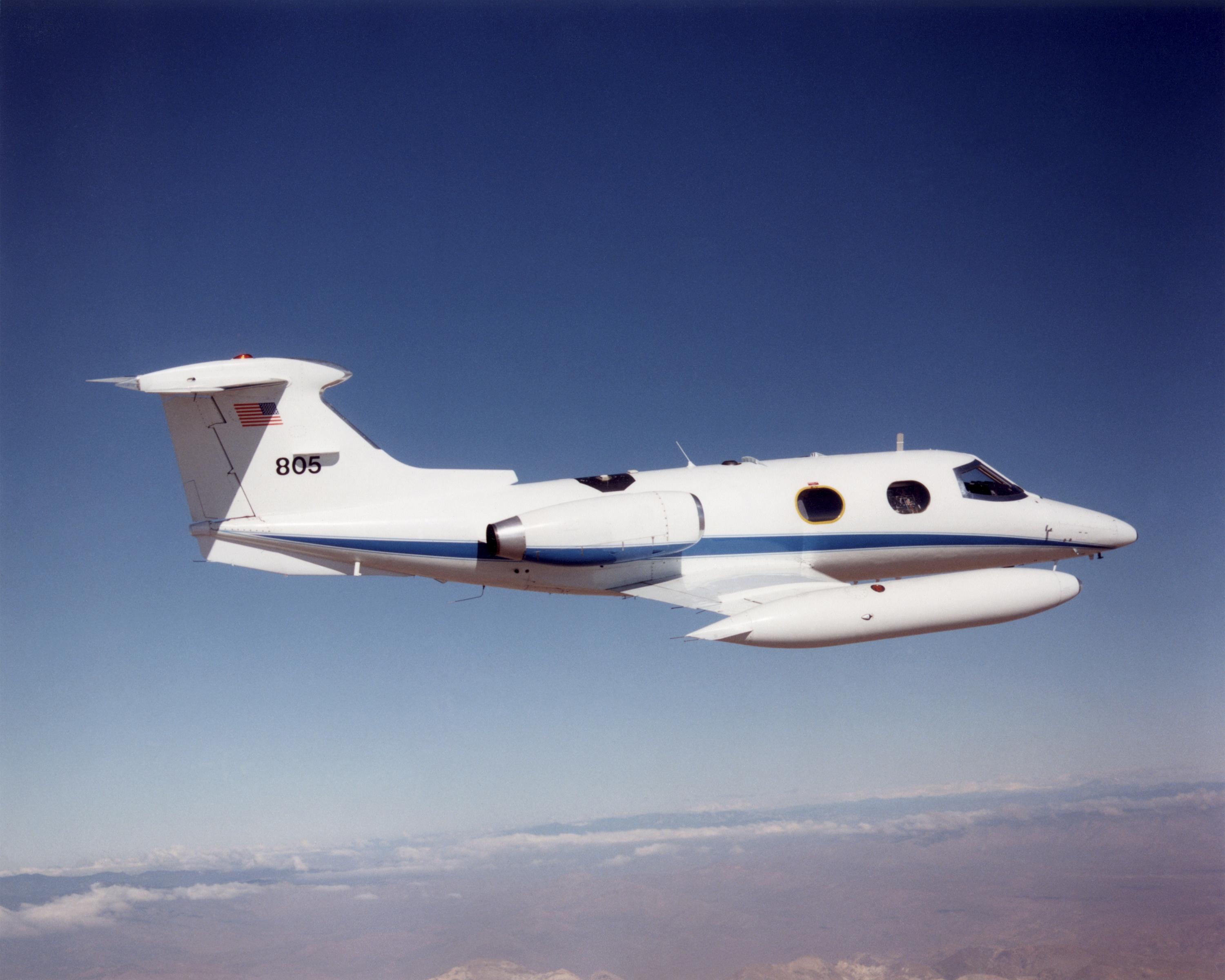
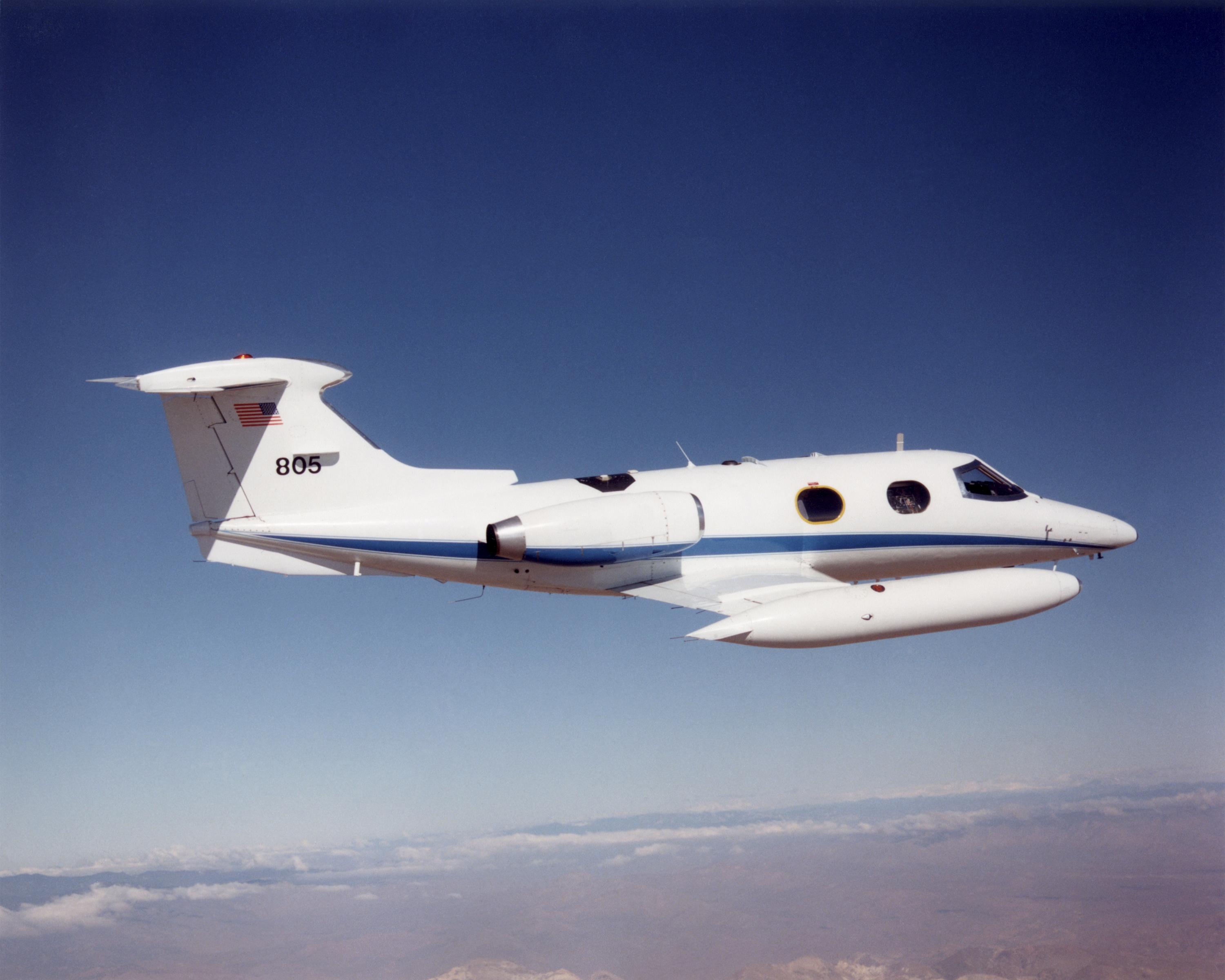
NASA's Learjet 24A in flight over California, October 1998. · Jim Ross / NASA, public domain, via Wikimedia Commons
Learjet · Light Jet
Learjet 24 (24, 24A–24F)
The second Learjet model and the most-built short-body Lear, offered in six versions from 1966 to 1977.
The Learjet 24 still climbs and cruises like few light jets, but it is a cramped, thirsty 1960s design with shrinking support. In the US it needs noise kits to use most airports. Buy it as a passion airplane, not as transport.
Buy it if
You want a historic, very fast jet for short trips with two or three passengers, already have type-rated pilots, and will consider only an airplane that already has noise kits, RVSM approval and ADS-B.
Skip it if
You need a practical business tool: room for five people and bags, predictable maintenance bills, easy insurance and a buyer when you sell. A Citation I or II, or a later Learjet 35, does that far better.
Biggest compromise
With full fuel the 24D can carry only about 342 lb of people and bags, so every trip trades fuel for passengers. Add turbojets burning about 257 gallons an hour, a 12-year inspection that can cost close to the airplane's value, and US noise rules that ground unmodified aircraft.
The numbers that matter
Purchase price
$235K–$308K
guide value (Conklin & de Decker; PlanePhD)
What it costs per year
$1.3M
at 300 hrs · two professional pilots
How far it flies
899 nm
About 900 nm with four passengers and standard IFR reserves
How fast
439 kt
high-speed cruise
Seats
5
5 typical, up to 6
Pilots needed
2
Requires two pilots; the captain needs a Learjet (LR-JET) type rating.
Price
What one costs to buy
Guide value
$235K–$308K
Other sites
Priced vs call
with a price / call for price
Only one airworthy Learjet 24 is listed: a 1974 24D with noise kits asking $350,000. Published guide values run about $235,000–$310,000.
Price vs its family and alternatives
Scroll to explore · select a jet for details
Learjet 24 (24, 24A–24F) · This aircraft
$235K–$308K guide
Guide value, not a listed asking price.
Sits between the Learjet 23 and the Learjet 25 / 25B / 25C / 25D.
For sale now
None listed right now
Cost to own
What it costs per year to run
300hours / year
Per year
Per flight hour
Estimate — your operator will quote actual numbers.
Fuel, airframe maintenance, engine overhaul reserve and landing, handling, crew travel and databases rise as you fly more. Two professional pilots, recurrent training, two pilots, hangar, insurance and management stay the same however much you fly.
Where the money goes
- Two professional pilots$285,00022%
- Recurrent training, two pilots$37,5003%
- Hangar$27,5002%
- Insurance$22,5002%
- Management$24,0002%
- Fuel$580,92045%
- Airframe maintenance$150,00012%
- Engine overhaul reserve$82,5006%
- Landing, handling, crew travel and databases$90,0007%
Fuel is the biggest single cost at 45% of the total.
The JetGrade
51 out of 100 — Well below its class
Peer group: Cessna Citation I (500), Learjet 25, Mitsubishi Diamond I (MU-300), Learjet 35 / 35A, Cessna Citation II (550)
Seven categories at a glance
- - - 70 = typical— This aircraft
Strongest on speed & trip time, weakest on running costs.
Grades are editorial opinions about the model, not any specific aircraft. Sponsors and affiliates have no input. Reviewed 2026-09-29.
Where it flies
Sample trips and reach
Typical trips on a map
Nonstop
Depends on weight or weather
Fuel stop likely
2 of 6 sample trips are comfortable nonstops.
Sample flight times
- 0.8 hr
Carlsbad → Las Vegas
205 nm · Short hop at high speed
- 1.8 hr
Carlsbad → Aspen
625 nm · Hot-and-high; depends on weight and weather
- 2.1 hr
Santa Ana → San José del Cabo
765 nm · Nonstop with four passengers in normal winds
- 2.5 hr
Teterboro → West Palm Beach
900 nm · At its range limit; winds decide, or stop
- 3.1 hr
Dallas → Teterboro
1,190 nm · Needs one stop, typically mid-route
- 5.3 hr
Carlsbad → Teterboro
2,100 nm · Needs two stops across the country
Lineage
What came before and after

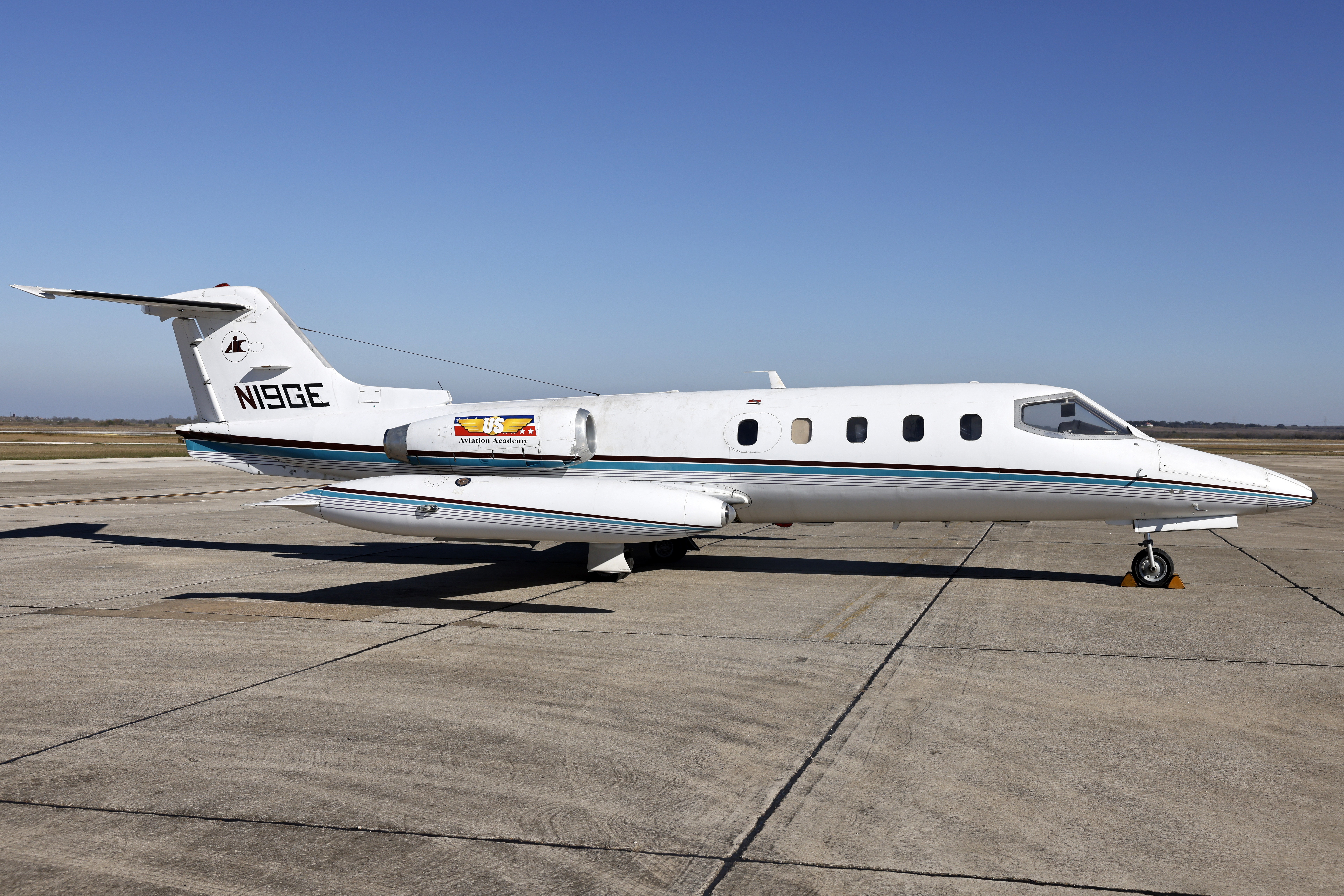
1966–1977
Learjet 24 / 24A–F
Airliner-standard certification, more pressurization and a 13,500-lb takeoff weight.

What changed from the Learjet 23
- Certified to transport-category (airliner) standards instead of small-airplane rules.
- Maximum takeoff weight rose from 12,499 lb to about 13,500 lb.
- Stronger cabin pressurization and one extra cabin window on the right side.
- New windshield design.
- Auxiliary fuel added in the wingtip tanks.
- Engine fire extinguishing system added.
Size and cabin
How big it is, inside and out
Outside
Silhouette · scaled to length
Length
Wingspan
Height
Inside the cabin
Cabin length
Width
Height
Compare
How it stacks up
This aircraft
Learjet 24 (24, 24A–24F)
- JetGrade
- 51
- Price
- $235K–$308K guide
- Cost per year
- $1.3M
- Range
- 1,200 nm
- Speed
- 439 kt
- Seats
- 5
- Cabin length
- 9′ 0″
- Pilots
- 2
- Years built
- 1966–1977
← Before
- JetGrade
- 53
- Price
- $80K–$301K guide
- Cost per year
- $1.2M
- Range
- 1,590 nm
- Speed
- 450 kt
- Seats
- 4
- Cabin length
- 9′ 0″
- Pilots
- 2
- Years built
- 1964–1966
After →
- JetGrade
- 54
- Price
- $150K–$400K guide
- Cost per year
- $1.24M
- Range
- 1,535 nm
- Speed
- 464 kt
- Seats
- 7
- Cabin length
- 12′ 0″
- Pilots
- 2
- Years built
- 1967–1982
Alternative
- JetGrade
- 67
- Price
- $581K–$920K guide
- Cost per year
- $1.31M
- Range
- 2,196 nm
- Speed
- 451 kt
- Seats
- 6
- Cabin length
- 12′ 11″
- Pilots
- 2
- Years built
- 1974–1993
Alternative
- JetGrade
- 62
- Price
- $473K
- Cost per year
- $841K
- Range
- 900 nm
- Speed
- 335 kt
- Seats
- 5
- Cabin length
- 12′ 8″
- Pilots
- 2
- Years built
- 1971–1985
- Learjet 35 / 35A instead: The same classic Learjet feel with quieter, far more efficient fan engines, roughly twice the range and a much larger support network, for a higher purchase price.
- Cessna Citation I (500) instead: Much slower, but a bigger cabin, shorter-runway manners, lower fuel burn and easier maintenance and insurance make it a more practical first jet.
- Learjet 25 instead: The stretched sister with up to eight seats and a longer cabin, the same engines and the same noise-kit question; better when you need more seats.
Gold marks the best figure in each row.
Owning one
What to know before you buy
Engines & inspections
2 × General Electric CJ610-6 (24 to 24D) or CJ610-8A (24E, 24F) · 2,950 lbf each
No APUEngine hours until overhaul
- 300-hour A inspection · 300 hr
- 600-hour B inspection · 600 hr
- Tip-tank flapper check · 600 hr
- 1,200-hour C inspection · 1,200 hr
- 2,400-hour D inspection · 2,400 hr
- Engine overhaul · 5,000 hr
- 12-year structural inspection every 144 months
No hourly engine program covers these turbojets. Owners pay for overhauls themselves, and only a few specialist shops still overhaul and lease CJ610 engines.
Known issues
US noise rules
Without approved Stage 3 hushkits it cannot use airports in the lower 48 US states except on special permits.
12-year inspection cost
Strips the airframe for X-rays over five to six weeks; labor alone is about $90,000 before repairs.
Main gear bolt warning
In October 2025 the NTSB urged checks of main landing gear retaining bolts on 20- and 30-series Learjets.
Pre-buy checklist
0 of 10 checked
Specialist Learjet shops still maintain 20-series aircraft, Bombardier's parts partner stocks many airframe parts, and a few engine shops overhaul and lease CJ610s. SimCom in Orlando offers simulator training for the type.
Review
The full review
Strengths
- Climbs about 6,800 ft per minute and reaches 43,000 ft in roughly 24 minutes, per Conklin & de Decker's 24D figures.
- Average cruise of about 410–440 knots, faster than most light jets of its era.
- Low entry price: guides put values near $235,000–$310,000; one airworthy 24D listed at $350,000 in September 2026.
Limitations
- Cabin only 9 ft long and 4 ft 4 in tall, about 192 cubic feet, with 40 cubic feet for bags.
- About 900 nm with four passengers and standard IFR reserves; full tanks leave only 342 lb for people.
- Without Stage 3 noise kits it cannot use airports in the lower 48 US states except on special permits.
The Learjet 24 is the airplane that made the Learjet name famous. It followed the original Learjet 23 in 1966 and was the first business jet certified to the FAA's transport-category (airliner) standards. Compared with the 23 it added stronger cabin pressurization, a new windshield, an extra window, engine fire extinguishing and a higher 13,500-lb maximum takeoff weight. Six versions followed through 1977, the 24, 24A, 24B, 24D, 24E and 24F, about 258 airplanes in all. The 24D, built from 1970 to 1976, is the most common and the version described here. The stretched Learjet 25 and the fan-engined Learjet 35 grew out of the same design.
Pilot's take
Pilots remember the Learjet 24 for how it goes. With about 6,800 ft per minute of initial climb and cruise above 400 knots, it feels closer to a fighter than to a straight-wing Citation. That performance comes with demands: fast approach speeds, a reference landing speed of about 124 knots in Conklin & de Decker's 24D figures, and a small, busy cockpit that rewards a crew already current in older Learjets. The original Learjets earned a reputation for punishing pilots who moved up from piston twins without proper training, and insurers still expect simulator training today. Treat it as a high-performance airplane, not an entry-level jet.
Who this is for
Collectors, museums, flight-test and special-mission operators, and experienced Learjet crews who want a flying piece of history for short, light trips and have the budget and shop access to keep a 50-year-old turbojet flying.

Ask about this aircraft
Answers come only from our research file on the Learjet 24 / 24A–F.
Your earlier questionsOwners
Private to verified ownersOwn a Learjet Learjet 24 (24, 24A–24F)? Verify with its FAA registration to join the owners' thread and the real-cost poll.