
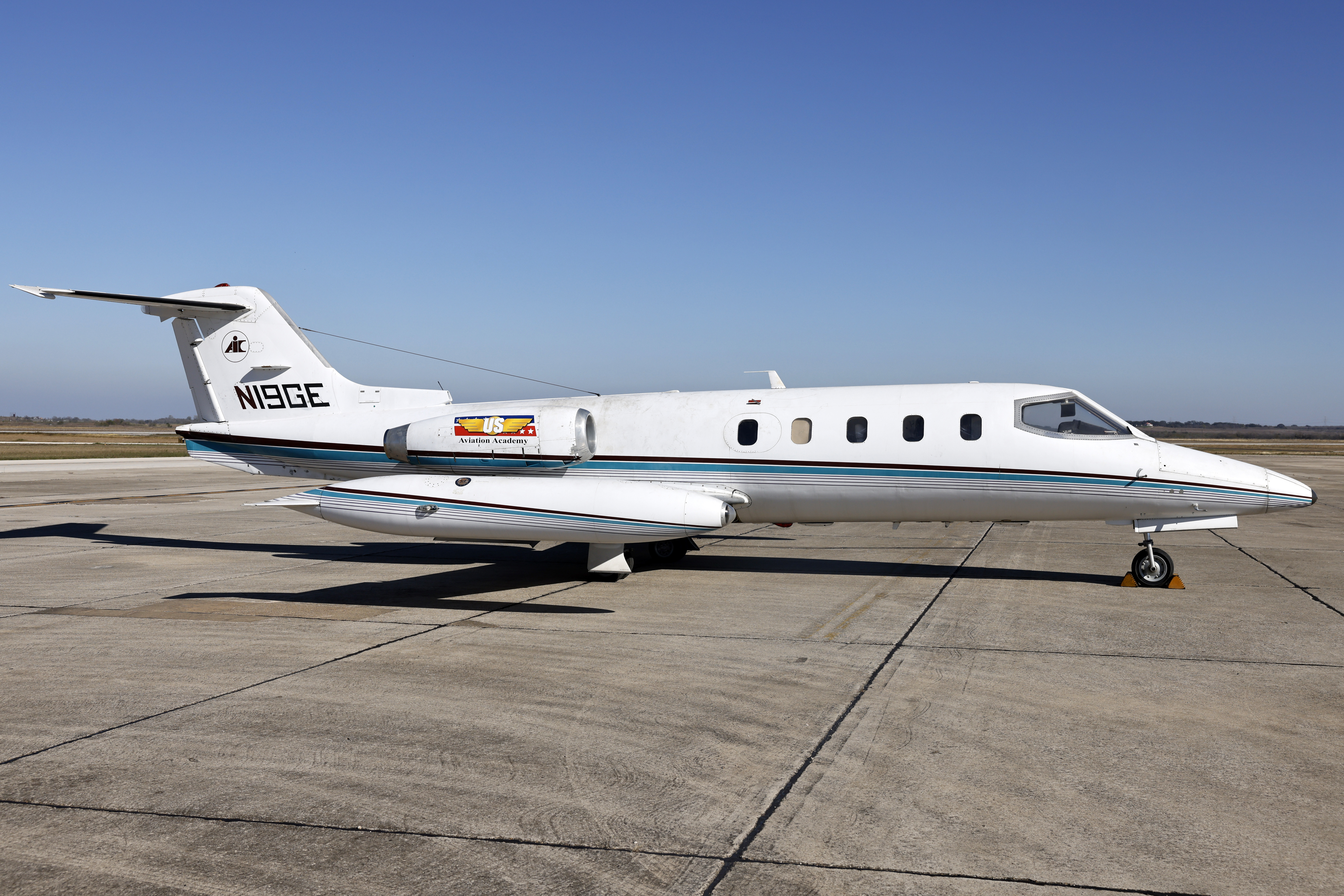
A 1980 Learjet 25D at San Marcos, Texas, in December 2025. · Photo: Duncan Kirk via Wikimedia Commons, CC BY 4.0
Learjet · Light Jet
Learjet 25 / 25B / 25C / 25D
The stretched, eight-seat member of the original Learjet 20 series, and the direct ancestor of the Learjet 35.
One of the fastest, cheapest ways into a twin jet, and one of the hardest to live with. Thirsty turbojets, a cramped cabin, no engine plans and a required noise kit make it a project for experienced operators.
Buy it if
You want 460-knot speed and a 51,000 ft ceiling for less than many used turboprops, have Learjet-trained pilots, and find an example with the noise kit, high-altitude approval, and recent engine and 12-year work done.
Skip it if
You need to carry four passengers more than about 1,000 nm, want room to stand or a private toilet, or want predictable costs. A Learjet 35A or Citation II is easier to own.
Biggest compromise
Fuel and paperwork. The CJ610 turbojets burn roughly 270–300 US gallons an hour over a trip, so fuel alone tops $2,000 an hour.
The numbers that matter
Purchase price
$150K–$400K
guide value (Everette Aviation appraisal commentary)
What it costs per year
$1.24M
at 300 hrs · two professional pilots
How far it flies
1,535 nm
800–1,014 nm with passengers
How fast
464 kt
high-speed cruise
Seats
7
7 typical, up to 8 certified
Pilots needed
2
Two pilots are required on every flight; there is no single-pilot version.
Price
What one costs to buy
Guide value
$150K–$400K
Other sites
Priced vs call
with a price / call for price
Two jets show asks: $365,000 and $1.9M for one with fresh engines. An appraiser puts most airworthy 25s at $150,000–$400,000.
Price vs its family and alternatives
Scroll to explore · select a jet for details
Learjet 25 / 25B / 25C / 25D · This aircraft
$150K–$400K guide
Guide value, not a listed asking price.
Sits between the Learjet 24 (24, 24A–24F) and the Learjet 36 / 36A.
For sale now
None listed right now
Cost to own
What it costs per year to run
300hours / year
Per year
Per flight hour
Estimate — your operator will quote actual numbers.
Fuel, airframe maintenance, engine overhaul reserve and 12-year inspection set-aside rise as you fly more. Two professional pilots, recurrent simulator training, hangar, insurance and management company stay the same however much you fly.
Where the money goes
Partial estimate- Two professional pilots$234,09319%
- Recurrent simulator training$33,0523%
- Hangar$34,9463%
- Insurance$16,6751%
- Management company$48,0004%
- Fuel$651,45653%
- Airframe maintenance$132,00011%
- Engine overhaul reserve$82,3207%
- 12-year inspection set-aside$7,5211%
Fuel is the biggest single cost at 53% of the total.
The JetGrade
54 out of 100 — Well below its class
Peer group: Learjet 24 / 24A–F, Cessna Citation I (500), Cessna Citation II (550), Dassault Falcon 10, Learjet 35 / 35A
Seven categories at a glance
- - - 70 = typical— This aircraft
Strongest on speed & trip time, weakest on reliability & support.
Grades are editorial opinions about the model, not any specific aircraft. Sponsors and affiliates have no input. Reviewed 2026-09-29.
Where it flies
Sample trips and reach
Typical trips on a map
Nonstop
Depends on weight or weather
Fuel stop likely
2 of 6 sample trips are comfortable nonstops.
Sample flight times
- 0.8 hr
Carlsbad → Las Vegas
205 nm · Short hop, well within range
- 1.8 hr
Carlsbad → Aspen
625 nm · Hot-and-high; depends on weight and weather
- 2.1 hr
Santa Ana → San José del Cabo
765 nm · Nonstop with four passengers in still air
- 2.6 hr
Teterboro → West Palm Beach
900 nm · Near the limit with four; headwinds cut margin
- 3.5 hr
Dallas → Teterboro
1,190 nm · Beyond range with four; one quick stop
- 5.9 hr
Carlsbad → Teterboro
2,100 nm · One stop with tailwinds; westbound may need two
Lineage
What came before and after

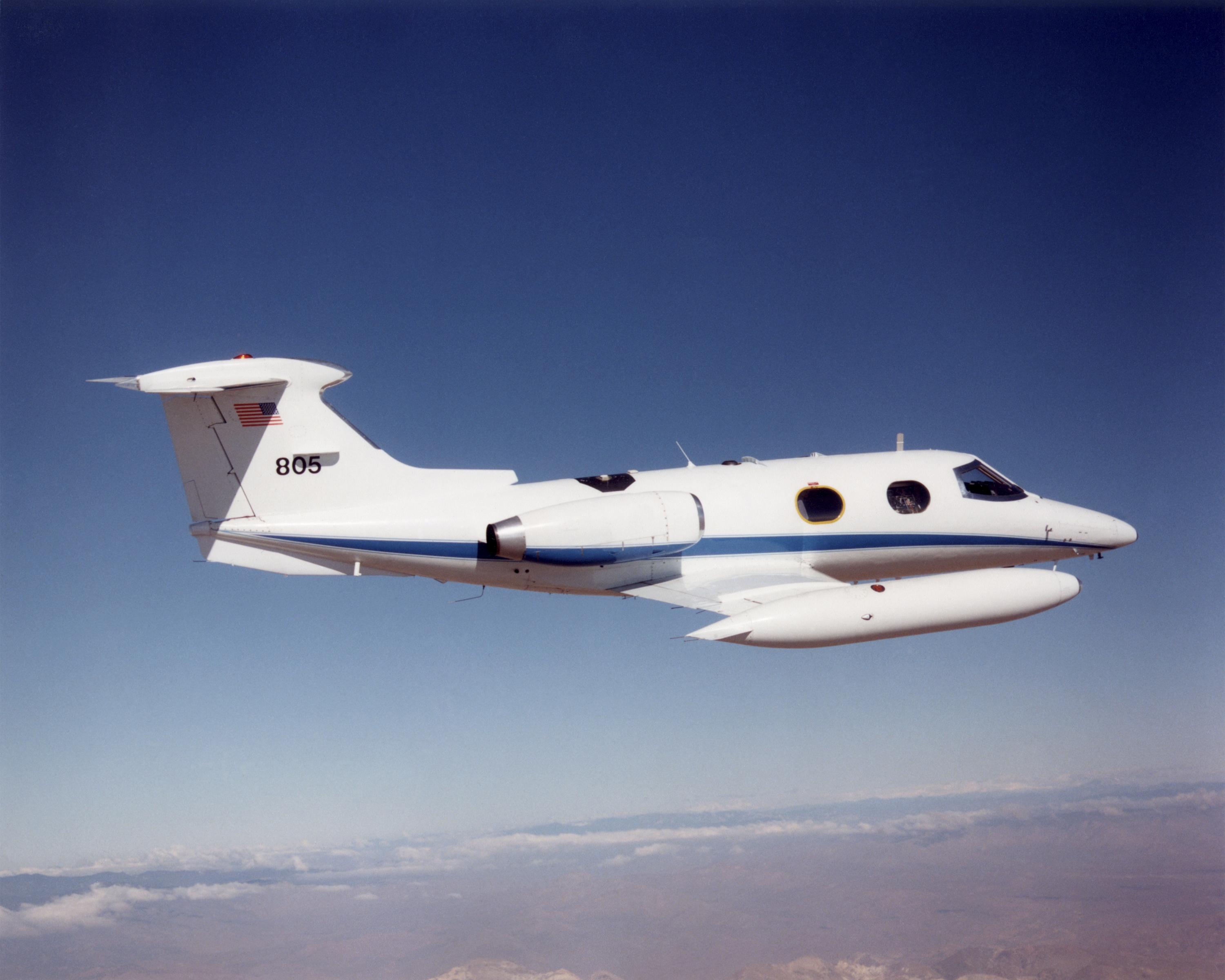
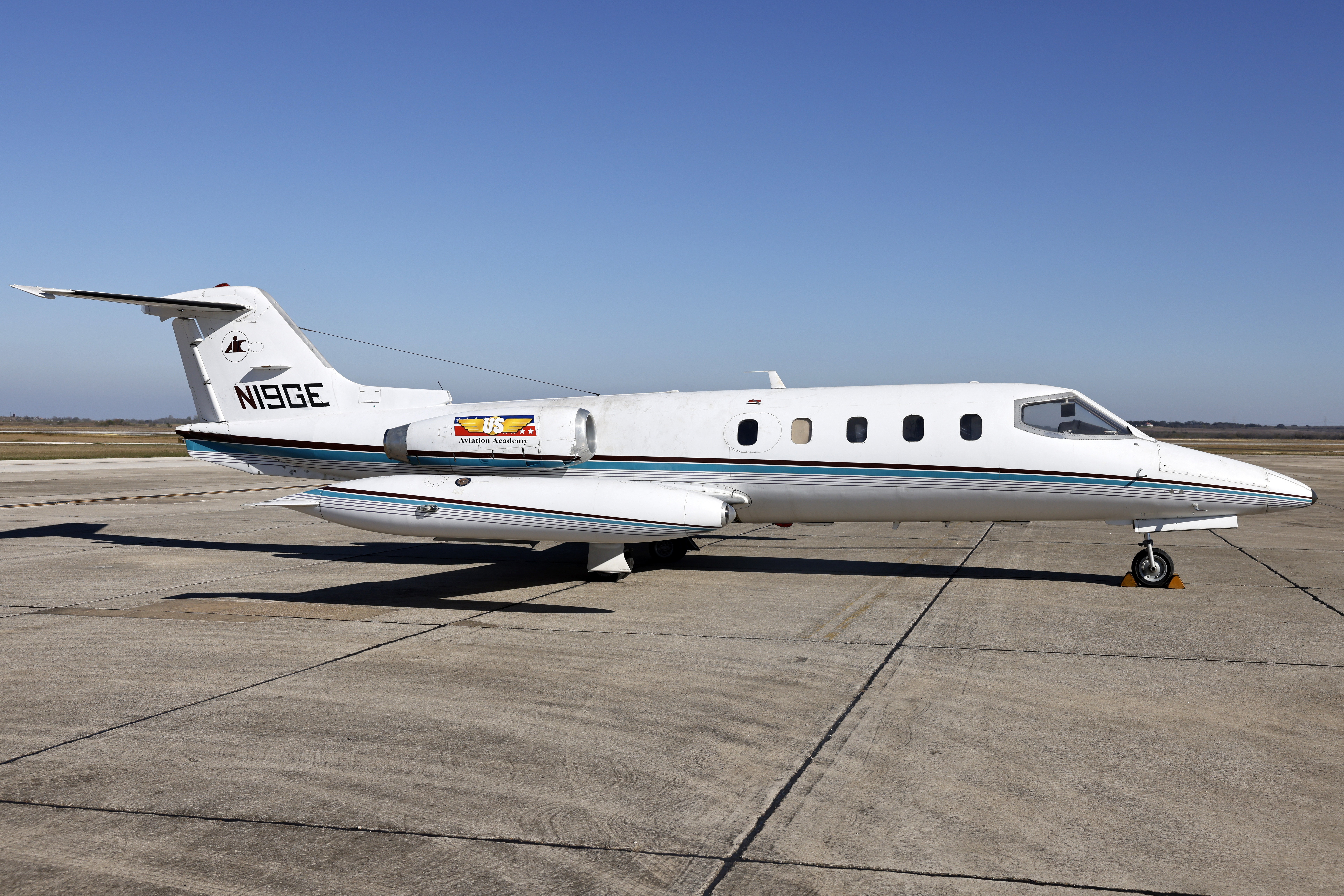
1967–1982
Learjet 25 / 25B / 25C / 25D
Stretched 24 seating up to eight; 25D added a new wing.


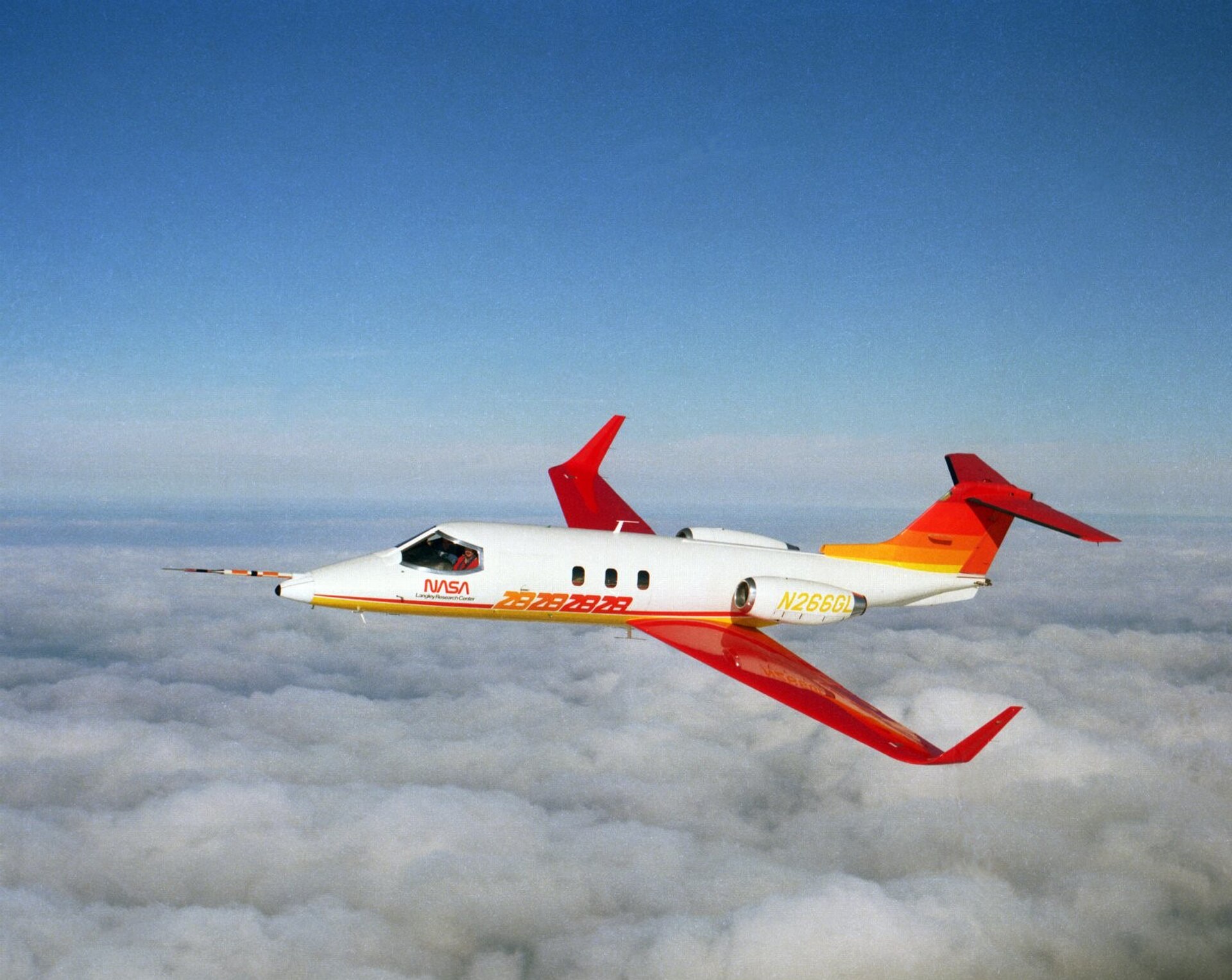
What changed from the Learjet 24 / 24A–F
- Fuselage stretched about 4 ft 2 in, adding room for two more passengers.
- Maximum takeoff weight rose to 15,000 lb from the 24's 13,000–13,500 lb.
- Larger fuselage fuel tank: 195 US gallons versus 125, or 388 on the 25C.
- General Electric CJ610-6 turbojets of 2,950 lb thrust; later 25Ds use the CJ610-8A.
- The 1976 25D added the reshaped Century III wing and a 350-knot speed limit.
- Later 25Ds are certified to 51,000 ft with stronger cabin pressurization.
Size and cabin
How big it is, inside and out
Outside
Silhouette · scaled to length
Length
Wingspan
Height
Inside the cabin
Cabin length
Width
Height
Compare
How it stacks up
This aircraft
Learjet 25 / 25B / 25C / 25D
- JetGrade
- 54
- Price
- $150K–$400K guide
- Cost per year
- $1.24M
- Range
- 1,535 nm
- Speed
- 464 kt
- Seats
- 7
- Cabin length
- 12′ 0″
- Pilots
- 2
- Years built
- 1967–1982
← Before
- JetGrade
- 51
- Price
- $235K–$308K guide
- Cost per year
- $1.3M
- Range
- 1,200 nm
- Speed
- 439 kt
- Seats
- 5
- Cabin length
- 9′ 0″
- Pilots
- 2
- Years built
- 1966–1977
After →
- JetGrade
- 67
- Price
- $581K–$920K guide
- Cost per year
- $1.31M
- Range
- 2,196 nm
- Speed
- 451 kt
- Seats
- 6
- Cabin length
- 12′ 11″
- Pilots
- 2
- Years built
- 1974–1993
Alternative
- JetGrade
- 67
- Price
- $895K
- Cost per year
- $919K
- Range
- 1,159 nm
- Speed
- 355 kt
- Seats
- 6
- Cabin length
- 15′ 9″
- Pilots
- 2
- Years built
- 1978–1994
- Learjet 35 / 35A instead: The turbofan successor: similar speed with roughly double the range, much lower fuel burn per mile, engine programs and a far bigger support base, for more money.
- Cessna Citation II (550) instead: Slower, but a roomier cabin, shorter runway needs, far lower fuel burn and Cessna's large service network.
- Learjet 24 / 24A–F instead: The shorter six-passenger sibling with the same engine family and wing: cheaper still, with even less cabin and baggage room.
Gold marks the best figure in each row.
Owning one
What to know before you buy
Engines & inspections
2 × General Electric CJ610-8A (25D); CJ610-6 on earlier 25s · 2,950 lbf each
No APUEngine hours until overhaul
- 300-hour airframe inspection · 300 hr
- 600-hour airframe inspection · 600 hr
- 1,200-hour airframe inspection · 1,200 hr
- 2,400-hour airframe inspection · 2,400 hr
- Engine overhaul · 5,000 hr
- 12,000-hour wing inspection · 12,000 hr
- 12-year structural inspection every 144 months
No pay-per-hour engine plan was found, so owners fund overhauls. A compressor upgrade can extend some engines' overhaul interval.
Known issues
Stage 3 noise kit required
Since 2016 a 25 without a Stage 3 hushkit cannot make normal flights in the lower 48 states. Confirm the kit and its paperwork.
12-year inspection cost
About $90,000 in labor alone plus X-rays and parts, five to six weeks down; it can approach the jet's value.
Main landing gear bolts
A 2025 safety recommendation covers gear attachment bolts on early Learjets after gear separations on two 25Bs; confirm the service bulletins.
Pre-buy checklist
0 of 10 checked
Bombardier still holds the type certificate and supports early Learjets, with parts through a partner and salvage sources. Independent shops handle 20-series inspections, and at least one repair station overhauls CJ610 engines.
Review
The full review
Strengths
- High-speed cruise of 464 knots and a 6,050 feet per minute climb make it among the quickest jets of its era.
- Later 25Ds are certified to 51,000 ft, above most weather and traffic, with the cabin held near 7,800 ft.
- Among the cheapest twin jets to buy: an appraiser puts most airworthy examples between $150,000 and $400,000.
Limitations
- About 1,000 nm with four passengers and standard fuel reserves; full tanks leave only about 810–850 lb for people and bags.
- A 12 ft long, 4 ft 4 in tall cabin where the only toilet doubles as a passenger seat.
- Fuel near 290 US gallons an hour, no pay-per-hour engine plans, and a 12-year inspection costing about $90,000 in labor.
The Learjet 25 is the stretched version of the original business jet. Gates Learjet added about 4 ft 2 in to the Learjet 24's fuselage, raised maximum takeoff weight to 15,000 lb and made room for up to eight passengers. The first 25 was approved in 1967, the 25B and long-range 25C followed in 1970, and the 25D arrived in 1976 with a reshaped wing and, on later aircraft, CJ610-8A engines and a 51,000 ft ceiling. About 368 were built before production ended in 1982. The turbofan Learjet 35 grew directly out of it.
Pilot's take
The Learjet 25 is remembered for performance that still impresses: a climb near 6,050 feet per minute and cruise above 460 knots from a jet designed in the 1960s. It demands respect at the edges. A stick shaker and stick pusher guard the stall, early 20-series Learjets drew a 1981 FAA review of their high-speed handling, and turbojet fuel burn climbs steeply down low, so trips are planned high and fast. Most 25s now carry retrofit navigators and displays, but the cockpit varies by airplane. Crews train on later Learjet simulators with a differences course for the 20 series, so pilots with early-Learjet experience are worth seeking out.
Who this is for
An experienced operator, cargo or special-mission user, or well-funded enthusiast with Learjet-trained pilots, flying two to five people on trips under about 900 nm, who values speed and climb over comfort and can absorb unpredictable maintenance bills.

Ask about this aircraft
Answers come only from our research file on the Learjet 25 / 25B / 25C / 25D.
Your earlier questionsOwners
Private to verified ownersOwn a Learjet Learjet 25 / 25B / 25C / 25D? Verify with its FAA registration to join the owners' thread and the real-cost poll.