
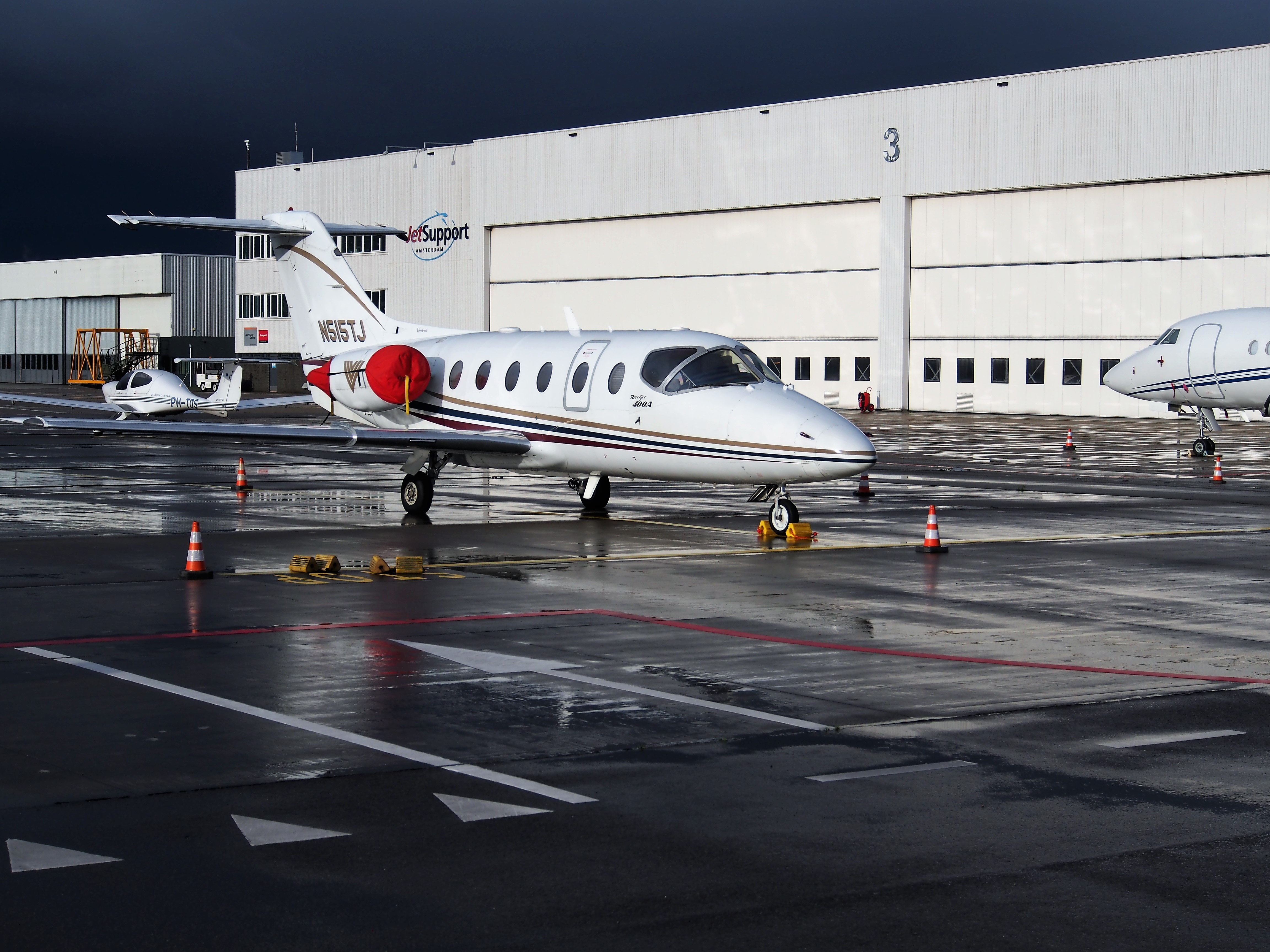
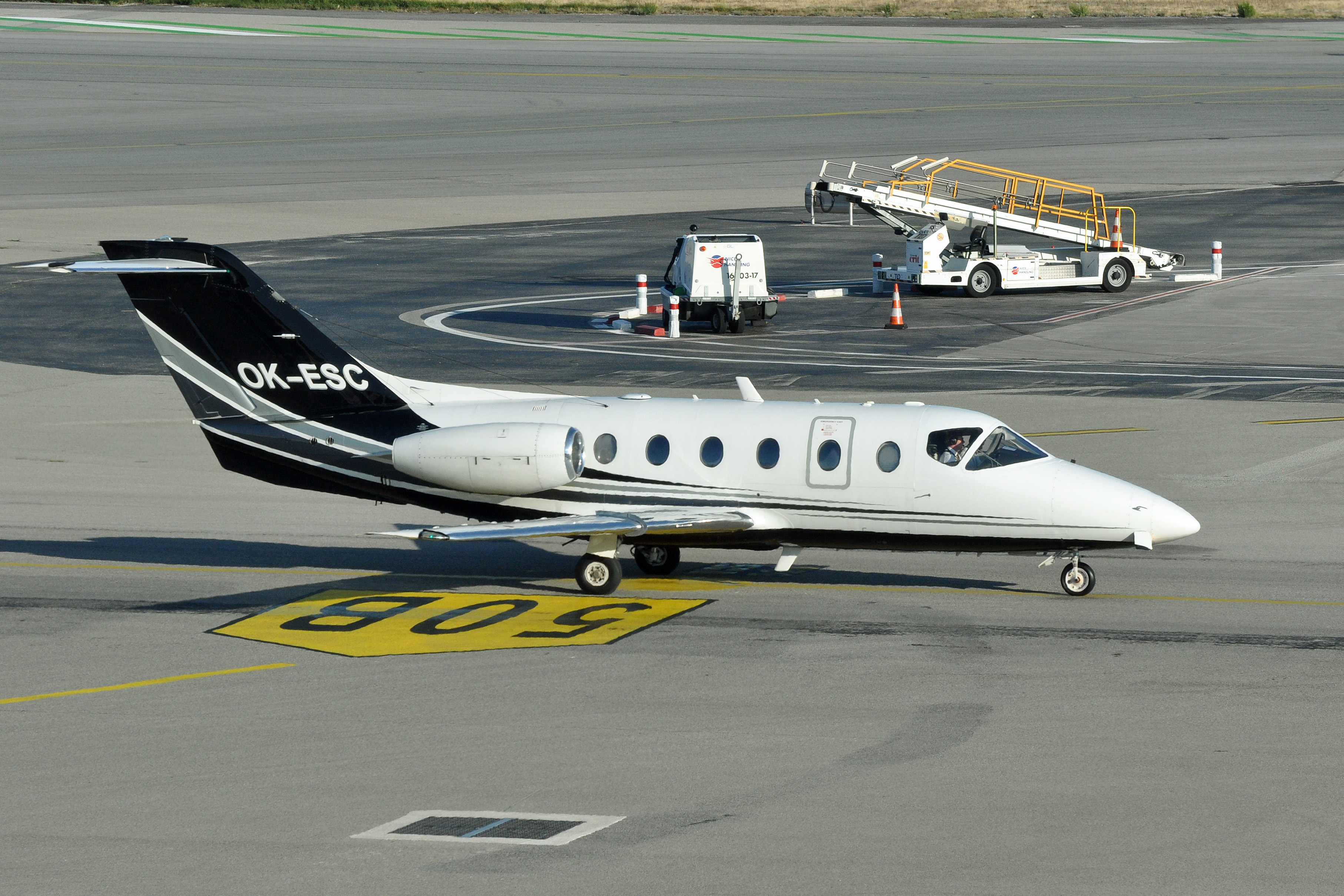
Beechjet 400A N515TJ parked at Amsterdam Schiphol. · Photo: Alf van Beem, public domain, via Wikimedia Commons
Beechcraft · Light Jet
Beechjet 400A
Fourth step in the Diamond, Beechjet and Hawker 400 line, between the Beechjet 400 and the Hawker 400XP.
The Beechjet 400A gives you real jet speed and a tidy, flat-floor cabin for the price of a used turboprop, but its range, runway needs, aging engines and dated cockpit demand a careful choice of airplane.
Buy it if
You fly two to four people on trips under about 1,000 nm, value speed over cabin size, have or can hire two qualified pilots, and want a proven jet for roughly $1.2 million.
Skip it if
You regularly fly six or more passengers with bags, need nonstop coast-to-coast range, operate from runways shorter than about 5,000 ft, or want to fly the airplane yourself without a second pilot.
Biggest compromise
Payload with full tanks is only about 473 lb, so filling the seats means cutting fuel and range. With four passengers the practical range is about 1,300 nm, and the 4,600 ft takeoff distance at maximum weight rules out many short runways that rival Citations can use.
The numbers that matter
Purchase price
$1.2M
typical asking · $1.15M–$1.29M
What it costs per year
$1.33M
at 300 hrs · two professional pilots
How far it flies
1,885 nm
About 1,326 nm with 4 passengers; 678 nm at maximum payload
How fast
458 kt
high-speed cruise
Seats
7
7 typical (8 in some layouts)
Pilots needed
2
Certified for two pilots; there is no single-pilot option.
Price
What one costs to buy
Typical asking price
$1,197,500
Where asking prices sit
Low
$1.15M
Typical
$1.2M
High
$1.29M
Most asking prices fall inside this band.
Other sites
Priced vs call
with a price / call for price
Four of 14 listed aircraft show a price, from $1.15M to $1.295M; engine time and cockpit upgrades drive most of the difference.
Price vs its family and alternatives
Scroll to explore · select a jet for details
Beechjet 400A · This aircraft
$1.2M
Sits between the Diamond IA (MU-300) and the Hawker 400XP (400A).
For sale now
None listed right now
Cost to own
What it costs per year to run
300hours / year
Per year
Per flight hour
Estimate — your operator will quote actual numbers.
Fuel, airframe maintenance, engine program or reserve and landing, handling and trip costs rise as you fly more. Two professional pilots, recurrent training, hangar, insurance, management and subscriptions and databases stay the same however much you fly.
Where the money goes
- Two professional pilots$295,00022%
- Recurrent training$37,5003%
- Hangar$29,5002%
- Insurance$27,5002%
- Management$48,0004%
- Subscriptions and databases$10,0001%
- Fuel$507,99038%
- Airframe maintenance$178,50013%
- Engine program or reserve$143,25011%
- Landing, handling and trip costs$57,0004%
Fuel is the biggest single cost at 38% of the total.
The JetGrade
68 out of 100 — Below its class average
Peer group: Cessna Citation Ultra, Cessna Citation Encore, Learjet 31A, Beechcraft Premier I
Seven categories at a glance
- - - 70 = typical— This aircraft
Strongest on speed & trip time, weakest on airport access.
Grades are editorial opinions about the model, not any specific aircraft. Sponsors and affiliates have no input. Reviewed 2026-09-29.
Where it flies
Sample trips and reach
Typical trips on a map
Nonstop
Depends on weight or weather
Fuel stop likely
Out of reach
4 of 8 sample trips are comfortable nonstops.
Sample flight times
- 0.9 hr
Carlsbad → Las Vegas
205 nm · Short hop at any practical load
- 1.9 hr
Carlsbad → Aspen
625 nm · Hot-and-high; depends on weight and weather
- 2.2 hr
Santa Ana → San José del Cabo
765 nm · Comfortable nonstop with four passengers
- 2.5 hr
Teterboro → West Palm Beach
900 nm · Comfortable nonstop with four passengers
- 3.4 hr
Dallas → Teterboro
1,190 nm · Near the limit with four; winds matter
- 4.3 hr
Teterboro → San Juan
1,410 nm · Usually one stop in Florida or the Bahamas
- 6.2 hr
Carlsbad → Teterboro
2,100 nm · Needs one stop, typically mid-continent
Los Angeles → Honolulu
2,215 nm · Beyond range; no stop possible over water
Lineage
What came before and after
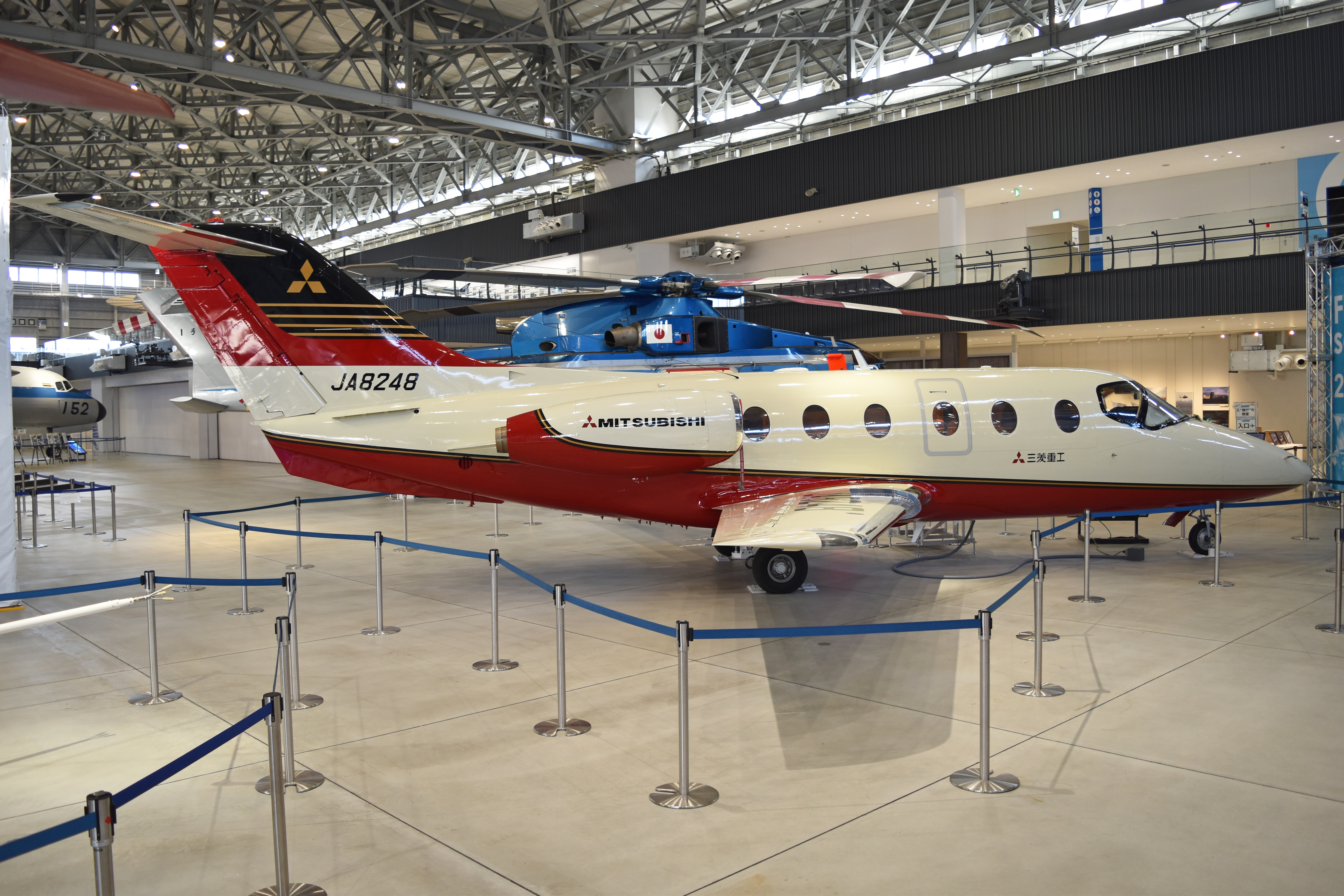
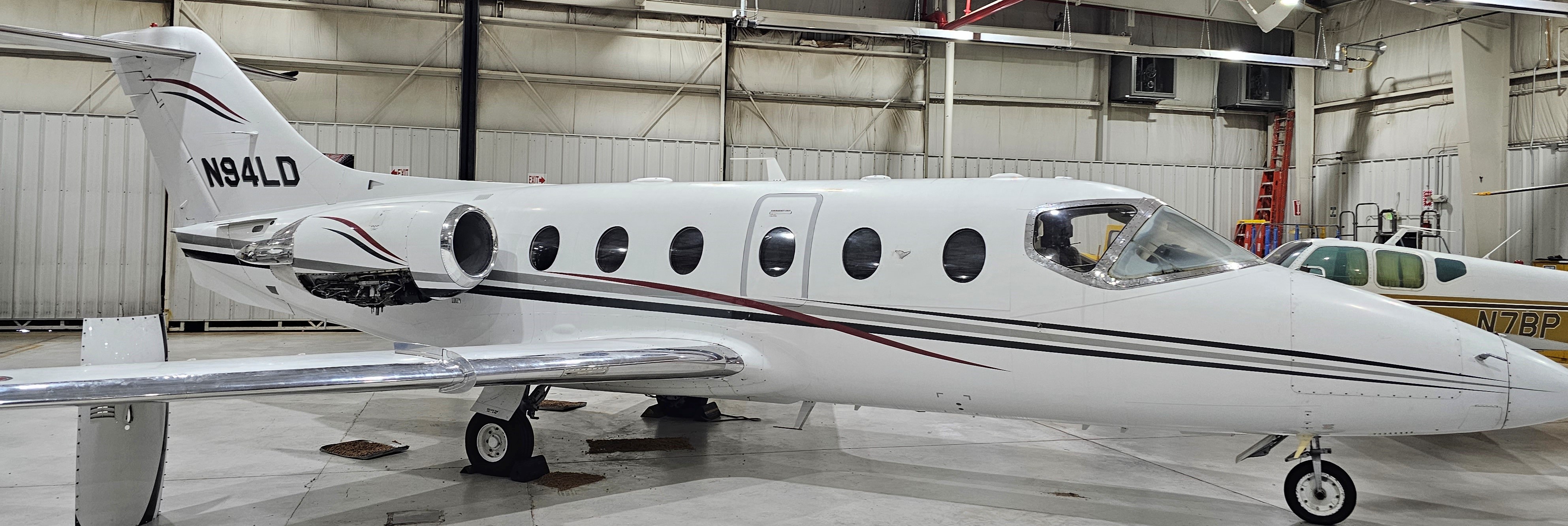
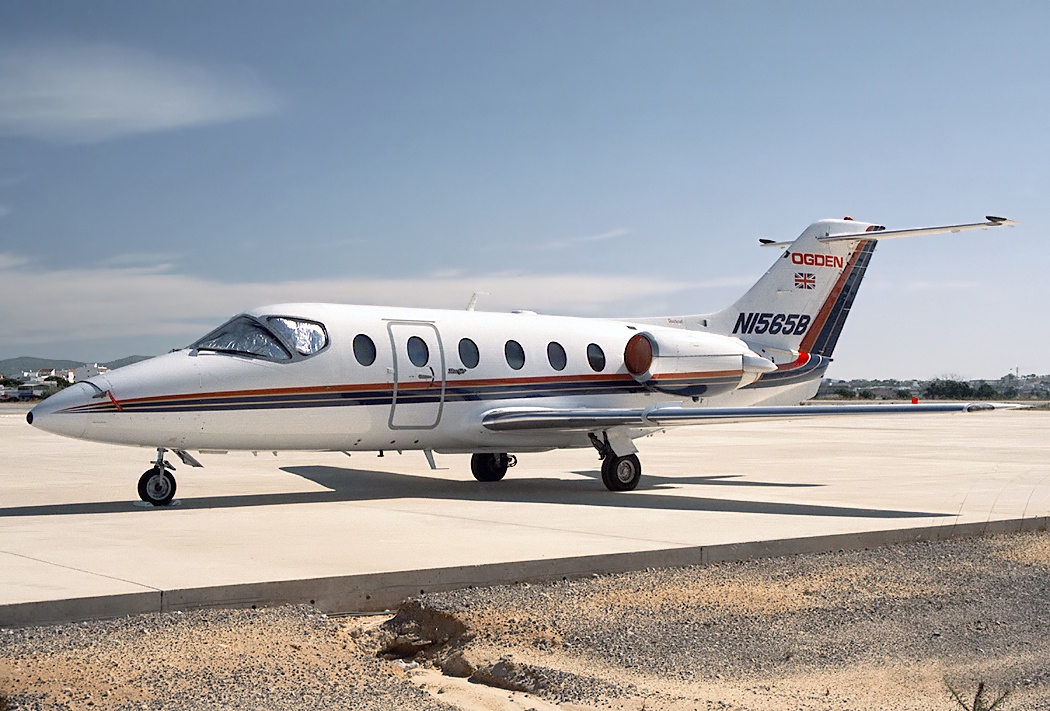

1990–2003
Beechcraft Beechjet 400A
Longer cabin, aft lavatory, Pro Line 4 cockpit and a 45,000 ft ceiling.


What changed from the Beechcraft Beechjet 400
- Fuselage fuel tank moved under the floor, lengthening the cabin without stretching the fuselage.
- Full-size enclosed lavatory at the rear, a flat floor and better soundproofing.
- Collins Pro Line 4 glass cockpit and a new autopilot replace the earlier instrument panel.
- Maximum takeoff weight up from 15,780 lb to 16,100 lb; landing weight from 14,200 lb to 15,700 lb.
- Maximum operating altitude raised from 41,000 ft to 45,000 ft.
- Same Pratt & Whitney Canada JT15D-5 engines, 2,900 lb of thrust each.
Size and cabin
How big it is, inside and out
Outside
Silhouette · scaled to length
Length
Wingspan
Height
Inside the cabin
Cabin length
Width
Height
Compare
How it stacks up
This aircraft
Beechjet 400A
- JetGrade
- 68
- Price
- $1.2M
- Cost per year
- $1.33M
- Range
- 1,885 nm
- Speed
- 458 kt
- Seats
- 7
- Cabin length
- 15′ 7″
- Pilots
- 2
- Years built
- 1990–2003
← Before
- JetGrade
- 60
- Cost per year
- $1.29M
- Range
- 1,400 nm
- Speed
- 461 kt
- Seats
- 7
- Cabin length
- 14′ 5″
- Pilots
- 2
- Years built
- 1986–1989
After →
- JetGrade
- 67
- Price
- $1.79M–$2.1M guide
- Cost per year
- $1.27M
- Range
- 1,510 nm
- Speed
- 450 kt
- Seats
- 7
- Cabin length
- 15′ 6″
- Pilots
- 2
- Years built
- 2003–2010
Alternative
- JetGrade
- 73
- Price
- $3.05M
- Cost per year
- $1.25M
- Range
- 1,970 nm
- Speed
- 427 kt
- Seats
- 7
- Cabin length
- 17′ 5″
- Pilots
- 2
- Years built
- 2000–2006
Alternative
- JetGrade
- 72
- Price
- $2.8M–$3.4M guide
- Cost per year
- $1.13M
- Range
- 2,160 nm
- Speed
- 460 kt
- Seats
- 7
- Cabin length
- 15′ 6″
- Pilots
- 2
- Years built
- 2014–2019
- Cessna Citation Encore instead: Slower at about 427 kt, but flies farther, carries about twice the full-fuel payload and needs less runway.
- Nextant 400XTi instead: The same airframe remanufactured with Williams engines, a modern cockpit and winglets, for about 2,000 nm of range at a higher price.
- Hawker 400XP instead: The same design built from 2003 to 2010, so younger airframes with similar performance and running costs.
Gold marks the best figure in each row.
Owning one
What to know before you buy
Engines & inspections
2 × Pratt & Whitney Canada JT15D-5 · 2,900 lbf each
Engine hours until overhaul
- 200-hour inspection · 200 hr
- 400-hour inspection · 400 hr
- 1,200-hour inspection · 1,200 hr
- Engine hot section inspection · 1,800 hr
- Pitch trim actuator replacement · 1,800 hr
- Horizontal stabilizer rib inspection · 2,400 hr
- Engine overhaul · 3,600 hr
- 5,000-hour inspection · 5,000 hr
Pratt & Whitney's ESP plan can cover hot sections and overhauls, but most aircraft for sale show no plan, so budget reserves.
Known issues
Costly engine overhauls
Overhauls run $250,000 to $600,000 per engine, a large share of the aircraft's value when no plan covers them.
Aging Pro Line 4 cockpit
The original CRT-screen avionics are dated; a Garmin G5000 retrofit modernizes the cockpit but is a major expense.
High-altitude ice-crystal flameouts
Several Beechjets lost engine power in ice crystals at altitude; crews now use ignition and anti-ice as a precaution.
Pre-buy checklist
0 of 10 checked
Textron Aviation still supplies parts and engineering support, and FlightSafety trains 400A crews in Wichita. Used JT15D engines are scarce, so engine condition matters more than usual.
Review
The full review
Strengths
- Cruises at about 450 kt and climbs to 45,000 ft, faster and higher than most jets at its price.
- A 305 cu ft cabin with a flat floor and an enclosed aft lavatory, uncommon among 1990s light jets.
- Priced asks of $1.15M to $1.3M buy a proven, widely flown design that Textron Aviation still supports.
Limitations
- About 1,300 nm with four passengers, so coast-to-coast trips need a fuel stop.
- Full-fuel payload of about 473 lb means one or two passengers when the tanks are full.
- Engine overhauls run $250,000 to $600,000 each, and most listed aircraft show no engine plan.
The Beechjet 400A is the second Beech-built version of a light jet that Mitsubishi designed in the late 1970s as the Diamond. Beech bought the program in 1985, built the Beechjet 400 from 1986 and introduced the 400A in 1990. It stayed in production until 2003, when the same design was renamed the Hawker 400XP. Compared with the original Beechjet 400, the 400A moved a fuel tank under the floor to lengthen the cabin, added a full-size aft lavatory, raised the maximum operating altitude from 41,000 ft to 45,000 ft and switched to a Collins Pro Line 4 glass cockpit.
Pilot's take
From the cockpit, the 400A feels like a small airliner. It is stable, climbs quickly and is happiest between 41,000 and 45,000 ft, where it trues out near 440 kt on modest fuel. Roll control comes from spoilers on the wing rather than ailerons, which gives it a distinctive, crisp feel that pilots learn quickly. Thrust reversers help on wet runways, but heavy takeoffs still call for long runways. Workload is reasonable for two pilots, and the original Pro Line 4 cockpit, while dated, is logical. In ice-crystal weather at altitude, crews should follow the published anti-ice and ignition procedures closely.
Who this is for
Owners and small charter operators who fly two to four passengers on 300 to 1,000 nm trips, want jet speed on a modest purchase budget, and plan for a two-pilot crew and a real maintenance budget.

Ask about this aircraft
Answers come only from our research file on the Beechcraft Beechjet 400A.
Your earlier questionsOwners
Private to verified ownersOwn a Beechcraft Beechjet 400A? Verify with its FAA registration to join the owners' thread and the real-cost poll.