
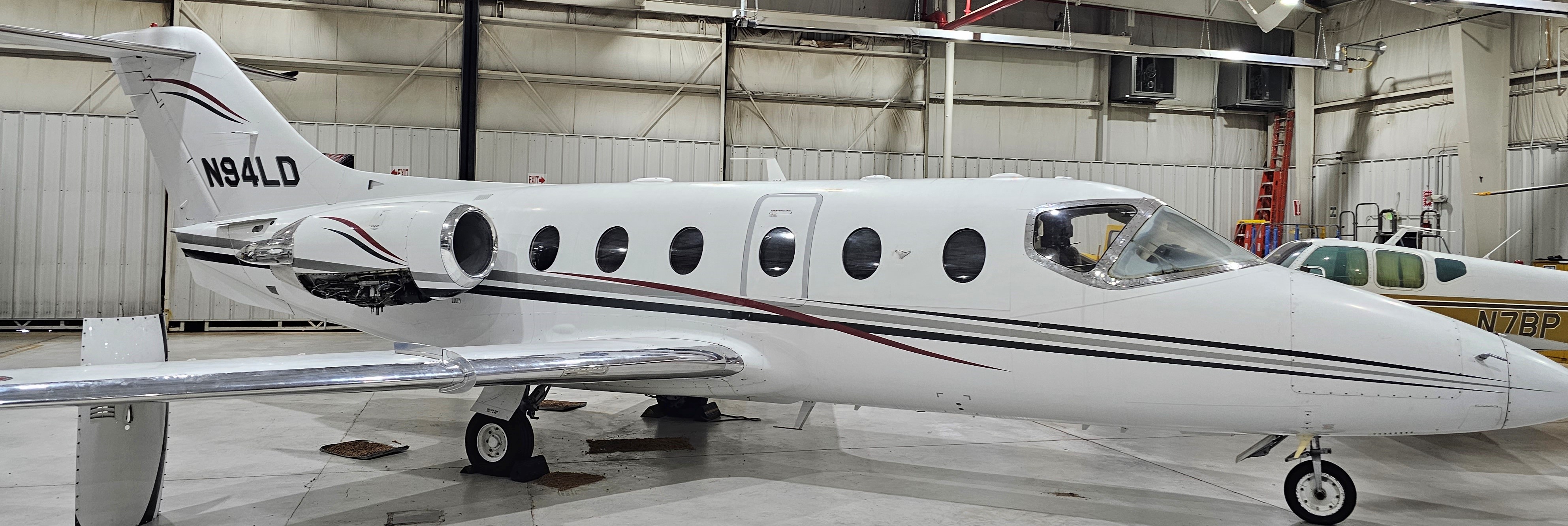
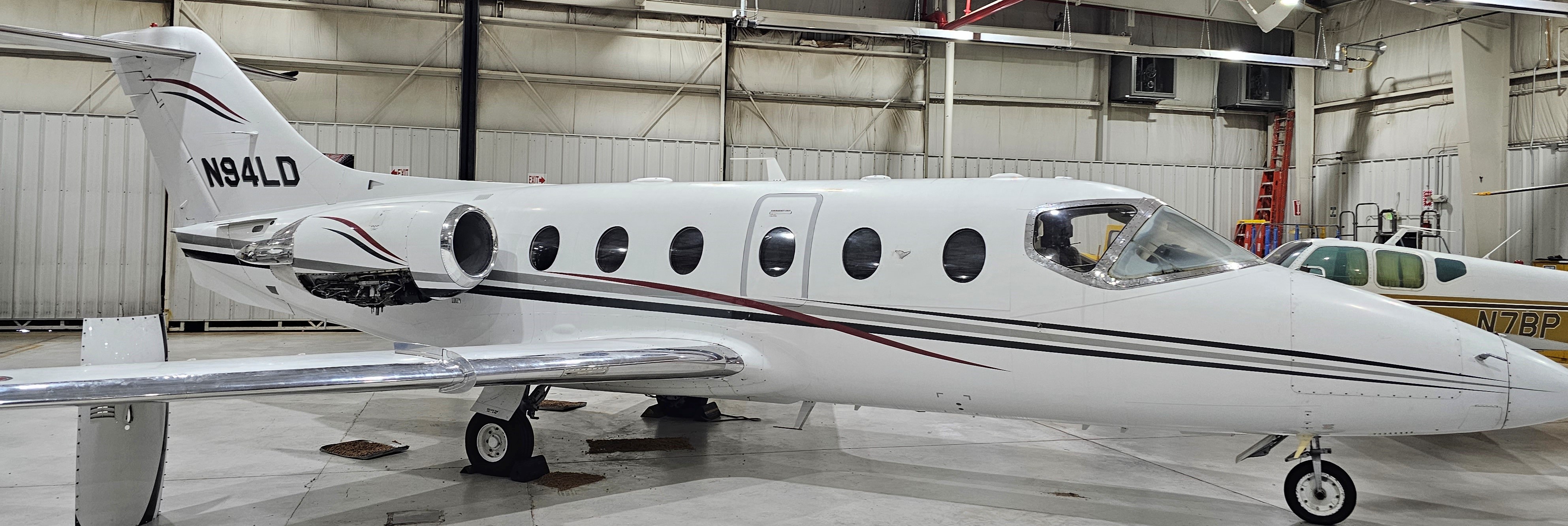
A 1984 Diamond IA, registered N94LD, in its hangar. · "N94LD MU-300 Diamond Jet" by KOMRADE DIMITRI, via Wikimedia Commons, CC BY-SA 4.0
Mitsubishi · Light Jet
Diamond IA (MU-300)
Second of Mitsubishi's three Diamond versions and the direct ancestor of the Beechjet 400 family.
The Diamond IA gives you a wide cabin and 420-knot speed for well under half a million dollars, but short range, long runways, two required pilots and a shrinking parts supply make it an airplane for specialists.
Buy it if
You fly two to four people on trips under 1,000 nm from runways of 5,000 ft or more, already have a two-pilot crew, and want jet speed at a used-turboprop purchase price.
Skip it if
You need nonstop coast-to-coast range, use short or high-altitude runways, want factory-backed engine and airframe programs, or expect to resell quickly.
Biggest compromise
Support. Textron still holds the type certificate and shares many parts with the Beechjet 400, but Mitsubishi-unique parts often come from salvaged aircraft, no pay-per-hour engine plan is confirmed for this engine version, and only 17 Diamonds remain on the US register.
The numbers that matter
Purchase price
$361K–$361K
guide value (PlanePhD)
What it costs per year
$1.26M
at 300 hrs · two professional pilots
How far it flies
1,200 nm
About 1,120–1,200 nm with 4 passengers
How fast
421 kt
high-speed cruise
Seats
7
7 typical, 9 certified maximum
Pilots needed
2
Two pilots are required on every flight; the type has no single-pilot approval.
Price
What one costs to buy
Guide value
$361K–$361K
Other sites
Priced vs call
with a price / call for price
No Diamond for sale shows a price. PlanePhD's March 2026 estimate puts a typical example near $360,500; engine time and records drive value.
Price vs its family and alternatives
Scroll to explore · select a jet for details
Diamond IA (MU-300) · This aircraft
$361K–$361K guide
Guide value, not a listed asking price.
Sits between the Diamond I (MU-300) and the Learjet 35 / 35A.
For sale now
None listed right now
Cost to own
What it costs per year to run
300hours / year
Per year
Per flight hour
Estimate — your operator will quote actual numbers.
Fuel, airframe maintenance, engine overhaul reserve and trip expenses and fees rise as you fly more. Two full-time pilots, recurrent training, hangar, insurance, aircraft management and navigation data and weather stay the same however much you fly.
Where the money goes
- Two full-time pilots$254,40020%
- Recurrent training$26,0002%
- Hangar$30,4982%
- Insurance$20,0002%
- Aircraft management$42,0003%
- Navigation data and weather$6,8801%
- Fuel$459,22536%
- Airframe maintenance$240,00019%
- Engine overhaul reserve$115,6509%
- Trip expenses and fees$67,5005%
Fuel is the biggest single cost at 36% of the total.
The JetGrade
61 out of 100 — Below its class average
Peer group: Cessna Citation II (550), Cessna Citation S/II (S550), Learjet 35 / 35A, Beechcraft Beechjet 400
Seven categories at a glance
- - - 70 = typical— This aircraft
Strongest on speed & trip time, weakest on reliability & support.
Grades are editorial opinions about the model, not any specific aircraft. Sponsors and affiliates have no input. Reviewed 2026-09-29.
Where it flies
Sample trips and reach
Typical trips on a map
Nonstop
Depends on weight or weather
Fuel stop likely
3 of 6 sample trips are comfortable nonstops.
Sample flight times
- 1.0 hr
Carlsbad → Las Vegas
205 nm · Short hop; easy at typical weights
- 2.1 hr
Carlsbad → Aspen
625 nm · High-altitude airport; weight and temperature limited
- 2.5 hr
Santa Ana → San José del Cabo
765 nm · Comfortable nonstop with four passengers
- 2.8 hr
Teterboro → West Palm Beach
900 nm · Nonstop in still air; strong headwinds erode margin
- 3.8 hr
Dallas → Teterboro
1,190 nm · Nonstop possible only with tailwinds and light loads
- 6.4 hr
Carlsbad → Teterboro
2,100 nm · Needs one stop, typically mid-continent
Lineage
What came before and after
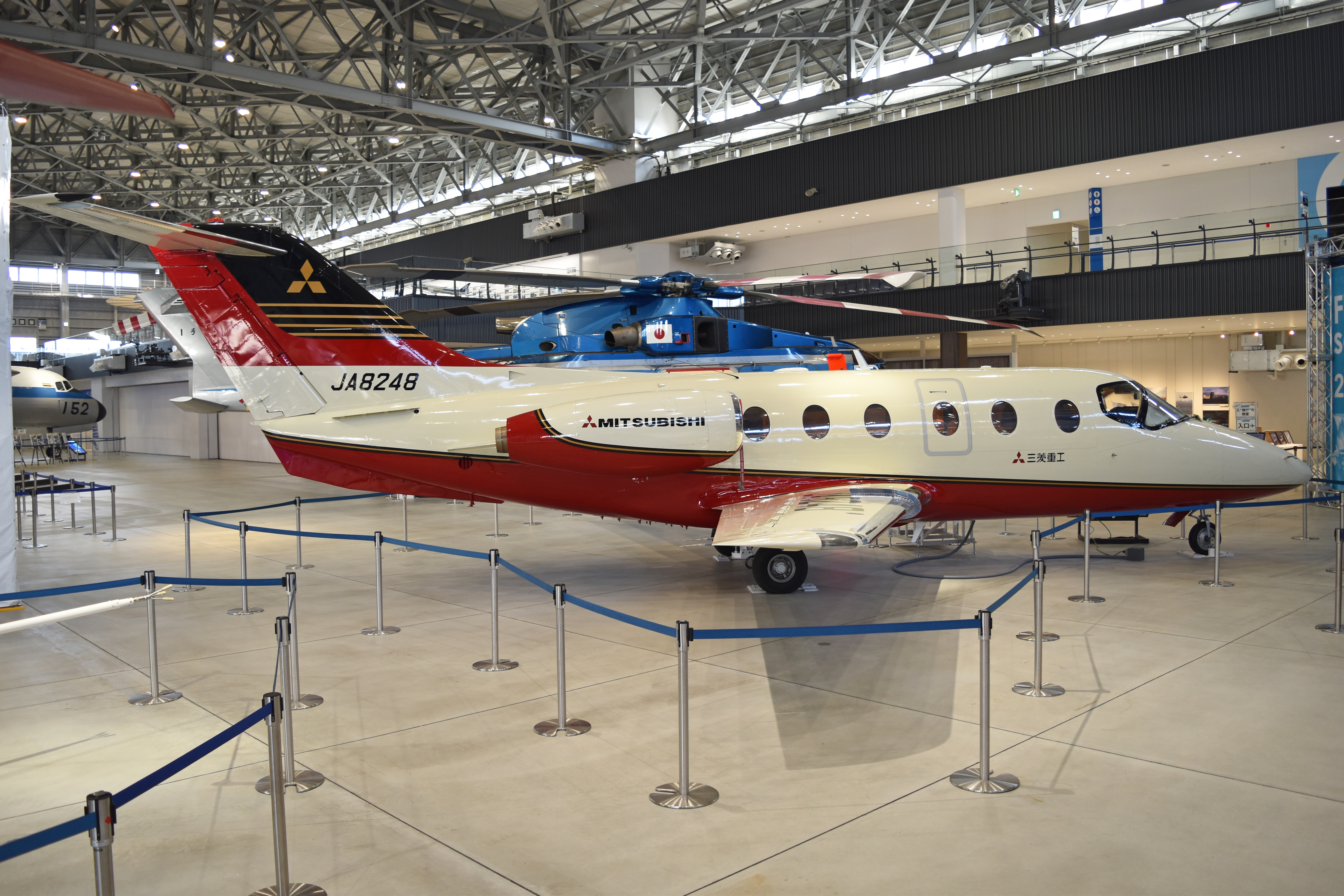
1984–1985
Mitsubishi Diamond IA (MU-300)
JT15D-4D engines for better hot-day thrust, plus electronic flight instruments.
1985
Mitsubishi Diamond II (MU-300-10)
Stronger JT15D-5 engines and higher weights; all became Beechjet 400s.
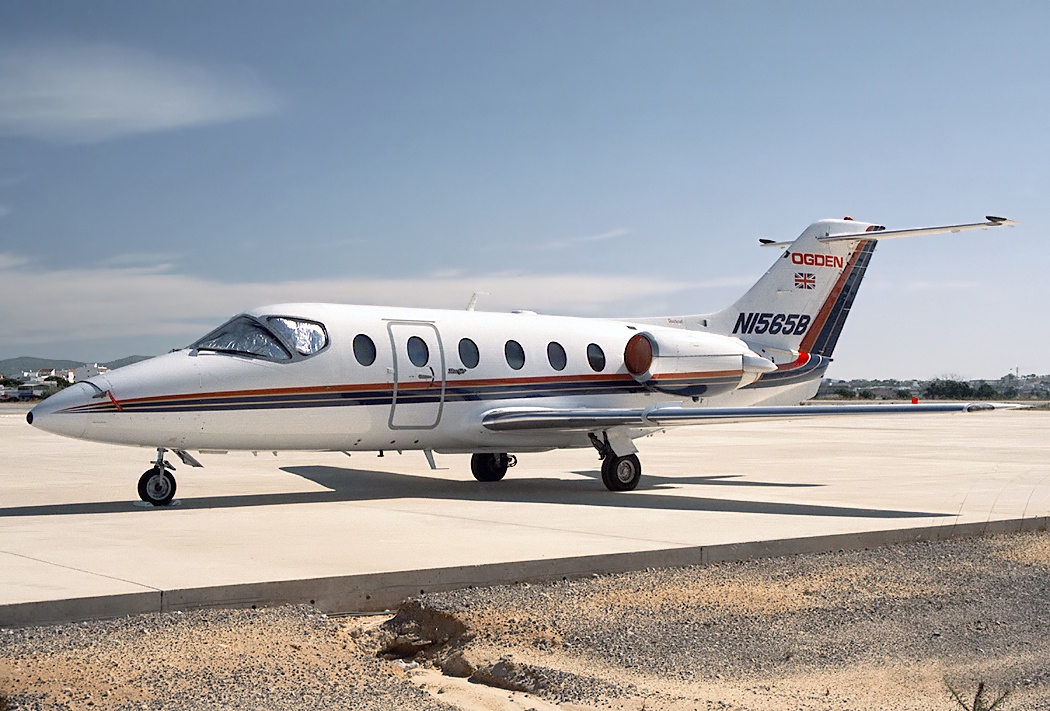


What changed from the Mitsubishi Diamond I (MU-300)
- JT15D-4D engines keep full 2,500 lb takeoff thrust on hotter days than the Diamond I.
- Electronic flight instrument displays added to the panel.
- Revised air conditioning, pitch-trim indicator, gear warning horn and engine gauges.
Size and cabin
How big it is, inside and out
Outside
Silhouette · scaled to length
Length
Wingspan
Height
Inside the cabin
Cabin length
Width
Height
Compare
How it stacks up
This aircraft
Diamond IA (MU-300)
- JetGrade
- 61
- Price
- $361K–$361K guide
- Cost per year
- $1.26M
- Range
- 1,200 nm
- Speed
- 421 kt
- Seats
- 7
- Cabin length
- 15′ 6″
- Pilots
- 2
- Years built
- 1984–1985
← Before
- JetGrade
- 64
- Price
- $250K–$400K guide
- Cost per year
- $1.3M
- Range
- 1,510 nm
- Speed
- 400 kt
- Seats
- 7
- Cabin length
- 15′ 6″
- Pilots
- 2
- Years built
- 1982–1984
After →
Mitsubishi Diamond II (MU-300-10)
Not yet graded
Alternative
- JetGrade
- 68
- Price
- $1.2M
- Cost per year
- $1.33M
- Range
- 1,885 nm
- Speed
- 458 kt
- Seats
- 7
- Cabin length
- 15′ 7″
- Pilots
- 2
- Years built
- 1990–2003
Alternative
- JetGrade
- 67
- Price
- $895K
- Cost per year
- $919K
- Range
- 1,159 nm
- Speed
- 355 kt
- Seats
- 6
- Cabin length
- 15′ 9″
- Pilots
- 2
- Years built
- 1978–1994
Alternative
- JetGrade
- 67
- Price
- $581K–$920K guide
- Cost per year
- $1.31M
- Range
- 2,196 nm
- Speed
- 451 kt
- Seats
- 6
- Cabin length
- 12′ 11″
- Pilots
- 2
- Years built
- 1974–1993
- Beechcraft Beechjet 400A instead: The same basic fuselage with a redesigned cabin, more range and far broader parts, program and upgrade support, for a higher purchase price.
- Cessna Citation II (550) instead: A straight-wing jet of the same era: about 40 knots slower, but it uses shorter runways and has a much larger parts and service network.
- Learjet 35 / 35A instead: Much longer range and higher speed from a similar-era jet, with a narrower cabin and heavier fuel burn.
Gold marks the best figure in each row.
Owning one
What to know before you buy
Engines & inspections
2 × Pratt & Whitney Canada JT15D-4D · 2,500 lbf each
Engine hours until overhaul
- Engine mount bracket check · 200 hr
- Bleed-air duct inspection · 400 hr
- Engine hot section inspection · 1,750 hr
- Pitch trim actuator replacement · 1,800 hr
- Stabilizer rib inspection · 2,400 hr
- Engine overhaul · 3,500 hr
No pay-per-hour engine plan is confirmed for this engine version, and most listed Diamonds show no enrollment; budget a cash reserve.
Known issues
Parts for Mitsubishi-unique items
Shared Beechjet parts are available, but Mitsubishi-unique components often come from salvaged aircraft and can keep an airplane grounded.
RVSM approval varies
Without RVSM approval the jet is held below 29,000 ft in most airspace, raising fuel burn; upgrades are costly.
Tailplane icing limits
Landing flaps are limited to 10 degrees in icing and an ice detector is required, lengthening landings.
Pre-buy checklist
0 of 9 checked
Textron Aviation holds the type certificate and supplies parts shared with the Beechjet 400 family. Mitsubishi-unique parts often come from salvage dealers, and pilot training is available from a small number of specialist providers.
Review
The full review
Strengths
- Wide, flat-floor cabin, 4 ft 11 in wide and 4 ft 9 in tall, roomier than most early-1980s light jets.
- High-speed cruise near 420 knots at 35,000 to 37,000 ft, with certification to 41,000 ft.
- Low entry price: PlanePhD's March 2026 estimate puts a typical Diamond near $360,500.
Limitations
- About 1,120 to 1,200 nm with four passengers, and full fuel leaves only about 800 lb for people and bags.
- Needs about 3,940 ft of runway at sea level and about 7,500 ft at a 5,000-ft airport on a warm day.
- Two pilots on every flight and a burn near 195 gallons an hour keep hourly costs around $4,200.
The Mitsubishi MU-300 Diamond IA is the improved version of Japan's first business jet. Mitsubishi flew the MU-300 in 1978, won FAA approval in November 1981 and assembled Diamonds in San Angelo, Texas, from parts built in Nagoya. The IA arrived in January 1984 with Pratt & Whitney Canada JT15D-4D engines that hold their full 2,500 lb of takeoff thrust on hotter days, electronic flight instruments and several systems changes. Roughly two dozen were built as IAs, and some earlier Diamond Is were later converted to the same standard. In December 1985 Beech bought the design, and its successor, the Diamond II, became the Beechjet 400, which makes the IA the grandfather of the Beechjet 400A and Hawker 400XP.
Pilot's take
From the flight deck the Diamond IA feels solid and honest, but it asks for discipline. Roll control comes from wing spoilers rather than ailerons and the controls are unboosted, so proper type training matters. The JT15D-4D engines give the IA better hot-day takeoff performance than the original Diamond, yet runway planning still dominates: at a high, warm airport the numbers grow quickly, and icing rules hold landing flaps at 10 degrees. Two pilots are always required. The investigation reports we reviewed involve runway overruns with tailwinds or snow and one unstable approach, which points to careful approach and landing planning rather than airframe weakness.
Who this is for
Owners with a professional two-pilot crew who fly regional trips of 300 to 1,000 nm from long runways, value cabin width over range, and are comfortable running an older, low-volume type with a specialist maintenance shop.

Ask about this aircraft
Answers come only from our research file on the Mitsubishi Diamond IA.
Your earlier questionsOwners
Private to verified ownersOwn a Mitsubishi Diamond IA (MU-300)? Verify with its FAA registration to join the owners' thread and the real-cost poll.