

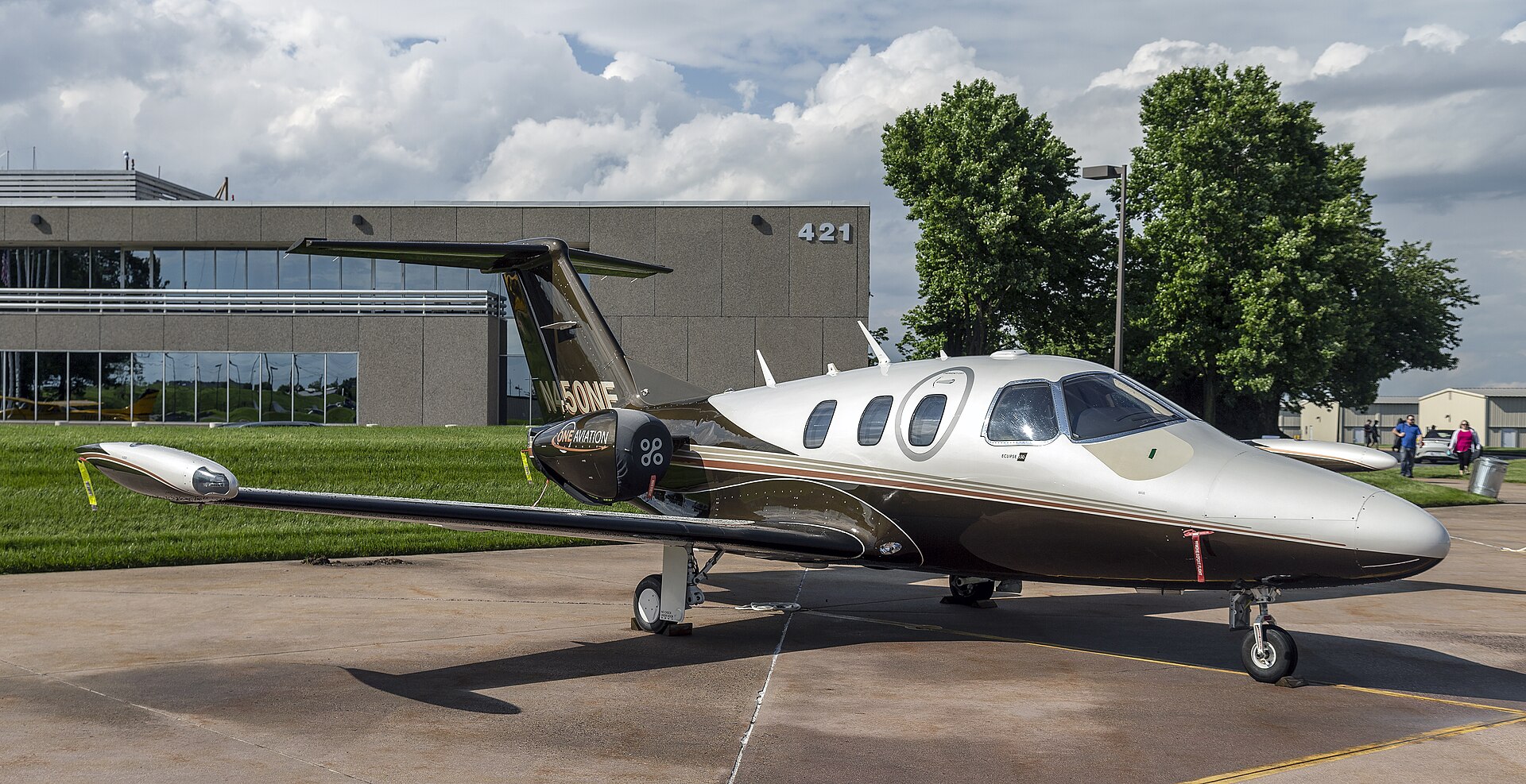
Eclipse 550 N450NE at Frederick, Maryland, in May 2019. · Acroterion, CC BY-SA 4.0, via Wikimedia Commons
Eclipse · Very Light Jet
Eclipse 550
The second production version of the Eclipse jet, built in small numbers since 2013.
An affordable way into a modern twin-engine jet: quick, frugal and easy on runways, with smart safety technology. The trade-offs are a small cabin with no toilet, about 1,125 nm of range, and parts support that depends on one small company.
Buy it if
You fly yourself or use one pilot, carry two or three people on trips under about 900 nm, and want a twin with known-icing approval and, on most examples, autothrottle for about $1.8M to $1.95M.
Skip it if
Your passengers need a toilet, standing room or real luggage space, you regularly fly four people beyond 900 nm, or you want a large service network and deep parts supply.
Biggest compromise
Support. Only about 35 Eclipse 550s were built, the maker has been through two bankruptcies since 2008, and in 2026 autopilot servos and the main aircraft computer were in short supply.
The numbers that matter
What it costs per year
$451K
at 300 hrs · one professional pilot
How far it flies
1,125 nm
574–900 nm with passengers
How fast
375 kt
high-speed cruise
Seats
4
4 typical: 3 cabin, 1 beside pilot
Pilots needed
1
Certified for one pilot; type training and mentoring are required for owner-pilots.
Price
What one costs to buy
Typical asking price
$0
Other sites
Priced vs call
with a price / call for price
Two of four listed 550s show prices, $1.79M and $1.95M. A new one lists at $2.995M; upgraded Eclipse 500s ask $1.40M to $1.70M.
Price vs its family and alternatives
Scroll to explore · select a jet for details
For sale now
None listed right now
Cost to own
What it costs per year to run
300hours / year
Per year
Per flight hour
Estimate — your operator will quote actual numbers.
Fuel, airframe maintenance and engine program rise as you fly more. One professional pilot, pilot recurrent training, hangar, insurance and charts, weather and tracking stay the same however much you fly.
Where the money goes
- One professional pilot$120,86727%
- Pilot recurrent training$9,3662%
- Hangar$13,2503%
- Insurance$15,2783%
- Charts, weather and tracking$6,4411%
- Fuel$165,61237%
- Airframe maintenance$48,56111%
- Engine program$71,22316%
Fuel is the biggest single cost at 37% of the total.
The JetGrade
65 out of 100 — Below its class average
Peer group: Cessna Citation Mustang, Embraer Phenom 100E, Honda HondaJet HA-420, Cirrus Vision Jet SF50 G2
Seven categories at a glance
- - - 70 = typical— This aircraft
Strongest on running costs, weakest on cabin & passenger comfort.
Grades are editorial opinions about the model, not any specific aircraft. Sponsors and affiliates have no input. Reviewed 2026-10-14.
Where it flies
Sample trips and reach
Typical trips on a map
Nonstop
Depends on weight or weather
Fuel stop likely
2 of 6 sample trips are comfortable nonstops.
Sample flight times
- 0.9 hr
Carlsbad → Las Vegas
205 nm
- 2.2 hr
Carlsbad → Aspen
625 nm · Hot-and-high; depends on weight and weather
- 2.6 hr
Santa Ana → San José del Cabo
765 nm
- 3.2 hr
Teterboro → West Palm Beach
900 nm · Payload-limited; four aboard may need a stop
- 4.2 hr
Dallas → Teterboro
1,190 nm · Needs one stop with four passengers
- 7.3 hr
Carlsbad → Teterboro
2,100 nm · Needs two stops with four passengers
Lineage
What came before and after
2010–2013
Total Eclipse
Factory-refurbished Eclipse 500s with updated systems.
2013–present
Eclipse 550
New cockpit, autothrottle option and anti-skid brakes; about 35 built.
2015–present
Eclipse SE
Refurbished Eclipse 500s with many 550 features.
2016–2017
Eclipse 700 (concept)
Stretched design that flew only as a test aircraft.
What changed from the Eclipse 500
- Dual Avio IFMS flight management, sharper displays and a standby display with its own attitude source.
- Autothrottle with stall and overspeed protection offered from 2014.
- Anti-skid brakes standard on new-build aircraft, plus new landing gear actuators.
- Glass windshields replace acrylic; airframe life set at 20,000 hours and 20,000 cycles.
- Known-icing approval standard; synthetic and enhanced vision offered as options.
- Same PW610F engines, weights and published range as the Eclipse 500.
Size and cabin
How big it is, inside and out
Outside
Silhouette · scaled to length
Length
Wingspan
Height
Inside the cabin
Cabin length
Width
Height
Compare
How it stacks up
This aircraft
Eclipse 550
- JetGrade
- 65
- Cost per year
- $451K
- Range
- 1,125 nm
- Speed
- 375 kt
- Seats
- 4
- Cabin length
- 12′ 4″
- Pilots
- 1
- Years built
- 2013–now
← Before
- JetGrade
- Not yet graded
- Range
- 1,125 nm
- Speed
- 370 kt
- Seats
- 4
- Years built
- 2006–2008
Alternative
- JetGrade
- 72
- Cost per year
- $850K
- Range
- 1,150 nm
- Speed
- 340 kt
- Seats
- 4
- Cabin length
- 9′ 9″
- Pilots
- 1
- Years built
- 2006–2017
Alternative
- JetGrade
- 71
- Cost per year
- $866K
- Range
- 1,178 nm
- Speed
- 390 kt
- Seats
- 4
- Cabin length
- 11′ 0″
- Pilots
- 1
- Years built
- 2014–2017
Alternative
- JetGrade
- Not yet graded
- Range
- 1,275 nm
- Speed
- 311 kt
- Seats
- 5
- Years built
- 2019–2020
- Cessna Citation Mustang instead: A bigger support network and similar range of about 1,150 nm, but a slower cruise of about 340 knots.
- Embraer Phenom 100E instead: A taller cabin, a belted toilet seat and about 390-knot cruise from a large manufacturer, for more money to buy and run.
- Cirrus Vision Jet SF50 G2 instead: One engine and a whole-airplane parachute, with seating for five adults and two children, but slower at about 311 knots.
Gold marks the best figure in each row.
Owning one
What to know before you buy
Engines & inspections
2 × Pratt & Whitney Canada PW610F-A · 900 lbf each
No APUEngine hours until overhaul
- 24-month airframe inspection · 300 hr
- Engine inspection · 300 hr
- 48-month airframe inspection · 1,200 hr
- Engine overhaul · 3,500 hr
- Airframe life limit · 20,000 hr
- Fuel tank internal inspection every 48 months
- Start system and battery check every 6 months
Pay-per-hour engine plans transfer with a sale and have no yearly minimum; ask for the statement of account and any deferred hours.
Known issues
Autopilot and computer parts scarce
In 2026 autopilot servos and the main aircraft computer were in short supply; Eclipse says it holds two to three years of parts.
Parts supplier ownership change
The main aftermarket parts maker announced closure in May 2026; Eclipse agreed in October 2026 to buy and keep it running.
Engine combustion liner upgrade
Engines without upgraded combustion liners are limited to 30,000 ft; confirm the Pratt & Whitney Canada fix is installed.
Pre-buy checklist
0 of 9 checked
Eclipse Aerospace holds the type certificate and runs service centers in Albuquerque, Aurora near Chicago and Vero Beach, with authorized shops in California, Florida, Louisiana, Guernsey, Germany and Lithuania.
Review
The full review
Strengths
- Takes off in about 2,433 ft at sea level and maximum weight, so short runways are rarely a problem.
- Burns about 60 to 75 gallons an hour, keeping a 300-hour year near $450,000 with a professional pilot.
- Certified for one pilot up to 41,000 ft, with known-icing approval and autothrottle on most examples.
Limitations
- The cabin is 4 ft 2 in tall with three passenger seats and no toilet.
- Range is about 1,125 nm with three passengers; four passengers cut that to roughly 900 nm.
- Only about 16 cubic feet of baggage space, enough for a few soft bags.
The Eclipse 550 is the second generation of the Eclipse very light jet. The original Eclipse 500 reached customers in 2006, and about 260 were built before Eclipse Aviation went bankrupt in 2008. The company that bought the design kept it alive, first by refurbishing 500s and then by launching the 550, which keeps the same airframe, Pratt & Whitney Canada PW610F engines and weights but adds about 60 upgrades. Deliveries began in late 2013, with fully equipped aircraft from March 2014. About 35 have been built, most by 2017, with a handful built to order between 2022 and 2024. Eclipse Aerospace still lists a new 550 at $2.995M.
Pilot's take
The Eclipse is a pilot's airplane first. The side-stick, dual Avio IFMS screens and, on most examples, an autothrottle make single-pilot flying manageable, and a published 2,433 ft takeoff distance opens a lot of small airports. Climbs are brisk, but plan on the high 30s and about 360 knots for real-world cruise. The flip side is discipline: there are no thrust reversers, so approach speeds and slick runways deserve respect, and weight planning matters whenever the tanks are full. Training does not stop at the checkride; mentoring and upset-recovery training are part of the deal.
Who this is for
Owner-pilots stepping up from piston twins or turboprops, and small charter operators, who fly two or three people on regional trips and value low running costs over cabin space.

Ask about this aircraft
Answers come only from our research file on the Eclipse 550.
Your earlier questionsOwners
Private to verified ownersOwn a Eclipse Eclipse 550? Verify with its FAA registration to join the owners' thread and the real-cost poll.