
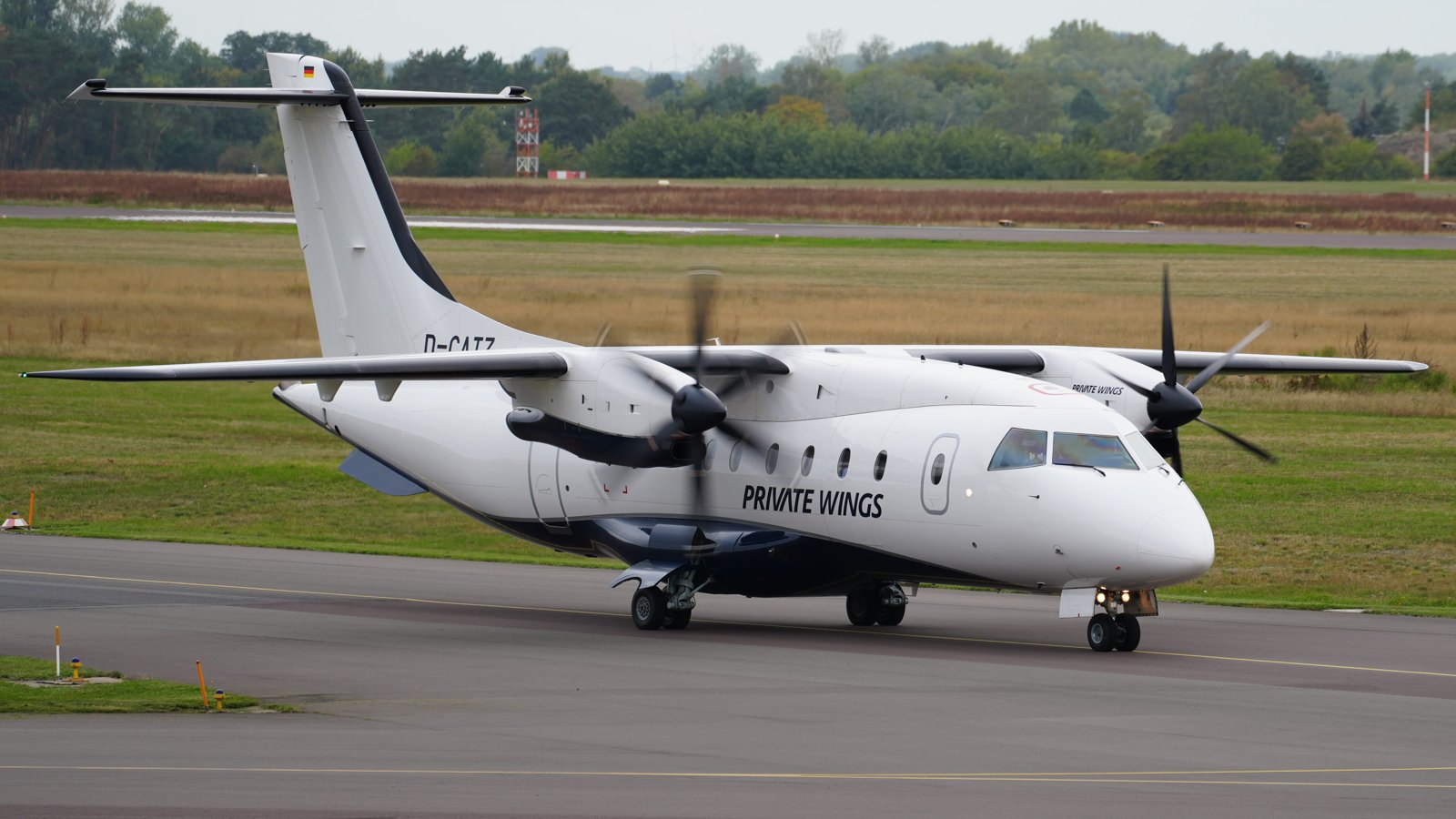
Private Wings Dornier 328-110 D-CATZ, a German charter shuttle, at Braunschweig in 2022. · Photo: MarcelX42, CC BY-SA 4.0, via Wikimedia Commons
Fairchild Dornier · Turboprop
Dornier 328-100 (turboprop)
The original turboprop member of the Dornier 328 family, later re-engined as the 328JET.
The 328 is one of the fastest turboprops of its size, with a quiet, wide stand-up cabin and real short-field ability. Ownership is the catch: two-pilot crews, a small fleet, factory support centered in Germany, and almost no resale market.
Buy it if
You move groups of 15 to 30 people on regular routes under 1,000 nm, want jet-like cabin size at turboprop costs per seat, and have a crew and maintenance shop committed to the type.
Skip it if
You usually fly fewer than eight passengers, need an easy resale exit, want a ready-made executive interior, or prefer an aircraft that any turboprop shop can maintain.
Biggest compromise
It is an airliner, not a business aircraft. You get a big, fast cabin for little money per seat, but nearly every example has a 30-plus-seat airline interior, needs two type-rated pilots, and depends on one factory support source with a fleet of only a few dozen active turboprops.
The numbers that matter
What it costs per year
$1.79M
at 300 hrs · two professional pilots
How far it flies
1,750 nm
1,000–1,400 nm with passengers
How fast
335 kt
high-speed cruise
Seats
30
30–33 airline seats; executive layouts vary
Pilots needed
2
Two pilots required; airline and charter operators also carry a flight attendant.
For sale now
None listed right now
Cost to own
What it costs per year to run
300hours / year
Per year
Per flight hour
Estimate — your operator will quote actual numbers.
Fuel, airframe and propeller maintenance, engine reserve and other (landing fees, supplies, miscellaneous) rise as you fly more. Two professional pilots, recurrent training, hangar, insurance and subscriptions and databases stay the same however much you fly.
Where the money goes
- Two professional pilots$360,00020%
- Recurrent training$55,0003%
- Hangar$85,0005%
- Insurance$90,0005%
- Subscriptions and databases$14,0001%
- Fuel$487,62027%
- Airframe and propeller maintenance$450,00025%
- Engine reserve$225,00013%
- Other (landing fees, supplies, miscellaneous)$22,5001%
Fuel is the biggest single cost at 27% of the total.
The JetGrade
68 out of 100 — Below its class average
Peer group: Beechcraft 1900D, Beechcraft King Air 350, BAe Jetstream 31 / 32, Saab 340, Embraer EMB 120 Brasilia
Seven categories at a glance
- - - 70 = typical— This aircraft
Strongest on speed & trip time, weakest on value & resale.
Grades are editorial opinions about the model, not any specific aircraft. Sponsors and affiliates have no input. Reviewed 2026-10-08.
Where it flies
Sample trips and reach
Typical trips on a map
Nonstop
Depends on weight or weather
Fuel stop likely
3 of 6 sample trips are comfortable nonstops.
Sample flight times
- 1.1 hr
Carlsbad → Las Vegas
205 nm
- 2.4 hr
Carlsbad → Aspen
625 nm · Hot-and-high; depends on weight and weather
- 2.9 hr
Santa Ana → San José del Cabo
765 nm
- 3.4 hr
Teterboro → West Palm Beach
900 nm
- 4.5 hr
Dallas → Teterboro
1,190 nm · Light loads only; headwinds may force a stop
- 7.5 hr
Carlsbad → Teterboro
2,100 nm · Needs one stop, typically mid-continent
Lineage
What came before and after

1993–2000
Dornier 328-100 turboprop
Fast 30-seat turboprop; most flying today are 328-110 or later.
In development
Deutsche Aircraft D328eco
Stretched 40-seat successor with new PW127XT engines.
What changed
- The 328-110 standard raised maximum takeoff weight by about 770 lb over the first aircraft.
- Range grew by roughly 160–270 nm over the first 1993 deliveries.
- Ventral strakes and a dorsal fin extension improved engine-out control at low speed.
- Later 328-120 and -130 standards use PW119C engines for better hot-day performance.
- Larger six-blade propellers, tail de-icing and a 32-degree landing flap setting arrived with the -110.
Size and cabin
How big it is, inside and out
Outside
Silhouette · scaled to length
Length
Wingspan
Height
Inside the cabin
Cabin length
Width
Height
Compare
How it stacks up
This aircraft
Dornier 328-100 (turboprop)
- JetGrade
- 68
- Cost per year
- $1.79M
- Range
- 1,750 nm
- Speed
- 335 kt
- Seats
- 30
- Cabin length
- 33′ 9″
- Pilots
- 2
- Years built
- 1993–2000
After →
- JetGrade
- Not yet graded
- Range
- 1,600 nm
- Speed
- 400 kt
- Seats
- 12
- Years built
- 1999–2005
Alternative
- JetGrade
- 76
- Cost per year
- $1.13M
- Range
- 1,806 nm
- Speed
- 312 kt
- Seats
- 8
- Cabin length
- 19′ 6″
- Pilots
- 1
- Years built
- 1990–2009
Alternative
- JetGrade
- 66
- Cost per year
- $1.24M
- Range
- 1,279 nm
- Speed
- 280 kt
- Seats
- 19
- Cabin length
- 25′ 3″
- Pilots
- 1
- Years built
- 1991–2002
- Beechcraft King Air 350 instead: Up to 11 passengers in a true business cabin, single-pilot capable, much cheaper to run and far easier to sell.
- Beechcraft 1900D instead: A 19-seat stand-up turboprop shuttle with a huge fleet and PT6 engines; slower and smaller, but cheaper and easier to support.
- Dornier 328JET instead: The same cabin with turbofan engines, cruising near 400 knots and up to 35,000 ft, at a higher fuel bill.
Gold marks the best figure in each row.
Owning one
What to know before you buy
Engines & inspections
2 × Pratt & Whitney Canada PW119B (PW119C on later standards) · 2,180 shp each
Engine hours until overhaul
- Propeller overhaul · 6,000 hr
Engines are maintained on condition within life-limited part limits; confirm any hourly coverage and whether it transfers.
Known issues
Fuel tank bonding straps
Worn straps inside the wing tanks require repeat inspections under a 2025 directive unless upgraded straps are installed.
Nose gear uplock cracks
A 2025 directive requires inspections for cracking in the nose landing gear uplock bracket and repairs as needed.
Fuselage frame cracks
A 2023 directive required detailed and eddy-current inspections for cracks at two fuselage frames.
Pre-buy checklist
0 of 9 checked
Deutsche Aircraft in Oberpfaffenhofen, Germany, holds the type certificate and provides spares, 24/7 AOG support and engineering. Straight Flight is its authorized US service center, and simulator training is in Velbert, Germany.
Review
The full review
Strengths
- Cruises up to about 335 knots at altitudes up to 31,000 ft, faster than most turboprops its size.
- Wide stand-up cabin about 7 ft 2 in across, with an 8,000 ft cabin altitude at 31,000 ft.
- Carries about 7,700 lb of payload and up to 33 passengers, with a 229 cu ft rear hold.
Limitations
- Roughly $1.8M a year at 300 hours with two pilots, about $550,000 more than a Beechcraft 1900D.
- Only one turboprop 328 was for sale worldwide in October 2026, and it was priced on request.
- Several FAA directives since 2019 cover fuel tank straps, landing gear, fuselage frames and the rudder.
The Dornier 328-100 is a twin turboprop airliner designed in Germany and delivered from 1993 to about 2000. About 107 turboprop examples were built before Fairchild Dornier moved the same airframe to jet power as the 328JET. It was sold to regional airlines, and today most survivors fly as charter shuttles, corporate group transports or military special-mission aircraft, including 20 operated by the US Air Force as the C-146A. Almost every aircraft flying today was built to, or upgraded to, the 328-110 standard or later, with higher weights and better engine-out handling than the first deliveries.
Pilot's take
From the flight deck the 328 feels more like a small jet than a commuter turboprop. Climb is brisk, it settles at up to 31,000 ft and cruises in the 320s, and contemporary flight tests described crisp handling with good engine-out control thanks to the -110 tail changes. The five-screen Honeywell cockpit was advanced for its day but now shows its age. Crews need a type rating, and recurrent simulator time means a trip to Germany. The practical challenges are crew training and a narrow support network.
Who this is for
Corporate shuttle operators, charter companies and special-mission users who regularly carry 15 or more people on short and medium routes, and who can commit trained crews and a specialist shop to an uncommon type.

Ask about this aircraft
Answers come only from our research file on the Dornier 328-100 turboprop (corporate).
Your earlier questionsOwners
Private to verified ownersOwn a Fairchild Dornier Dornier 328-100 (turboprop)? Verify with its FAA registration to join the owners' thread and the real-cost poll.