
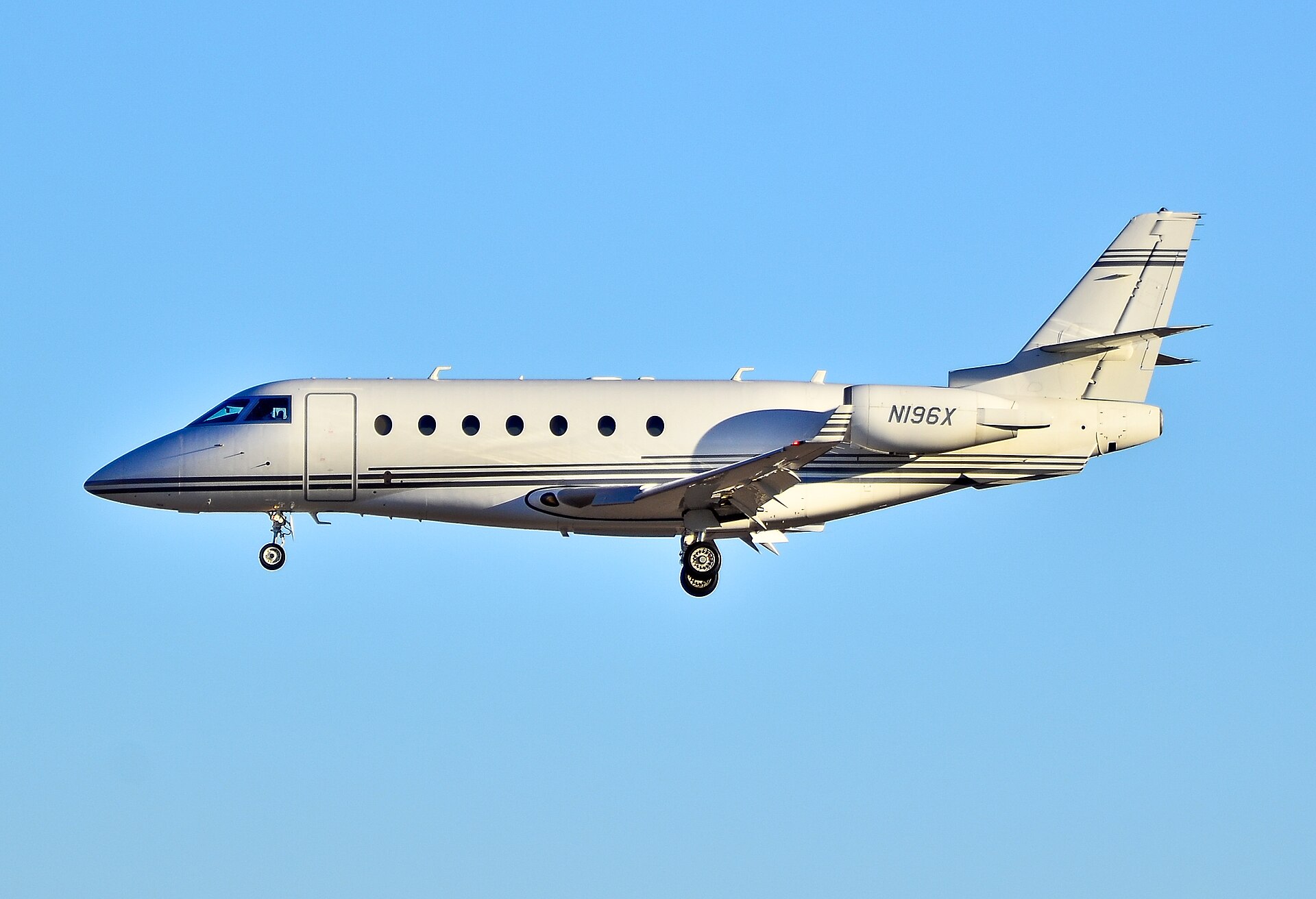
Gulfstream G200 N196X, photographed in 2011. · Photo: Tomás Del Coro via Wikimedia Commons, CC BY-SA 2.0
Gulfstream · Super-Midsize Jet
Gulfstream G200 (Galaxy)
Gulfstream's first super-midsize jet; it used an enlarged Astra wing and was replaced by the G280 in 2012.
The G200 pairs a 6 ft 3 in tall, 7 ft 2 in wide cabin with about 3,400 nm of range, and most ask $2.3–6.5M. The trade-offs are long runways, slow climbs, aging cockpit screens and a crowded resale market.
Buy it if
You want a stand-up super-midsize cabin and coast-to-coast or transatlantic range for the price of a light jet, fly from runways of 6,000 ft or more, and will keep the engines on a pay-per-hour plan.
Skip it if
You fly from short or high-altitude runways, need bags during the flight, or want a modern cockpit and easy resale; a Challenger 300 or G280 fits those missions better.
Biggest compromise
Runway length. At maximum weight it needs about 6,100 ft at sea level and about 8,800 ft on a hot day at a 5,000 ft airport.
The numbers that matter
Purchase price
$3.69M
typical asking · $2.35M–$6.5M
What it costs per year
$2.48M
at 300 hrs · two professional pilots
How far it flies
3,400 nm
3,130–3,400 nm with passengers
How fast
470 kt
high-speed cruise
Seats
8
8–10 typical by interior
Pilots needed
2
Certified for two pilots; there is no single-pilot version.
Price
What one costs to buy
Typical asking price
$3,695,000
Where asking prices sit
Low
$2.35M
Typical
$3.69M
High
$6.5M
Most asking prices fall inside this band.
Other sites
25.3% of the fleet
Priced vs call
with a price / call for price
13 of 61 listings show prices, from $2.35M for a high-time 2004 to $6.5M for a 2009. Newer aircraft ask far more.
Price vs its family and alternatives
Scroll to explore · select a jet for details
Gulfstream G200 (Galaxy) · This aircraft
$3.69M
Sits between the Citation X (750) and the Challenger 300.
For sale now
None listed right now
Cost to own
What it costs per year to run
300hours / year
Per year
Per flight hour
Estimate — your operator will quote actual numbers.
Fuel, airframe maintenance, engine program, apu program and landing, handling and trip costs rise as you fly more. Two professional pilots, recurrent training, hangar, insurance, management and subscriptions and office costs stay the same however much you fly.
Where the money goes
- Two professional pilots$566,54023%
- Recurrent training$45,0002%
- Hangar$62,9753%
- Insurance$34,3791%
- Management$81,0003%
- Subscriptions and office costs$62,5003%
- Fuel$638,84426%
- Airframe maintenance$453,15018%
- Engine program$260,10010%
- APU program$56,6642%
- Landing, handling and trip costs$223,2009%
Fuel is the biggest single cost at 26% of the total.
The JetGrade
70 out of 100 — Typical for its class
Peer group: Bombardier Challenger 300, Cessna Citation X, Hawker 4000, Dassault Falcon 50EX
Seven categories at a glance
- - - 70 = typical— This aircraft
Strongest on range & payload, weakest on airport access.
Grades are editorial opinions about the model, not any specific aircraft. Sponsors and affiliates have no input. Reviewed 2026-10-29.
Where it flies
Sample trips and reach
Typical trips on a map
Nonstop
Depends on weight or weather
6 of 8 sample trips are comfortable nonstops.
Sample flight times
- 0.9 hr
Carlsbad → Las Vegas
205 nm · Light weight suits Carlsbad's 4,900 ft runway
- 1.8 hr
Carlsbad → Aspen
625 nm · Aspen's altitude and runway limit landing weight
- 2.1 hr
Santa Ana → San José del Cabo
765 nm
- 2.4 hr
Teterboro → West Palm Beach
900 nm
- 3.0 hr
Dallas → Teterboro
1,190 nm
- 3.5 hr
Teterboro → San Juan
1,410 nm
- 5.3 hr
Carlsbad → Teterboro
2,100 nm · Carlsbad's short runway likely limits fuel for nonstop
- 5.6 hr
Los Angeles → Honolulu
2,215 nm · Westbound headwinds and overwater equipment matter
Lineage
What came before and after


1999–2011
Gulfstream G200 (Galaxy)
New wide-body fuselage, PW306A engines and much longer range.

What changed from the IAI Astra SPX
- All-new fuselage about 90 inches wide, giving a 7 ft 2 in wide stand-up cabin.
- Astra SPX wing strengthened, with 2 ft more span at the root and extra leading-edge flaps.
- Pratt & Whitney Canada PW306A engines of 6,040 lb thrust replaced 4,250 lb Honeywell TFE731s.
- Maximum takeoff weight rose from 24,650 lb to as much as 35,650 lb.
- Range with four passengers grew from about 2,950 nm to about 3,400 nm.
- An auxiliary power unit became standard; it had been optional on the Astra SPX.
Size and cabin
How big it is, inside and out
Outside
Silhouette · scaled to length
Length
Wingspan
Height
Inside the cabin
Cabin length
Width
Height
Compare
How it stacks up
This aircraft
Gulfstream G200 (Galaxy)
- JetGrade
- 70
- Price
- $3.69M
- Cost per year
- $2.48M
- Range
- 3,400 nm
- Speed
- 470 kt
- Seats
- 8
- Cabin length
- 24′ 5″
- Pilots
- 2
- Years built
- 1999–2011
← Before
- JetGrade
- 68
- Cost per year
- $1.5M
- Range
- 2,950 nm
- Speed
- 470 kt
- Seats
- 7
- Cabin length
- 17′ 1″
- Pilots
- 2
- Years built
- 1996–2001
After →
- JetGrade
- 72
- Price
- $17.75M–$22.5M guide
- Cost per year
- $2.3M
- Range
- 3,600 nm
- Speed
- 482 kt
- Seats
- 9
- Cabin length
- 25′ 10″
- Pilots
- 2
- Years built
- 2012–now
Alternative
- JetGrade
- 75
- Price
- $11.87M
- Cost per year
- $2.29M
- Range
- 3,065 nm
- Speed
- 470 kt
- Seats
- 8
- Cabin length
- 28′ 7″
- Pilots
- 2
- Years built
- 2004–2014
Alternative
- JetGrade
- 63
- Price
- $3.5M
- Cost per year
- $2.89M
- Range
- 3,070 nm
- Speed
- 525 kt
- Seats
- 8
- Cabin length
- 23′ 11″
- Pilots
- 2
- Years built
- 1996–2012
- Bombardier Challenger 300 instead: Needs far less runway, has a longer cabin and baggage you can reach in flight, but costs more to buy.
- Gulfstream G280 instead: The successor fixes the runway and climb weaknesses with a new wing and engines, but asks are several times higher.
- Cessna Citation X instead: About 50 kt faster with shorter runway needs, but a narrower, lower cabin.
Gold marks the best figure in each row.
Owning one
What to know before you buy
Engines & inspections
2 × Pratt & Whitney Canada PW306A · 6,040 lbf each
Engine hours until overhaul
- A check · 500 hr
- Engine hot-section inspection · 3,000 hr
- Engine overhaul · 6,000 hr
- Annual C check every 12 months
- 96-month inspection every 96 months
- 144-month inspection every 144 months
- 192-month inspection every 192 months
Nearly every G200 for sale has engines on Pratt & Whitney's Eagle Service Plan. Check the plan level, that it transfers, and whether a buy-in is owed.
Known issues
Engine program status drives value
Engines off Pratt & Whitney's pay-per-hour plan face costly hot-section inspections and overhauls; nearly every aircraft for sale is enrolled.
Aging cockpit displays
The Pro Line 4 tube displays are obsolete; repairs moved to a third party in 2025, and an LCD replacement is approved.
Wing corrosion under flap fairings
A 2023 directive requires inspecting debonded flap fairings and repairing corrosion on the lower wing skin.
Pre-buy checklist
0 of 10 checked
Gulfstream still supports the G200 through its St. Louis midsize service center, with Duncan Aviation and others as authorized shops. Pratt & Whitney Canada's network maintains the engines.
Review
The full review
Strengths
- About 3,400 nm with four passengers, enough for New York to London or Los Angeles to Honolulu nonstop.
- Cabin 6 ft 3 in tall and 7 ft 2 in wide, with a forward galley and enclosed aft lavatory.
- Asks of $2.3–6.5M buy a stand-up cabin and long range for far less than a G280.
Limitations
- Needs about 6,100 ft of runway at maximum weight, among the longest in its class.
- Full tanks leave only about 640 lb for people and bags.
- Collins Pro Line 4 cockpit uses aging tube displays; datalink for oceanic routes needs an aftermarket upgrade.
The Gulfstream G200 began life as the IAI 1126 Galaxy, an Israel Aerospace Industries design that combined a strengthened version of the Astra SPX wing with an all-new fuselage about 90 inches wide. It first flew in 1997 and was certified in 1998. Gulfstream bought the program in 2001 and renamed it the G200 without changing the airplane. IAI built 250 before production ended in 2011, and the larger G280 replaced it in 2012.
Pilot's take
From the cockpit, the G200 is a stable, solid long-range jet, but it rewards planning. The Pro Line 4 displays and EICAS (the engine and alert display) are logical, though the tube screens and older flight management systems feel dated next to newer cockpits. On a hot day at heavy weight the takeoff numbers grow quickly, and initial climbs are slow, so expect to step-climb on long legs. Once level near FL410 it settles into an efficient 430 kt cruise. Passengers tend to notice the wide cabin far more than the dated cockpit.
Who this is for
Owners and charter operators who want a big-cabin feel and long range on a modest budget, fly mostly from long runways, and accept older avionics and a slow resale market in exchange for a low purchase price.

Ask about this aircraft
Answers come only from our research file on the G200 (Galaxy).
Your earlier questionsOwners
Private to verified ownersOwn a Gulfstream Gulfstream G200 (Galaxy)? Verify with its FAA registration to join the owners' thread and the real-cost poll.