
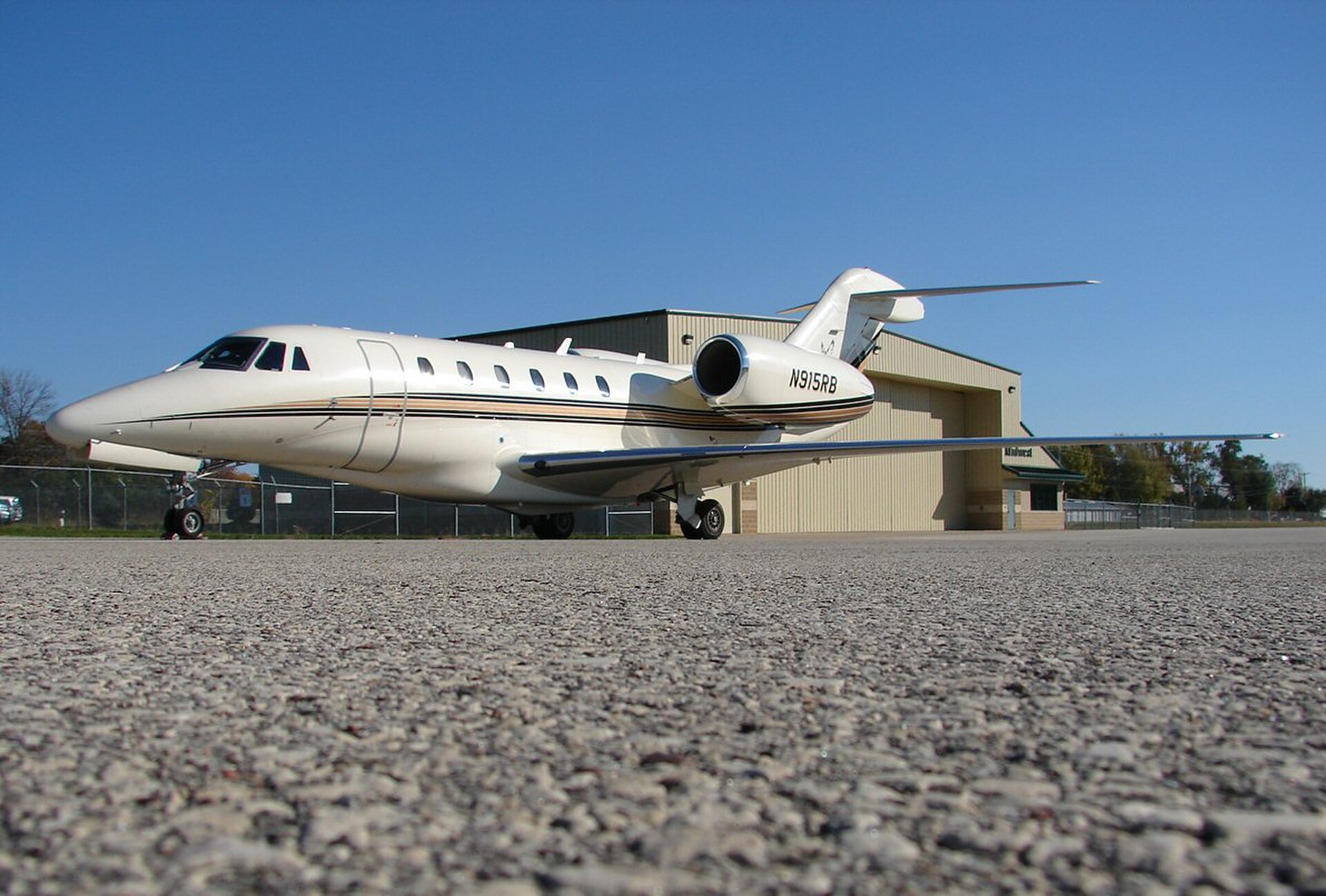
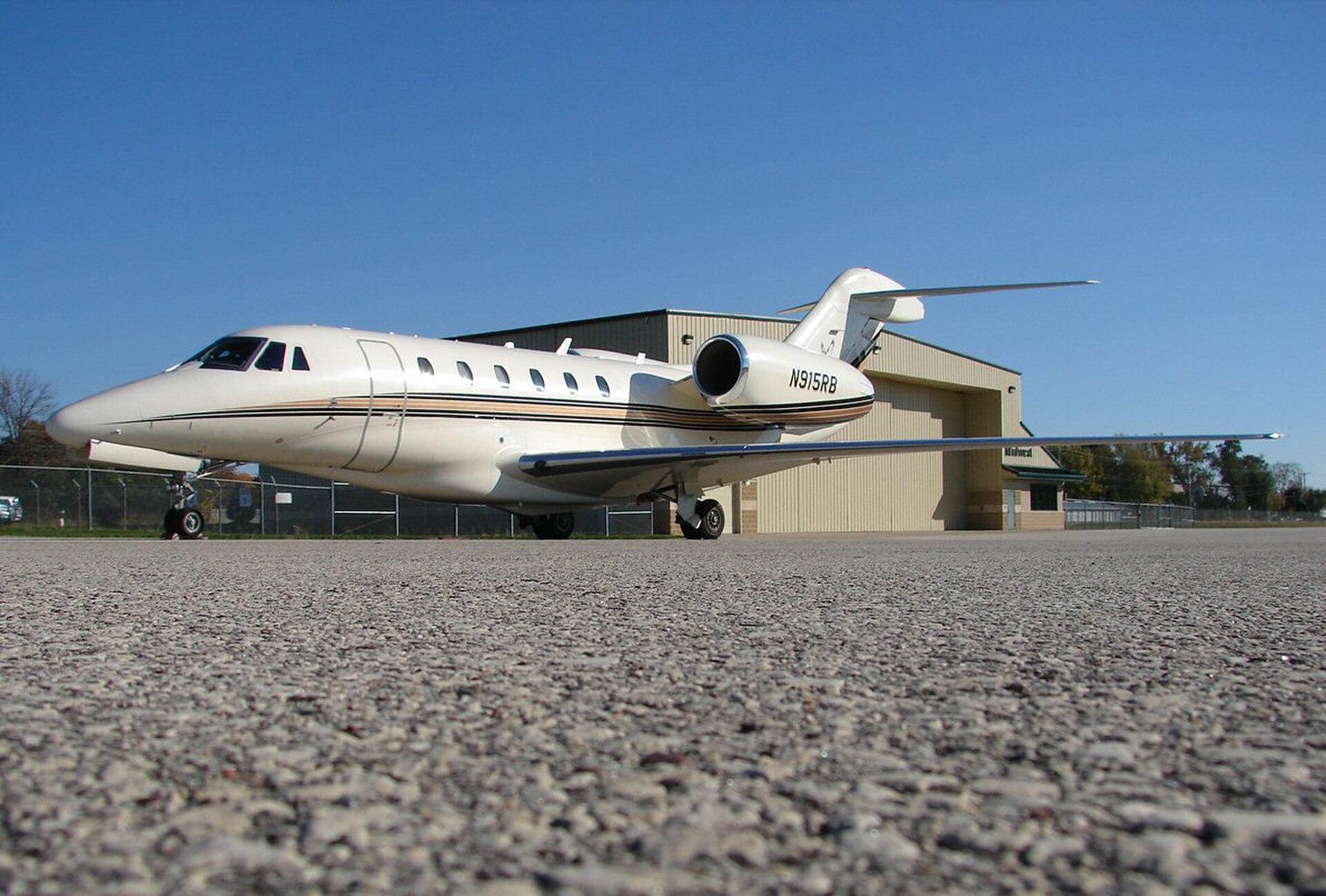
An original Citation X on the ramp in 2007, without the winglets many owners later added. · Photo: Cory W. Watts, CC BY-SA 2.0, via Wikimedia Commons
Cessna · Super-Midsize Jet
Citation X (750)
Cessna's first Model 750 and its speed flagship, later stretched into the Citation X+.
The Citation X still flies faster than almost any business jet and now sells for about $3.5 million. You pay for that speed every hour: it burns more fuel than its rivals, and its cabin is narrower and lower than theirs.
Buy it if
You mostly fly two to six people on long trips where saving time matters, you want strong Cessna and Rolls-Royce support, and you can budget about $2.9 million a year at 300 hours.
Skip it if
Your passengers want to stand up and move around, you carry a lot of luggage, or you want the lowest hourly running cost among super-midsize jets.
Biggest compromise
Speed costs money. At 300 hours a year our budget comes to about $9,650 an hour, driven by fuel burn of roughly 355 gallons an hour, and published comparisons put its hourly cost above the Challenger 300, Gulfstream G200 and Hawker 4000.
The numbers that matter
Purchase price
$3.5M
typical asking · $3.29M–$4.95M
What it costs per year
$2.89M
at 300 hrs · two professional pilots
How far it flies
3,070 nm
3,070–3,110 nm with passengers
How fast
525 kt
high-speed cruise
Seats
8
8 typical, up to 12 certified
Pilots needed
2
Always flown by two pilots; there is no single-pilot option.
Price
What one costs to buy
Typical asking price
$3,500,000
Where asking prices sit
Low
$3.29M
Typical
$3.5M
High
$4.95M
Most asking prices fall inside this band.
Other sites
4.8% of the fleet
Priced vs call
with a price / call for price
Three of fourteen listed jets show a price, $3.3M to $4.95M. JETNET data on AvBuyer puts current asks at $2.5–5.8M.
Price vs its family and alternatives
Scroll to explore · select a jet for details
Citation X (750) · This aircraft
$3.5M
Sits between the Citation VII (650) and the Gulfstream G200 (Galaxy).
For sale now
None listed right now
Cost to own
What it costs per year to run
300hours / year
Per year
Per flight hour
Estimate — your operator will quote actual numbers.
Fuel, airframe maintenance, engine program, both engines and crew travel, landing and handling rise as you fly more. Two pilots, recurrent simulator training, hangar, insurance, management and databases, charts and other fixed stay the same however much you fly.
Where the money goes
- Two pilots$889,28031%
- Recurrent simulator training$45,0002%
- Hangar$73,3143%
- Insurance$33,7001%
- Management$81,0003%
- Databases, charts and other fixed$62,5002%
- Fuel$831,76529%
- Airframe maintenance$390,00013%
- Engine program, both engines$237,0008%
- Crew travel, landing and handling$251,4009%
Two pilots is the biggest single cost at 31% of the total.
The JetGrade
63 out of 100 — Below its class average
Peer group: Bombardier Challenger 300, Gulfstream G200, Hawker 4000, Dassault Falcon 50EX
Seven categories at a glance
- - - 70 = typical— This aircraft
Strongest on speed & trip time, weakest on cabin & passenger comfort.
Grades are editorial opinions about the model, not any specific aircraft. Sponsors and affiliates have no input. Reviewed 2026-10-29.
Where it flies
Sample trips and reach
Typical trips on a map
Nonstop
Depends on weight or weather
6 of 8 sample trips are comfortable nonstops.
Sample flight times
- 0.9 hr
Carlsbad → Las Vegas
205 nm · Short hop well within range
- 1.8 hr
Carlsbad → Aspen
625 nm · Hot-and-high; depends on weight and weather
- 2.1 hr
Santa Ana → San José del Cabo
765 nm · Easy nonstop with four passengers
- 2.3 hr
Teterboro → West Palm Beach
900 nm · Easy nonstop with four passengers
- 2.9 hr
Dallas → Teterboro
1,190 nm · Nonstop with ample reserve
- 3.3 hr
Teterboro → San Juan
1,410 nm · Nonstop with room for winds and alternates
- 4.7 hr
Carlsbad → Teterboro
2,100 nm · In range; Carlsbad's short runway limits fuel
- 5.0 hr
Los Angeles → Honolulu
2,215 nm · Nonstop with four passengers; watch headwinds
Lineage
What came before and after

1996–2012
Cessna Citation X (750)
New swept wing and Rolls-Royce engines for a Mach 0.92 top speed.


What changed from the Cessna Citation VII (650)
- Rolls-Royce AE3007C turbofans of 6,442 lb thrust replace the Citation VII's Honeywell TFE731 engines.
- All-new, sharply swept wing with leading-edge slats, built for a Mach 0.92 top speed.
- Keeps the Citation VII's cabin cross-section in a longer 23 ft 11 in cabin.
- Honeywell Primus 2000 cockpit with five color screens and a flight management system.
- Range grows to about 3,070 nm, enough for nonstop coast-to-coast trips.
- Hydraulically powered flight controls and computer-controlled (FADEC) engines.
Size and cabin
How big it is, inside and out
Outside
Silhouette · scaled to length
Length
Wingspan
Height
Inside the cabin
Cabin length
Width
Height
Compare
How it stacks up
This aircraft
Citation X (750)
- JetGrade
- 63
- Price
- $3.5M
- Cost per year
- $2.89M
- Range
- 3,070 nm
- Speed
- 525 kt
- Seats
- 8
- Cabin length
- 23′ 11″
- Pilots
- 2
- Years built
- 1996–2012
← Before
- JetGrade
- 65
- Price
- $2.3M
- Cost per year
- $1.93M
- Range
- 1,825 nm
- Speed
- 452 kt
- Seats
- 8
- Cabin length
- 18′ 5″
- Pilots
- 2
- Years built
- 1992–2000
After →
- JetGrade
- 63
- Price
- $9.4M–$10M guide
- Cost per year
- $2.72M
- Range
- 3,460 nm
- Speed
- 528 kt
- Seats
- 8
- Cabin length
- 25′ 2″
- Pilots
- 2
- Years built
- 2014–2018
Alternative
- JetGrade
- 75
- Price
- $11.87M
- Cost per year
- $2.29M
- Range
- 3,065 nm
- Speed
- 470 kt
- Seats
- 8
- Cabin length
- 28′ 7″
- Pilots
- 2
- Years built
- 2004–2014
Alternative
- JetGrade
- 70
- Price
- $3.69M
- Cost per year
- $2.48M
- Range
- 3,400 nm
- Speed
- 470 kt
- Seats
- 8
- Cabin length
- 24′ 5″
- Pilots
- 2
- Years built
- 1999–2011
- Bombardier Challenger 300 instead: Wider, taller stand-up cabin and lower hourly costs, but it costs far more to buy and cruises about 65 knots slower.
- Gulfstream G200 instead: Similar purchase price with a 7 ft 2 in wide cabin and more baggage room, but it needs longer runways and is slower.
- Cessna Citation X+ (750) instead: Same basic jet, 17 inches longer inside, with winglets and a Garmin G5000 cockpit; costs roughly three times as much.
Gold marks the best figure in each row.
Owning one
What to know before you buy
Engines & inspections
2 × Rolls-Royce AE3007C or AE3007C1 · 6,764 lbf each
Engine hours until overhaul
- Engine compressor wash · 100 hr
- Inspection Document 8 · 500 hr
- Inspection Document 11 · 2,000 hr
- Inspection Document 1 every 12 months
- Inspection Document 2 every 24 months
- Inspection Document 3 every 36 months
- Inspection Document 4 every 48 months
Most listed jets have engines on Rolls-Royce CorporateCare, an hourly plan of roughly $290–500 per engine; engines off a plan carry large shop-visit risk.
Known issues
Engine program status
Engines off CorporateCare face costly shop visits, and directives have shortened fan and turbine wheel lives.
Elevator replacement directive
A 2010 directive requires replacing both elevators, up to 200 hours of labor; confirm it is done.
High fuel burn
Budgets assume roughly 325 to 386 gallons an hour, the main reason running costs top the class.
Pre-buy checklist
0 of 10 checked
Textron Aviation and many independent Citation shops support the X, and Rolls-Royce backs the engines through CorporateCare. A Honeywell display upgrade exists, but no Garmin G5000 retrofit.
Review
The full review
Strengths
- Mach 0.92 top speed and about 525 knots in cruise, roughly 55 to 65 knots faster than its rivals.
- About 3,070 nm of range with four passengers covers coast-to-coast and Los Angeles to Honolulu nonstop.
- Typical asking price near $3.5 million, below most super-midsize rivals, with about 290 still flying.
Limitations
- Cabin is 5 ft 6 in wide and 5 ft 8 in tall, narrower and lower than every rival compared.
- Fuel burn of roughly 325 to 386 gallons an hour pushes yearly costs near $2.9 million at 300 hours.
- Original CRT-screen cockpit; the LCD upgrade starts at $435,000, and no Garmin retrofit exists.
The Citation X is the original Cessna Model 750, built from 1996 to 2012 and designed around one idea: speed. Cessna gave it a new, sharply swept wing and Rolls-Royce AE3007 engines but kept the cabin cross-section of the older Citation VII. About 313 were built, roughly 290 are still flying, and the type was followed by the stretched Citation X+ and, later, the Citation Longitude at the top of Cessna's range.
Pilot's take
From the cockpit, the X is all about pace. It climbs quickly when light, cruises above 500 knots and covers coast-to-coast legs in under five hours. It asks a lot of the crew: speeds on approach are higher than in slower jets, the hydraulic system is complex, and the original cockpit lacks autothrottles and relies on five older CRT screens. Heavy, it needs step climbs to reach the high, efficient altitudes unless winglets are fitted. Crews who fly it regularly tend to rate its handling highly.
Who this is for
Owners and flight departments who value speed over cabin space: frequent coast-to-coast travelers flying small groups, and buyers who want long range and Mach 0.9 speed for under $5 million.

Ask about this aircraft
Answers come only from our research file on the Citation X (750).
Your earlier questionsOwners
Private to verified ownersOwn a Cessna Citation X (750)? Verify with its FAA registration to join the owners' thread and the real-cost poll.