
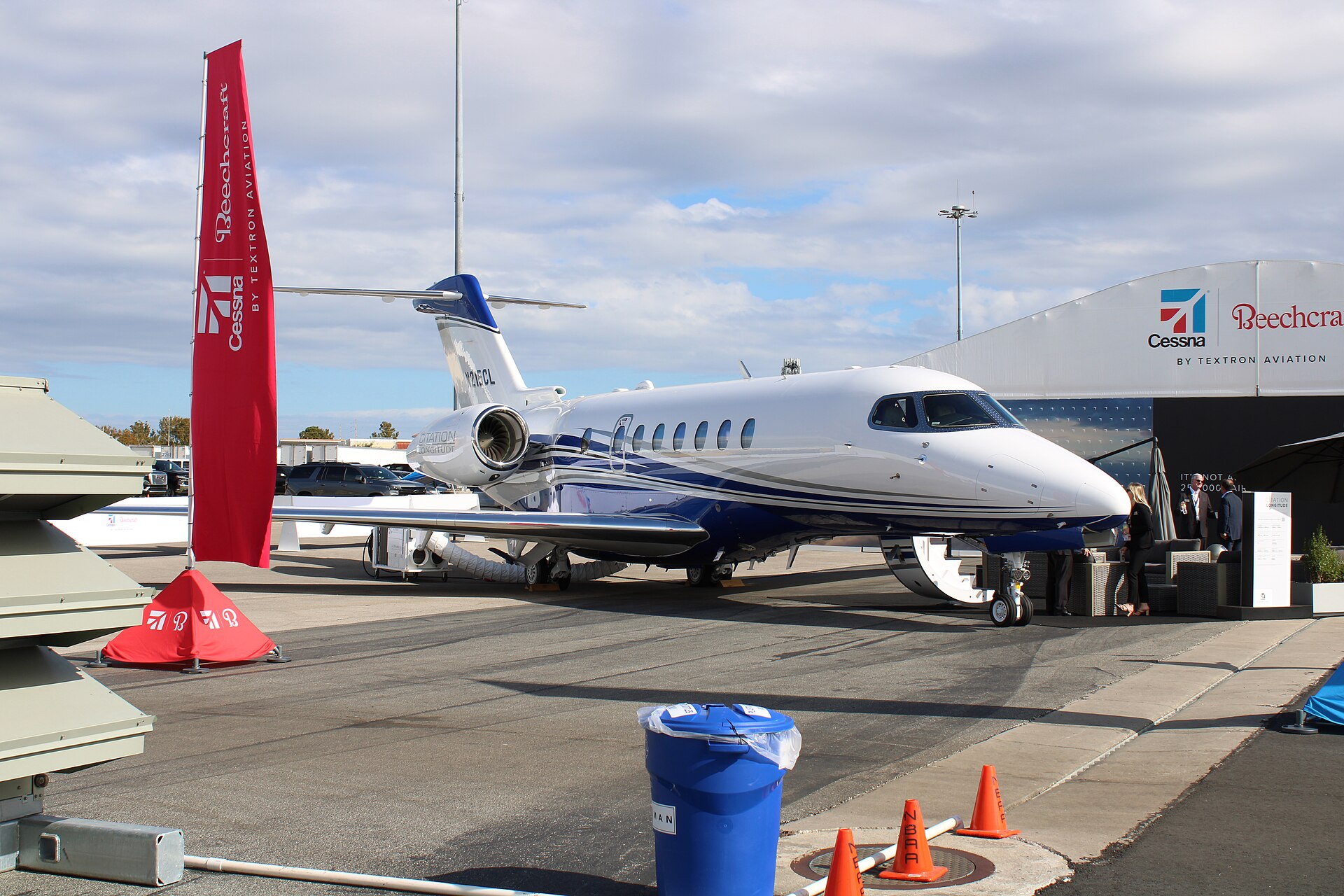
A Citation Longitude on display at the 2022 NBAA business aviation show in Orlando, Florida. · Photo: ZLEA, CC BY-SA 4.0, via Wikimedia Commons
Cessna · Super-Midsize Jet
Citation Longitude (700)
Cessna's largest jet and super-midsize flagship, which took over from the Citation X+ at the top of the Citation line.
The Longitude is the quickest of the popular super-midsize jets on everyday trips and has a hushed, flat-floor cabin with seats that lie flat. It costs the most new, carries the least payload and its cabin is narrower than a Challenger 3500's.
Buy it if
You fly four to eight people on trips up to about 3,000 nm, value a quiet cabin and lie-flat seats for overnight legs, and want Cessna's service network and a fleet of about 173 aircraft behind you.
Skip it if
You often carry heavy loads on long legs, want the widest cabin for the money, or need the most range per dollar; a Praetor 600 or G280 goes farther for less.
Biggest compromise
Payload and width. Maximum payload is 3,200 lb and full tanks leave 1,600 lb, about eight passengers at 200 lb with bags.
The numbers that matter
What it costs per year
$2.45M
at 300 hrs · two professional pilots
How far it flies
3,500 nm
3,420–3,500 nm with passengers
How fast
483 kt
high-speed cruise
Seats
8
8 typical, up to 12
Pilots needed
2
Two pilots are required on every flight.
Price
What one costs to buy
Typical asking price
$0
Other sites
3.5% of the fleet
Priced vs call
with a price / call for price
Only two of eight listed aircraft show prices: $21.9M for a 2021 without an engine plan and $25.5M for a 2022 on one. New equipped price is about $30M.
Price vs its family and alternatives
Scroll to explore · select a jet for details
For sale now
None listed right now
Cost to own
What it costs per year to run
300hours / year
Per year
Per flight hour
Estimate — your operator will quote actual numbers.
Fuel, airframe maintenance, engine program, both engines and trip expenses rise as you fly more. Two professional pilots, recurrent training, hangar, insurance, management and charts, software and connectivity stay the same however much you fly.
Where the money goes
- Two professional pilots$462,41019%
- Recurrent training$45,0002%
- Hangar$76,7873%
- Insurance$66,0303%
- Management$81,0003%
- Charts, software and connectivity$62,5003%
- Fuel$730,98930%
- Airframe maintenance$356,55015%
- Engine program, both engines$313,95013%
- Trip expenses$251,40010%
Fuel is the biggest single cost at 30% of the total.
The JetGrade
71 out of 100 — Slightly above its class
Peer group: Bombardier Challenger 3500, Gulfstream G280, Embraer Praetor 600, Bombardier Challenger 350
Seven categories at a glance
- - - 70 = typical— This aircraft
Strongest on reliability & support, weakest on range & payload.
Grades are editorial opinions about the model, not any specific aircraft. Sponsors and affiliates have no input. Reviewed 2026-10-29.
Where it flies
Sample trips and reach
Typical trips on a map
Nonstop
Fuel stop likely
10 of 12 sample trips are comfortable nonstops.
Sample flight times
- 0.8 hr
Carlsbad → Las Vegas
205 nm · Short hop with ample margin at any load
- 1.7 hr
Carlsbad → Aspen
625 nm · Mountain airport; summer heat can limit weight
- 2.0 hr
Santa Ana → San José del Cabo
765 nm · Easy nonstop with a full cabin
- 2.3 hr
Teterboro → West Palm Beach
900 nm · Easy nonstop with a full cabin
- 2.9 hr
Dallas → Teterboro
1,190 nm · Easy nonstop with a full cabin
- 3.4 hr
Teterboro → San Juan
1,410 nm · Nonstop over water with a full cabin
- 4.9 hr
Carlsbad → Teterboro
2,100 nm · Coast to coast nonstop with seats filled
- 5.2 hr
Los Angeles → Honolulu
2,215 nm · Long overwater leg; nonstop with four passengers
- 6.9 hr
Teterboro → London
2,990 nm · Nonstop eastbound with four passengers
- 7.2 hr
Teterboro → Paris
3,150 nm · Four passengers; headwinds or more weight can force stop
- 11.0 hr
Los Angeles → Tokyo
4,745 nm · Needs one fuel stop, such as Anchorage
- 13.6 hr
Teterboro → Dubai
5,940 nm · Needs one fuel stop, such as in Europe
Lineage
What came before and after
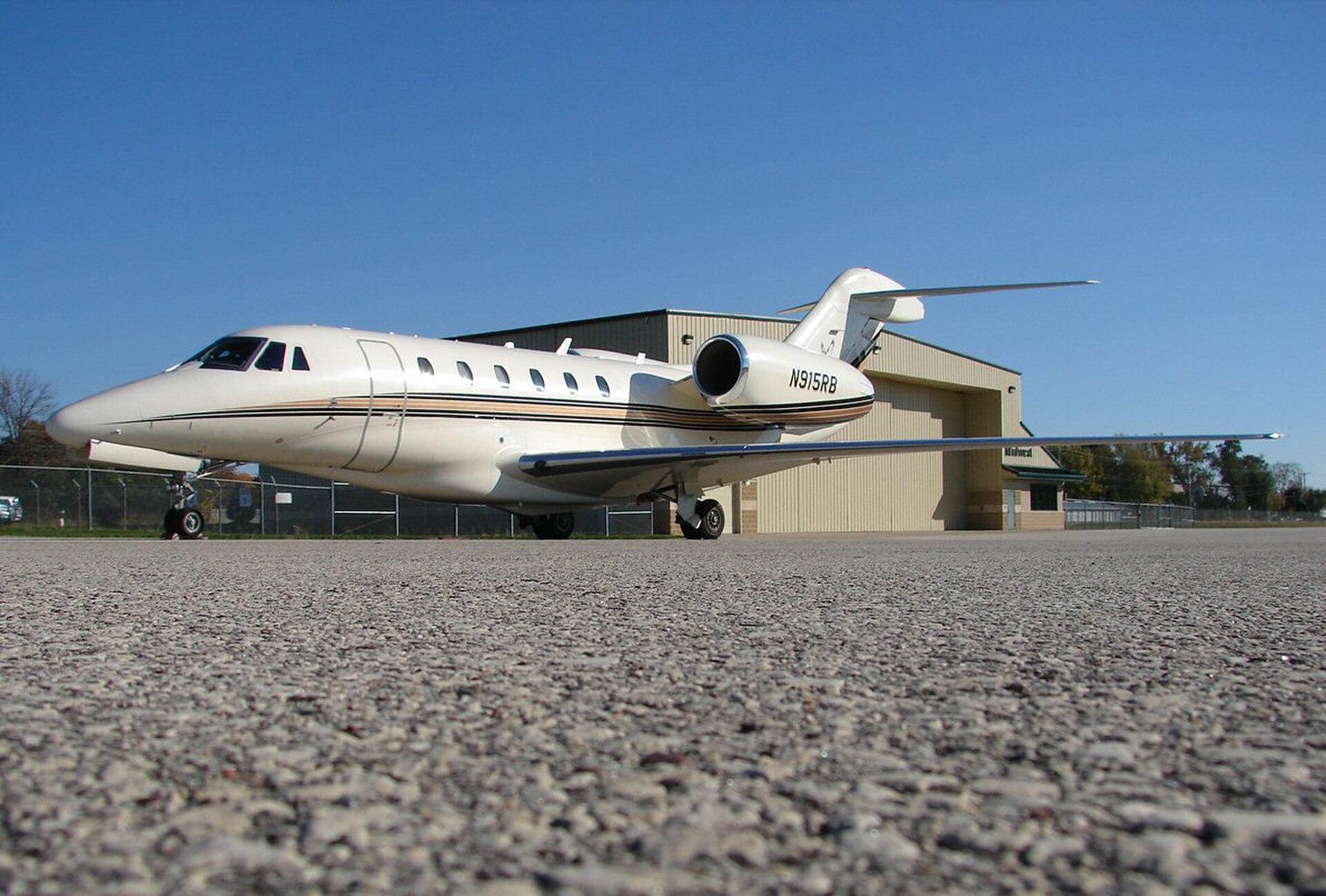


2019–present
Citation Longitude (700)
New design trading top speed for a six-foot flat-floor cabin and lower costs.
What changed from the Citation X+ (750)
- Six-foot, 77-inch-wide flat-floor cabin replaces the X+'s lower, narrower dropped-aisle cabin.
- Uses the Citation Latitude's round fuselage, stretched by one seat row.
- New 28.6-degree swept wing with winglets instead of the X+'s 37-degree high-speed wing.
- Honeywell HTF7700L engines of 7,665 lb thrust replace Rolls-Royce AE3007C2 engines.
- Lower 5,950 ft cabin altitude at 45,000 ft and a walk-in baggage hold reachable in flight.
- Gives up about 40 kt of top cruise for range of 3,500 nm with four passengers.
Size and cabin
How big it is, inside and out
Outside
Silhouette · scaled to length
Length
Wingspan
Height
Inside the cabin
Cabin length
Width
Height
Compare
How it stacks up
This aircraft
Citation Longitude (700)
- JetGrade
- 71
- Cost per year
- $2.45M
- Range
- 3,500 nm
- Speed
- 483 kt
- Seats
- 8
- Cabin length
- 25′ 2″
- Pilots
- 2
- Years built
- 2019–now
← Before
- JetGrade
- 63
- Price
- $9.4M–$10M guide
- Cost per year
- $2.72M
- Range
- 3,460 nm
- Speed
- 528 kt
- Seats
- 8
- Cabin length
- 25′ 2″
- Pilots
- 2
- Years built
- 2014–2018
Alternative
- JetGrade
- 72
- Price
- $23.3M–$28M guide
- Cost per year
- $2.11M
- Range
- 3,400 nm
- Speed
- 470 kt
- Seats
- 8
- Cabin length
- 25′ 2″
- Pilots
- 2
- Years built
- 2022–now
Alternative
- JetGrade
- 72
- Price
- $17.75M–$22.5M guide
- Cost per year
- $2.3M
- Range
- 3,600 nm
- Speed
- 482 kt
- Seats
- 9
- Cabin length
- 25′ 10″
- Pilots
- 2
- Years built
- 2012–now
Alternative
- JetGrade
- 78
- Price
- $20.5M–$23.29M guide
- Cost per year
- $2.37M
- Range
- 4,018 nm
- Speed
- 466 kt
- Seats
- 8
- Cabin length
- 27′ 7″
- Pilots
- 2
- Years built
- 2019–now
- Bombardier Challenger 3500 instead: A wider 86-inch cabin and 3,400 lb payload for similar money; slightly slower on typical trips and about 100 nm less range.
- Gulfstream G280 instead: About $5M less new and roughly 200 nm more range with four passengers, but it needs more runway at high, hot airports.
- Embraer Praetor 600 instead: Goes about 500 nm farther with four passengers and carries 4,000 lb for about $4M less new; the cabin is slightly shorter.
Gold marks the best figure in each row.
Owning one
What to know before you buy
Engines & inspections
2 × Honeywell HTF7700L · 7,665 lbf each
Engine hours until overhaul
- Base airframe inspection · 800 hr
- 1,600-hour inspection · 1,600 hr
- 2,400-hour inspection · 2,400 hr
- Engine hot-section borescope · 4,800 hr
- Engine compressor borescope · 9,600 hr
- Three-year inspection every 36 months
- Six-year inspection every 72 months
- Eight-year inspection every 96 months
Engines are maintained on condition with no fixed overhaul time; most aircraft for sale are on pay-per-hour plans, and coverage strongly affects value.
Known issues
Engine program status
Engines off a pay-per-hour plan carry overhaul and buy-in costs that weigh heavily on resale value.
Former test and demo aircraft
Several early airframes flew in Cessna's test program or as demonstrators; their history and paperwork need careful review.
Engine borescope service bulletins
Engines without two Honeywell bulletins fall to a 4,000-hour hot-section check instead of 4,800 hours.
Pre-buy checklist
0 of 8 checked
Cessna supports the Longitude through 20 company-owned service centers and more than 30 mobile and line locations, with 24-hour support; most aircraft are enrolled in factory parts and engine plans.
Review
The full review
Strengths
- Quickest of its main rivals on typical trips: 600 nm in about 1 hr 23 min, per Business & Commercial Aviation.
- Flat-floor cabin 25 ft 2 in long and 6 ft tall, with lie-flat double-club seats and a 5,950 ft cabin altitude.
- Walk-in 112 cu ft baggage hold you can reach in flight, rated for 1,000 lb of bags.
Limitations
- Maximum payload of 3,200 lb is the lowest of its main rivals; full tanks leave 1,600 lb for people and bags.
- Cabin is 77 in wide, about 9 in narrower than a Challenger 3500 and 6 in narrower than a G280.
- Costs about $30M new equipped, the most of its main rivals, yet a G280 or Praetor 600 flies farther.
The Citation Longitude is Cessna's largest and most expensive business jet, a super-midsize twin that entered service in late 2019 and took over from the Citation X+ at the top of the Citation range. It borrows the Citation Latitude's round fuselage, stretches it by a row of seats, and pairs it with a new swept wing with winglets, a T-tail and two Honeywell HTF7700L engines of 7,665 lb of thrust each. About 173 are in service, and NetJets, which agreed to take up to 175, flies a large share of them.
Pilot's take
From the flight deck, the Longitude feels like a big, modern Citation. The Garmin G5000 with full-regime autothrottles and envelope protection keeps workload low, and Aviation Week's evaluation pilot reached 40,000 ft in under 20 minutes. Approach speeds are moderate, with a reference speed around 120 kt, but full flaps bring a noticeable nose-up pitch change that takes trimming, and the ailerons feel heavy at first. The cockpit stays quiet even at Mach 0.84. Crews coming from a Latitude will find the Garmin avionics and systems logic familiar, which shortens training and widens the pool of qualified pilots.
Who this is for
Owners and flight departments stepping up from a Latitude, Sovereign or Challenger 300 who fly coast to coast or to Europe with four to six people, prize a quiet cabin, and want simple factory support across the United States.

Ask about this aircraft
Answers come only from our research file on the Cessna Citation Longitude (700).
Your earlier questionsOwners
Private to verified ownersOwn a Cessna Citation Longitude (700)? Verify with its FAA registration to join the owners' thread and the real-cost poll.