
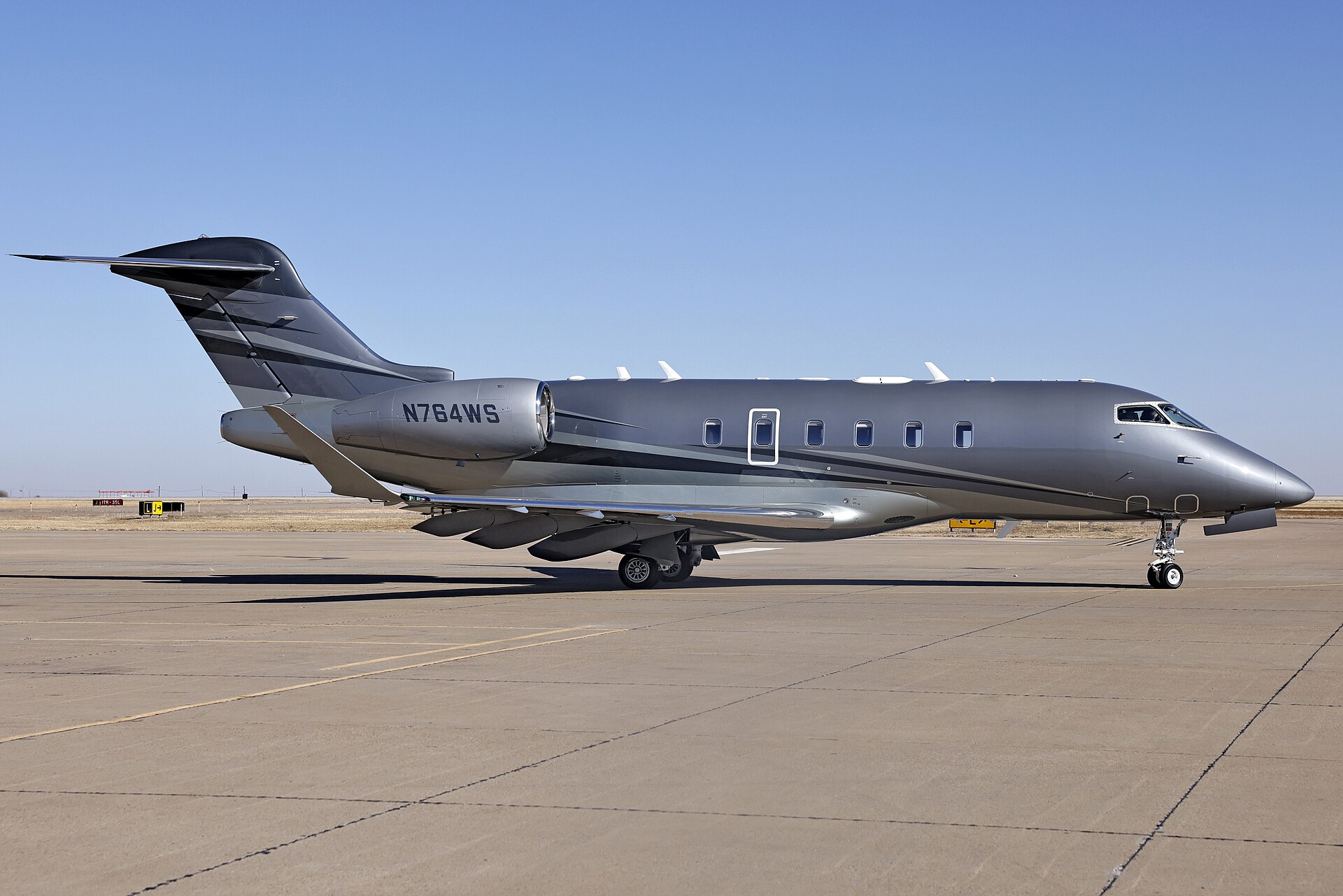
A 2024 Challenger 3500 on the ramp at Lubbock, Texas, in December 2025. · Photo: DUNCAN KIRK from Coeur d'Alene, United States / Wikimedia Commons, CC BY 4.0
Bombardier · Super-Midsize Jet
Challenger 3500
The third and current version of Bombardier's Challenger 300 family, after the Challenger 300 and Challenger 350.
The safest bet in the super-midsize class. It flies 3,400 nm with four passengers, has the widest cabin among its direct rivals and now keeps the cabin at 4,850 ft. You pay near the top of the class to buy and run it.
Buy it if
You fly coast to coast or to Hawaii with up to eight people, value a quiet, wide cabin and easy resale, and want the support of a 1,000-plus jet family.
Skip it if
You regularly need more than 3,400 nm, carry lots of luggage, or want the lowest purchase price; a Praetor 600 goes farther for less money.
Biggest compromise
Price for what is underneath. The airframe, engines and cockpit are carried over from the 2014 Challenger 350, so the 3500's gains are in comfort rather than speed or range.
The numbers that matter
Purchase price
$23.3M–$28M
guide value (Radar (CRAFT) and Guardian Jet value estimates)
What it costs per year
$2.11M
at 300 hrs · two professional pilots
How far it flies
3,400 nm
3,400 nm with four passengers
How fast
470 kt
high-speed cruise
Seats
8
8 typical, up to 10
Pilots needed
2
Two pilots are required.
Price
What one costs to buy
Guide value
$23.3M–$28M
Other sites
Priced vs call
with a price / call for price
None of the few Challenger 3500s offered shows a price. Model-based estimates run $23.3–28.0 million; a new one listed at $27.2 million in 2023.
Price vs its family and alternatives
Scroll to explore · select a jet for details
Challenger 3500 · This aircraft
$23.3M–$28M guide
Guide value, not a listed asking price.
The most expensive here; the Praetor 600 (EMB-550) is the next step down.
For sale now
None listed right now
Cost to own
What it costs per year to run
300hours / year
Per year
Per flight hour
Estimate — your operator will quote actual numbers.
Fuel, airframe maintenance, engine program, apu program and landing, handling and other costs rise as you fly more. Two pilots, recurrent training, hangar, insurance and management stay the same however much you fly.
Where the money goes
- Two pilots$365,74017%
- Recurrent training$66,5553%
- Hangar$67,4393%
- Insurance$46,6212%
- Management$78,0004%
- Fuel$683,55932%
- Airframe maintenance$295,74014%
- Engine program$335,71216%
- APU program$24,4711%
- Landing, handling and other costs$144,9317%
Fuel is the biggest single cost at 32% of the total.
The JetGrade
72 out of 100 — Slightly above its class
Peer group: Cessna Citation Longitude, Gulfstream G280, Embraer Praetor 600, Bombardier Challenger 350
Seven categories at a glance
- - - 70 = typical— This aircraft
Strongest on cabin & passenger comfort, weakest on range & payload.
Grades are editorial opinions about the model, not any specific aircraft. Sponsors and affiliates have no input. Reviewed 2026-10-29.
Where it flies
Sample trips and reach
Typical trips on a map
Nonstop
Depends on weight or weather
7 of 8 sample trips are comfortable nonstops.
Sample flight times
- 0.8 hr
Carlsbad → Las Vegas
205 nm · Short hop at high-speed cruise
- 1.8 hr
Carlsbad → Aspen
625 nm · Hot-and-high; depends on weight and weather
- 2.1 hr
Santa Ana → San José del Cabo
765 nm · Easy nonstop with room to spare
- 2.5 hr
Teterboro → West Palm Beach
900 nm · Easy nonstop with full cabin
- 3.0 hr
Dallas → Teterboro
1,190 nm · Easy nonstop with full cabin
- 3.5 hr
Teterboro → San Juan
1,410 nm · Comfortable nonstop over water
- 5.1 hr
Carlsbad → Teterboro
2,100 nm · Coast to coast nonstop, even into headwinds
- 5.2 hr
Los Angeles → Honolulu
2,215 nm · Nonstop to Hawaii with reserves to spare
Lineage
What came before and after

2004–2014
Bombardier Challenger 300
Clean-sheet original that set the super-midsize template.

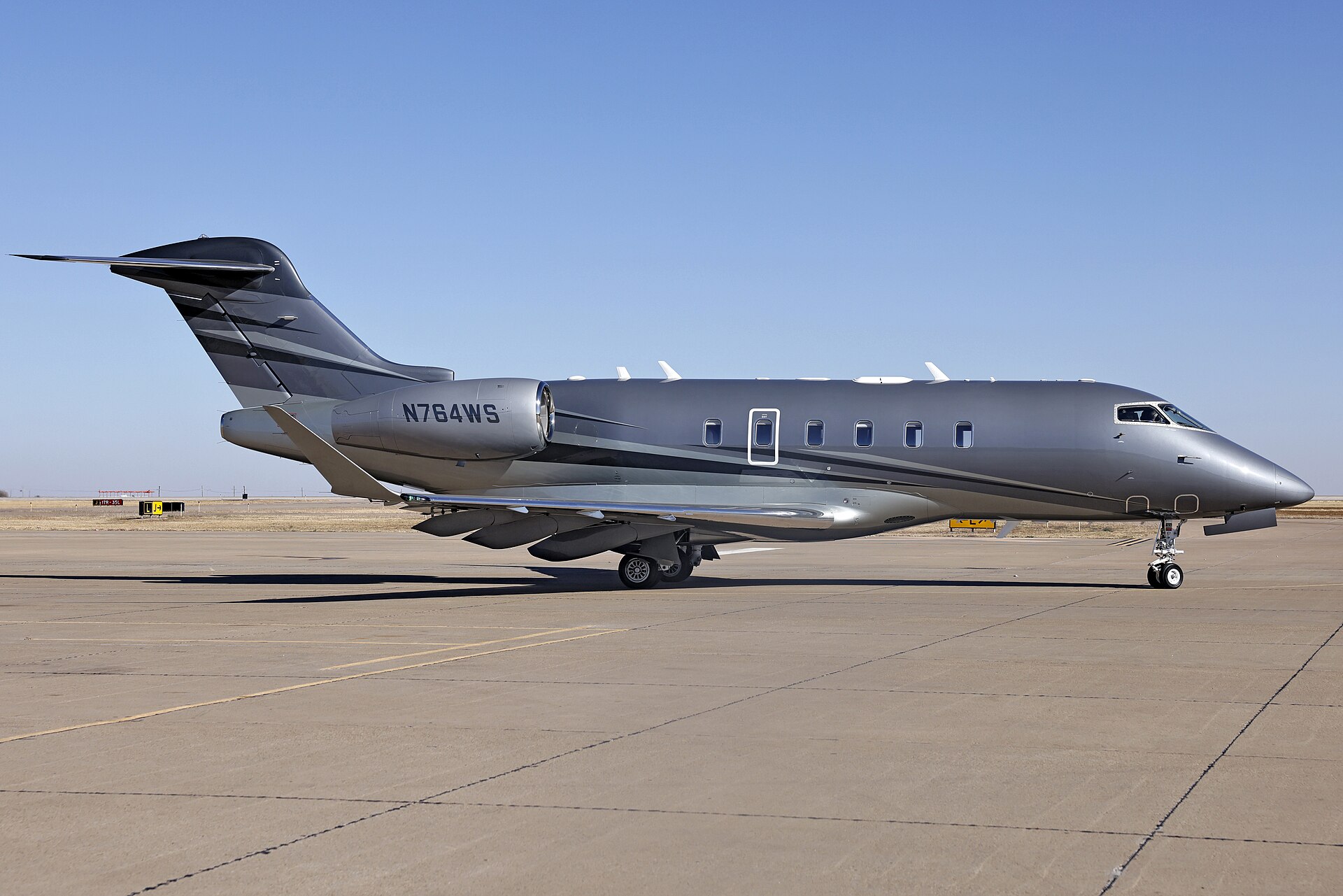
2022–present
Bombardier Challenger 3500
Autothrottle, lower cabin altitude and a redesigned cabin.
What changed from the Bombardier Challenger 350
- Autothrottle now standard, a first for the Challenger line.
- Cabin altitude lowered to 4,850 ft at 41,000 ft, about 2,000 ft better.
- Nuage seats from the Global 7500 and a redesigned forward galley.
- Voice-controlled cabin, wireless charging and 24-inch 4K displays.
- Aircraft health monitoring unit fitted as standard.
- Same Honeywell HTF7350 engines and airframe; performance carried over.
Size and cabin
How big it is, inside and out
Outside
Silhouette · scaled to length
Length
Wingspan
Height
Inside the cabin
Cabin length
Width
Height
Compare
How it stacks up
This aircraft
Challenger 3500
- JetGrade
- 72
- Price
- $23.3M–$28M guide
- Cost per year
- $2.11M
- Range
- 3,400 nm
- Speed
- 470 kt
- Seats
- 8
- Cabin length
- 25′ 2″
- Pilots
- 2
- Years built
- 2022–now
← Before
- JetGrade
- 75
- Price
- $12.9M–$25.9M guide
- Cost per year
- $2.36M
- Range
- 3,200 nm
- Speed
- 470 kt
- Seats
- 9
- Cabin length
- 25′ 2″
- Pilots
- 2
- Years built
- 2014–2022
Alternative
- JetGrade
- 78
- Price
- $20.5M–$23.29M guide
- Cost per year
- $2.37M
- Range
- 4,018 nm
- Speed
- 466 kt
- Seats
- 8
- Cabin length
- 27′ 7″
- Pilots
- 2
- Years built
- 2019–now
Alternative
- JetGrade
- 71
- Cost per year
- $2.45M
- Range
- 3,500 nm
- Speed
- 483 kt
- Seats
- 8
- Cabin length
- 25′ 2″
- Pilots
- 2
- Years built
- 2019–now
- Embraer Praetor 600 instead: Flies about 4,018 nm with four passengers, has the biggest baggage hold in the class and a fly-by-wire cockpit, usually for less money.
- Cessna Citation Longitude instead: Slightly faster at 483 ktas with a quiet cabin and 3,500 nm range, but narrower inside at 6 ft 5 in.
- Bombardier Challenger 350 instead: Same airframe and engines for several million dollars less used, if you can live without the autothrottle and lower cabin altitude.
Gold marks the best figure in each row.
Owning one
What to know before you buy
Engines & inspections
2 × Honeywell HTF7350 · 7,323 lbf each
Engine hours until overhaul
- Engine turbine borescope · 4,800 hr
- Engine compressor borescope · 9,600 hr
- Stabilizer actuator records check · 14,500 hr
- 48-month inspection every 48 months
- 96-month inspection every 96 months
- 192-month inspection every 192 months
Engines have no fixed overhaul time and are checked by borescope. Most owners use Honeywell's pay-per-hour plan, quoted around $540 to $580 per engine hour in 2026.
Known issues
Stabilizer trim directives
Pitch trim system has drawn repeated FAA directives since 2022, with another proposed in September 2026.
Early-serial retrofits
Several directives cover only the earliest 3500s from 2022 and 2023; confirm each fix is done.
DC power center
A 2024 directive requires checking and replacing affected power center units on all aircraft.
Pre-buy checklist
0 of 9 checked
Bombardier runs its own service centers in North America, Europe, the Middle East and Asia, plus mobile repair teams. With over 1,000 family jets flying, parts and trained technicians are easy to find.
Review
The full review
Strengths
- Cabin 7 ft 2 in wide and 6 ft tall with a flat floor, the widest among its direct rivals.
- Cabin pressure equal to 4,850 ft at 41,000 ft, about 2,000 ft lower than the Challenger 350.
- Over 1,000 Challenger 300-family jets delivered, so parts, pilots, programs and buyers are easy to find.
Limitations
- Range of 3,400 nm with four passengers trails the Praetor 600 at 4,018 nm and the G280 at 3,600 nm.
- Baggage space of 106 cu ft is the smallest in the group; the Praetor 600 offers 155 cu ft.
- Its stabilizer trim system has drawn repeated FAA directives since 2022, so records need careful checking.
The Challenger 3500 is the third version of Bombardier's Challenger 300 family, after the Challenger 300 of 2004 and the Challenger 350 of 2014. It entered service in September 2022 and Bombardier delivered the 200th in July 2026. Counting all three versions, more than 1,000 have been built, which gives it one of the largest fleets in its class. Officially it is still the same certified model as its predecessors, the BD-100-1A10, and the airframe, Honeywell HTF7350 engines and Collins Pro Line 21 Advanced cockpit carry over from the 350.
Pilot's take
We see the Challenger 3500 as an easy airplane to fly well. The standard autothrottle, new to the Challenger line, takes speed management off the pilots' plate through climbs, descents and approaches, and the Pro Line 21 Advanced cockpit with synthetic vision is familiar to any Challenger 350 crew. Climbing straight to 43,000 ft at maximum weight keeps it above most traffic. Takeoff runs near 4,835 ft at full weight, so hot or high departures need planning. Pilots should know the stabilizer trim procedures thoroughly, given the directives issued since 2022.
Who this is for
Owners and flight departments that fly two to eight passengers on US trips of up to about seven hours, want a big-cabin feel without a big-cabin budget, and care about resale. It also suits fractional and charter fleets.

Ask about this aircraft
Answers come only from our research file on the Bombardier Challenger 3500.
Your earlier questionsOwners
Private to verified ownersOwn a Bombardier Challenger 3500? Verify with its FAA registration to join the owners' thread and the real-cost poll.