
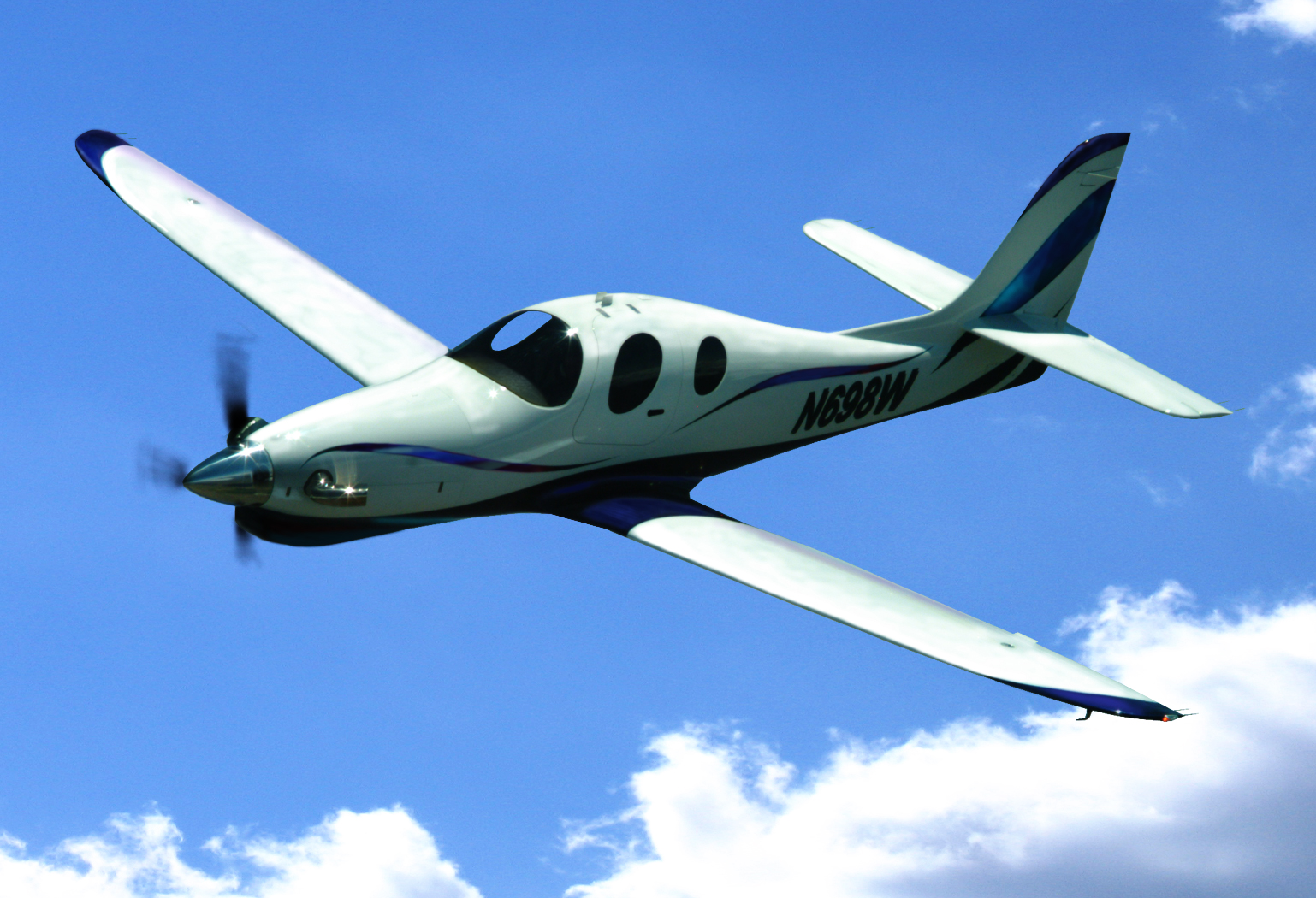
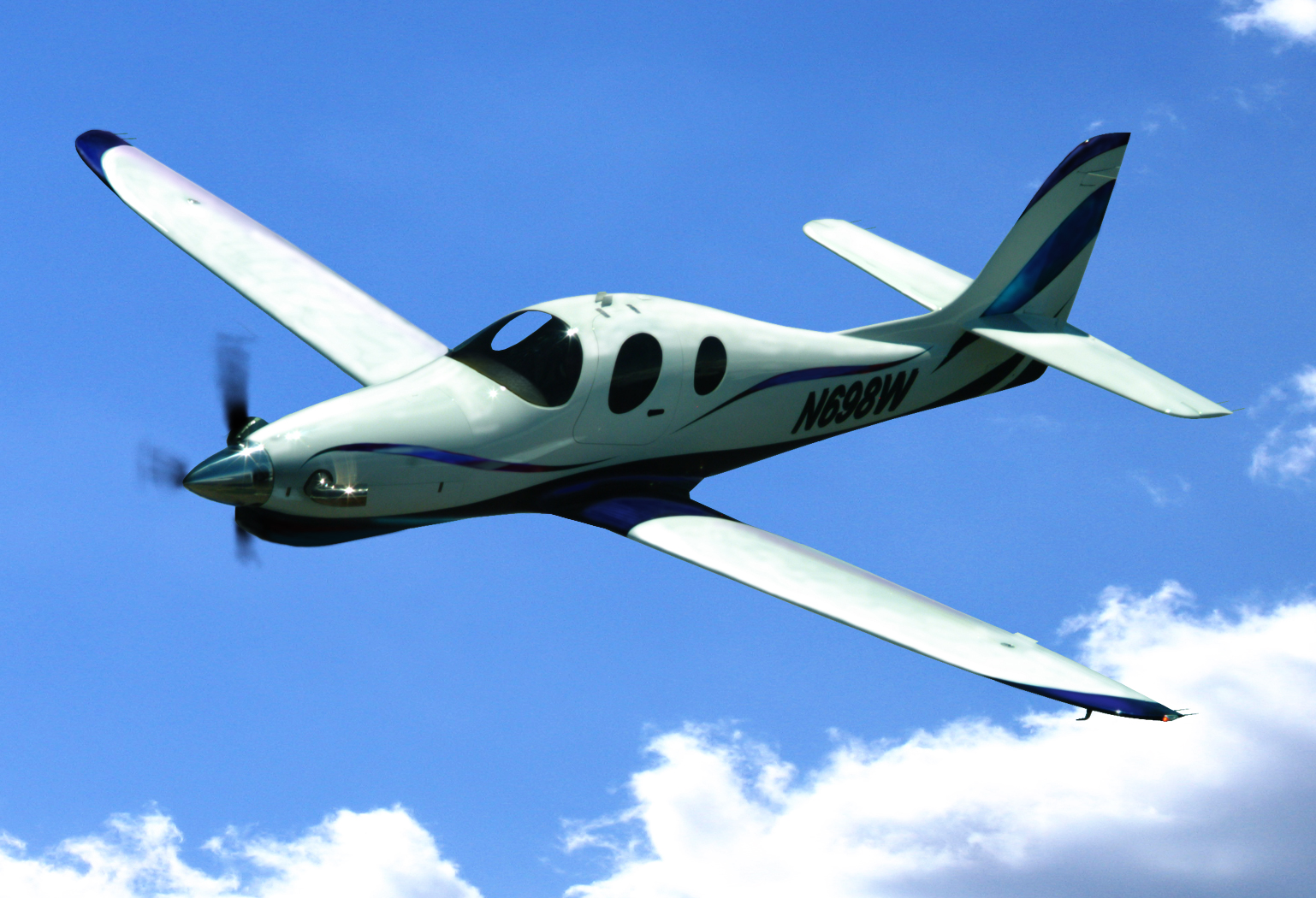
A turbine Lancair Evolution in flight over central Oregon. · Photo: Lancair International, CC BY-SA 3.0, via Wikimedia Commons
Lancair · Turboprop
Lancair Evolution Turbine
The last and largest of Lancair's four-seat pressurized kits, replacing the Lancair IV-P.
The Evolution delivers near-jet speed and turboprop efficiency for about $1.3 million. In exchange you accept four seats, an experimental certificate, a thin support network and an accident record insurers price in. Best for skilled, committed owner-pilots.
Buy it if
You fly yourself, want 1,000-mile trips at nearly 300 knots, value the PT6 turbine's reliability and fuel economy, and accept the paperwork, insurance and maintenance realities of an amateur-built airplane.
Skip it if
You need more than three passengers, a toilet, charter income, approval for known icing, dependable trips to Mexico, a deep factory support network or an easy resale.
Biggest compromise
It is a homebuilt. 5 to 6 percent of hull value, and a far smaller pool of buyers than a certified turboprop.
The numbers that matter
What it costs per year
$235K
at 300 hrs · owner flown
How far it flies
1,173 nm
1,000–1,000 nm with passengers
How fast
300 kt
high-speed cruise
Seats
3
Pilot plus three passengers
Pilots needed
1
Flown by one pilot; as an amateur-built experimental it has no type certificate.
Price
What one costs to buy
Typical asking price
$0
Other sites
Priced vs call
with a price / call for price
Two current US listings ask $1.30M and $1.35M; two older overseas ads ask $0.8M–$1.1M. Standard price guides do not cover this homebuilt.
Price vs its family and alternatives
Scroll to explore · select a jet for details
For sale now
None listed right now
Cost to own
What it costs per year to run
300hours / year
Per year
Per flight hour
Estimate — your operator will quote actual numbers.
Fuel, airframe, propeller and annual inspection, engine overhaul set-aside and oil, landing and parking fees rise as you fly more. Recurrent training and support, hangar, insurance and databases and subscriptions stay the same however much you fly.
Where the money goes
- Recurrent training and support$7,5003%
- Hangar$12,0005%
- Insurance$47,25020%
- Databases and subscriptions$3,0001%
- Fuel$91,92039%
- Airframe, propeller and annual inspection$30,00013%
- Engine overhaul set-aside$37,29316%
- Oil, landing and parking fees$6,0003%
Fuel is the biggest single cost at 39% of the total.
The JetGrade
62 out of 100 — Below its class average
Peer group: Piper PA-46 JetPROP DLX, Piper Meridian, Cessna P210 Silver Eagle, Daher TBM 700C1/C2
Seven categories at a glance
- - - 70 = typical— This aircraft
Strongest on speed & trip time, weakest on reliability & support.
Grades are editorial opinions about the model, not any specific aircraft. Sponsors and affiliates have no input. Reviewed 2026-10-04.
Where it flies
Sample trips and reach
Typical trips on a map
Nonstop
Depends on weight or weather
Fuel stop likely
2 of 6 sample trips are comfortable nonstops.
Sample flight times
- 1.1 hr
Carlsbad → Las Vegas
205 nm · Short hop at about 280 knots
- 2.6 hr
Carlsbad → Aspen
625 nm · Winter trips limited without known-icing approval
- 3.0 hr
Santa Ana → San José del Cabo
765 nm · Mexico has refused US homebuilts; permission needed
- 3.6 hr
Teterboro → West Palm Beach
900 nm · Nonstop with light loads; full cabin may stop
- 4.7 hr
Dallas → Teterboro
1,190 nm · Needs one stop with a full cabin
- 7.9 hr
Carlsbad → Teterboro
2,100 nm · Usually two stops with a full cabin
Lineage
What came before and after
1990 onward
Lancair IV
Four-seat composite kit that set the speed template.
Lancair IV-P
Pressurized IV; turbine versions were sold as the Propjet.
2008–present
Lancair Evolution Turbine
Clean-sheet carbon-fiber successor with a 750 shp PT6 turbine.
What changed from the Lancair IV-P
- All-new heat-cured carbon-fiber airframe, designed using certified-airplane standards as a guide.
- Cabin about four inches wider and taller; pressurization raised from 5.0 to 6.5 psi.
- Larger, longer wing lowers the landing stall to 61 knots with a gentler stall.
- Designed around the 750 shp Pratt & Whitney PT6A-135A turbine from the start.
- Payload rose roughly 350 to 400 lb over the IV-P.
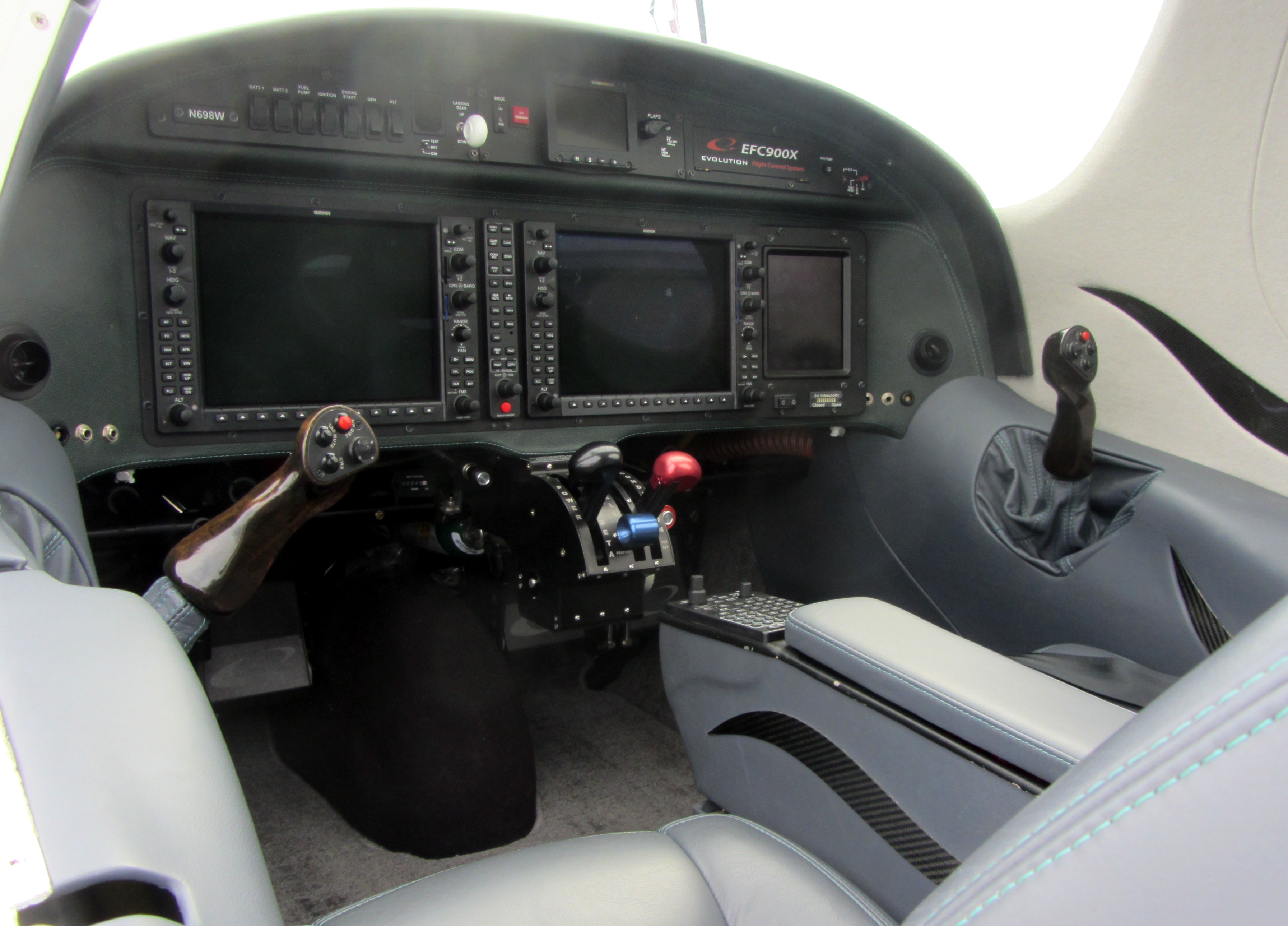
- Garmin G900X glass panel with GFC 700 autopilot; later builds use Garmin G3X Touch.
Size and cabin
How big it is, inside and out
Outside
Silhouette · scaled to length
Length
Wingspan
Height
Inside the cabin
Photo · this model
Width
Height
Compare
How it stacks up
This aircraft
Lancair Evolution Turbine
- JetGrade
- 62
- Cost per year
- $235K
- Range
- 1,173 nm
- Speed
- 300 kt
- Seats
- 3
- Pilots
- 1
- Years built
- 2008–now
← Before
Lancair IV-P
Not yet graded
Alternative
- JetGrade
- 63
- Price
- $1.05M
- Cost per year
- $347K
- Range
- 1,000 nm
- Speed
- 260 kt
- Seats
- 4
- Cabin length
- 12′ 3″
- Pilots
- 1
- Years built
- 1998–now
Alternative
- JetGrade
- 63
- Price
- $1.28M
- Cost per year
- $418K
- Range
- 1,000 nm
- Speed
- 260 kt
- Seats
- 4
- Cabin length
- 12′ 3″
- Pilots
- 1
- Years built
- 2000–2015
Alternative
- JetGrade
- 70
- Price
- $2M
- Cost per year
- $457K
- Range
- 1,580 nm
- Speed
- 296 kt
- Seats
- 4
- Cabin length
- 13′ 3″
- Pilots
- 1
- Years built
- 2002–2006
- Piper PA-46 JetPROP DLX instead: A certified turbine conversion of the Piper Malibu with a club-seat cabin and a broader service network, at a similar price but noticeably slower.
- Piper Meridian instead: Factory-built and certified, with six seats and Piper dealer support; slower, but easier to insure, finance and resell.
- Daher TBM 700C1/C2 instead: A certified pressurized single with similar speed, six seats and a large worldwide fleet, typically at a higher purchase price.
Gold marks the best figure in each row.
Owning one
What to know before you buy
Engines & inspections
1 × Pratt & Whitney Canada PT6A-135A · 750 shp each
No APUEngine hours until overhaul
- Engine hot section inspection · 1,800 hr
- Engine overhaul · 3,600 hr
- Annual condition inspection every 12 months
Overhaul and hot-section intervals are recommendations on experimental aircraft. Ask Pratt & Whitney Canada whether a specific engine can join its hourly plan.
Known issues
Thin factory support
The maker nearly closed in 2017; support now comes from Evolution Aircraft, a few specialist shops and JMB Aircraft.
Cabin door opening in flight
Doors opened or separated in flight in 2010, 2020 and 2021; the kit maker issued a latch inspection advisory.
No known-icing approval
De-ice gear is for inadvertent icing only; a 2021 fatal breakup followed icing at 25,000 ft.
Pre-buy checklist
0 of 10 checked
Evolution Aircraft in Redmond, Oregon, and JMB Aircraft in the Czech Republic support the design alongside a small group of specialist shops. The PT6 engine is supported worldwide; airframe parts are the harder part.
Review
The full review
Strengths
- Cruises at 285 to 300 knots at 28,000 ft while burning about 37 gallons of jet fuel an hour.
- Pressurized to 6.5 psi, holding an 8,000 ft cabin at its 28,000 ft ceiling, with backup oxygen.
- Climbs at about 4,000 feet per minute and lands at a 61-knot stall speed on short runways.
Limitations
- Four seats in a 50-inch-wide cabin, no toilet, and about 800 lb of payload with full fuel.
- Amateur-built status rules out charter and known-icing approval, and has blocked trips to Mexico since 2020.
- About 70 turbine examples on the US register, with factory support that nearly collapsed in 2017.
The Lancair Evolution is a four-seat, pressurized, carbon-fiber airplane sold as a kit and finished by its owner or a specialist shop, which makes it an experimental amateur-built aircraft rather than a certified one. Lancair's team in Redmond, Oregon, designed it as a clean-sheet replacement for the Lancair IV-P and flew the prototype in March 2008. The company became Evolution Aircraft in 2017, and since 2022 low-volume production has continued with JMB Aircraft in the Czech Republic. Most examples use a 750 shp Pratt & Whitney Canada PT6A-135A turbine, and about 70 turbine Evolutions are on the US register.
Pilot's take
On paper the Evolution flies like a small jet with a propeller: brisk climb, high cruise and a gentle 61-knot stall. The numbers favor a pilot who stays ahead of it. Accident reports point to pilots new to the type losing control at low speed, and to high-altitude icing in an airplane that is not approved for it. We would budget for professional transition training, keep recurrent training current, treat winter weather at 28,000 ft with respect, and check every cabin door latch before each flight. Flown that way, it rewards its owner with real 280-knot trips.
Who this is for
An instrument-rated owner-pilot with high-performance or turbine experience who flies 200 to 400 hours a year, usually with one or two passengers, and values speed per dollar over the reassurance of a certified airplane.

Ask about this aircraft
Answers come only from our research file on the Evolution Turbine (experimental).
Your earlier questionsOwners
Private to verified ownersOwn a Lancair Lancair Evolution Turbine? Verify with its FAA registration to join the owners' thread and the real-cost poll.