
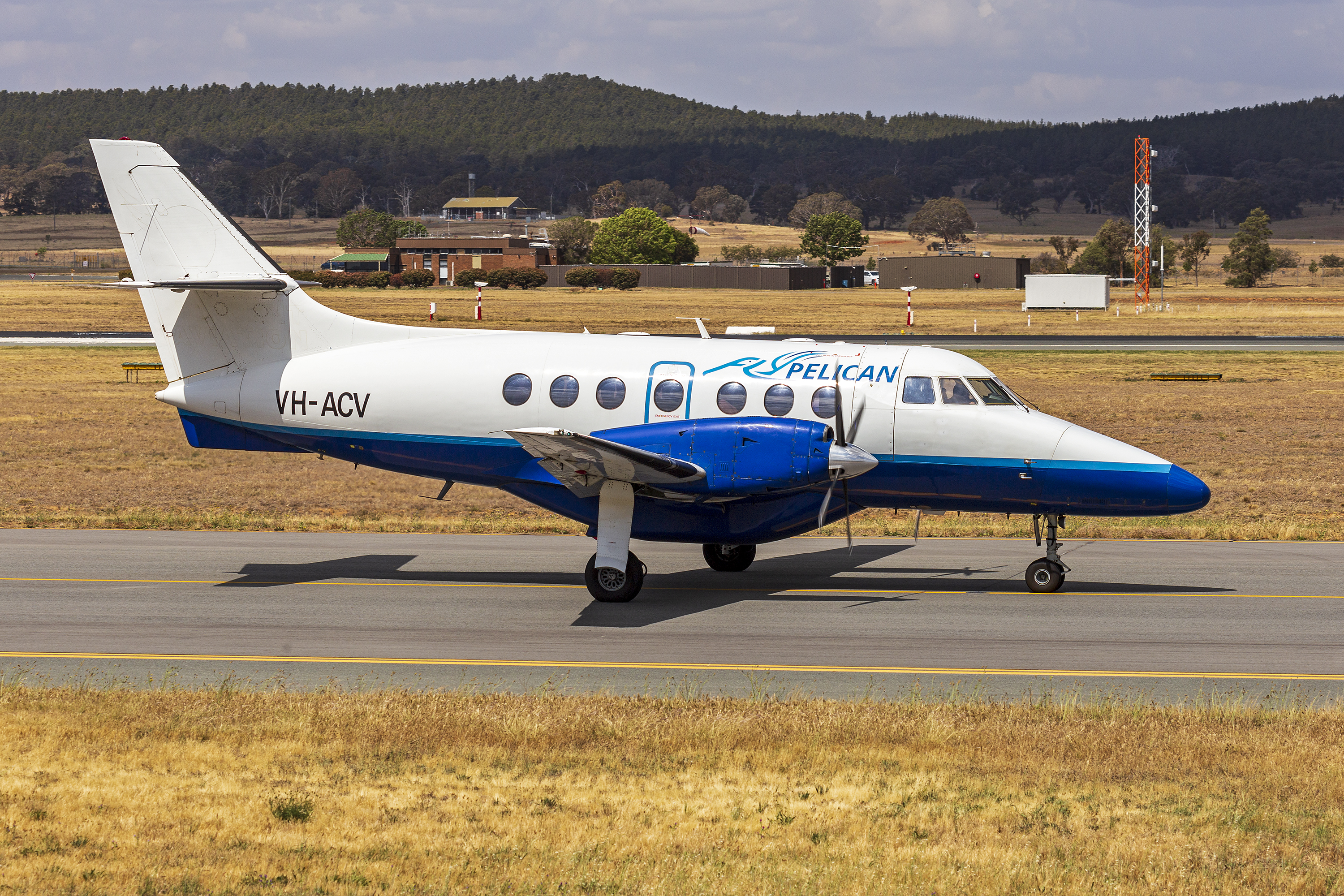
A Jetstream 32, registered VH-ACV, taxiing at Canberra Airport in November 2019. · Photo: Bidgee, CC BY-SA 3.0 AU, via Wikimedia Commons
BAe · Turboprop
BAe Jetstream 31 / 32
The Garrett-engined third generation of the Jetstream, between the original Handley Page design and the stretched Jetstream 41.
The Jetstream 31/32 buys a 5 ft 11 in cabin, a lavatory and room for a dozen executives for under $500,000, but two required pilots, costly engine overhauls and landing gear corrosion directives make it expensive to keep.
Buy it if
You need to move 8 to 12 people on regional legs under 400 nautical miles, already employ two pilots, and want a cabin you can stand in at a low purchase price.
Skip it if
You fly from hot or high airports, want a nonstop range beyond about 700 nautical miles, or plan to fly yourself. A King Air 200 or 1900D offers more support and an easier resale.
Biggest compromise
Ownership cost against value. The aircraft is cheap to buy, but a TPE331-10 overhaul averaged about $487,000 in 2025 and two pilots are required on every flight, so annual costs near $780,000 dwarf the purchase price.
The numbers that matter
What it costs per year
$781K
at 300 hrs · two professional pilots
How far it flies
790 nm
400–700 nm with passengers
How fast
255 kt
high-speed cruise
Seats
12
8–16 executive or 19 airline seats
Pilots needed
2
Certified for two pilots on every flight; there is no single-pilot option.
Price
What one costs to buy
Typical asking price
$0
Other sites
Priced vs call
with a price / call for price
Two US Jetstream 31s show asking prices of $449,000 and $499,950; four others, including three Jetstream 32s, are price on request.
Price vs its family and alternatives
Scroll to explore · select a jet for details
Metro III / Metro 23
$810K–$1.09M guide
Guide value, not a listed asking price.
See the Metro III / Metro 23For sale now
None listed right now
Cost to own
What it costs per year to run
300hours / year
Per year
Per flight hour
Estimate — your operator will quote actual numbers.
Fuel, airframe maintenance, engine program or reserve and propeller overhauls rise as you fly more. Two pilots, recurrent training, hangar, insurance and subscriptions stay the same however much you fly.
Where the money goes
- Two pilots$255,00033%
- Recurrent training$25,0003%
- Hangar$45,0006%
- Insurance$27,5004%
- Subscriptions$8,5001%
- Fuel$220,59028%
- Airframe maintenance$105,00013%
- Engine program or reserve$76,58710%
- Propeller overhauls$17,5002%
Two pilots is the biggest single cost at 33% of the total.
The JetGrade
65 out of 100 — Below its class average
Peer group: Beechcraft 1900C, Beechcraft 1900D, Fairchild Metro III / 23, Dornier 228-100 / -200
Seven categories at a glance
- - - 70 = typical— This aircraft
Strongest on cabin & passenger comfort, weakest on range & payload.
Grades are editorial opinions about the model, not any specific aircraft. Sponsors and affiliates have no input. Reviewed 2026-10-08.
Where it flies
Sample trips and reach
Typical trips on a map
Nonstop
Depends on weight or weather
Fuel stop likely
1 of 6 sample trips are comfortable nonstops.
Sample flight times
- 1.2 hr
Carlsbad → Las Vegas
205 nm · Short hop, well within range
- 3.0 hr
Carlsbad → Aspen
625 nm · Hot-and-high; depends on weight and weather
- 3.8 hr
Santa Ana → San José del Cabo
765 nm · Just beyond four-passenger range; plan one stop
- 4.4 hr
Teterboro → West Palm Beach
900 nm · Needs one stop, typically in the Carolinas
- 5.6 hr
Dallas → Teterboro
1,190 nm · Needs one stop, typically mid-route
- 9.6 hr
Carlsbad → Teterboro
2,100 nm · Needs at least two fuel stops
Lineage
What came before and after
1967–1975
Handley Page Jetstream 1
Original pressurized design with Turbomeca Astazou engines.
1970s
Scottish Aviation Jetstream 200
Improved Astazou version, mostly built as military trainers.

From 1982
BAe Jetstream 31
Re-engined with Garrett TPE331s; 19 seats and two pilots.
1988–1993
BAe Jetstream 32 (Super 31)
More power, higher weights and stronger landing gear.
1991–1997
BAe Jetstream 41
Stretched 29-seat airliner on a separate type certificate.
What changed from the Handley Page / Scottish Aviation Jetstream 1 and 200
- Garrett TPE331-10 engines of 900–940 shaft horsepower replace the French Turbomeca Astazous.
- US takeoff weight rises from 12,500 lb to 15,212 lb on the Jetstream 31.
- New electrical, air conditioning and engine controls, with stronger structure and higher speeds.
- Certified for 19 passengers, with a headroom of about 5 ft 11 in.
- The Jetstream 32 adds 1,020 shaft horsepower TPE331-12 engines and 16,204 lb takeoff weight.
- Jetstream 32 gets new landing gear, wheels and brakes plus a second overwing exit.
Size and cabin
How big it is, inside and out
Outside
Silhouette · scaled to length
Length
Wingspan
Height
Inside the cabin
Cabin length
Width
Height
Compare
How it stacks up
This aircraft
BAe Jetstream 31 / 32
- JetGrade
- 65
- Cost per year
- $781K
- Range
- 790 nm
- Speed
- 255 kt
- Seats
- 12
- Cabin length
- 24′ 3″
- Pilots
- 2
- Years built
- 1982–1993
← Before
Handley Page / Scottish Aviation Jetstream 1 and 200
Not yet graded
After →
BAe Jetstream 41
Not yet graded
Alternative
- JetGrade
- 66
- Cost per year
- $1.24M
- Range
- 1,279 nm
- Speed
- 280 kt
- Seats
- 19
- Cabin length
- 25′ 3″
- Pilots
- 1
- Years built
- 1991–2002
Alternative
- JetGrade
- 72
- Cost per year
- $729K
- Range
- 1,490 nm
- Speed
- 289 kt
- Seats
- 6
- Cabin length
- 16′ 8″
- Pilots
- 1
- Years built
- 1974–1981
Alternative
- JetGrade
- 65
- Cost per year
- $840K
- Range
- 1,600 nm
- Speed
- 290 kt
- Seats
- 19
- Cabin length
- 25′ 5″
- Pilots
- 1
- Years built
- 1981–2001
- Beechcraft 1900D instead: Stand-up cabin with more payload and widely supported Pratt & Whitney PT6 engines, at a higher purchase price.
- Beechcraft King Air 200 instead: Smaller cabin, but one pilot can fly it and parts, shops and buyers are everywhere.
- Fairchild Metro III / 23 instead: Another 19-seat commuter with TPE331 engines at a similar price; compare cabin height and local support.
Gold marks the best figure in each row.
Owning one
What to know before you buy
Engines & inspections
2 × Honeywell (Garrett) TPE331-10 (Jetstream 31); TPE331-12 (Jetstream 32) · 900 shp each
No APUEngine hours until overhaul
- Engine hot section inspection · 3,500 hr
- Wing spigot post bolts · 4,000 hr
- Propeller overhaul · 6,000 hr
- Engine overhaul · 7,000 hr
- Control cable terminal inspection every 24 months
- Landing gear overhaul every 72 months
- Corrosion prevention program tasks every 24 months
Engines go 7,000 hours between overhauls under Honeywell's service bulletin; Honeywell service centers sell maintenance plans, exchanges and rental engines.
Known issues
Main gear corrosion cracking
Stress corrosion has broken main gear legs on landing, including twice on one airframe, and drives repeated FAA inspections.
Engine overhaul exposure
A TPE331-10 overhaul averaged about $487,000 in 2025, so two engines can cost about twice the asking price.
Hot-and-high takeoff limits
Operators report weight limits on warm days and high fields; the Jetstream 32EP kit improves this.
Pre-buy checklist
0 of 10 checked
BAE Systems still holds the type certificate and gives technical support, Saywell International stocks Jetstream 31/32 spares, and Honeywell service centers support the TPE331 engines worldwide.
Review
The full review
Strengths
- Cabin headroom of about 5 ft 11 in, rare for a 19-seat turboprop at this price.
- Asking prices of $449,000 to $499,950 for executive or airliner examples in October 2026.
- Pressurized to 25,000 feet and approved for known icing with the right equipment fitted.
Limitations
- Two pilots are required on every flight, so crew costs of about $255,000 a year are unavoidable.
- With four passengers, practical range with standard reserves is about 700 nautical miles; with 12, about 400.
- Main landing gear corrosion has caused gear collapses and brings repeated inspections every 900 landings.
The BAe Jetstream 31 is a 19-seat pressurized twin turboprop that British Aerospace built at Prestwick, Scotland, from 1982. It took the 1960s Handley Page Jetstream, replaced its French Astazou engines with Garrett TPE331s, strengthened the structure and raised the weights. The Jetstream 32, sold as the Super 31 from 1988, added 1,020 shaft horsepower TPE331-12 engines, new landing gear and a 16,204 lb takeoff weight. Production of both ended in 1993, and the stretched 29-seat Jetstream 41 followed on a separate certificate. Most were built as commuter airliners; the corporate examples on the market today are executive conversions of 8 to 16 seats.
Pilot's take
From the flight deck, the Jetstream is a busy two-crew airplane, and both pilots need a type rating. Operators describe performance that is fine on cool days near sea level but falls away quickly with heat, altitude and weight, so takeoff planning matters on every trip. Icing deserves respect: FAA directives changed de-icing boot sequencing and added severe-icing limits after tail ice built faster than the boots cleared it. A stall warning and stick pusher are required equipment. We would treat weight and balance, de-icing discipline and landing gear history as the core of safe ownership.
Who this is for
Companies, sports teams and charter operators moving 8 to 16 people on short regional legs, with two professional pilots and a maintenance shop that knows the type.

Ask about this aircraft
Answers come only from our research file on the Jetstream 31 / 32 (corporate).
Your earlier questionsOwners
Private to verified ownersOwn a BAe BAe Jetstream 31 / 32? Verify with its FAA registration to join the owners' thread and the real-cost poll.