
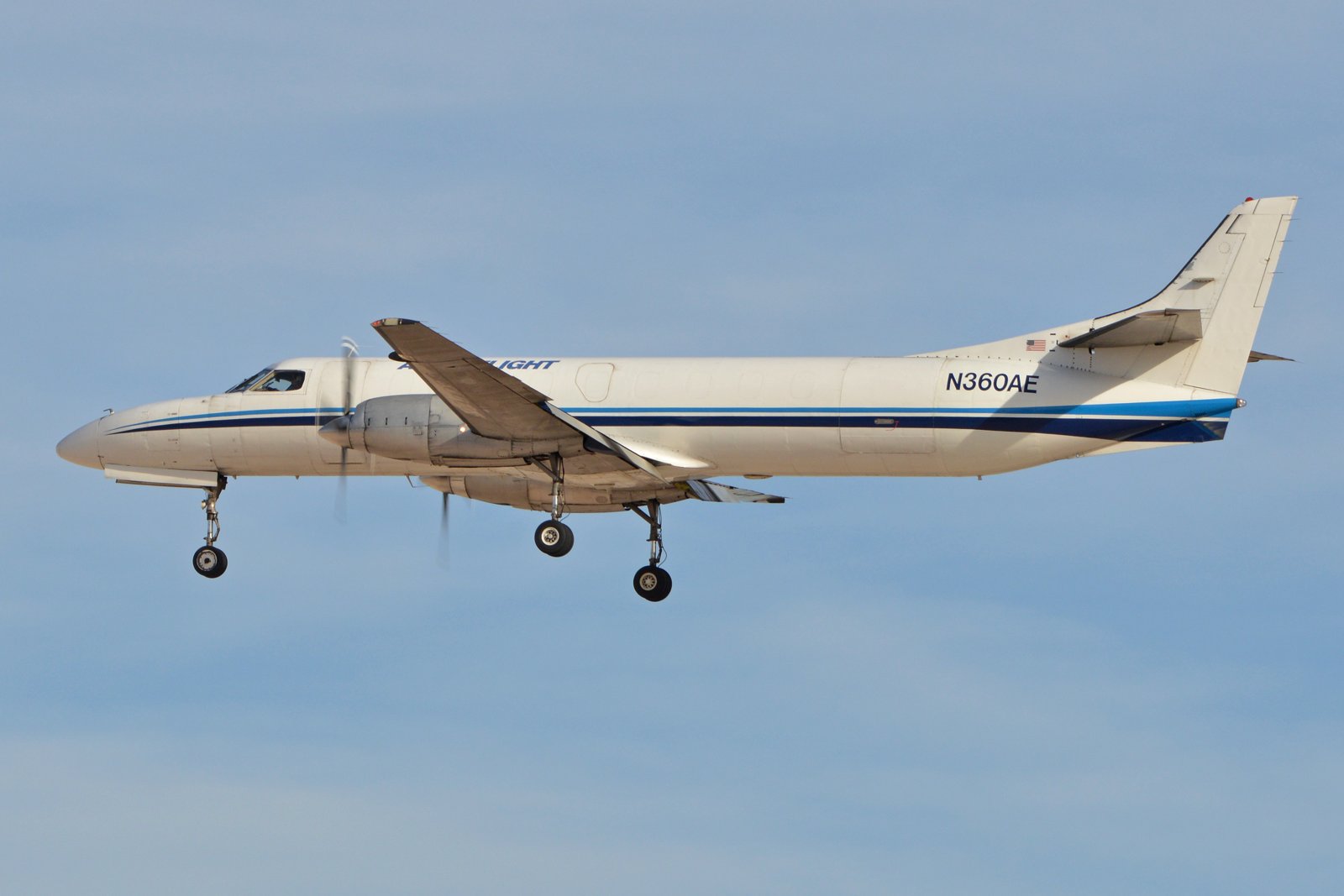
A Metro III arriving at Las Vegas in March 2016. · Photo: Alan Wilson, CC BY-SA 2.0, via Wikimedia Commons
Fairchild · Turboprop
Metro III / Metro 23
The final production Metroliners, after the Metro and Metro II; nothing replaced the Metro 23.
The Metro is one of the fastest 19-seat commuters, carrying up to 5,000 pounds. But a 4 ft 9 in cabin, fast landing speeds, aging structure and costly engine overhauls make it a utility tool, not a private aircraft.
Buy it if
You need to move crews, freight or teams quickly on 200–900 nm regional legs, can staff two professional pilots, and have a shop that knows the Honeywell TPE331 and the Metro's structural inspections.
Skip it if
You want a private aircraft for family or executive trips. Passengers stoop in a 4 ft 9 in cabin with no lavatory in airline layouts, and a King Air 350 or Beechcraft 1900D is easier to own and sell.
Biggest compromise
Structure and engines on high-time airframes. High-time airline Metros can pass 40,000 to 50,000 landings, so the wing spar webs, wing attach fittings and pitch trim need repeat checks under FAA directives.
The numbers that matter
Purchase price
$810K–$1.09M
guide value (AircraftCostCalculator)
What it costs per year
$840K
at 300 hrs · two professional pilots
How far it flies
1,050 nm
700–1,050 nm with passengers
How fast
290 kt
high-speed cruise
Seats
19
19 airline seats; 11–14 executive
Pilots needed
1
One pilot for cargo or private flying; Part 135 passenger service with 10 or more seats needs two.
Price
What one costs to buy
Guide value
$810K–$1.09M
Other sites
Priced vs call
with a price / call for price
None of the six Metros for sale shows a price. AircraftCostCalculator's average pre-owned values are about $810,000 for a Metro III and $1.09M for a Metro 23.
For sale now
None listed right now
Cost to own
What it costs per year to run
300hours / year
Per year
Per flight hour
Estimate — your operator will quote actual numbers.
Fuel, airframe maintenance, engine overhaul and hot section and propeller overhauls rise as you fly more. Two pilots, recurrent training, hangar, insurance and subscriptions stay the same however much you fly.
Where the money goes
- Two pilots$255,00030%
- Recurrent training$25,0003%
- Hangar$45,0005%
- Insurance$35,0004%
- Subscriptions$8,5001%
- Fuel$266,48732%
- Airframe maintenance$127,50015%
- Engine overhaul and hot section$63,7298%
- Propeller overhauls$14,0002%
Fuel is the biggest single cost at 32% of the total.
The JetGrade
65 out of 100 — Below its class average
Peer group: Beechcraft 1900C, Beechcraft 1900D, BAe Jetstream 31 / 32, Dornier 228-100 / -200
Seven categories at a glance
- - - 70 = typical— This aircraft
Strongest on speed & trip time, weakest on cabin & passenger comfort.
Grades are editorial opinions about the model, not any specific aircraft. Sponsors and affiliates have no input. Reviewed 2026-10-08.
Where it flies
Sample trips and reach
Typical trips on a map
Nonstop
Depends on weight or weather
Fuel stop likely
3 of 6 sample trips are comfortable nonstops.
Sample flight times
- 1.1 hr
Carlsbad → Las Vegas
205 nm
- 2.6 hr
Carlsbad → Aspen
625 nm · Hot-and-high; depends on weight and weather
- 3.1 hr
Santa Ana → San José del Cabo
765 nm
- 3.6 hr
Teterboro → West Palm Beach
900 nm · Little reserve margin into strong headwinds
- 4.8 hr
Dallas → Teterboro
1,190 nm · One stop, typically in the Ohio Valley
- 8.2 hr
Carlsbad → Teterboro
2,100 nm · Two stops, typically mid-continent
Lineage
What came before and after

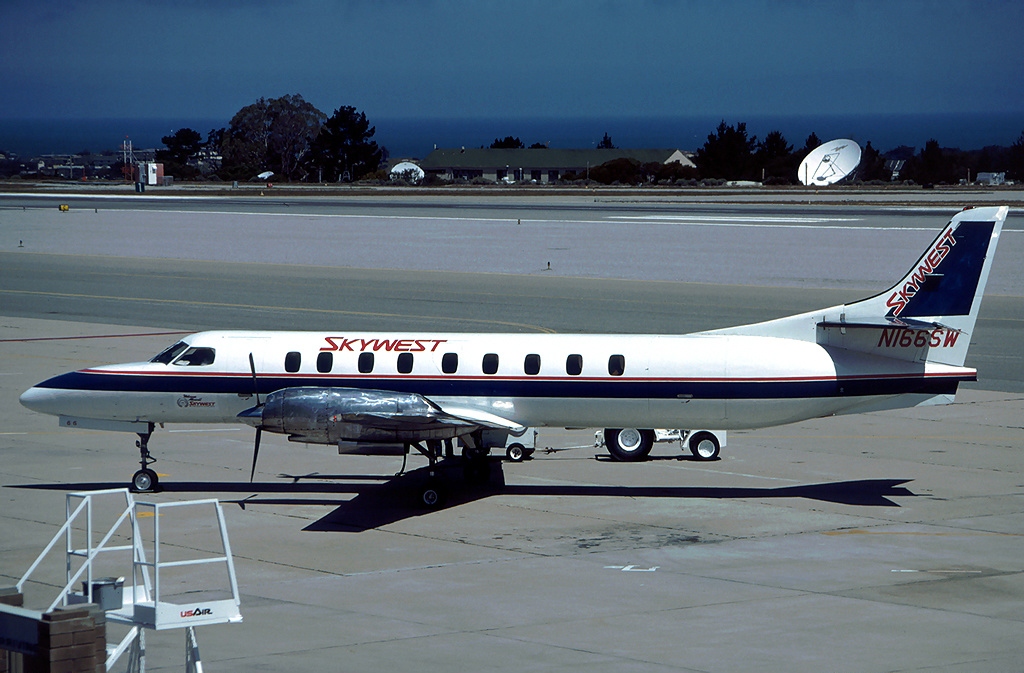

1981–2001
Metro III / Metro 23
57 ft wing, bigger engines; the Metro 23 raised takeoff weight to 16,500 lb.
What changed from the Metro II
- Wingspan grew about 10 feet, from 46 ft 3 in to 57 ft.
- TPE331-11U engines of 1,000–1,100 hp replaced the 840–940 hp TPE331-3.
- Slower-turning four-blade 106-inch propellers replaced the earlier three-blade units.
- Takeoff weight rose to 14,500 lb, or 16,000 lb with a factory kit.
- Drag clean-up, quick-access engine cowlings and gear doors that close after extension.
- Metro 23 (1990): TPE331-12 engines, 16,500 lb takeoff weight, redesigned landing gear.
Size and cabin
How big it is, inside and out
Outside
Silhouette · scaled to length
Length
Wingspan
Height
Inside the cabin
Cabin length
Width
Height
Compare
How it stacks up
This aircraft
Metro III / Metro 23
- JetGrade
- 65
- Cost per year
- $840K
- Range
- 1,600 nm
- Speed
- 290 kt
- Seats
- 19
- Cabin length
- 25′ 5″
- Pilots
- 1
- Years built
- 1981–2001
← Before
- JetGrade
- 59
- Cost per year
- $817K
- Range
- 1,500 nm
- Speed
- 255 kt
- Seats
- 19
- Pilots
- 2
- Years built
- 1974–1981
Alternative
- JetGrade
- 66
- Cost per year
- $1.24M
- Range
- 1,279 nm
- Speed
- 280 kt
- Seats
- 19
- Cabin length
- 25′ 3″
- Pilots
- 1
- Years built
- 1991–2002
Alternative
- JetGrade
- 66
- Cost per year
- $938K
- Range
- 1,425 nm
- Speed
- 275 kt
- Seats
- 19
- Cabin length
- 25′ 3″
- Pilots
- 1
- Years built
- 1984–1991
Alternative
- JetGrade
- 64
- Cost per year
- $827K
- Range
- 1,730 nm
- Speed
- 280 kt
- Seats
- 8
- Cabin length
- 33′ 1″
- Pilots
- 2
- Years built
- 1970–1987
- Beechcraft 1900D instead: Stand-up cabin and Pratt & Whitney engines with wider support; typically dearer to buy, but far easier to fly passengers in and to resell.
- Beechcraft 1900C instead: A similar low 19-seat cabin, with a big rear cargo door and PT6 engines, but slower and shorter-legged with every seat full.
- Merlin IV / IVA / IVC instead: The Metro's corporate sibling, with executive interiors and a lavatory built in, for buyers who want this airframe for private travel.
Gold marks the best figure in each row.
Owning one
What to know before you buy
Engines & inspections
2 × Honeywell (Garrett) TPE331-12 series on the Metro 23 and SA227-BC; TPE331-11U on the SA227-AC Metro III · 1,100 shp each
No APUEngine hours until overhaul
- Pitch trim actuator check · 250 hr
- Front pressure bulkhead inspection · 1,000 hr
- Wing spar web inspection · 2,000 hr
- Engine hot section inspection · 3,500 hr
- Propeller overhaul · 5,000 hr
- Engine overhaul · 7,000 hr
Honeywell offers its pay-per-hour Maintenance Service Plan for the TPE331; rates are not published and are quoted per aircraft.
Known issues
Wing structure fatigue
Wing spar webs and wing attach fittings need repeat crack checks; repairing both spar webs costs about $26,000 or more.
Pitch trim actuator failures
Six in-flight trim actuator failures led the FAA to propose new repeat checks in 2026; a replacement costs about $20,000.
Costly engine events
Turbine and compressor parts carry cycle limits and directives; high-end overhauls of the related TPE331-10 ran near $487,000 in 2025.
Pre-buy checklist
0 of 10 checked
Ontic, which took over the type certificate in 2022, supplies factory parts through AAR with around-the-clock AOG help, revises the manuals and trains mechanics. Honeywell supports the engines through a broad US shop network.
Review
The full review
Strengths
- Cruises at about 290 knots, roughly 20 to 40 knots faster than a Beechcraft 1900C on regional legs.
- The Metro 23 lifts up to 5,000 pounds, with 1,650 pounds of baggage allowed across nose and rear holds.
- The Metro 23 is pressurized to 7 psi, holding roughly a 4,500-foot cabin at its 25,000-foot ceiling.
Limitations
- The cabin is 4 ft 9 in tall and 5 ft 2 in wide; passengers stoop, and airline layouts have no lavatory.
- Takeoff needs about 4,400 feet even below maximum weight, and approaches run near 113 knots.
- Six Metros were advertised in October 2026 and none showed a price, so values are hard to pin down.
The Fairchild Metro III and Metro 23 are the final versions of the Swearingen Metroliner, a pressurized 19-seat twin turboprop built in San Antonio for commuter airlines. The Metro III arrived in 1981 with a wing about 10 feet longer than the Metro II's and Garrett TPE331-11U engines of 1,000 to 1,100 horsepower turning slower four-blade propellers. In 1990 Fairchild recertified the design under newer commuter-category rules as the Metro 23, with 1,100-horsepower TPE331-12 engines and a 16,500 lb takeoff weight. The last one was delivered in 2001. Military versions fly as the C-26, and the executive Merlin IVC shares the airframe.
Pilot's take
From the flight deck, the Metro rewards precision. It climbs well and cruises near 290 knots, but its small, heavily loaded wing brings approach speeds around 110 to 120 knots and little tolerance for being fast or slow on final. An engine failure needs prompt feathering, because the drag-limiting system is only partial and there is no autofeather. Icing rules are strict: boots on at the first sign of ice. With current Garmin avionics a well-kept Metro is a capable cargo tool, and with two trained pilots it is a solid shuttle.
Who this is for
Cargo feeders, charter and crew-shuttle operators, and special-mission or medevac users who value speed and payload over cabin comfort and already have Metro or TPE331 maintenance support nearby.

Ask about this aircraft
Answers come only from our research file on the Fairchild Metro III / 23.
Your earlier questionsOwners
Private to verified ownersOwn a Fairchild Metro III / Metro 23? Verify with its FAA registration to join the owners' thread and the real-cost poll.