
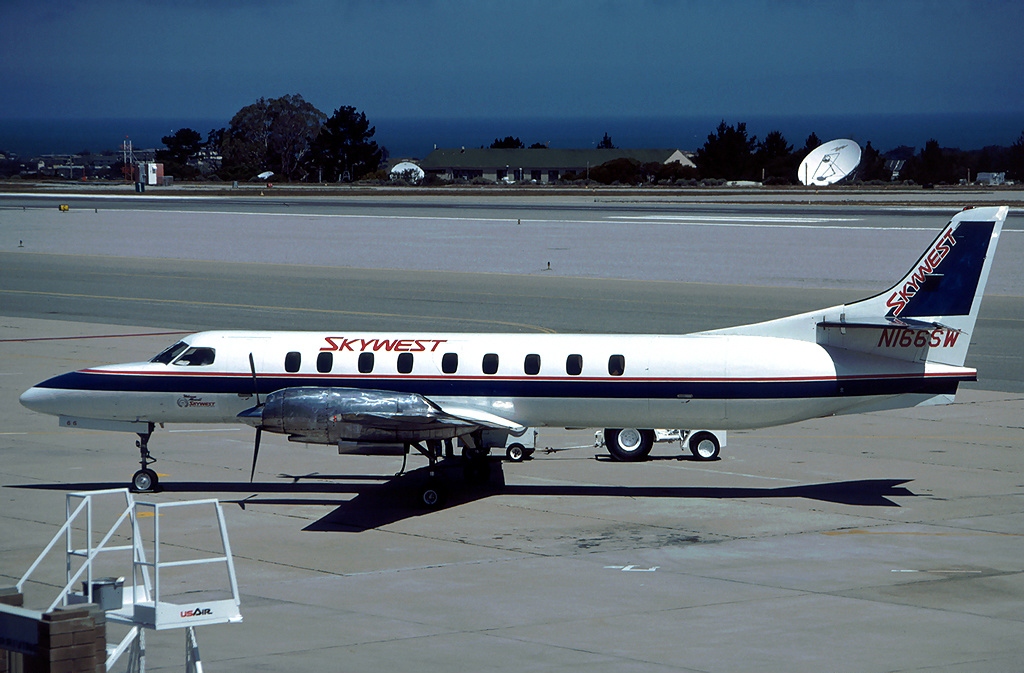
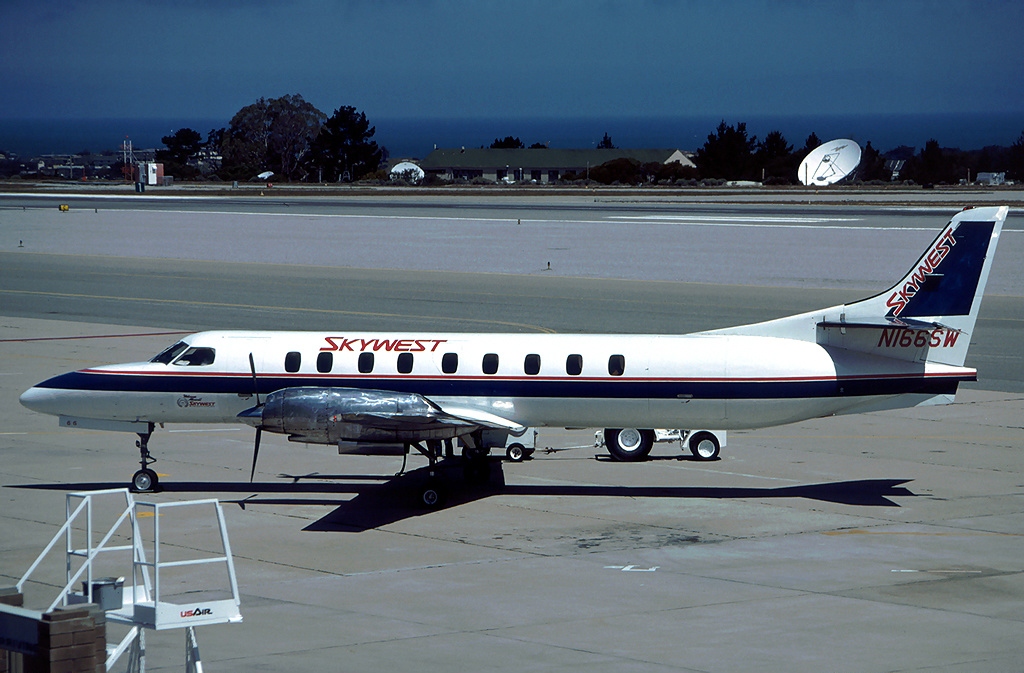
A Metro II in SkyWest Airlines colors in May 1988, showing its long, slim fuselage. · Photo: Eduard Marmet, CC BY-SA 3.0, via Wikimedia Commons
Fairchild · Turboprop
Fairchild Metro II
Second version of the Metro commuter, between the original Metro and the longer-winged Metro III.
A fast, rugged 19-seat freighter and crew shuttle from the 1970s. It is cheap to buy, but thin payload, a cramped cabin and very expensive engines make it a poor fit for private flying.
Buy it if
You run freight, crew or shuttle flights on short regional legs, can staff two professional pilots, and have maintenance people who know TPE331 engines and 50-year-old Swearingen structure.
Skip it if
You want a private aircraft for family or business travel. The cabin is low, payload with full fuel is tiny, and one engine overhaul can cost more than the airplane.
Biggest compromise
Engines versus airframe value. An average TPE331-10 overhaul cost about $487,000 in 2025, while the last executive Metro II we found advertised asked $285,000.
The numbers that matter
What it costs per year
$817K
at 300 hrs · two professional pilots
How far it flies
750 nm
About 750 nm with four passengers; about 175 nm with 2,500 lb aboard
How fast
255 kt
high-speed cruise
Seats
19
19 airline seats; about 12–14 executive
Pilots needed
2
Two pilots typical; the 13,100 lb Metro IIA requires a type rating, the 12,500 lb Metro II does not.
Price
What one costs to buy
Typical asking price
$0
Other sites
Priced vs call
with a price / call for price
No Metro II is advertised with a price right now. An earlier executive example was offered at $285,000; engine condition drives value more than the airframe.
Price vs its family and alternatives
Scroll to explore · select a jet for details
Metro III / Metro 23
$810K–$1.09M guide
Guide value, not a listed asking price.
See the Metro III / Metro 23For sale now
None listed right now
Cost to own
What it costs per year to run
300hours / year
Per year
Per flight hour
Estimate — your operator will quote actual numbers.
Fuel, airframe maintenance, engine overhaul reserve and propellers and other rise as you fly more. Two pilots, recurrent training, hangar, insurance and subscriptions stay the same however much you fly.
Where the money goes
- Two pilots$230,00028%
- Recurrent training$25,0003%
- Hangar$37,5005%
- Insurance$32,5004%
- Subscriptions$7,0001%
- Fuel$249,30031%
- Airframe maintenance$127,50016%
- Engine overhaul reserve$93,72311%
- Propellers and other$14,0002%
Fuel is the biggest single cost at 31% of the total.
The JetGrade
59 out of 100 — Well below its class
Peer group: Beechcraft 1900C, Beechcraft Beech 99 / A99 / B99 / C99 Airliner, BAe Jetstream 31 / 32, Dornier 228-100 / -200, Swearingen / Fairchild Merlin IV / IVA / IVC
Seven categories at a glance
- - - 70 = typical— This aircraft
Strongest on speed & trip time, weakest on value & resale.
Grades are editorial opinions about the model, not any specific aircraft. Sponsors and affiliates have no input. Reviewed 2026-10-08.
Where it flies
Sample trips and reach
Typical trips on a map
Nonstop
Depends on weight or weather
Fuel stop likely
1 of 6 sample trips are comfortable nonstops.
Sample flight times
- 1.2 hr
Carlsbad → Las Vegas
205 nm · Easy nonstop hop
- 3.0 hr
Carlsbad → Aspen
625 nm · Hot-and-high; depends on weight and weather
- 3.6 hr
Santa Ana → San José del Cabo
765 nm · Nonstop only with a light load
- 4.4 hr
Teterboro → West Palm Beach
900 nm · Needs one fuel stop on the way
- 5.6 hr
Dallas → Teterboro
1,190 nm · Needs one fuel stop en route
- 9.5 hr
Carlsbad → Teterboro
2,100 nm · Two fuel stops across the country
Lineage
What came before and after

1970–1974
Swearingen Metro
Original stretched 19-seat commuter with small round windows.
1974–1981
Fairchild Metro II
Larger windows, quieter cabin; IIA adds TPE331-10 engines.

What changed from the Swearingen Metro
- Larger squared-oval cabin windows replace the original Metro's small round ones.
- Revised cabin furnishings to cut interior noise.
- Nosewheel steering moved from a hand tiller to the rudder pedals.
- Optional tail-cone rocket for full-weight takeoffs at fields up to 7,000 ft.
- Single-point pressure refueling added.
- Metro IIA (1980) adds TPE331-10 engines and a 13,100 lb takeoff weight.
Size and cabin
How big it is, inside and out
Outside
Silhouette · scaled to length
Length
Wingspan
Height
Inside the cabin
Width
Height
Compare
How it stacks up
This aircraft
Fairchild Metro II
- JetGrade
- 59
- Cost per year
- $817K
- Range
- 1,500 nm
- Speed
- 255 kt
- Seats
- 19
- Pilots
- 2
- Years built
- 1974–1981
← Before
Swearingen Metro
Not yet graded
After →
- JetGrade
- 65
- Cost per year
- $840K
- Range
- 1,600 nm
- Speed
- 290 kt
- Seats
- 19
- Cabin length
- 25′ 5″
- Pilots
- 1
- Years built
- 1981–2001
Alternative
- JetGrade
- 64
- Cost per year
- $827K
- Range
- 1,730 nm
- Speed
- 280 kt
- Seats
- 8
- Cabin length
- 33′ 1″
- Pilots
- 2
- Years built
- 1970–1987
Alternative
- JetGrade
- 72
- Cost per year
- $729K
- Range
- 1,490 nm
- Speed
- 289 kt
- Seats
- 6
- Cabin length
- 16′ 8″
- Pilots
- 1
- Years built
- 1974–1981
- Swearingen / Fairchild Merlin IV / IVA / IVC instead: The corporate version of the same airframe, built with executive interiors and lavatories rather than airline seats retrofitted later.
- Fairchild Metro III / 23 instead: A 10 ft longer wing, more power and takeoff weights up to 16,000 lb fix much of the Metro II's payload problem.
- Beechcraft King Air 200 instead: Fewer seats, but an easier cockpit, a vast support network and a far deeper resale market for private owners.
Gold marks the best figure in each row.
Owning one
What to know before you buy
Engines & inspections
2 × Honeywell (Garrett) TPE331-3UW-303G as built; many converted to TPE331-10UA · 940 shp each
No APUEngine hours until overhaul
- Engine hot section inspection · 1,800 hr
- Wing spar web inspection · 2,000 hr
- Pitch trim fitting inspection · 5,000 hr
- Engine overhaul · 5,400 hr
- Aileron chain replacement · 10,000 hr
- Annual inspection program every 12 months
- Bleed air and wiring check every 12 months
Honeywell has offered pay-per-hour plans for TPE331 engines; ask whether an aircraft is enrolled and whether coverage transfers on sale.
Known issues
Engine overhaul exposure
An average TPE331-10 overhaul reached about $487,000 in 2025, far above the last advertised Metro II asking price.
Wing spar web cracking
FAA rules require wing spar web checks every 2,000 hours after 6,500; repairs ran about 400 labor hours.
Flight control corrosion
Directives cover corroded elevator torque tubes and pitch trim fittings; neglected aircraft can need costly structural work.
Pre-buy checklist
0 of 10 checked
Ontic bought the Metro type certificates from M7 Aerospace in 2022 and supports parts. FlightSafety still trains Metro II and IIA crews, and many TPE331 shops service both engine versions.
Review
The full review
Strengths
- Fast for a 1970s commuter: about 255 kt maximum cruise and a 2,400 ft-per-minute initial climb.
- Long pressurized tube seats 19, or carries about 626 cubic feet of cargo through a 53 by 51 in rear door.
- Low entry price: the last executive example we found advertised asked $285,000, a fraction of newer 19-seat turboprops.
Limitations
- Full tanks leave only about 300 lb for people and bags, so fuel and passengers are traded on every trip.
- The cabin is about 4 ft 9 in tall and 5 ft 2 in wide, with single airline seats.
- One TPE331-10 overhaul averaged about $487,000 in 2025, more than most Metro IIs are likely worth.
The Metro II is the second version of Swearingen's 19-seat pressurized commuter, built in San Antonio from 1974 to about 1981 under the SA226-TC type certificate. It replaced the original Metro, shares its wing and tail with the corporate Merlin family, and was followed by the longer-winged Metro III. A 1980 update, the Metro IIA, added more powerful TPE331-10 engines and raised maximum takeoff weight from 12,500 lb to 13,100 lb.
Pilot's take
From the cockpit the Metro II is a quick, capable 1970s airliner that rewards discipline. It climbs and cruises well for its age, but the TPE331 engines want careful starts, ideally on ground power, and close attention to temperature limits on hot days. Many examples have no autopilot, and pilots who fly the type say its cockpit flows make it a two-pilot airplane in practice, especially when something fails. Weight and balance is never an afterthought: with full fuel there is almost no payload left. Treat it as a professional crew aircraft, train on a dedicated Metro course, and it will do steady work.
Who this is for
Cargo, crew-shuttle and specialty operators who need a fast pressurized box with a big rear door, already run turboprops with professional maintenance, and can absorb engine events. Few private owners will be happy with one.

Ask about this aircraft
Answers come only from our research file on the Fairchild Metro II.
Your earlier questionsOwners
Private to verified ownersOwn a Fairchild Fairchild Metro II? Verify with its FAA registration to join the owners' thread and the real-cost poll.